
It’s hard for us to understand how much better horses hear than we do. Our sounds or words easily become signals if we use them consistently. Sounds can also become environmental signals the horse adopts according to the routines of his captivity.
- house door opening if the horse lives near the handler’s house
- person’s car arriving at the paddock (with special feed, treats or anticipated adventures)
- rattle of food buckets or pellets in a tin
- whistle to recall for a treat or a feed
When we use Clicker Training, we refine this response to sound when we use a click or other unique sound to mark the precise response we want.
Horse ears have ten muscles each, which means they can move their ears almost 180 degrees. The shape of the ear allows horses to capture more sound, and from further away, than our ears. On top of that, horses can pick up sounds at higher and lower frequencies than we can.
The shape and mobility of the two ears allows accurate gauging of the direction of a sound. Sound and vision are obviously linked, but sound serves better when vision is restricted. Due to the horse’s ecosystem role as a prey animal, he is wired to notice any sound, especially sneaky, sudden, or unusual sounds.
Horses have strong emotional responses to sounds. Anxious type horses will find the sounds and tense atmosphere of shows and events over-stimulating and problematic. It helps to gradually habituate them to this sort of environment rather than depend on flooding (overstimulation until the horse ‘shuts down’) to get a horse more able to cope with noisy, unfamiliar surroundings.
Ears, it seems, can give us a large range of signals, ranging from curiosity, acceptance, concentration, irritation, fear, dominance and submission. All we have to do is work out which is which – and when – for each horse in our life!
It seems that horses also pick up vibrations from the ground through their feet or through their whiskers and teeth while grazing. No doubt this relates to the ‘early warning’ horses and other animals can give us about earthquakes and other catastrophes. It might also be why they are waiting at the gate before they can see our car. But that could also be a function of their hearing.
Ear postions might be categorized as:
Alert — forward, scanning in observant or anxious mode.
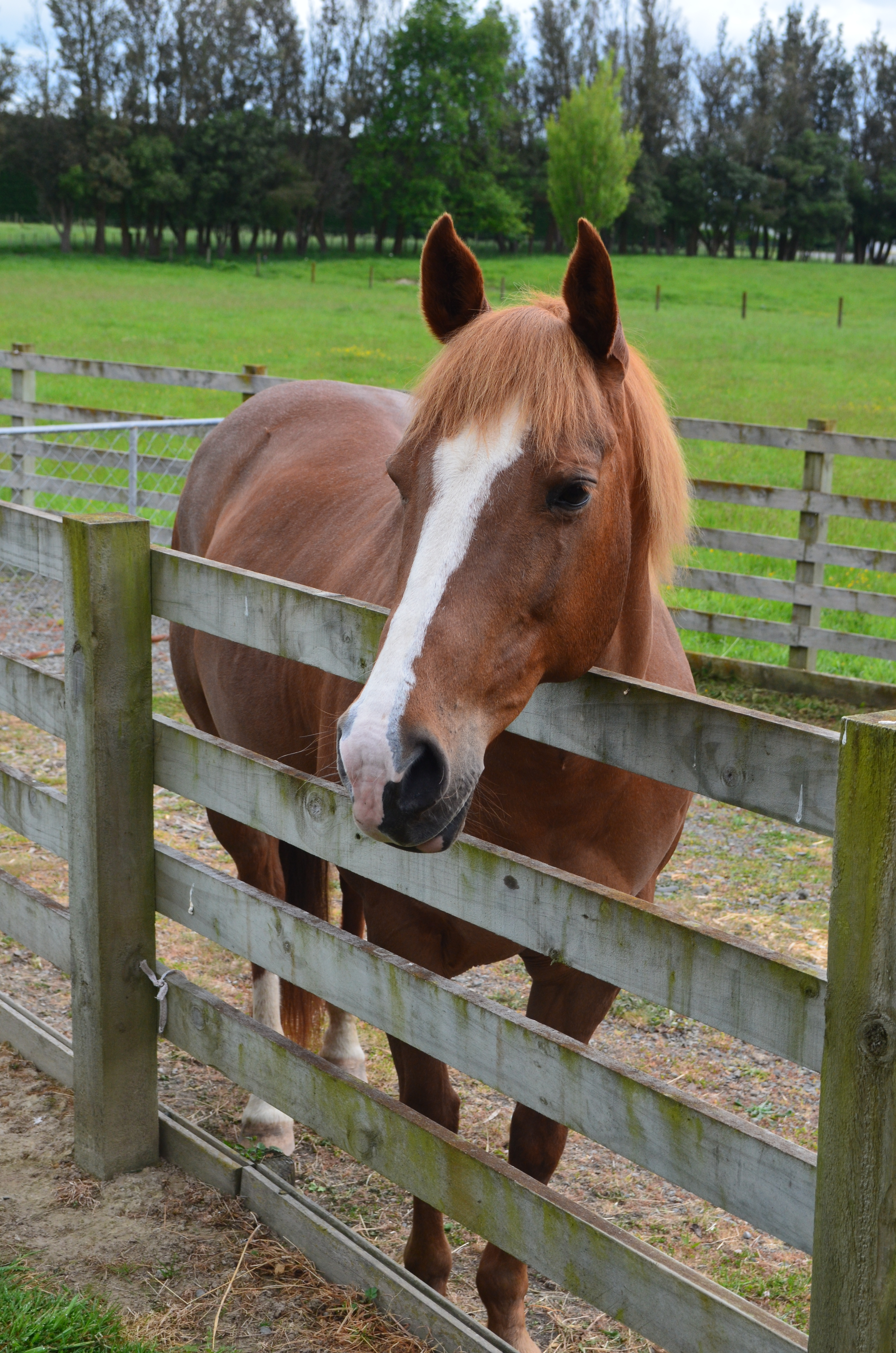
Alert ears. Probably she is watching for someone to appear with treats to entertain her.
Curious/Interested — forward with head movement up or down to focus the eyes.
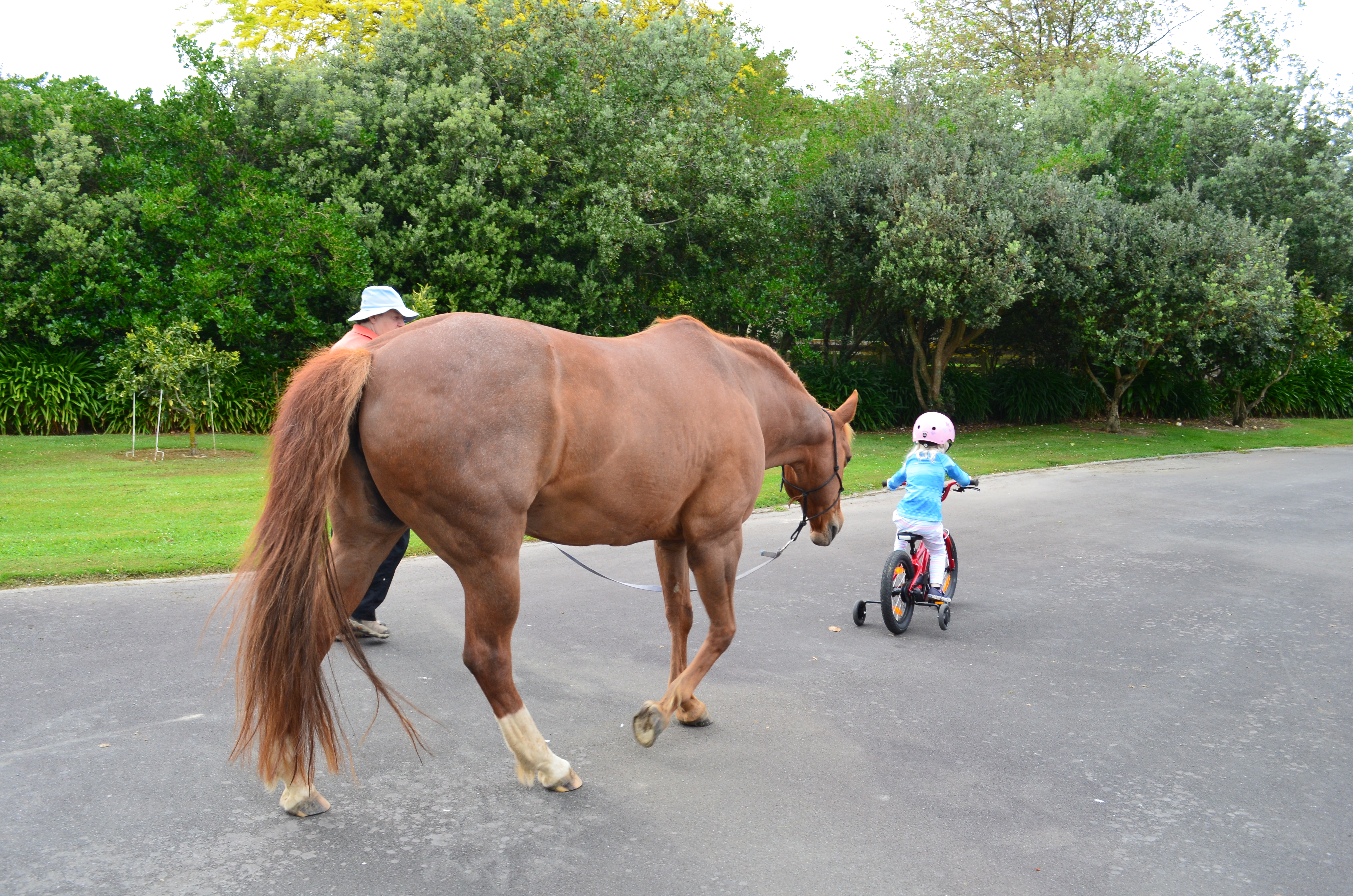
Because the lens in the horse’s eye does not adjust like ours, horses have to lower and raise their head to get a good focus on an object – like a person wearing bifocal or trifocal glasses.
Attentive — total focus on what she is doing.
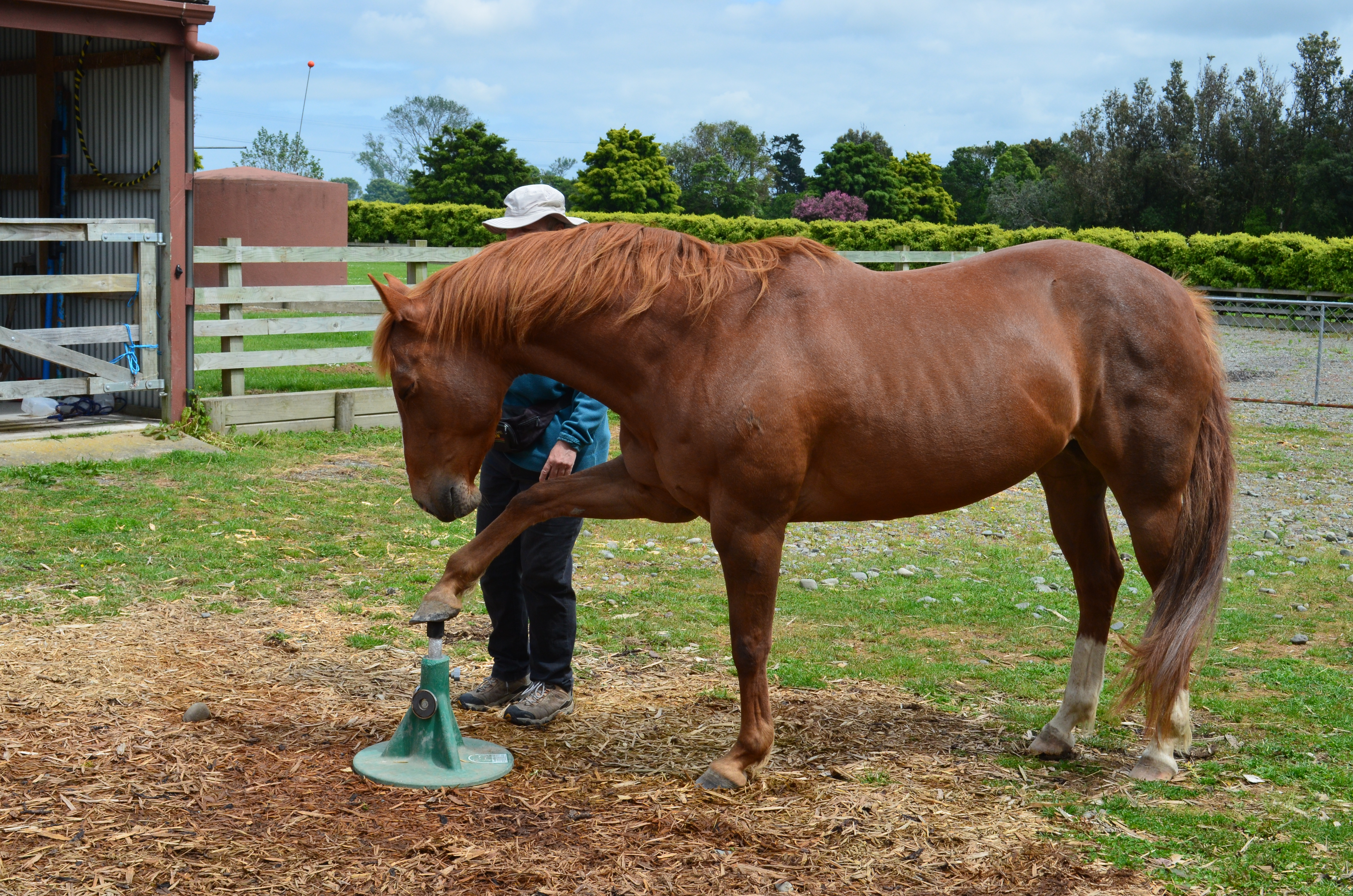
She is extremely focussed on the task. It has her full attention.
Back/Sideways – Tension or Anxious — only the context of the situation and the rest of the horse’s body language can tell us if the ears are back due to anxiety (very stiff), or back/to the side because the horse is strongly focusing on a task, causing natural tension (not as stiff). See also, ‘Working Ears’ below.
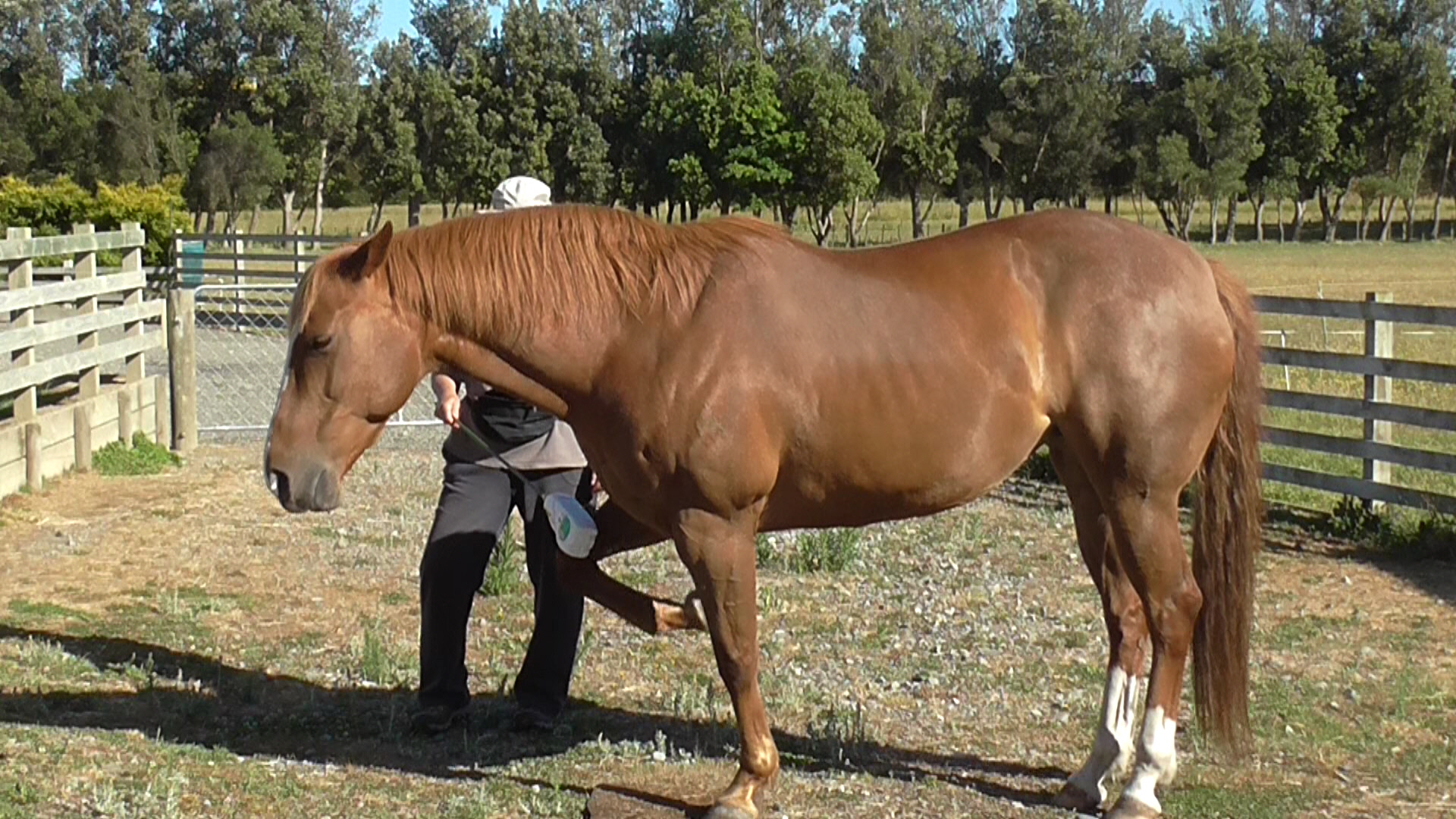
Ears are sideways and lower lip is a little bit tight, so Boots is putting a lot of concentration into this task which she is just learning. There is some tension, but the rest of her body language does not, which suggests that she is in focus mode, rather than anxious.
Back/Sideways – Floppy — a chilled out, resting, or casually moseying along horse often has the ears half back in a relaxed state.

Smoky is dozing beside a favorite person. His eyes are partly closed and his lower lip is floppy. His ears would be soft for the ear-bending test described below.
Pinned — truly pinned ears are a very strong signal that all is not well, and other action will follow if things don’t change immediately. Some horses lay their ears almost flat when they are strongly focusing on a complex task. This can be more like a ‘frown’ of concentration and we must be careful not to presume the ears are pinned and take evasive/inhibitory action that will confuse the horse who was just busy thinking his way through a problem.

Truly pinned ears. Boots is giving Smoky a clear message that his presence near the treats is not wanted. Her next move, if there wasn’t a fence between them, would be to lunge at him.
We should always give the horse the benefit of any doubt and read the overall situation and body language rather than just the ears. Truly pinned ears are unmistakable, once seen. They are usually accompanied by a very angry face overall and are often followed by snaky-neck movement toward the cause of annoyance, lunging at the intruder, or wheeling around ready to a kick.
Working Ears: Back or Sideways, – Focused/Thinking — horses often put their ears to the back or side when they are in ‘thinking mode’.

We often see these sorts of ear positions in horses doing their ‘job’ of the moment; e.g., cutting horses, calf-roping horses, dressage horses, horses doing an agility course or a gymnastic routine.
Because they are carrying out a learned pattern in a known environment, their mind is focused on the task at hand and the precise signals coming from their handler. Their ears often resemble the ears of a dog working sheep. Back and full of concentration on the job.
Such ears may resemble that of an irritated or disgruntled horse, but if the horse is doing his ‘job’ and his overall tension and body expression suggest that he is focused, we are probably seeing his personal ‘working’ expression.
Often, as soon as the horse has finished a part of his ‘job’, the ears pop forward before the next obstacle or cow or whatever.
It’s helpful to watch video clips focusing just on the horse’s ears. Usually they are constantly in motion and give us an insight into what may be going on in the horse’s mind. Obviously, we can never be sure, but we can get an idea.
The Ear Test:
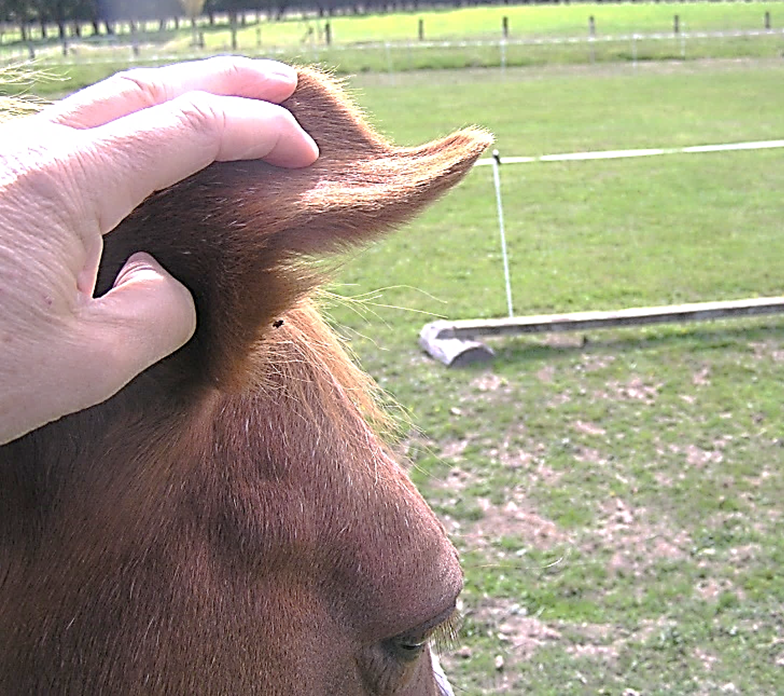
The Ear Test: how easily we can bend the tip of the ear is a good indicator of the horse’s overall tension or relaxation.
If we can easily bend the tip of the ear, the horse is generally relaxed. If the ear is too stiff to bend easily, it tells us that the horse has tension in his whole body and lacks confidence or is anxious at the moment.
Each horse’s ear expressions will follow the same general pattern, but at the same time be unique, so we should be careful about generalizing too much between horses.
Ear Expression Summary Chart

More about ears
A. Ear differences between mares and geldings/stallions.
It’s interesting to study the ear differences between mares and geldings or stallions.
I watched YouTube clips of the Pignon brothers Frederic and Jean-Francois. Frederic and his wife, Magali Delgado, were the original stars of Cavalia (2003-2009).
Below is the link if you would like to watch Frederic playing with three of his young stallions. It is interesting to note the way they respond to Frederic’s energy levels. He uses a body extension to help communicate with the horses.
https://youtu.be/w1YO3j-Zh3g (accessed 15.03.24)
In another clip, Jean-Francois Pignon played with a troupe of mares.
https://youtu.be/qncbDfT5KsU (accessed 15.03.24)
I didn’t know they were mares when I first watched, but their behavior was so different from that of Frederic’s stallions, I presumed they were mares. The message was in the ears.
The mares were constantly using their ears to maintain their individual bubbles while performing their routines which often had them very close together.
Mares in a natural herd situation determine much of the social structure of their group. Social order within a group needs a ready language with all sorts of nuances. Mare’s ears have these nuances.
Mares’ job of giving birth and caring for their foals means that they need to cultivate detailed knowledge of their environment when they live in the wild.
- Best grazing spots
- Safe water
- The nature and habits of the local predators
- Health of the herd stallion
- Bachelor groups in the vicinity
- Intrinsic awareness of their present rank in the group of mares
Horses give way to horses above them in rank, and they expect horses lower in rank to give way to them, just like people do in many situations. Mares need to keep track of many things.
Mares have a full complement of hormones and hormonal cycles. In wild herds, their position in the herd is closely linked with survival of themselves and their offspring during the annual hard times of summer drought and winter cold and snow.
We often like to romanticize wild horses, but there is not much romantic about a life lived in the environmental margins of the deserts, plains and mountains where they manage to survive.
Having had mares and geldings, I have found a distinct difference. All other things being equal (which they never are) mares tend to be more independent-minded, geldings more easy-going. That’s a generalization, but it’s not a coincidence that Cavalia uses only geldings and stallions for their shows.
B: Ears and Horse Character Type
The detail about how a specific horse uses his ears will also relate to the innate character type of the horse.
We can never put horses into labelled pigeonholes, but often it is helpful to describe what we see and create categories so we can communicate our descriptions to each other more easily.
One way of categorizing horse character types is to look at their tendency to move their feet. A strong need to move suggests an extroverted character type. Less tendency to move suggest a more introverted character.
Another way of looking at horse character types is to note whether the horse is innately bold and curious or if he tends to stay out of the limelight and easily becomes anxious.
Quite likely, an extroverted bold horse will want to know where the party is and get going with it. He’ll often show forward, inquisitive ears. If the handler is not providing fun, he is inclined to create fun for himself.
An extroverted but anxious type of horse, who tends to weigh up the cost/benefit of every situation, may have ears moving through many expressions.
An introverted bold, imaginative horse is usually most interested in the next blade of available grass. He sees little reason to move if his life is not in danger. He is strongly committed to his own ideas. He will learn things readily enough if we make it worth his while.
Such a horse tends to love food reward reinforcement and easily becomes a Clicker Training star. Once he learns something, he likes to make it his idea. He then tries hard to ‘get it right’. His focus during training may often include ears lying back or sideways as he thinks his way through a puzzle we’ve given him.
An introverted anxious type of horse may have active ears regularly checking out all points of the compass. He may appear externally ‘quiet’ but is heaving with emotions inside. Horses like this are more suddenly ‘explode’ with an inexperienced handler, so it is important to identify them and keep a close eye on where they are in relation to the edge of their comfort zone in a specific context.
These are generalizations but generalizations can help give us an overview. Ears are obviously highly personalized for each horse. In new situations horses behave differently than they do at home, just as we do.
What I want to highlight is that it is easy to simplify how ears should look on a ‘happy horse’ when we really have little idea of what is going on in the horse’s mind and being expressed in his ears.
We should always read ears in the context of the rest of the horse’s body and the specific context of the moment.
A horse in an enclosed space with little stimulation will have different ear expressions than the same horse out and about with a wide view of things going on all around him.
 herthamuddyhorse