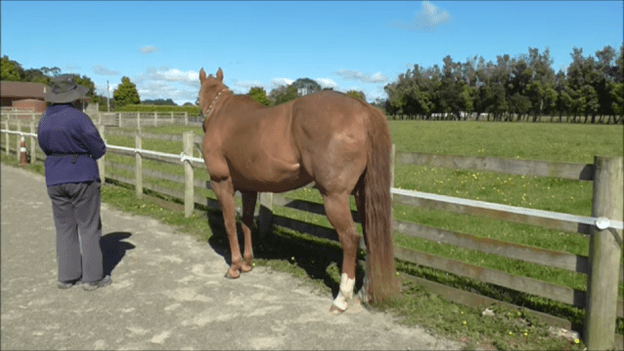
The photo above illustrates a moment when it would not be a good idea to give the horse a signal/cue, becaue her attention is strongly focussed on something happening on the road.
Horses are generally co-operative beings. Most horses are happy to comply if the message is clear for them and if what we ask is within their emotional, mental and physical capability.
On the other hand, if we send mumbled or mixed messages or use non-natural signals that the horse has not learned, or which he physically can’t do (perhaos due to pain) the horse is in a real bind. A horse in this situation may react in one of the following ways.
- He may try to fill in with what he thinks the handler might mean, best as he can.
- He may give up trying to understand and opt out mentally.
- He may opt out physically by moving his feet to escape the situation, if he can.
- If he can’t escape, he may ‘take over’ physically by pushing on, through or over the handler.
- He may ‘freeze’ into a catatonic state. Some horses simply collapse.
Choosing the right opportunity to ask our horse to do something is important. It’s pointless to ask our horse to do something unless there is a 99% chance that he can and will do it. Otherwise we are teaching him to ignore our requests because they are too hard to understand or beyond his physical ability at the moment.
Setting Up Opportunities
Do we set up lots of occasions for the horse to practice learning what we want him to learn?

By playing with picking up, then walking, carrying her feed bucket every day, Boots became adept at it.
In other words, do we give the horse ample opportunity to learn in a controlled environment where he can gradually build his confidence and expand his comfort zone as he comes to understand each new thing we are teaching?
Traditional training was geared to what the human wanted right now, and proceeded to demand it with force, coercion and body extensions designed to inflict increasing discomfort.
Since what people want is usually not part of a horse’s natural repertoire of behavior, the horse is often catapulted into a state of bewilderment.
How much more comfortable and safer all around, if we thin-slice a large task into its smallest parts, teach each part and then chain the parts together to achieve the whole task?
When we do this, we allow the horse opportunity and time to master each small part before moving on. Please see Blog Numbers 13 and 106 on the Quick Contents Page for lots of detail about thin-slicing.
We want to allow the horse to keep his integrity and we want to keep his goodwill. We allow him to adjust to the strange life he must live with us. We earn his trust so that he is willing to put the placement of his feet into our hands. For an animal, whose sole defense is the ability to flee from perceived danger, this is a big ask.
To build the horse’s knowledge and confidence, we need to first get (and reward) the behavior that we want, then we can add a specific signal to it. Often a signal arises naturally out of the way we initiated the behavior.

The desired behavior here is for the horse to target a specific object. We make it easy at first and set it up with the least distractions, so we can quickly click&treat the behaviour we want. Once it is good 99% of the time with a simple set-up, we can add verbal and gesture signals to ask for the behavior. Then we can start to ask the horse to touch all kinds of things with his nose, so building his confidence and courage.
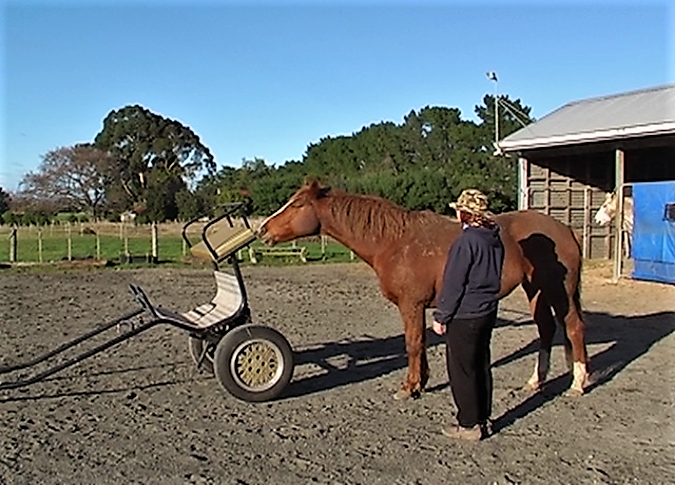
Because Boots had a long history of touching unusual objects with her nose, she willinging targetted the cart.
Once the horse understands the key signal, we can layer in other signal types. We can also replace a signal by adding a new one and fading out the earlier one.
Most horses don’t seem to have any trouble understanding several signals for the same thing. For example, my horse will ‘walk on’ with a verbal signal, a ‘breath-in’ signal, an arm gesture signal and an ‘outside leg steps forward’ signal. If we are doing work on a long line or reverse round pen, she understands the verbal, breathing and arm gesture signals from different angles and distances.
Additionally, horses can understand one signal in a variety of different situations. My horse understands the verbal ‘whoa’ signal when walking beside me, when she is behind me, when I am walking behind her as in long-reining, and from the riding position.
It’s also essential to be aware of the ways that our horse signals to us. Often, we are so immersed in working out what we want the horse to do, we miss the signals the horse is sending us about what he need us to do so he can remain confident.
By reading the horse, we can decide whether we should:
- Carry on with what we are doing.
- Go back a step or more to regain confidence.
- Have a break and do something that’s already easy.
- Stop for the day or for this session.
 herthamuddyhorse