Tag Archives: communication-skills

The Concept of ‘Feel’

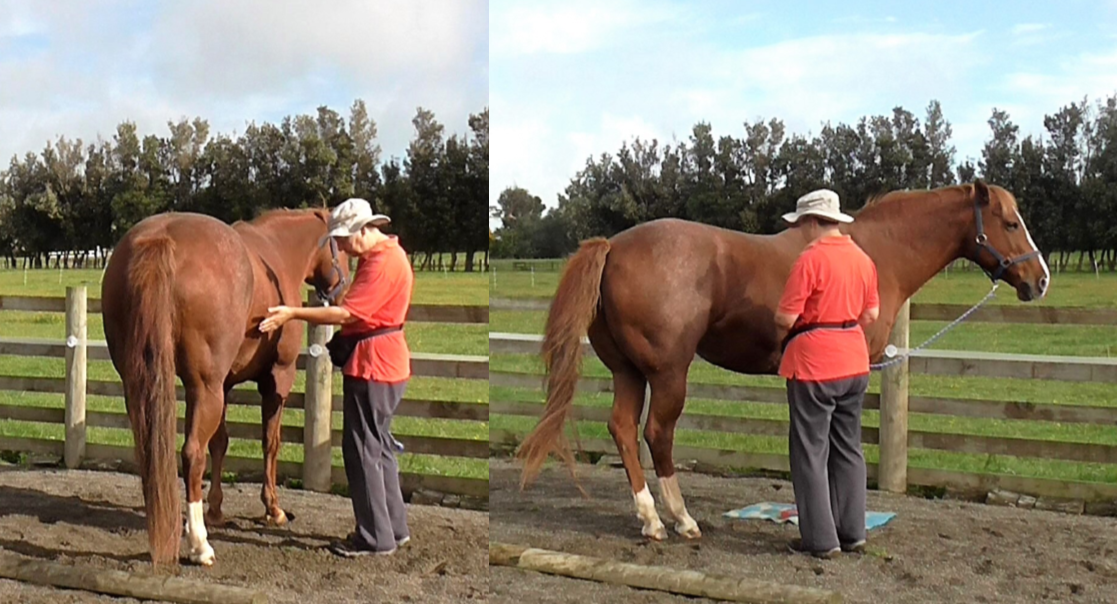
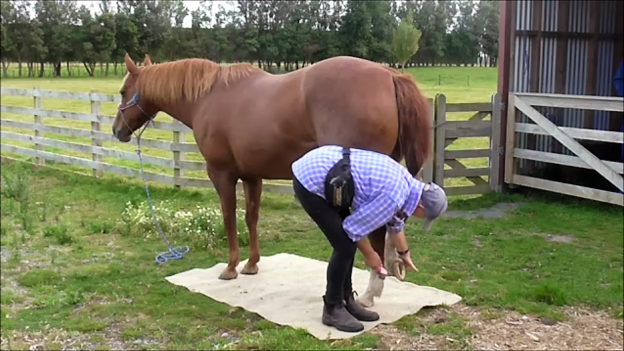
In the photo above, Bridget can FEEL that Boots is relaxed enough for her to carry on with foot care.

Feel is an aspect of horsemanship that sometimes seems elusive, but it doesn’t have to be. It is closely linked with the idea of empathy. Empathy itself is the ability to ‘feel’ what another being is probably feeling.

When dealing with horses, empathy and feel are involved with everything we do. The more we understand about the nature of horses as a prey species that depends on rapid moving away from danger and group life for security, the more empathetic we can be when our horse shows us that he is uncomfortable about something we are asking him to do.

The more we understand that the horse’s digestive system is geared toward a steady flow of low nutrient forage, the better job we can do at providing such forage. We know that to keep the horse comfortable, we must feed the bacteria in the gut in a way that keeps them happy. 

OLYMPUS DIGITAL CAMERA

Horse have evolved to reqire a constant supply of low-energy forage to keep their microbiome in good working condition.

Horses have small stomachs and a large caecum where bacteria break down the food so it can be absorbed by the horse. These bacteria need a constant flow of food and do not like sudden changes of diet.

The more we understand how the horse’s circulation system depends on slow, regular walking movement over 24 hours, the less inclined we will be to confine horses in boxes. After all, they are not chocolates.

The horse’s feet compress and expand with each step the horse takes. Foot movements work like four extra pumps to help send blood the very long way up the legs back to the heart. 

Horses step along as they graze. The only time they are still is for the few hours that they sleep, which are spread over 24 hours. Consistent movement is an integral part of horse circulation health.

Horses are naturally active on a 24-hour rhythm, not a day/night rhythm like we are. By ‘putting them in at night’ and by ‘feeding them meals’ in one place, we are seriously mucking about with their movement, their blood circulation and their natural biorhythms.

Many horse ‘problems’ stem from unnatural housing and unnatural feeding regimes as well as the damage caused by nailing inflexible steel shoes to a dynamic live foot mechanism.

As we develop empathy and ‘feel’ about what a horse is experiencing in the strange human-based world in which he finds himself, it becomes easier to know what we should do to ensure the horse is as comfortable as possible.

A horse high on adrenalin will find comfort in being allowed to trot or run the adrenalin out of his system. When he becomes high-headed and agitated, a handler with feel gives him the opportunity to move until he can switch from reactive mode to responsive mode.

A strong-spirited, low-energy horse can be extremely frustrating. A handler with feel for this sort of horse will use click&treat motivation as much as possible. Then it is easier to appreciate the reliable nature of this type of horse once he is on-side with the handler rather than trying to outwit him or her.

As soon as we can see our horse, he can see us. As soon as he can see us, he is gauging our energy level. He is ‘feeling’ us. A person with ‘feel’ will be doing the same with the horse – gauging his mood, the way he is moving or grazing, checking for anything out of the ordinary.

As soon as a horse sees us, he is feeling our mood, our energy level and our intent.

When a handler develops ‘feel’ of this sort, s/he is not frustrated by undesirable horse behaviors. S/he seeks the cause(s) and adjusts the horse’s lifestyle plus his Individual Education Program (IEP) to accommodate the horse. This is the essence of a handler’s emotional neutrality. 

Horses don’t do things just to annoy us. At any moment in time the horse is doing what he believes is the best thing do.

With careful education, we can enlarge the horse’s comfort zone and areas of expertise. We can expand his repertoire of things he can do with confidence.

It takes considerable time and effort, but done at the horse’s pace, he will gain skills to help him through his whole life.

27-1: Some concepts of ‘feel’

‘Feel’ comes in many guises.  Here are some of them.

  1. Feeling the difference between reaction and response
  2. Realizing that every horse will feel different, and that to the horse, each handler feels different
  3. Knowing the precise moment to release signal pressure (click&treat)
  4. Acknowledging the difference between teaching and forcing
  5. Knowing when we are pushing too much, resulting in a loss of willingness
  6. Knowing when we are pausing too much, resulting in a loss of interest
  7. Recognizing physical well-being, so that lack of wellness stands out
  8. Finding the ‘balance’ between the two extremes of ‘unbalanced’
  9. Able to cause a subtle shift in the horse so he regains balance
  10. Staying grounded when the horse loses his physical, mental and/or emotional balance
  11. Able to pause for lesson absorption or for a shift in balance
  12. Able to ignore unwanted behavior and quietly ‘re-set’ a task
  13. Understanding a specific horse’s underlying character type
  14. Recognizing when the horse is ready to move on to the next slice of the new learning
  15. Recognizing when the horse-human connection is present and when it is absent
  16. Not taking the horse’s trust for granted
  17. Understanding the lives of horses in the wild; their natural 24 hour and seasonal rhythms
  18. Understanding physical, mental and emotional thresholds of a specific horse
  19. Understanding how habituation works
  20. Understanding how desensitization works
  21. Understanding how sensitization works
  22. Physical feel through the rope
  23. Physical feel through the reins
  24. Physical and emotional feel through the whole body when riding
  25. Feel for two-way communication playing at liberty. If the horse decides to leave, knowing how to motivate him to join up again or deciding to call it a day
  26. Knowing when to stop a session, or a part within the session
  27. Understanding that the way the handler feels is instantly picked up by the horse, good feelings and bad feelings equally.

Moving Away From Touch or Gesture

In the photo above, Boots is lifting her foot in response to Bridget’s arm signal gesture and the intent of her body language. It makes hoof care so much easier.

Shaping with Touch Guidance

Research on dopamine release shows that knowing how to avoid or decrease a stimulus we don’t like gives a ‘reward hit’ to the brain, similar to how achieving something desirable feels rewarding. For example; stopping in time for a red light gives an instant feeling of relief and accomplishment.

This is why the training system made popular by Pat and Linda Parelli gave such ‘good’ results in teaching horses how to respond to human requests. People who have been considered ‘good’ horsemen over the years have used the same principle for millenia.

The principle is basically this: Use a consistent touch/gesture signal and remove the touch/gesture the instant the horse complies even just a little bit. Build from there with repeats until the horse responds readily because it understands the cue and the system. This is negative reinforcement – called negative because the touch or gesture energy is removed when the horse responds. The term ‘negative’ is here used in the mathematical sense. It is not related to it’s other common meaning of something ‘bad’.

BUT: It takes considerable skill in reading horses – to know when the horse remains in the learning zone, i.e. under threshold (see Number 107 in the Blog Quick Links for more about this) or has been pushed beyond threshold. Is the horse responding or reacting? If the handler is not sensitive and/or lacks experience helped by a good teacher, it can end up with a confused and unhappy horse. Also, the touch or gesture signal needs to be totally consistent so the horse can depend on it being the same each time.

Pressure is not a dirty word. Horses understand pressure. They use it with each other all the time. It is the nature of the pressure, plus when it is removed, that makes or breaks good training to create a horse confident with people.

Using touch/gesture pressure followed by a click&treat immediately the horse responds, is an essential step in teaching a horse to be resilient in a variety of human environments. We can’t know the future, If our personal situation changes, the horse may have to go elsewhere. If confronted by flood, fire, earthquake, the horse may need to be moved quickly.

Such teaching with negative reinforcement, backed instantly by positive reinforcment, is often called ‘combined reinforcement’. Some people refer to it as negative reinforcement ‘with a cherry on top’, as a way of discounting it. Yet, if we use a neck rope or headgear or our legs for riding, we usually want the horse to move away from our touch. It’s convenient to be able to touch the horse’s chest lightly to get a back up. Or to touch his leg for a lift if we want to tend the hoofs.

Gesture

Horses interacting with each other use gesture as a first communication. If the annoying horse does not move away, the gesture escalates gradually via touch with nose, teeth or hooves. The first suggestion might be a just a ‘look’ or an ear/tail flick. Play between youngsters is full of touch and gesture.

Because horse are super sensitive to movement, they easily pick up the meaning of a specific gesture if we use it with total consistency.

Once a horse understands our meaning:

  • Reaching down to his foot will have him lift a leg.
  • Fingers raised in front of him (far enough back to be out of his blind spot) and tapping the air at his eye level will have him back up.
  • A light touch or gesture to his shoulder will have him move it into a turn on the haunches.
  • A light touch or gesture (or even a focussed look) to the side of his rump will have him move it away into a turn on the forehand.
  • A light touch at (or gesture toward) his ribs will have him sidestep.
  • A light touch to his chest or nose will have him back up.

I taught moving the front end away into a turn on the haunches with touch to the neck and shoulder, but eventually only my focus and a gesture were enough of a cue.

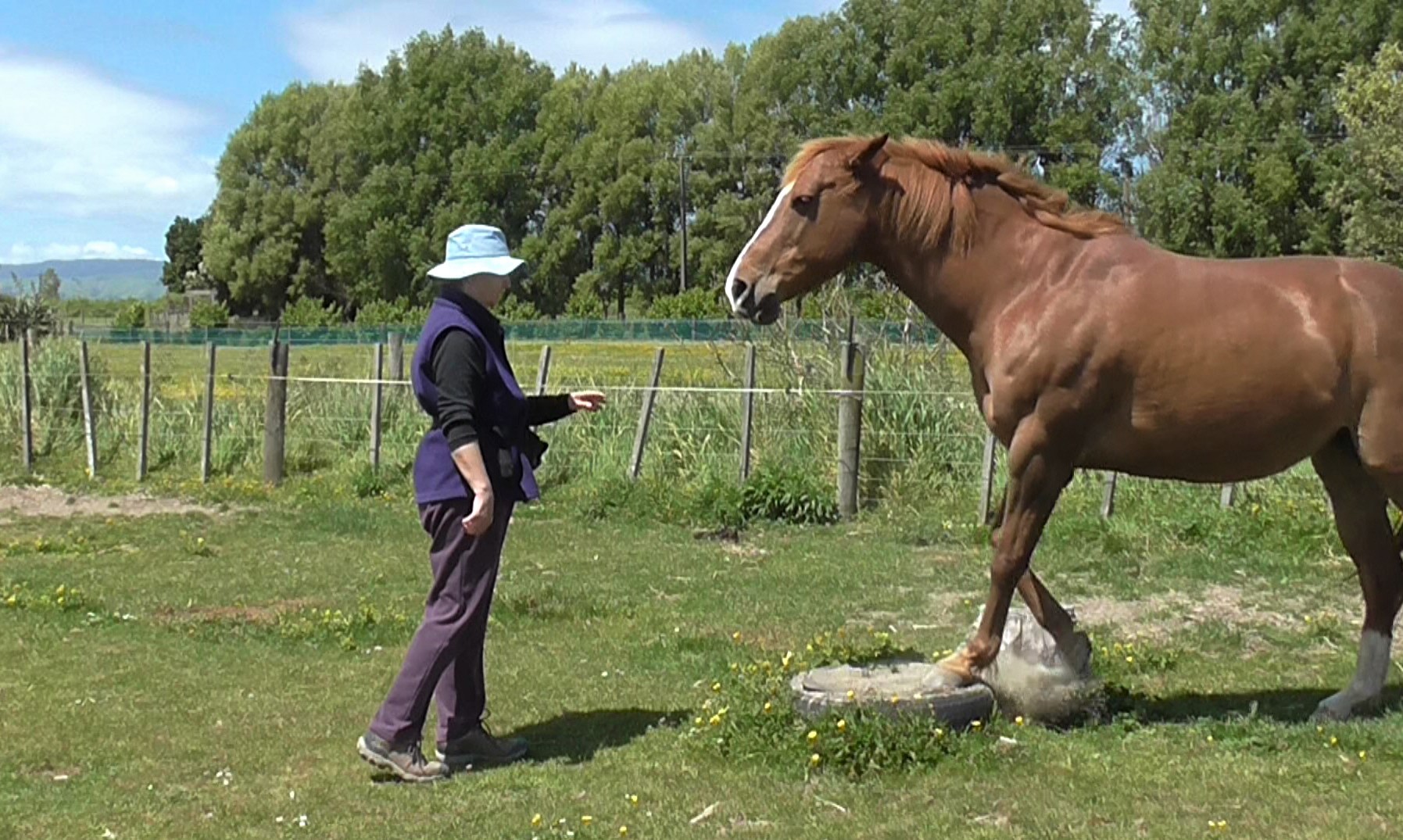
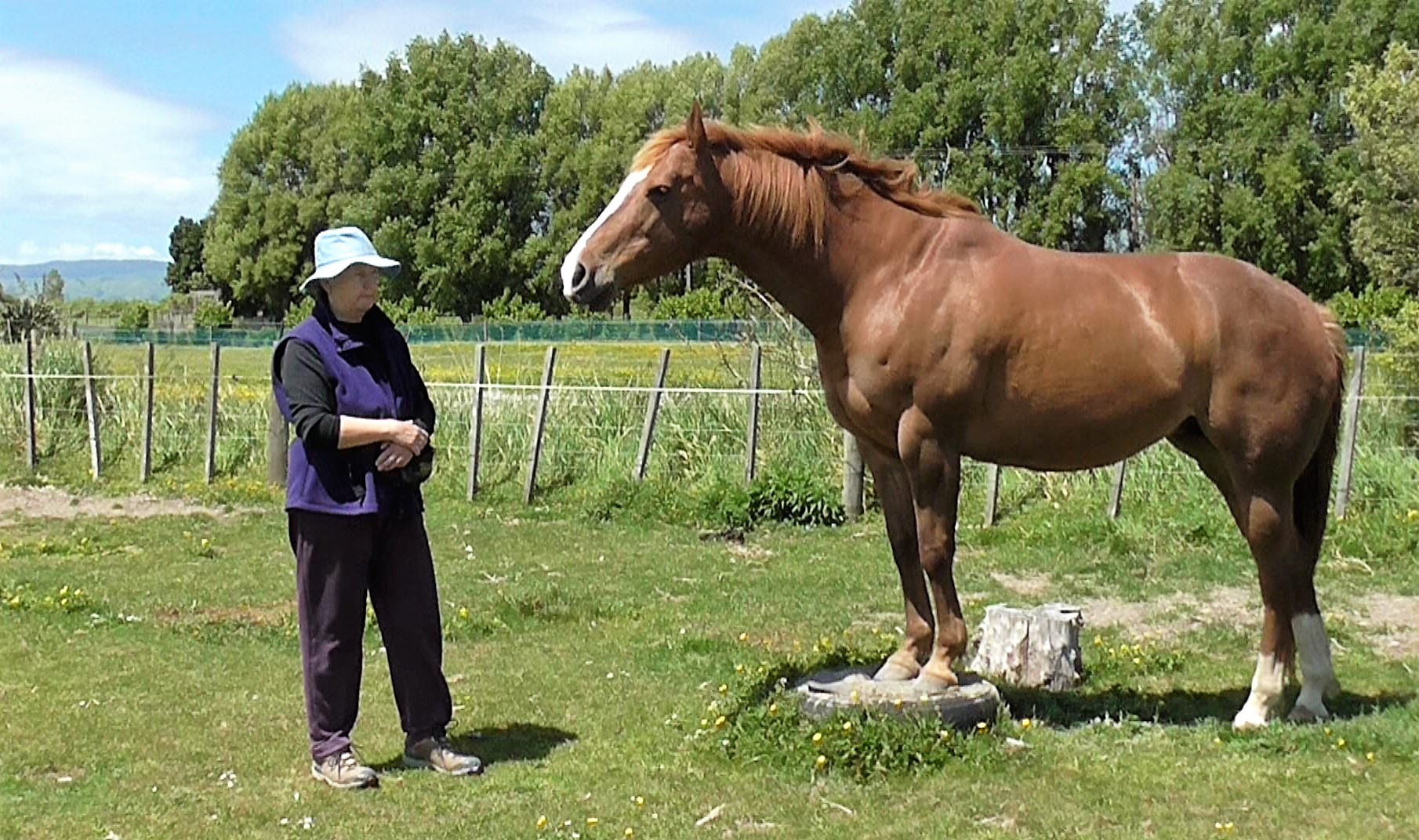
Likewise, I used touch to teach a signal for moving the hind end away from me, but after a while my body orientation. intent and gesture, even from quite a distance, was enough of a cue, even when her front feet were on a pedestal.

A simple arm/hand gesture is enought to tell Boots that she will earn a click&treat for backing off the pedestal.

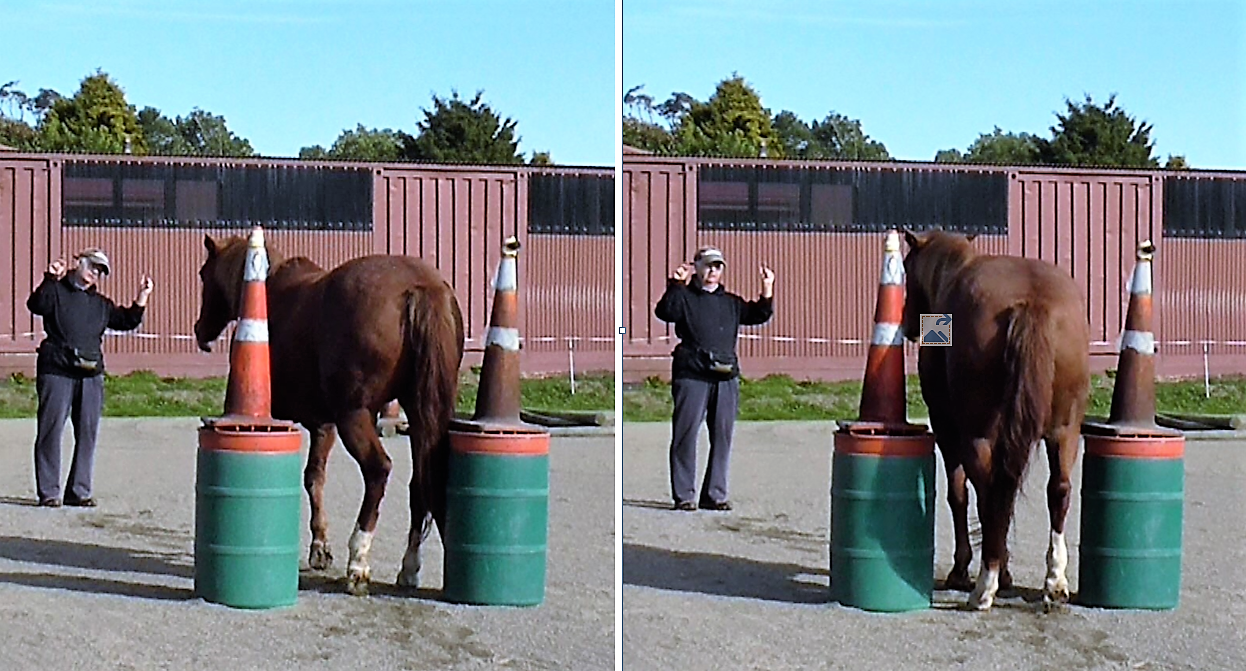
We spent several weeks perfecting backing between two tall objects at greater and greater distances. In the first photo I am looking toward her right butt to get it to straighten out so she doesn’t knock the barrel. No doubt this one earned a triple treat or a jackpot.

If you have an interest in seeing how we reached this stage in the photo above, I filmed most of the days we worked on this. We did a few repeats over many, many days. Here is the link: https://www.youtube.com/playlist?list=PLHJTeGrtF98Pjy3zvmPhgBxBP6V3lwhkh

First we learned sidestepping along a rail with touch to shoulder and butt in rhythm. Once she had the idea, a light touch to the ribs became the cue. Eventually it only needed a gesture and my focus toward her ribs.

Eventually we didn’t need a rail to do side-stepping, which is a good suppling exercise.

Here I’m using a gesture as well as the idea of ‘follow the feel of the rope’ to teach a twirl. (See Blog Number 116 in the Quick Links.) Confidence with ropes touching the legs is another essential skill we should teach in a gradual, nuanced way. (Not starting with the above photo!). Before long, a voice and gesture signal were enough information for her and she would happily insert a couple of twirls into a recall. It became one of her favorite things to show off. Ample click&treat during the teaching process made it a favorite.

Here we are both doing a twirl or spin during our dancing routine. We are both turning to our right and seem to be in step. As she comes around I will click&treat. What began as a ‘follow the feel of the rope’ exercise morphed into just a combined hand and voice signal at liberty. It’s easiest for the horse if they are already in motion in a recall.

All these skills take time to develop, but are so much fun.

Body Language Awareness

The main tool we have, to communicate with our horse, is our body language. We instinctively respond to the body language of other people because, like horses, we live in groups. But because people talk so much, we have become less aware of the effect of body language. 

Our awareness is still there, but it’s mostly subconscious. We may reflect on how an interaction with a specific person left us feeling good or not so good. Or we may get a ‘gut feeling’ about a person on first meeting. In these situations, we are tuning in to our instinctive understanding of human body language.

All species that live in groups need to be able to ‘read’ each other’s body language because the resources of the environment are finite and need to be used by all members of the group.

To prevent energy wastage by constant bickering or fighting within the group, animals that live together have invariably developed sophisticated body language communication.

With time and consistency, horses can get highly skilled at interpreting our body language.

In human terms, think of posture and intent:

  • Shoulders back versus slouched/slumped.
  • Head high and eyes focused versus head bowed/downcast.
  • Meeting someone’s eye rather than avoiding it.
  • Standing firm rather than moving away.
  • Striding purposefully rather than reluctantly.
  • Chest expanded rather than shrunken/subdued.
  • Handshake firm rather than limp or aggressive.
  • Offer handshake rather than wait for the offer.
  • Approach assertively rather than timidly.
  • Unsmiling to passer-by versus smiling at passer-by.
  • Ignore group member versus acknowledging him/her.
  • Determined versus dubious.
  • Confidently neutral versus jittery or nervous.

When a teacher and a class of students meet for the first time, the students have the teacher sized up in the first few seconds of visual contact. Horses are the same. As well as visual signs, people (and horses) give off an aura of energy that spells confidence, timidity, or anxiety.

Interestingly, with a few adjustments, the body language we already instinctively know and acknowledge in other people can be transferred to our interactions with other group animals such as dogs and horses. On the other hand, it doesn’t transfer nearly as much to solitary-living animals such as cats and bears.

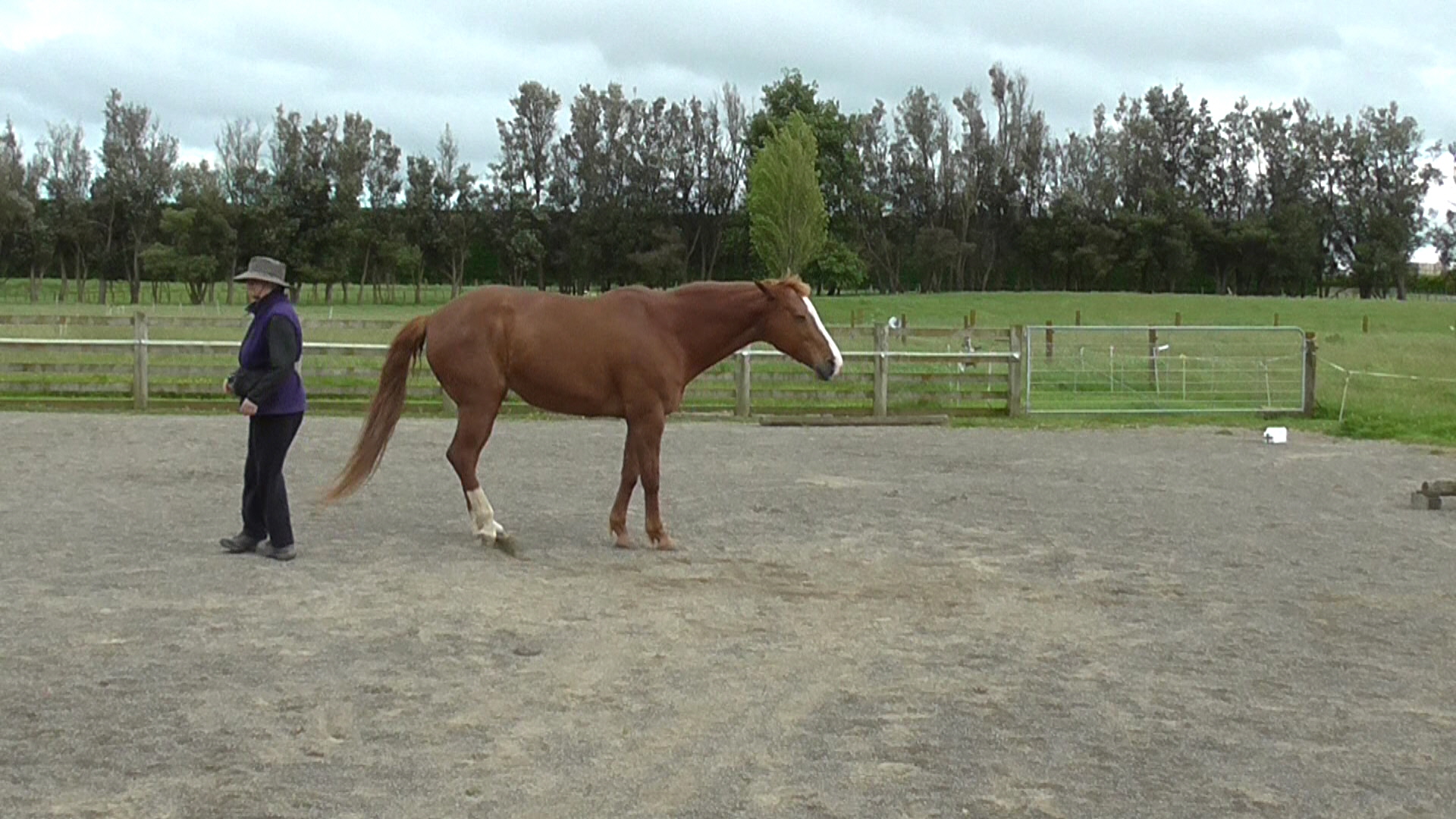
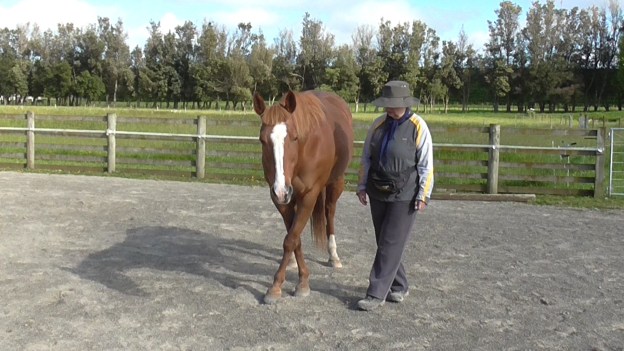
This is a ‘relaxation’ or ‘no intent’ body language posture. Energy drained out of body, hands crossed over treat pouch, looking nowhere. Boots has learned that this posture means we are having a ‘rest’ and nothing is expected of her at this moment.

Body language postures are similar whether we consider people, dogs or horses. A horse willing to touch our outstretched hand with his nose is willingly ‘shaking hands’. A dog who rolls over and exposes his belly is volunteering a very timid handshake.

This foal is learning to greet a person. We hold our hand near the horse and must be sure to let the horse close the last inch of space to initiate the contact.

Here is a small horse experiment that could be illuminating.  It may be interesting to use with your horses or a horse you are thinking of buying.

  1. Stand in a roomy area or paddock where the horse can see you. Stand very quietly with a slumped and despondent posture. Wait. Observe what your horse does (casually, don’t stare at him).
  2. While the horse is minding his own business in a roomy area, make your body language large and assertive (not aggressive), focus on him strongly and walk briskly toward his shoulder in a straight line. What happens?

Some people may, without realizing it at first, slip from assertive to aggressive. As with horses and dogs, human aggression often arises from fear and is a defense mechanism. This is important to remember when we are around horses. 

What looks to us like aggressive, intimidating horse behavior is often grounded in fear if the horse is contained with ropes or in a small pen. A horse’s only way of regaining a feeling of safety is to move himself away as far as he needs to go. When we restrict his ability to move away, his remaining options are limited.

Some people (and some horses) are naturally on the timid end of a ‘timid-bold continuum’. A person may want to learn to be confident with their horse, but quickly slips from confidence to nervousness. This creates a problem for the horse when he is relying on the person’s clear communication, and it is suddenly fuzzy and incomprehensible to him.

The strength of the relationship we build with a horse depends on how clearly we can present ourselves to the horse as another being who is confident, trustworthy and fair. 

Emotional Neutrality

Our body language is intimately linked with our emotions. The more we can lay aside emotional responses, especially stress-related and negative emotional responses, the more we can be ‘in the moment’ with our horse. The more we are ‘in the moment’, the more open we are to noticing the signals the horse is sending us. 

The more we can be open to his signals, the better we can ‘stay with the horse’ and give him time to work out how he can earn his next click&treat.

If we are totally focused on our own agenda, it is hard to also be mindful of the horse’s signals and take them on board so that we can quickly act in the most appropriate way.

The more negative emotion a horse feels from the handler, the harder it is for the horse to focus on what we are asking. He will either withdraw into himself or seek to escape by looking away and moving his feet away as far as a rope or fence allows.

Emotional neutrality relates to the ‘aura of energy’ mentioned earlier. A horse can pick up our pleasure and joy when he does something well. He equally picks up every hint of frustration or annoyance. By the time we recognize we are annoyed or angry, the horse will have withdrawn from accepting our communication at that moment.

It takes a long time to build the trust of a prey animal wired for flight. A moment of aggression can erase a lot of trust. If the horse is contained with rope, reins or small enclosed spaces, he perceives human aggression as a threat to his life.

Horses don’t have a concept of ‘punishment’. In the wild, a horse always has the option to move away from assertive or aggressive behavior by herd mates. We must never forget that they are prey animals and their key defense is flight. We must accept that nothing a horse does is ever a personal affront to us. What a horse does at any one moment is what he feels he needs to do because he is a horse.

Body orientation, Gestures, Touch, Voice, Intent are all things we an refine to make it easier for the horse to understand our requests.