
In the photo above, Boots is lifting her foot in response to Bridget’s arm signal gesture and the intent of her body language. It makes hoof care so much easier.
Shaping with Touch Guidance
Research on dopamine release shows that knowing how to avoid or decrease a stimulus we don’t like gives a ‘reward hit’ to the brain, similar to how achieving something desirable feels rewarding. For example; stopping in time for a red light gives an instant feeling of relief and accomplishment.
This is why the training system made popular by Pat and Linda Parelli gave such ‘good’ results in teaching horses how to respond to human requests. People who have been considered ‘good’ horsemen over the years have used the same principle for millenia.
The principle is basically this: Use a consistent touch/gesture signal and remove the touch/gesture the instant the horse complies even just a little bit. Build from there with repeats until the horse responds readily because it understands the cue and the system. This is negative reinforcement – called negative because the touch or gesture energy is removed when the horse responds. The term ‘negative’ is here used in the mathematical sense. It is not related to it’s other common meaning of something ‘bad’.
BUT: It takes considerable skill in reading horses – to know when the horse remains in the learning zone, i.e. under threshold (see Number 107 in the Blog Quick Links for more about this) or has been pushed beyond threshold. Is the horse responding or reacting? If the handler is not sensitive and/or lacks experience helped by a good teacher, it can end up with a confused and unhappy horse. Also, the touch or gesture signal needs to be totally consistent so the horse can depend on it being the same each time.
Pressure is not a dirty word. Horses understand pressure. They use it with each other all the time. It is the nature of the pressure, plus when it is removed, that makes or breaks good training to create a horse confident with people.
Using touch/gesture pressure followed by a click&treat immediately the horse responds, is an essential step in teaching a horse to be resilient in a variety of human environments. We can’t know the future, If our personal situation changes, the horse may have to go elsewhere. If confronted by flood, fire, earthquake, the horse may need to be moved quickly.
Such teaching with negative reinforcement, backed instantly by positive reinforcment, is often called ‘combined reinforcement’. Some people refer to it as negative reinforcement ‘with a cherry on top’, as a way of discounting it. Yet, if we use a neck rope or headgear or our legs for riding, we usually want the horse to move away from our touch. It’s convenient to be able to touch the horse’s chest lightly to get a back up. Or to touch his leg for a lift if we want to tend the hoofs.
Gesture
Horses interacting with each other use gesture as a first communication. If the annoying horse does not move away, the gesture escalates gradually via touch with nose, teeth or hooves. The first suggestion might be a just a ‘look’ or an ear/tail flick. Play between youngsters is full of touch and gesture.
Because horse are super sensitive to movement, they easily pick up the meaning of a specific gesture if we use it with total consistency.
Once a horse understands our meaning:
- Reaching down to his foot will have him lift a leg.
- Fingers raised in front of him (far enough back to be out of his blind spot) and tapping the air at his eye level will have him back up.
- A light touch or gesture to his shoulder will have him move it into a turn on the haunches.
- A light touch or gesture (or even a focussed look) to the side of his rump will have him move it away into a turn on the forehand.
- A light touch at (or gesture toward) his ribs will have him sidestep.
- A light touch to his chest or nose will have him back up.

I taught moving the front end away into a turn on the haunches with touch to the neck and shoulder, but eventually only my focus and a gesture were enough of a cue.
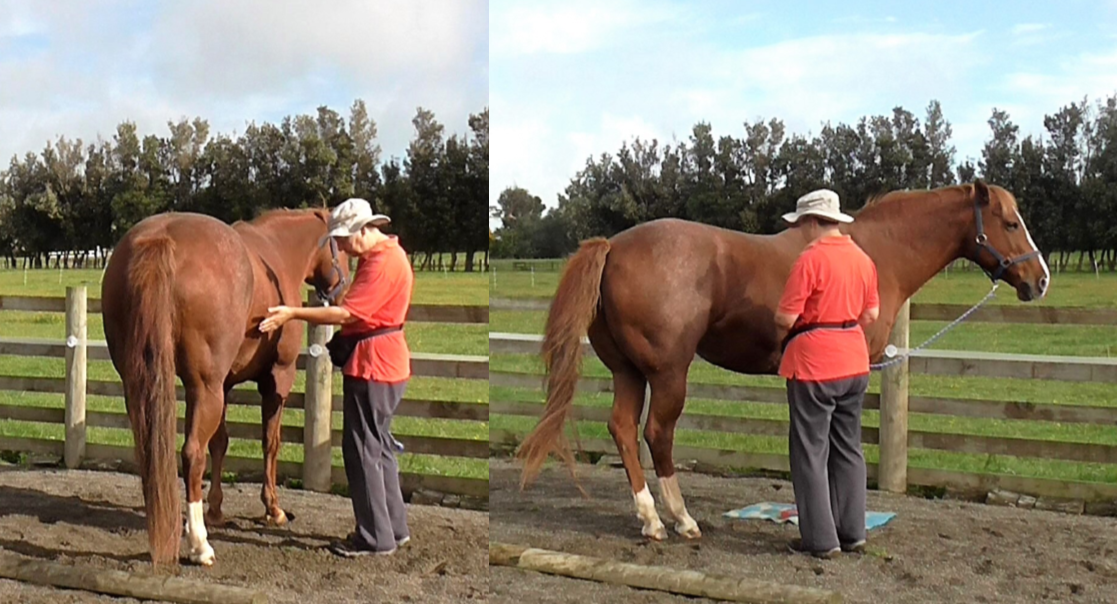
Likewise, I used touch to teach a signal for moving the hind end away from me, but after a while my body orientation. intent and gesture, even from quite a distance, was enough of a cue, even when her front feet were on a pedestal.
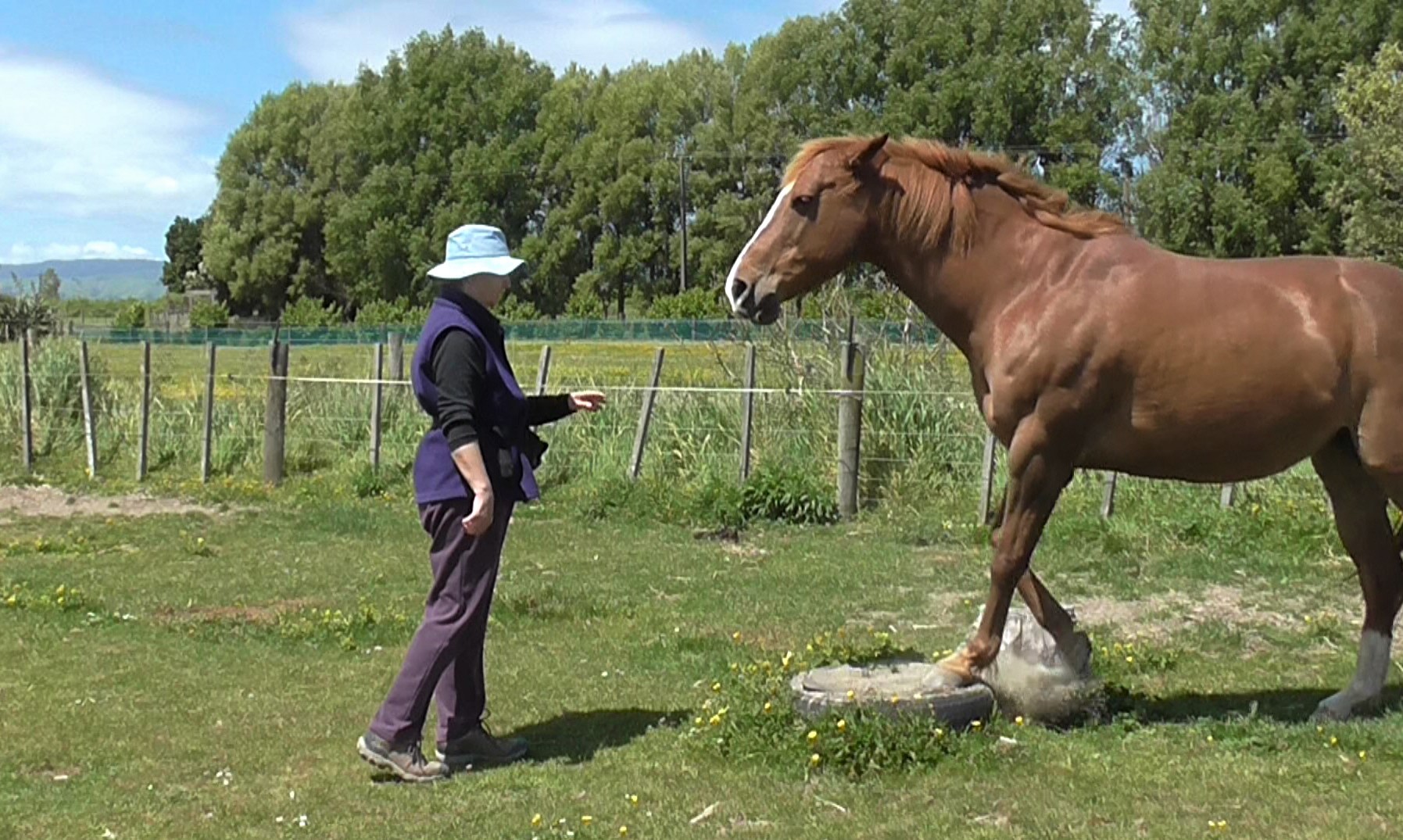
A simple arm/hand gesture is enought to tell Boots that she will earn a click&treat for backing off the pedestal.
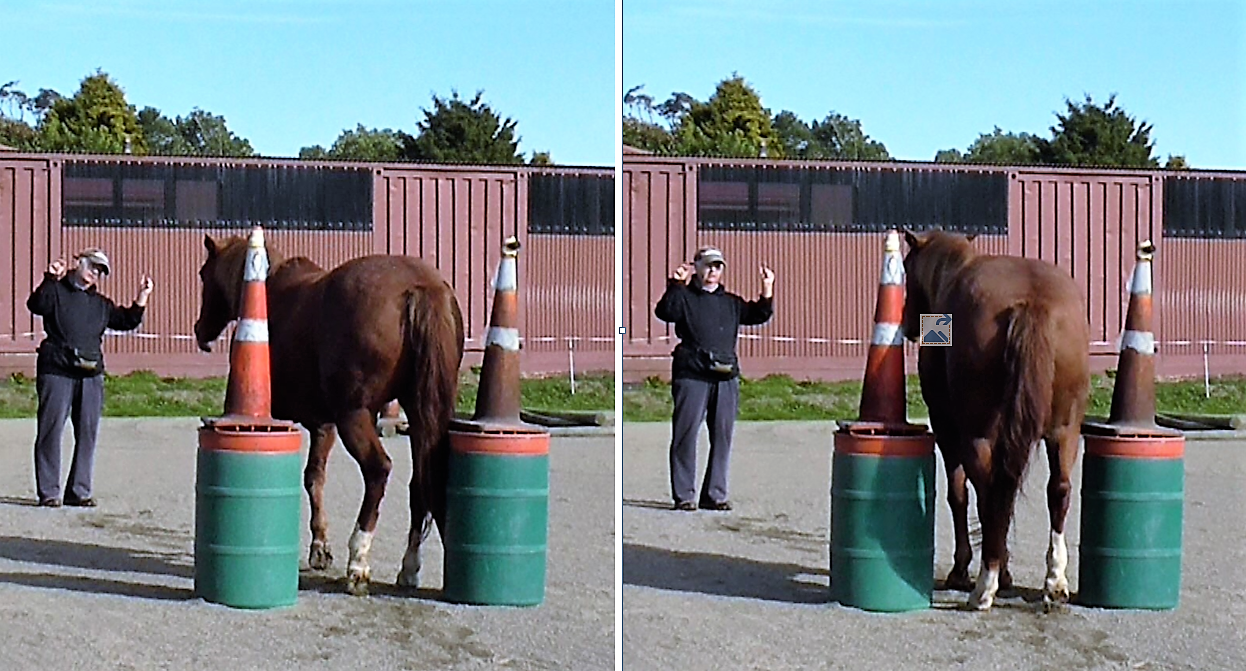
We spent several weeks perfecting backing between two tall objects at greater and greater distances. In the first photo I am looking toward her right butt to get it to straighten out so she doesn’t knock the barrel. No doubt this one earned a triple treat or a jackpot.
If you have an interest in seeing how we reached this stage in the photo above, I filmed most of the days we worked on this. We did a few repeats over many, many days. Here is the link: https://www.youtube.com/playlist?list=PLHJTeGrtF98Pjy3zvmPhgBxBP6V3lwhkh

First we learned sidestepping along a rail with touch to shoulder and butt in rhythm. Once she had the idea, a light touch to the ribs became the cue. Eventually it only needed a gesture and my focus toward her ribs.

Eventually we didn’t need a rail to do side-stepping, which is a good suppling exercise.

Here I’m using a gesture as well as the idea of ‘follow the feel of the rope’ to teach a twirl. (See Blog Number 116 in the Quick Links.) Confidence with ropes touching the legs is another essential skill we should teach in a gradual, nuanced way. (Not starting with the above photo!). Before long, a voice and gesture signal were enough information for her and she would happily insert a couple of twirls into a recall. It became one of her favorite things to show off. Ample click&treat during the teaching process made it a favorite.
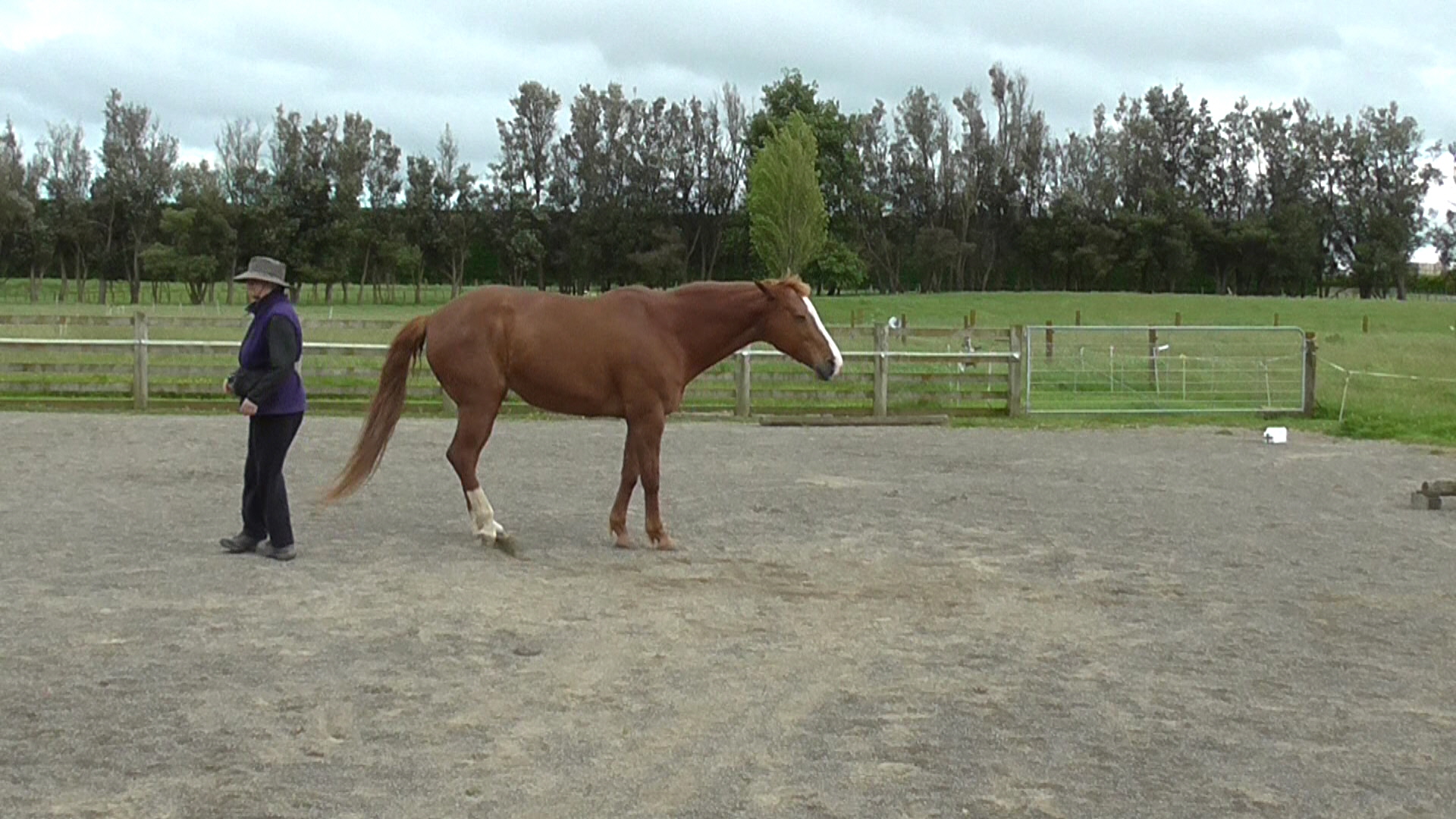
Here we are both doing a twirl or spin during our dancing routine. We are both turning to our right and seem to be in step. As she comes around I will click&treat. What began as a ‘follow the feel of the rope’ exercise morphed into just a combined hand and voice signal at liberty. It’s easiest for the horse if they are already in motion in a recall.
All these skills take time to develop, but are so much fun.
 herthamuddyhorse