
Clicker training teaches both the handler and the horse important things.
- The horse learns that the click means ‘Yes’ that’s right. That’s what I’m asking you to do.

Here I used click&treat to show Boots that what I want is for her to halt with her back feet in the square of squashed bottles.
2. The handler learns to look for and click&treat the slightest try in the direction of the desired behavior.

When first teaching about mats, we click&treat the slightest interest in the mat, even looking at it or approaching it or sniffing the edge of it.
Clicker training allows us to shape* behavior by ensuring that the horse can be continually successful. We do this by putting the following points into place.
[Terms with an asterisk (*) are further explained in the GLOSSARY section. The link to this is at the tip of the page.]
- We start with an end goal clear in our mind.
- We note what the horse is able to offer already.
- We work toward our goal through a series of ‘successive approximations’* which in plain English means gradual tiny changes toward our end goal.
- Each tiny change becomes the horse’s decision. He then ‘owns’ that change because he understands that he made a good choice because it earned him a click&treat.
- Unwanted behavior is ignored or re-directed. If we feel unsafe, we return to having a barrier between us and the horse.
- If the horse’s behavior makes us feel unsafe or frustrated, it is essential to go back to the place in our training where both horse and handler feel confident and comfortable. Then work forward again from there. If we feel unsafe or annoyed, the horse will pick up our feeling and also feel unsafe and want to leave (if he is in anxious mode) or take over (if he is in confident mode).
- It is important to thin-slice* end goals into the tiniest clickable moves that we can think of. It helps a great deal to create a written ‘Individual Education Program’ (IEP)* for each horse. We make revisions as we go along and learn via the feedback from each interaction with the horse. A written plan allows us to look back and review how well (or not) a particular horse responded to each slice of our Program. Being able to look back gives us more feedback so we can adjust the Individual Education Program (IEP).
As a thin-slicing example, let’s look at Pool Noodle Task we did for Horse Agility
The various ‘slices’ of this task build the horse’s confidence to walk through an overlapping horizontal pool noodle arrangement, so the horse is comfortable pushing through them with his chest. Each slice* could take a minute or a day, week, month of short, fun sessions. How long each ‘slice’ takes depends on many factors.
We know we can move on when the horse tells us, through his body language, that he is OK with each slice. Boots is already familiar with this sort of work because she was taught to pull a cart using positive reinforcement. A horse new to these concepts will probably need multiple short sessions for each slice*.
SLICES: The video that follows illustrates the slices* for this task.
1. Investigate the pool noodle (PN) in her own time with nose and feet.
2. Comfortable with PN rubbed all over her body, both sides.
3. Confidently pushes her chest into the PN, held by the handler, as they walk along together.
4. Confidently walks over the PN on the ground.
5. Confidently walks over the PN between the gap created by the uprights for the eventual task set-up of the pool noodles.
6. Confidently walks through the gap with one PN in place at chest height — in both directions.
7. Confidently walks through two PNs in place (slightly overlapping).
8. Waits when asked, while handler walks through the PN, then follows on request.
9. As 8, at liberty.
10. Add more pairs of PN, one at a time, until we have 5 pairs.
11. Trot through.
Every change we make is relevant to the horse. If we change something, we have changed a parameter*, and need to be aware of how the horse might perceive the change. A parameter is something we keep constant during our interactions with the horse. It becomes a condition or action that the horse can depend on because it stays the same. When we change a parameter, we have to carefully teach the horse what the change means.
Number 8 in the Blog Contents List goes into more detail about parameters.
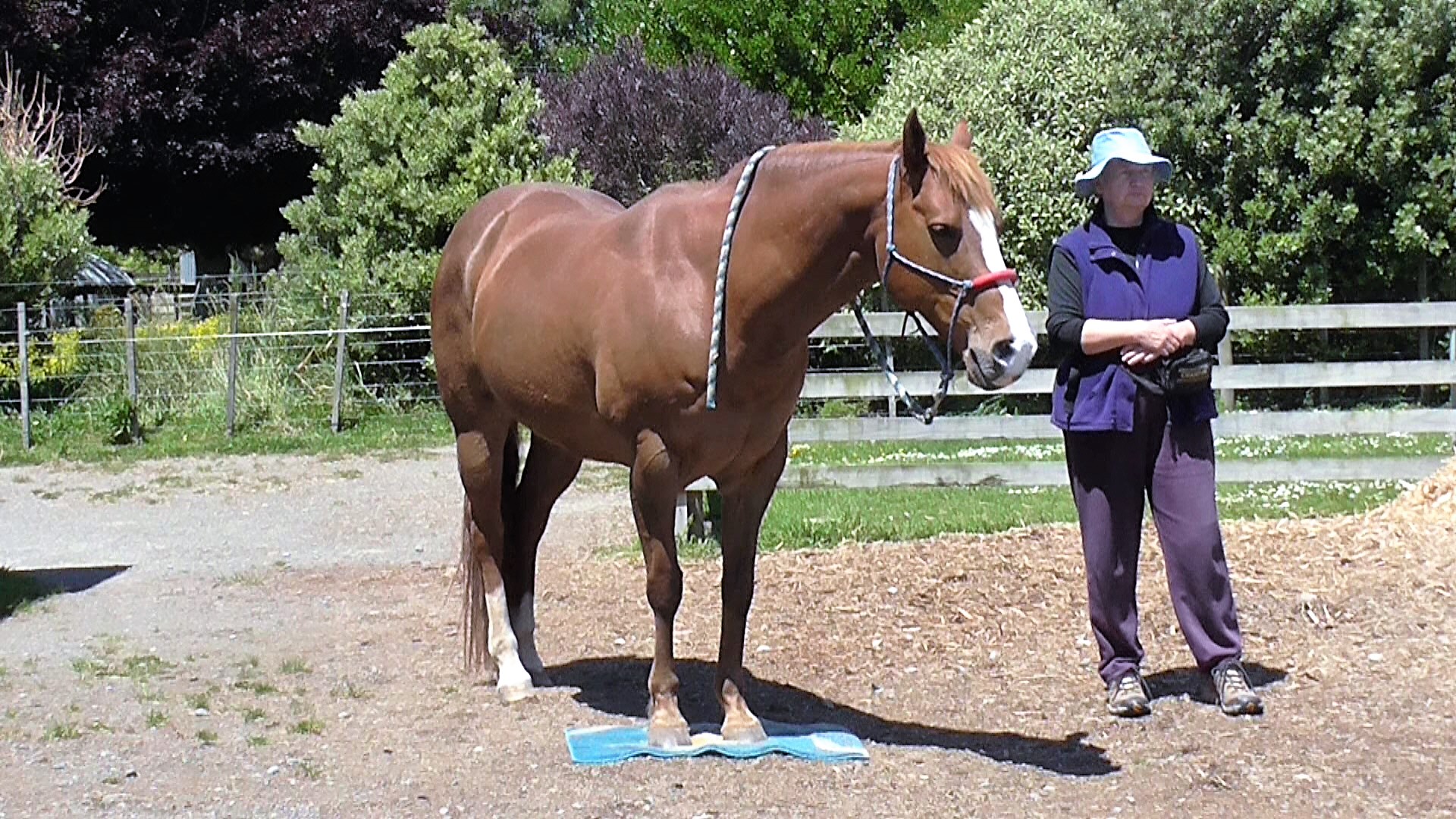
The parameter here is that when I stand doing nothing, looking nowhere and with my hands crossed across my belly, the horse is required to stand quietly, and hopefully relaxed, waiting for the click – this is DURATION at the halt..
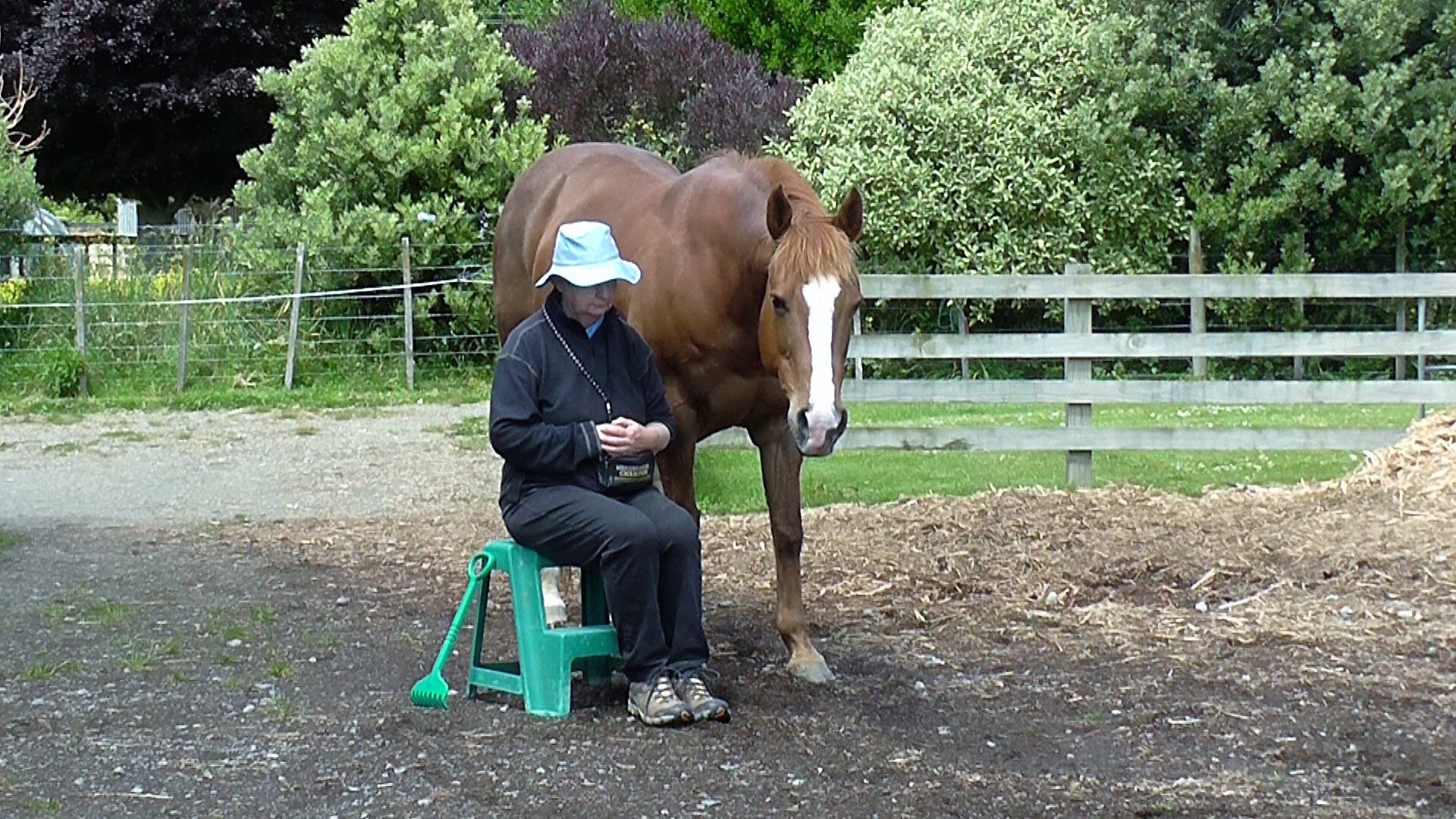
That parameter can be changed/extended to include when I’m in a sitting position.
 herthamuddyhorse