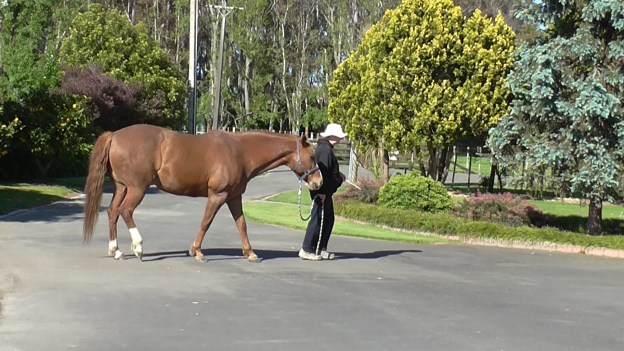
Leading Position 2 (LP2) has the handler in front but to one side of the horse; the horse keeps his eye/nose at or behind the handler’s shoulder. We walk in parallel tracks. Note that I use a body extension to make my intent clearer for the horse, but this soon morphs into an arm signal.
In the photo above, I’m about to step forward. In LP2, we want the horse to remain just at or slightly behind our shoulder and walking in his own track beside our track, not right behind us.
Clip #47 in my HorseGym with Boots playlist looks at LP2.
Leading Position 2, in some ways, resembles the position in which a mare often keeps her foal when the herd is moving. She wants it close beside her and keeping its nose behind hers. So in a way it is a position of safety for the horse. He is not out in front.
Aim:
To teach signals that indicate we want the horse to walk, in a relaxed manner, keeping his nose/eye at or behind our shoulder. We want the horse to stay close beside us on his own track, not edging behind us into LP1 or moving forward to bring his neck/shoulder into LP3.
Environment:
- Horse in an area where he is usually relaxed and confident.
- Herd buddies not able to interfere but in view if possible.
- Horse in a learning frame of mind.
- Safe fence-line (not a wire fence).
- Body extension can be an aid for initial teaching.
- Halter and lead.
- This plan is written for a clicker savvy horse.
Slices:
- Begin in LP3 (beside neck/shoulder). Ensure the horse is confident walking with you in LP3 along the fence. The horse is between you and the fence.
- Work out a signal that lets the horse know you want him to keep his nose/eye behind your shoulder. It might be the same signal used to teach Leading Position 1 – i.e. stepping in front of the horse and staying in front. For some horses, an arm held out in front of his nose is enough of an indicator. For other horses, a swishy body extension is useful to disturb the air in front of the horse to let him know you want him to remain behind your shoulder. Think of a mare letting her foal know it needs to stay close and keep its nose behind her nose. Once the horse understands the concept, the initial larger signal can morph into a small hand gesture and your body language. It may take a while to sort out your exact signal. It can help to try things out with another person standing in as the horse.
- Walk along in LP3, then increase your pace slightly while at the same time giving your signal to let the horse know you want his nose/eye to stay behind your shoulder or elbow. Walk a step or two in the desired position, slow to a halt; click&teat. A clicker savvy horse will stop when he hears the click – turn to deliver the treat. It may be a rough approximation at first, but each time you do the movement, it will get a bit more accurate as the horse learns that staying back earns the click and treat.
- Once 3 above is smooth, walk a bit further, repeating your signal to stay in LP2 if necessary, before you click&treat.
- Once 4 above is smooth, gradually walk even further each time before you click&treat. Using destinations makes it easier because you can put them a little further apart each session. Destinations allow the horse to know when the next click&treat stop will be, no matter what leading position you are asking for.
- Once 5 above is smooth, build in halt duration with the horse remaining in LP2. At first turn toward him as you click&treat to reinforce the idea that staying in LP2 was the right thing to do. Then build up duration at the halt (before turning and the click&treat) one second at a time.
- Teach it all from the beginning on the horse’s other side.
Generalization
- When it is very good along a fence, use LP2 walking along a track or the road and in open areas.
- Play with it doing serpentines or weaves and walking a circle.
- Play with it at the trot.
LP2 is a nice position to use at times for companionable walking together. The horse can easily read our body language from his position just behind our shoulder.
In some situations we don’t want the horse’s eye and nose ahead of ours, as it is using LP3, and we don’t want him right behind us in LP1.

Using a safe fence. Horse and I in parallel tracks. Building ‘wait time’ in LP2.
 herthamuddyhorse