Tag Archives: cues

Signal Opportunities

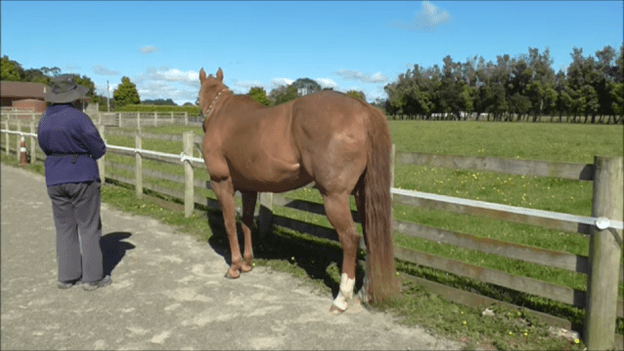
The photo above illustrates a moment when it would not be a good idea to give the horse a signal/cue, becaue her attention is strongly focussed on something happening on the road.

Horses are generally co-operative beings. Most horses are happy to comply if the message is clear for them and if what we ask is within their emotional, mental and physical capability.

On the other hand, if we send mumbled or mixed messages or use non-natural signals that the horse has not learned, or which he physically can’t do (perhaos due to pain) the horse is in a real bind. A horse in this situation may react in one of the following ways.

  1. He may try to fill in with what he thinks the handler might mean, best as he can.
  2. He may give up trying to understand and opt out mentally.
  3. He may opt out physically by moving his feet to escape the situation, if he can. 
  4. If he can’t escape, he may ‘take over’ physically by pushing on, through or over the handler.
  5. He may ‘freeze’ into a catatonic state. Some horses simply collapse.

Choosing the right opportunity to ask our horse to do something is important. It’s pointless to ask our horse to do something unless there is a 99% chance that he can and will do it. Otherwise we are teaching him to ignore our requests because they are too hard to understand or beyond his physical ability at the moment.

Setting Up Opportunities

Do we set up lots of occasions for the horse to practice learning what we want him to learn?

By playing with picking up, then walking, carrying her feed bucket every day, Boots became adept at it.

In other words, do we give the horse ample opportunity to learn in a controlled environment where he can gradually build his confidence and expand his comfort zone as he comes to understand each new thing we are teaching?

Traditional training was geared to what the human wanted right now, and proceeded to demand it with force, coercion and body extensions designed to inflict increasing discomfort. 

Since what people want is usually not part of a horse’s natural repertoire of behavior, the horse is often catapulted into a state of bewilderment.

How much more comfortable and safer all around, if we thin-slice a large task into its smallest parts, teach each part and then chain the parts together to achieve the whole task?

When we do this, we allow the horse opportunity and time to master each small part before moving on. Please see Blog Numbers 13 and 106 on the Quick Contents Page for lots of detail about thin-slicing.

We want to allow the horse to keep his integrity and we want to keep his goodwill. We allow him to adjust to the strange life he must live with us. We earn his trust so that he is willing to put the placement of his feet into our hands. For an animal, whose sole defense is the ability to flee from perceived danger, this is a big ask.

To build the horse’s knowledge and confidence, we need to first get (and reward) the behavior that we want, then we can add a specific signal to it. Often a signal arises naturally out of the way we initiated the behavior.

The desired behavior here is for the horse to target a specific object. We make it easy at first and set it up with the least distractions, so we can quickly click&treat the behaviour we want. Once it is good 99% of the time with a simple set-up, we can add verbal and gesture signals to ask for the behavior. Then we can start to ask the horse to touch all kinds of things with his nose, so building his confidence and courage.
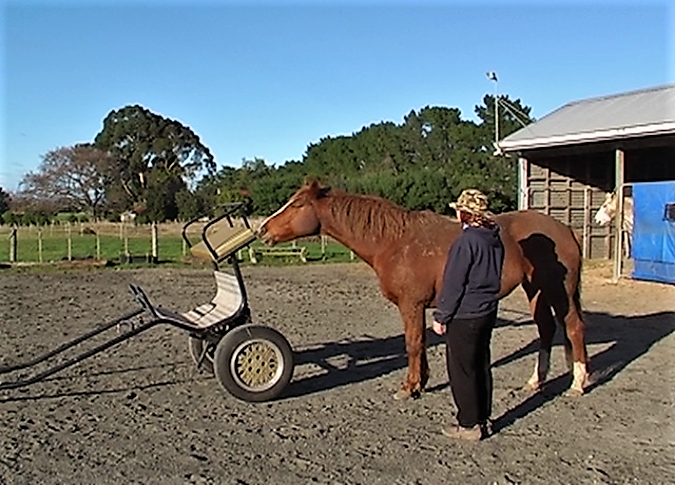
Because Boots had a long history of touching unusual objects with her nose, she willinging targetted the cart.

Once the horse understands the key signal, we can layer in other signal types. We can also replace a signal by adding a new one and fading out the earlier one.

Most horses don’t seem to have any trouble understanding several signals for the same thing. For example, my horse will ‘walk on’ with a verbal signal, a ‘breath-in’ signal, an arm gesture signal and an ‘outside leg steps forward’ signal. If we are doing work on a long line or reverse round pen, she understands the verbal, breathing and arm gesture signals from different angles and distances.

Additionally, horses can understand one signal in a variety of different situations. My horse understands the verbal ‘whoa’ signal when walking beside me, when she is behind me, when I am walking behind her as in long-reining, and from the riding position.

It’s also essential to be aware of the ways that our horse signals to us. Often, we are so immersed in working out what we want the horse to do, we miss the signals the horse is sending us about what he need us to do so he can remain confident.

By reading the horse, we can decide whether we should:

  • Carry on with what we are doing.
  • Go back a step or more to regain confidence.
  • Have a break and do something that’s already easy.
  • Stop for the day or for this session.

Multi-Signals or Signal Bundles

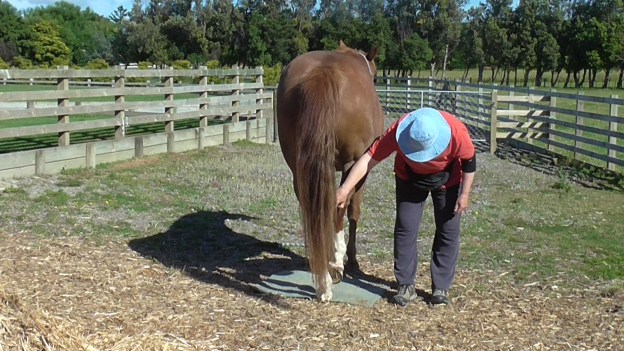
In the photo above, I am using a multi-signal. In terms of environment, I’ve asked Boots to park on the mat. My body orientation is beside her butt, facing backwards. My hand is giving a touch gesture on her hock to ask her to lift her leg. I also say, ‘Lift.’ Because I use this signal bundle or multi-signal consistently, she can link them reliably to foot care.

Behaviors Must be ‘On Signal’

Once we have taught a horse a response, either by free-shaping it or through careful application of approximations to reach a desired ‘finished’ behaviour, it is essential that we put the behaviour ‘on cue’ or ‘on signal’.

Often the last thing we taught our horse is his favorite because it has a recent high level of reinforcement. When I taught Boots to target her hindquarters to my hand, it became her favorite thing. But when she keenly wanted to show it off while I was talking to visitors, it became a bit of a problem.

Let’s look in detail at the topic of signal or cues. It’s imprtant that we are aware of everything that the horse may be observing.

Sometimes we use one type of signal in isolation, but often our signal is a mixture of body orientation, body language and gesture, energy change in our body, and often it has a verbal component. We are in essence using a ‘multi-signal’. 

In this photo Bridget is using a signal bundle or multi-signal to ask Smoky to exit the trailer. She is in position behind the trailer, using touch on the tail, a clear ‘back up’ hand signal, and body energy indicating ‘backwards’. I’m in the front of the trailer using a ‘back up’ signal Smoky already understands.

We may think we are giving a clear signal but our energy, orientation and intent may not match what we want the signal to say. The horse will always do what he believes to be the right thing to do at that moment.

Even if we think we are giving one clear signal, the horse is noticing everything that is happening. That is why it is so easy to inadvertently teach horses things we didn’t intend them to learn. 

One reason Clicker Training is so powerful is because it allows us to pinpoint exactly what we want the horse to do and teaches us to be more consistent. Horses appreciate this clarity enormously. It removes much of the guesswork for them.

The marker signal (click) tells the horse that what he just did is what we wanted and that he can go into treat-retrieval mode. The treat is offered right after sounding the marker signal.

 We must remember that body language is a big deal with horses. It is their first and essential language. It’s what they use with each other. It helps explain why horses who do marvelous groundwork may suddenly become ‘lost’ when their handler mounts up. Suddenly the horse can no longer see all the body language signals that accompany groundwork.

Looking at signals in isolation can make it easier to become more mindful about exactly how we are using:

  • our environment
  • our whole body orientation
  • our gestures
  • our voice
  • our hands
  • any of our body extensions (ropes, reins, lanes, etc.)
  • our energy
  • how and where we present the treat after the clicker.

#38 HorseGym with Boots illustrates some of these ideas. You will notice that Boots is so clued in to some of my body orientations that she offers a belly crunch while I face her front on, a front leg lift when I stand shoulder-to-shoulder facing backwards, and a wee back-up when I face her. Now and then I do make a request but mainly I’m asking her to stay parked on the mat and not do anything else. It’s important that I keep my body energy low.

As an exercise, you could work out what you usually ask the horse to when you are in each of these body orientations.

Resetting Tasks

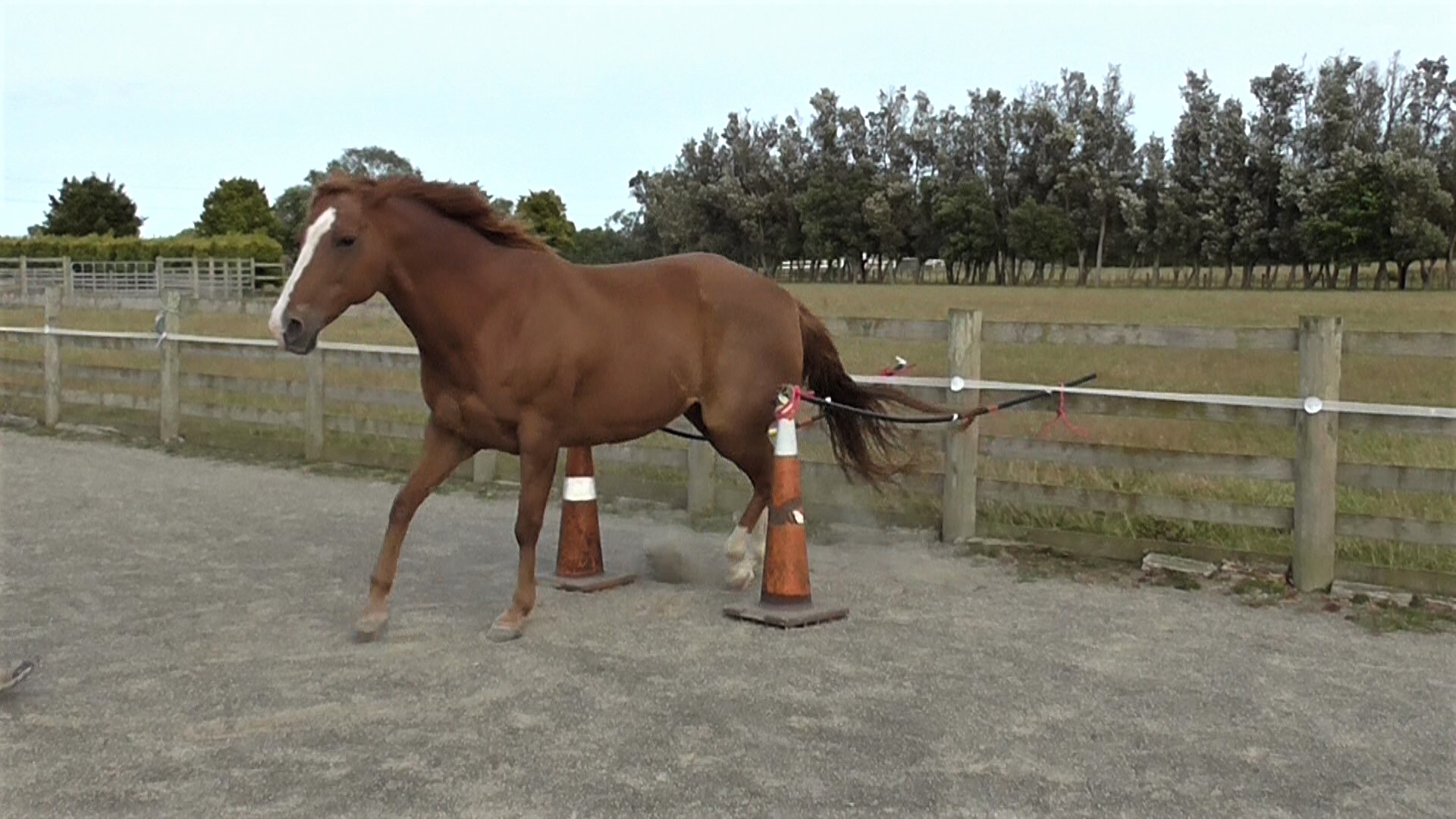
We first played with this task at liberty and Boots scared herself when her leg touched the pipe on her left as she backed into the space. She jumped forward.
She jumped forward a step or two and then stopped. I was standing well back (you can just see the toe of my shoe) in case this happened.
We quietly reset the task with the help of halter and lead, with click&treat for each step back and she quickly regained her confidence. I’m standing to the side in case she feels the need to suddenly come forward.

The task above is a good one to prepare a horse for being restricted behind, as in a horse trailer. It is also a task for preparing a horse to back between cart shafts.

Rather than correct something that did not go well, we learn to reset* a task without placing a negative value judgement on what the horse just did. This makes a huge difference to how horses perceive their training.

While he is learning a new task, a horse can’t be wrong, because he does not yet know what you want.

Clicker-savvy* horses often don’t want their sessions to end. The positive vibrations that go with good clicker training make it fun rather than a chore.

Clicker training gives us a way to let the horse know instantly, by the sound of the marker signal* (click), when he is right. It takes away much of the guessing horses must do as they strive to read our intent* (which is often fuzzy to them).

A horse’s perceptions and world view are quite different from human perception and world view. While we are with our horse, the more closely we can align our world view with that of the horse, the easier it is for him to understand us and comply with our requests.

There is much more about this in my book: Conversations with Horses: An In-depth look at the Signals & Cues between Horses and their Handlers available as an e-book or a paperback.

Counting with the Front Feet

Introduction

You may have heard the story about a horse called Clever Hans who could add, subtract, multiply and divide. I think it was eventually found that Hans responded to eyebrow signals from his person to let him know when he should start and stop lifting his foot.

My horse, Boots, and I won’t reach such a level of sophistication, but teaching ‘counting’ can be fun. It also forced me to refine and clarify the way I presented my signals, as well as improve the timing of my ‘click’.

Leg lifts without moving are a good way to play with mobilization. Viewing the video clips, I notice that lifting one leg engages her whole body.

‘Counting’ is a game we developed over many months with several starts and stops to focus on other things. It’s an engaging game for a few minutes at a time when the weather is too hot, wet, windy, or cold to be out and about.

The key, as for most of equine clicker training, is to have many short sessions, two or three minutes long, over many, days. By keeping it short, the horse begins to look forward to the new game as a relatively easy way to earn clicks&treats.

NOTE: Items with an asterisk {*} are described in the GLOSSARY which you can access at the top of the home page.

Developing Boots’ Individual Education Program* for ‘Counting’ helped me:

  • Be more aware of deciding and stabilizing my body orientation, which is a key part of any signal. Horses are super aware of body positioning.
  • Refine the nature and energy of my signal for this task. We do a lot of different things, so it is tricky to keep all my signals ‘clean’.
  • Improve the timing for when I turn the signal on and off.
  • Remember to take up my ‘zero intent*’ position to wait for the horse to tell me when she is ‘ready to repeat’ (Consent Signals*)
  • Relax when the horse attends to external distractions and wait for her to bring her attention back to me.

This exercise is an extension of tasks we developed to create confidence with standing on three legs for hoof care. Details of this are available in my book, Confident Foot Care using Reward Reinforcement.

Once Boots readily lifted a leg when I pointed to it, it was not a big leap to ask for two lifts in a row before the click&treat*. She is presently on her way to counting to ten. Which lets us have fun doing simple math questions when the grandchildren visit.

Aim

To have the horse understand a signal for lifting a front leg (either one) and able to repeat lifting the leg up to ten times on request (number is optional) before a click&treat.

Prerequisites

  1. Horse and handler are clicker-savvy.
  2. Handler uses clear body language to indicate ‘intent’ and ‘zero intent’. Click here.
  3. Horse is relaxed about foot care and willingly lifts his feet for cleaning/trimming. Or this task can also be part of improving balance on three legs.
  4. Horse has developed one or more ‘Consent Signals*’ to let the handler know when he is ready to go ahead with what we are doing. Click here.
  5. Horse understands touching a target with his nose, his knee, and his foot. #89 HorseGym with Boots: Balance on Three Legs looks at foot targeting. Click here.

Videos

MATERIALS AND ENVIRONMENT

  • Ideally, the horse can see his buddies, but they can’t interfere.
  • The horse is not hungry.
  • A space where the horse can stand relaxed and confident.
  • A safe fence (not electrified or wire) or similar barrier.
  • A target safe for foot targeting and easy to handle. I find a piece of cloth slipped into the leather end loop of an old riding crop makes a nice lightweight target. Bulky things like pool noodles are harder to hold and harder to remove from view to ‘take out of play’.
  • A rail on the ground may be helpful in some cases.

Notes

  1. Using props when we begin a new task makes it much easier for the horse to understand what to do to earn his next click&treat. Use of well-planned props takes us halfway to achieving our aim.
  2. Once the horse understands the task, we gradually fade out the props.
  3. Pawing is not the same as counting with a discreet signal from the handler for each ‘number’ counted. If pawing becomes an issue, repeated click&treat for ONE lift of the foot may (over many short sessions) may make it clearer for the horse.
  4. I start each session (once we can count more than ONE) with click&treat for ONE, and work up the numbers to our present limit.
  5. I like to encourage the horse to use both front feet for the counting. Boots sometimes uses both and sometimes mostly one foot. Using both gives better distribution of the muscle movement throughout the body.
  6. HANDLER SKILL: Your horse may begin to offer foot lifts once you’ve started this game. Boots does it in the video clips. This ‘offering’ is precious. It shows you that the horse understands the game and is volunteering to start. If I’m ready, I count such an ‘offer’ as ONE and begin to signal for TWO and so on.
  7. HANDLER SKILL: Click as the horse is in the act of lifting his foot. Good timing is not always easy and can always be improved. Don’t worry if you don’t get it exactly right each time. Focus on the upward movement of the foot. Once you are conscious of this, and with practice, your timing will improve.
  8. HANDLER SKILL: Carefully check your body orientation to keep it the same each time you begin to ask for ‘counting’. Horses are super aware of how our body is orientated. Consistent orientation is a large part of signal clarity.
  9. HANDLER SKILL: Ensure that you always use the hand closest to the horse to give the ‘lift foot’ signal. Which hand you use is highly significant to the horse. I use the hand furthest from the horse to give a signal for ‘shoulder away’.
  10. HANDLER SKILL: The signal for each ‘foot lift’ is an ON-OFF signal.
  11. HANDLER SKILL: As you click, remove the target (and later your hand/finger) to behind your body to consciously take it ‘out of play’ – the OFF part of the signal. When you present it again for the next ‘repeat’ it will catch the horse’s attention as your ON signal. Once you are using your finger, make your moving finger the ON signal and learn to tuck your finger way for the OFF signal.
  12. HANDLER SKILL: I begin the task by using a voice signal. I say, “Counting – Fronts” and quietly count each foot lift, exaggerating my voice for the number I will click. Boots has learned that while I say the number softly, she will need to do another one – in other words, she listens for my loud, happy final number plus click. I’m also teaching her to count with the back feet, where I start by saying, “Counting – Rear” and my body orientation is quite different.
  13. HANDLER SKILL: In the clips you will notice that occasionally Boots pauses. She is not being slow or stubborn, she is thinking. Be sure to give your horse ample thinking time and sometimes they like a bit of time to enjoy their last treat before resuming the game.
  14. HANDLER SKILL: Always click before you reach for the treat or the horse will learn to watch your hand rather than focus on what you are teaching. This is especially important for this task because your hand moving slightly forward with a finger wiggling will become the ON signal as you fade out the target prop.
  15. HANDLER SKILL: Feed the treat away from your body. Try to position your treat hand so the horse straightens his head to retrieve the treat.
  16. HANDLER SKILL: If the horse is distracted, wait with ‘zero intent*’ body language until the horse brings his attention back to you – hopefully using a ‘consent’ signal*. Sometimes the waiting feels like a long time, but it is usually only a few seconds. Pay attention to whatever has caught the horse’s attention by looking at it keenly, then breathe out deeply. This shows the horse that you have noticed his concern but are not worried about it.
  17. HANDLER SKILL: Teach everything on either side of the horse. One side may feel more difficult. The horse may be less comfortable with you on one side. We are usually less smooth giving signals when we use the non-dominant side of our body. I like to teach each slice of this task on both sides before moving on to the next slice. While the horse is learning, I am learning to be more particular about everything mentioned in these notes.
  18. HANDLER SKILL: Stay with X-number of leg lifts until it feels like the horse is ho-hum with that number, even if you stay at ONE or TWO for what feels like ages. Nothing derails our training as quickly as going faster than the horse is able to absorb each new slice and put it into deep memory.
  19. HANDLER SKILL: If you get a nice series of ‘counting’, resist the natural urge to ‘do it again to see if we can do it again’. Stop when it feels really nice and wait until your next session.

Slices

  1. If you already have a space where the horse stands comfortably relaxed, start with Slice 2. If not, we first need to establish a place we can use consistently for teaching this task. One way is to ensure your horse is comfortable standing between a safe fence and a rail on the ground. Walk him through the space in both directions. Then halt in the space; click&treat, in both directions. The fence and rail help show the horse that you don’t want him to move sideways. When he is relaxed in the space, start with Slice 2.
  2. Set the scene to let the horse know that ‘targeting’ is the game of the moment by asking him to target his nose, a knee, then the back of a front foot to your target.
  3. Repeat touching the foot to the target ONCE with a click&treat each time. Somewhere between three and five repeats is plenty at one time. (See The Rule of Three. Click here. )
  4. When the horse readily lifts his foot once, ask for twice before the click&treat.
  5. When the horse readily ‘counts’ to TWO, ask for THREE before the click and treat.
  6. And so on, to as high a number as you like, always staying within the horse’s ability and interest level.
  7. As you reach a higher number (over five), the horse may pause more often to think. He may be thinking about which foot to lift next.
  8. When it feels like the horse has a good understanding of the task, gradually introduce a finger wiggle with the hand holding the target. Horse peripheral vision is magic at picking up movement, so they will notice the finger wiggle easily.
  9. Gradually lessen the movement of the target stick toward the horse as you wiggle your finger. Eventually you’ll realize that you no longer need the target stick – that your hand/finger movement has become the signal.
  10. Remember, bringing your hand forward and the wiggling your finger is your ON signal. Put your hand ‘away’ and out of play is your OFF signal. Then when you bring your hand with wiggling finger forward again, the horse will notice it as your ON signal to do another ‘count’.

Generalizations

  1. When the horse is ho-hum about his ‘counting’ task in the familiar spot you have been using, move to different venues. You may want to begin with fence and rail props in a new venue. Horses let us know when the props are no longer needed.
  2. At some point you can begin to mix up the number you ask for – sometimes THREE, sometimes FIVE, occasionally SEVEN, and so on.