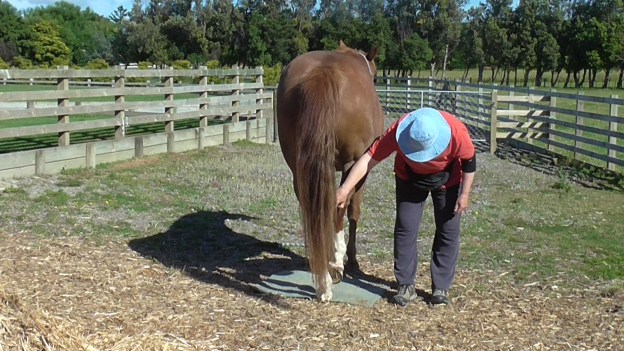
In the photo above, I am using a multi-signal. In terms of environment, I’ve asked Boots to park on the mat. My body orientation is beside her butt, facing backwards. My hand is giving a touch gesture on her hock to ask her to lift her leg. I also say, ‘Lift.’ Because I use this signal bundle or multi-signal consistently, she can link them reliably to foot care.
Behaviors Must be ‘On Signal’
Once we have taught a horse a response, either by free-shaping it or through careful application of approximations to reach a desired ‘finished’ behaviour, it is essential that we put the behaviour ‘on cue’ or ‘on signal’.
Often the last thing we taught our horse is his favorite because it has a recent high level of reinforcement. When I taught Boots to target her hindquarters to my hand, it became her favorite thing. But when she keenly wanted to show it off while I was talking to visitors, it became a bit of a problem.
Let’s look in detail at the topic of signal or cues. It’s imprtant that we are aware of everything that the horse may be observing.
Sometimes we use one type of signal in isolation, but often our signal is a mixture of body orientation, body language and gesture, energy change in our body, and often it has a verbal component. We are in essence using a ‘multi-signal’.

In this photo Bridget is using a signal bundle or multi-signal to ask Smoky to exit the trailer. She is in position behind the trailer, using touch on the tail, a clear ‘back up’ hand signal, and body energy indicating ‘backwards’. I’m in the front of the trailer using a ‘back up’ signal Smoky already understands.
We may think we are giving a clear signal but our energy, orientation and intent may not match what we want the signal to say. The horse will always do what he believes to be the right thing to do at that moment.
Even if we think we are giving one clear signal, the horse is noticing everything that is happening. That is why it is so easy to inadvertently teach horses things we didn’t intend them to learn.
One reason Clicker Training is so powerful is because it allows us to pinpoint exactly what we want the horse to do and teaches us to be more consistent. Horses appreciate this clarity enormously. It removes much of the guesswork for them.
The marker signal (click) tells the horse that what he just did is what we wanted and that he can go into treat-retrieval mode. The treat is offered right after sounding the marker signal.
We must remember that body language is a big deal with horses. It is their first and essential language. It’s what they use with each other. It helps explain why horses who do marvelous groundwork may suddenly become ‘lost’ when their handler mounts up. Suddenly the horse can no longer see all the body language signals that accompany groundwork.
Looking at signals in isolation can make it easier to become more mindful about exactly how we are using:
- our environment
- our whole body orientation
- our gestures
- our voice
- our hands
- any of our body extensions (ropes, reins, lanes, etc.)
- our energy
- how and where we present the treat after the clicker.
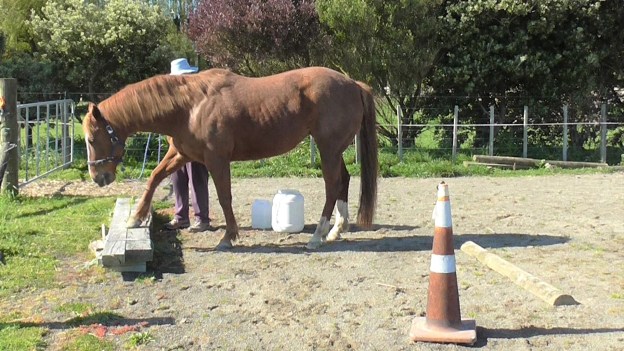
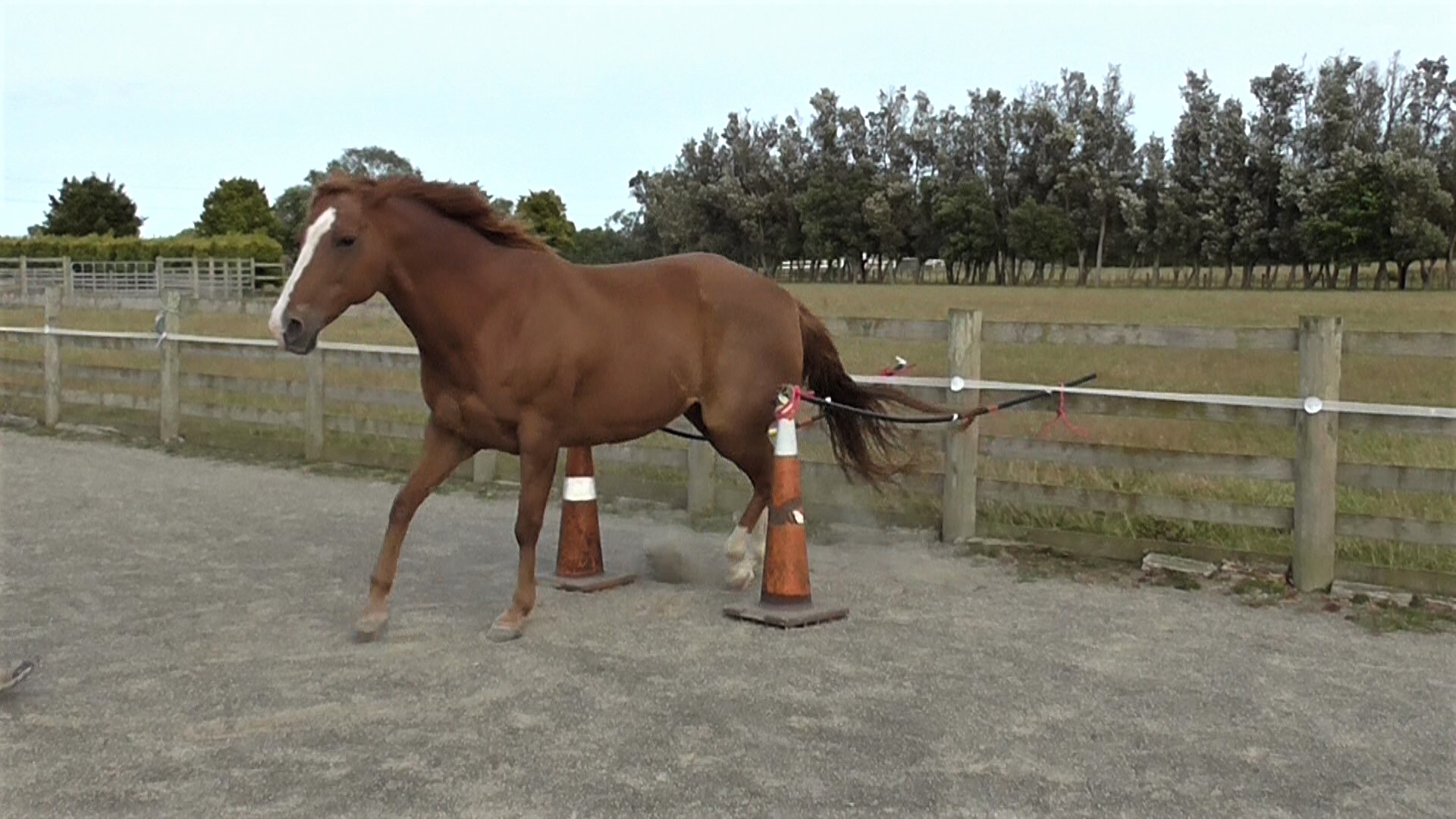
#38 HorseGym with Boots illustrates some of these ideas. You will notice that Boots is so clued in to some of my body orientations that she offers a belly crunch while I face her front on, a front leg lift when I stand shoulder-to-shoulder facing backwards, and a wee back-up when I face her. Now and then I do make a request but mainly I’m asking her to stay parked on the mat and not do anything else. It’s important that I keep my body energy low.
As an exercise, you could work out what you usually ask the horse to when you are in each of these body orientations.



 herthamuddyhorse