
The key prerequisite for all the tasks shown in the clips below about UNUSUAL SURFACES is having first mastered smooth ‘walk on’ and ‘halt’ transitions. If we have to first work on this prerequisite, we can do it using target destinations and training ourselves to be really clear when we are requesting ‘walk on’ and when we are requesting ‘halt’. Blog Number 16 in my Blog Contents Quick Links demonstrates. Below is a quick revision.
Walk-on Body Language
These four things are done all together – a ‘multi-signal’.
- Breathe in deeply (horses hear this) plus raise your torso and body anergy.
- Forward gesture with your outside hand. If you are using a hand-held target to first teach this, as in the video below, the action of moving the target forward into play will soon morph into just an arm signal.
- Step off with your ouside foot. It’s easier for the horse to see your outside foot moving forward.
- Use your chosen voice signal for ‘walk-on’.
Halt Body Language
These four things are done together – again, a multi-signal.
- Drain the energy from your body while you –
- Drop your weight down into your butt (as we want the horse to do when he halts)
- Breathe out loudly (horses hear this)
- Use your ‘halt’ or ‘whoa’ voice signal
The following clip was made to support relaxed foot care, so there is a bit at the very end about backing up to shift the horse’s weight
When ‘walk-on’ and ‘halt’ are solidly in place, we can carry on with unusual surfaces.
Thin-Slicing the 1m Board
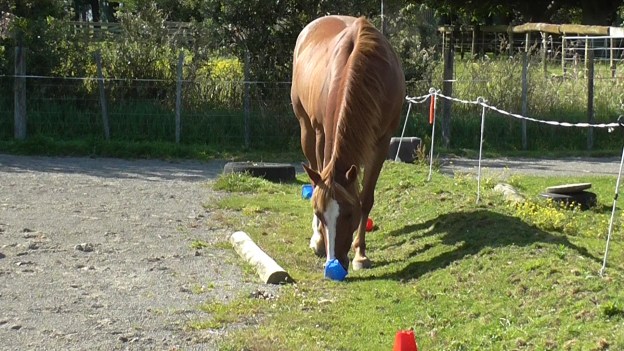
Thin-Slicing Walking on Plastic Bottles
More About Unusual Surfaces and Backing Up
Other related blogs: You can find the links easily on my Blog Contents Quick Links page.
- No. 9: Mats: Parking or Stationing and Much More
- No. 10: ‘Zero Intent’ and ‘Intent’
- No. 17: Destination Training
- No. 26: Getting a Smooth Halt in Many Situations
- No. 33: Willing Response to a Halt Voice Signal
- No. 51: Reverse Pens
- No. 68: 20 Steps Exercise
- No. 101: Precision Leading
Also, all the routines in my book, Companion Horse Training Using Positive Reinforcement, refine the skills of walking with a handler. The book works through a series of activities that require minimal equipment (set of rags and a fence). They are designed to make the horse ‘handy’ and happy following our clear body language including turns and backing up.
 herthamuddyhorse