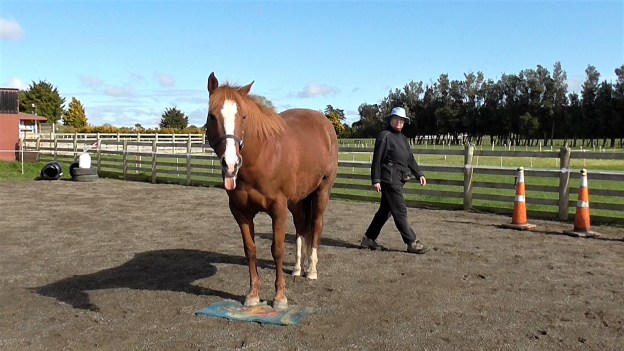
In the photo above, we are working on building duration staying on the mat while I move around. Note her ear and eye on where I am and what I’m doing.
Creating resources to help people learn more about training horses is tricky for several reasons.
When we start out with horses we learn from the people nearest us. We tend to absorb their ideas and their way of doing things.
This morning my granddaughter, almost five, excitedly brought two library books about horses for us to read together.
They were about children learning to ride and going to shows, featuring standard British riding paraphernalia and methodology.
She has been riding Boots for over a year and shows great interest in how we clean her feet and she makes a good effort at brushing her.
It was an interesting challenge for me to explain that we don’t put things in Boots’ mouth (other than food). I explained that it is easy to teach a horse to change directions with a halter or bitless bridle using clicker training, body language and words.
She is familiar with clicker training because that is all she has seen. We play games where we pretend to be either the horse or the handler.
Her question, of course, was, “Why do these people do it this way?”
All I could say was, “This is the way they were shown how to do it, but there are other ways too.”
When it came to explaining the picture with the horse who had his mouth tied shut with a cross-over noseband, I found myself lost for words. Yet in the distant past I used one of these – what was my rationale at the time? To keep the bit in place?
Thankfully, the other book she brought outlined gymkhana games that I can adapt for her and her sister to play on their next visit.

For many horse owners, especially those involved in horse sports (sport for the rider) the concept of training with positive reinforcement is still something to be discovered.
It is common for people moving toward positive reinforcement at a traditional horse facility to be mocked, told off, ridiculed, and told not to spoil their horse.
My hope is that my work helps open the door to being with horses in a way that respects their intelligence and willingness to take part in the weird things that humans expect of them.
Writing a detailed plan and keeping track of where we are in the plan, tweaking the plan as we get feedback each session from the horse and ourself, is the way forward. Below is one way of keeping a record with a 5-point outline. It can be used with anything we want the horse to master.

At the end of this blog is a video clip on the importance of setting up the learning environment for the horse.
Spiral Learning with Linear Resources
Another difficulty with teaching and learning is that usually materials must be presented in a linear manner, such as in a book, video, or online course.
However, we don’t learn in a linear way. Learning is more a spiral process. We begin and get side-tracked. As we learn more about one aspect of training horses, other things suddenly begin to make sense.
We leave a difficult task or challenge and come back to it later. As we get better and better at reading our horse, what was once a mystery becomes obvious.
We become more aware of our body language and what it might be saying to the horse, so our signals become clearer.
Realization dawns that what we thought was a simple task for the horse actually has a whole series of mini-behaviors the horse must be comfortable with before he can confidently achieve the task we want.
We move forward with our training but learn to recognize when slowing down and consolidating are more important so we can maintain the horse’s confidence and interest.
A book forces the author to present ideas one after the other. But improving handler skills and good training come about by frequent returns to revise key concepts. We learn continuously as we gain feedback from the horse and our own actions.
Each training experience gives the text of a book, or the ideas in a video, enhanced flavor because we return with different insights.
Becoming adept with this new way of communicating is an exciting business, but it takes commitment to learning new information and letting go of information and habits that no longer fit with what we’re now striving to do. It can require a significant rearrangement of a person’s belief system.
Change is always a challenge. It is especially hard if we are trying to change against the stream of what the people around us do with their horses. It takes a fair amount of belief and stick-ability to persevere to the point of proficiency when we hear unpleasant comments from colleagues.
But we can also find kindred spirits. There are equine clicker training tribes on the Internet. Facebook groups allow us to share ideas and give support to people new to clicker training.
The science behind clicker training is straightforward. All people and other animals are motivated to do more of whatever makes them feel good or gains them a reward.
However, gaining skill with the mechanics of clicker training and understanding its layers of possibilities are not simple processes.
Once the handler is proficient and the horse is clicker-savvy*, we can use clicker training to build complex chains* of behavior*. Terms with asterisks (*) are explained in the glossary you can access at the top of this blog page.
When it is truly adopted, the click&treat dynamic infiltrates every corner of the relationship and becomes the backbone of the horse’s Individual Education Programs (IEPs)*.
In other words, clicker training becomes the mainstay of a holistic approach to educating a horse to live in captivity.
 herthamuddyhorse