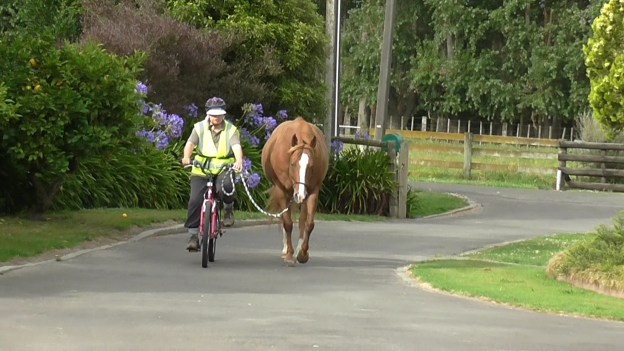
ROPES: It’s hard to overemphasize the importance of educating our horses to be totally comfortable with ropes. Our main enjoyment may be to play with our horse at liberty and teach everything using targeting, voice and gesture signals. But sadly, horses in captivity are totally dependent on people for their well-being. Other people may regularly handle our horse or something may happen so that help from other people is needed. In case of fire, flood, or if you are hurt, or your horse must be moved, he will need a solid foundation of rope confidence. If he is sold, we want him to be comfortable with ropes.
If we take our horse out into public places we need him to be relaxed on a lead rope. If we tie our horse up, we have to get him comfortable with that. Rope Confidence includes ropes moving around him, ropes constricting him and ropes touching all parts of his body. The same is necessary if you want to teach your horse long-reining and maybe driving. Sooner or later we are going to drop a rope or rein and it is better if the horse does not see this as a reason to panic, which can lead to running into or over fences, or danger on a road.
#121 HorseGym with Boots in clip called Stick and Rope Confidence shows a way to begin. https://youtu.be/WIpsT4PPiXo
There are several elements to Rope Relaxation. #22 HorseGym with Boots in a clip called Rope Relaxation shows some of the elements mentioned in the list coming up. https://youtu.be/6Y34VlUk0Iw
We want to gain the horse’s confidence to remain parked while we do the following activities.
- Swing a second rope (not attached to the horse) near him.
- Gently toss the end of a soft rope all over his body, including around behind, under the belly and around the legs. It should feel like horses standing tail to nose swishing flies off each other with their tails. Start with a second rope not attached to the horse, then graduate to using the end of a long lead rope.
- When the rope is attached to the horse, make sure you keep a constant drape in the part attached to his halter while you toss the other end around his body. You want to avoid putting touch pressure on the halter.
- Toss a coiled rope (not attached to the horse) in the air across him.
- Randomly drop a coil of rope (not attached to the horse) onto the ground in various positions around him.
We also want to continue building his confidence with the rope when we:
- drag a second rope while we walk along with the horse on a loose lead as in the second video above.
- attach a second rope to the horse’s halter which he drags while we walk with him on a loose lead, including walking curves and corners where the dragging rope may touch the horse’s feet or legs, as in the second video above.
- If the horse has reason to move when his rope is attached and dragging, we want him to be calm about it.
- And eventually, with careful shaping, we can leave the horse ground-tied in different situations.

I’ve created a reason for Boots to walk forward dragging her rope on her own, so if she is ever in that situation, it is not unfamiliar.
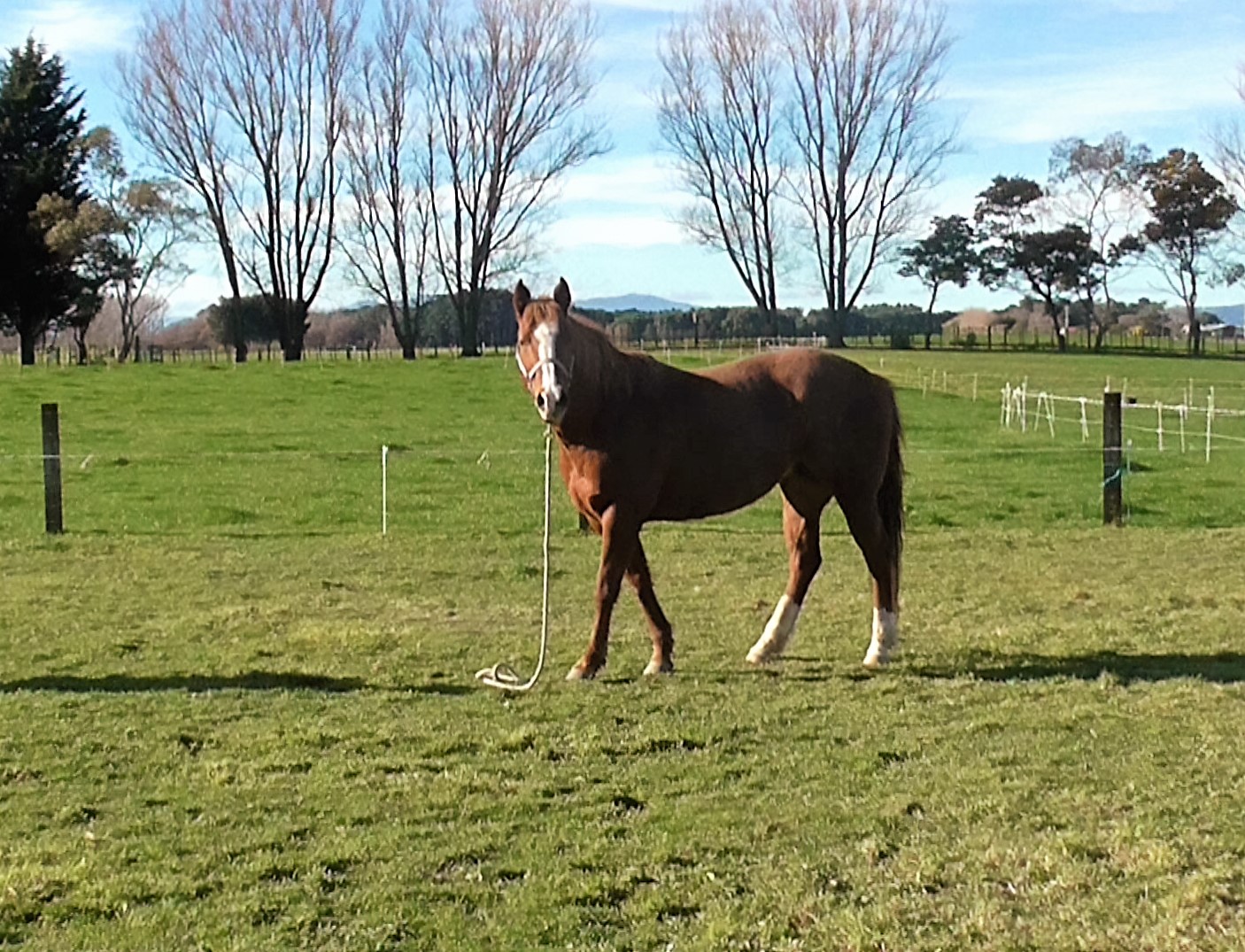
Eventually we can practice ground-tying in different situations. The dropped rope and the gesture/verbal WAIT signals tell her that staying in place will eventually earn her a treat.
Here is the link to the complete ‘Ground Tying‘ BLOG: https://herthamuddyhorse.com/2019/10/31/ground-tying/
 herthamuddyhorse