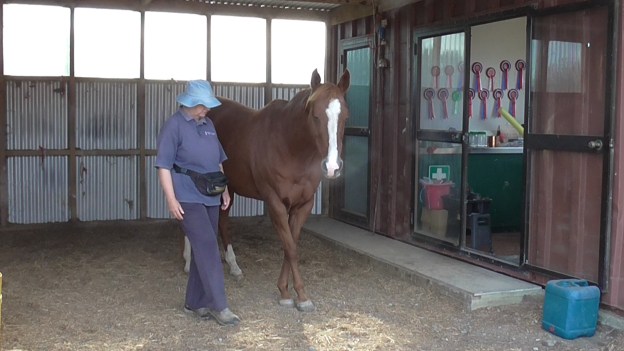
In the photo above, Boots demonstrates how aware of, and responsive to, a horse can become if our body movements are taught and used with total consistency.
During everyday management of our horses, basic care or getting them ready for a walk or ride, we tend to move in and out of their personal space without thinking about it. When we do ground work, we move into and out of various positions as part of the signals we are giving.
Sometimes we forget that horses notice everything. If we can learn to become more conscious of our positions, we can use ‘position’ as part of our communication package.
If we are aware of, and consistent with, our relative body position, the position itself can become the signal if the horse is closely tuned-in to what we are doing. The horse will become more and more mentally connected to our intent. If we are totally consistent, it will seem as if the horse is reading our mind.
We can approach everything we do with one of two mind-sets. We can see horse behaviors we don’t want as dark problems we have to ‘fix’ or overcome. Or we can recognize that a horse always does what he feels is best at that moment. We can enjoy the challenge of creating a relationship with such a sensitive being by gradually building a mutual communication system.
By increasing our spatial awareness, our signals can become much lighter. The horse begins to find staying ‘in tune’ with us much easier because our body language has less ‘static’ or ‘background noise’ in it.
The more we can eliminate meaningless movement (and chatter), the clearer the horse will find our communication.
Expanding our Concept of ‘Leading’
We can expanded our concept of ‘leading’. When we think of someone leading a horse, we usually visualize a person walking beside a horse or in front with the horse closely behind.
We usually see a lead rope as part of the picture. But when we begin to think deeply about ‘leading’ it is easy to see that there is much more involved.
We can enlarge our concept of “leading” to encompass all the ways that we influence where the horse puts his nose or his feet. That is, when we want to make our idea his idea.
We can be on the ground, riding, using headgear, a neck-rope, or have the horse at liberty. We can be using any combination of body language, shifts in our weight, changes in orientation, rope/reins, and voice. With clicker training, we use a marker signal plus a treat to ‘capture’ or reward specific behaviors that we like.
In other words, everything we do when we want to influence the horse comes under the umbrella of ‘leading’.
We might:
- Call him out of the paddock.
- Ask him to wait while we go through a gate first.
- Ask him to offer his head for haltering.
- Ask him to back up out of our personal space.
- Pick up a foot to clean it or trim it or dress a wound.
- Ask him to step on, over and across unusual surfaces.
- Ask him to step into and out of a tight spot like a trailer, lane, or water.
- Ask him to move away from us as in circle work with a reverse round pen or playing at liberty.
- Ride, or drive with long reins.
- Ask him to stay tied up or parked.
- Guide him through an agility obstacle.
In simplest terms, any time we want the horse to do something specific with his nose or his feet, we are ‘leading’ him. ‘Guiding’ may be a better word. We are orchestrating his movement, or lack of movement if we need him to stand still.
There are eight key leading positions which can be static or dynamic. They may flow into each other as we make a request, the horse complies, and we move or stand quietly together.
Horses value clarity of intent. They generally are happy to comply as long as they can understand what we want and we make our request politely and reward a positive effort.
Doing things with our horse is comparable to being on a sailboat. At every moment the sailor is conscious of the wind, the waves, and the relationship of his sails to how the boat is responding. He makes constant adjustments to keep his boat sailing smoothly.
Every moment we are with our horse, we need a similar consciousness of the immediate environment, the distant environment, how we are asking the horse to do what we want and how the horse is responding to our request.
We have to quickly compute the horse’s large responses, plus the nuances of his body language, so we can gauge his emotional, intellectual and physical comfort at the moment. As we get better at seeing all these things, it becomes easier to know the best way forward to yield the result we want.
Pictorial Summary of Eight Leading Positions

Leading Position 1: The horse is in relaxed mode on a morning walk. I carefully keep a drape (smile) in the lead. This is how horses in a herd follow each other during quiet movement from A to B.

Leading Postion 2: Horse keeps his nose and eye just behind the handler’s shoulder.
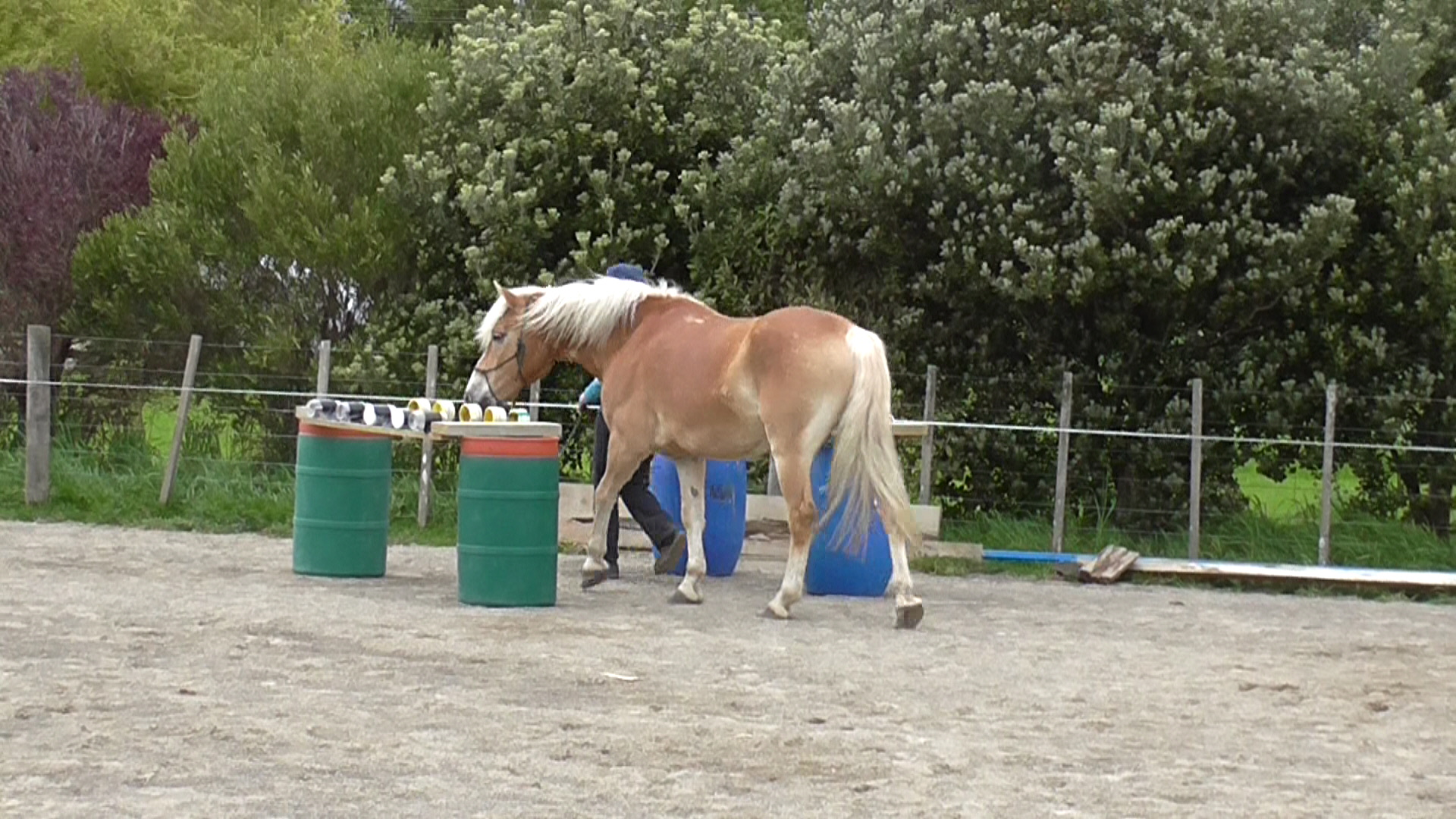
Leading Position 3: Anywhere between the ears and the shoulder. A versatile position that we can use as our basic leading position for all kinds of things.

Leading Position 4: Behind the withers, alongside the ribs. This position has the horse moving out in front of us like he will be if we ride . Horses used to following behind can find this difficult at first, so we teach it en route to a stationary target where he knows he will earn and click&treat.
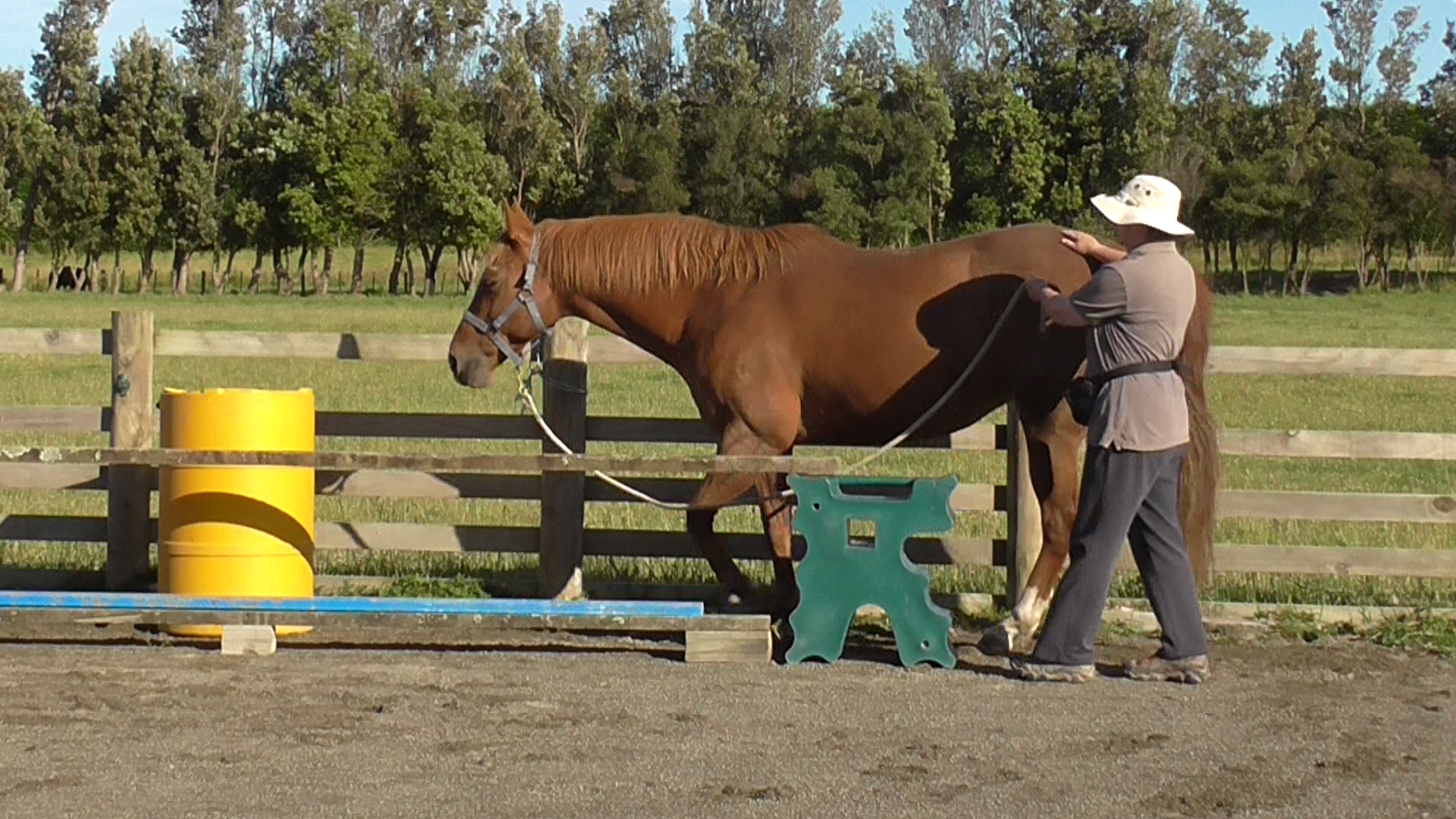
Leading Position 5: Beside the horse’s hindquarters. If the horse knows a touch signal on his butt as a ‘walk on’ signal, we have a way of sending him in front of us into a narrow space like a trailer or a gate. Again, teaching this first with a well-known stationary target makes it easy for the horse to understand our intent.
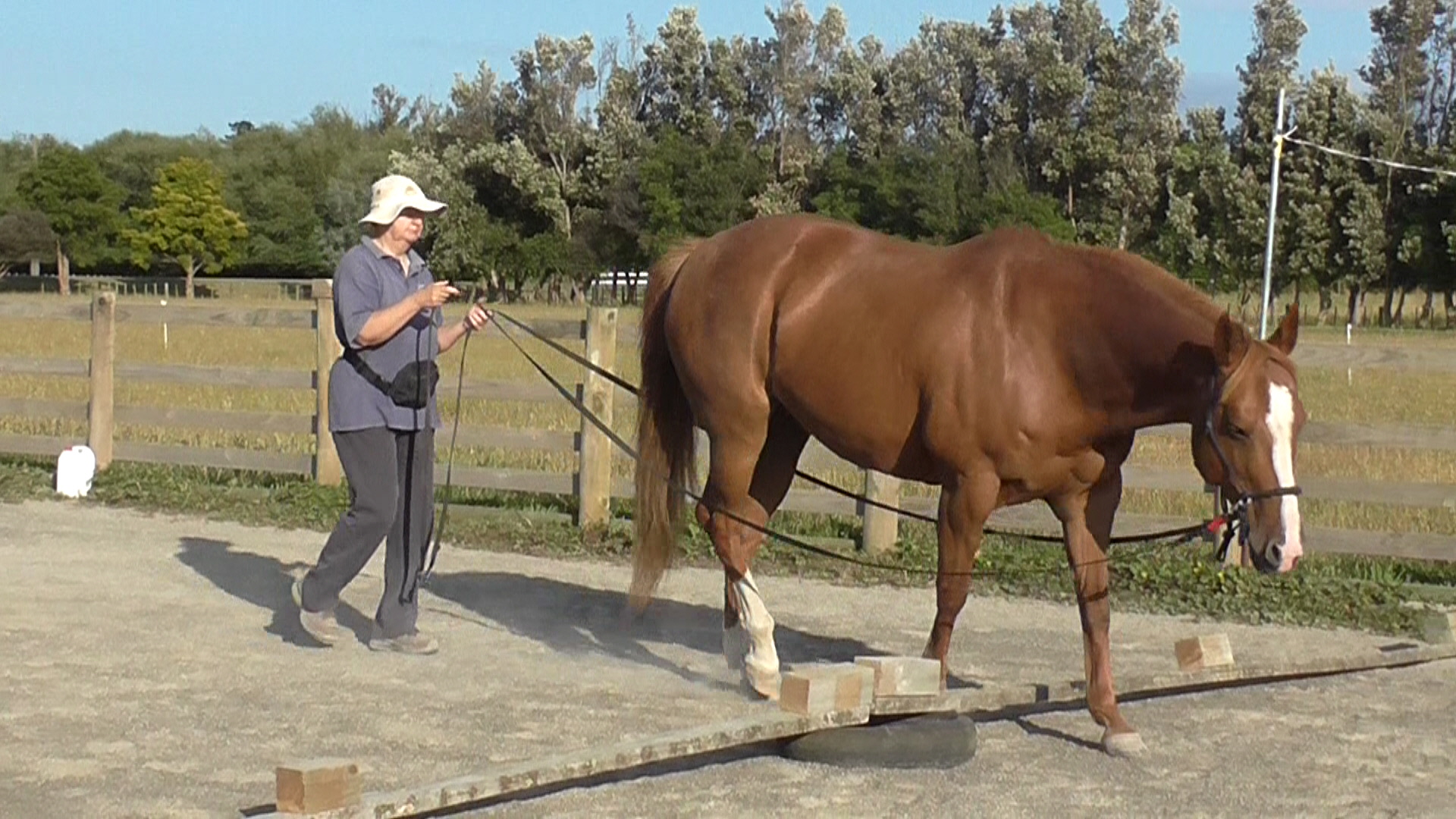
Leading Position 6: Behind the horse: Long-reining is a superb way to teach the horse all about turning and backing signals applied to his head gear via reins from behind, before adding the complication of a rider.
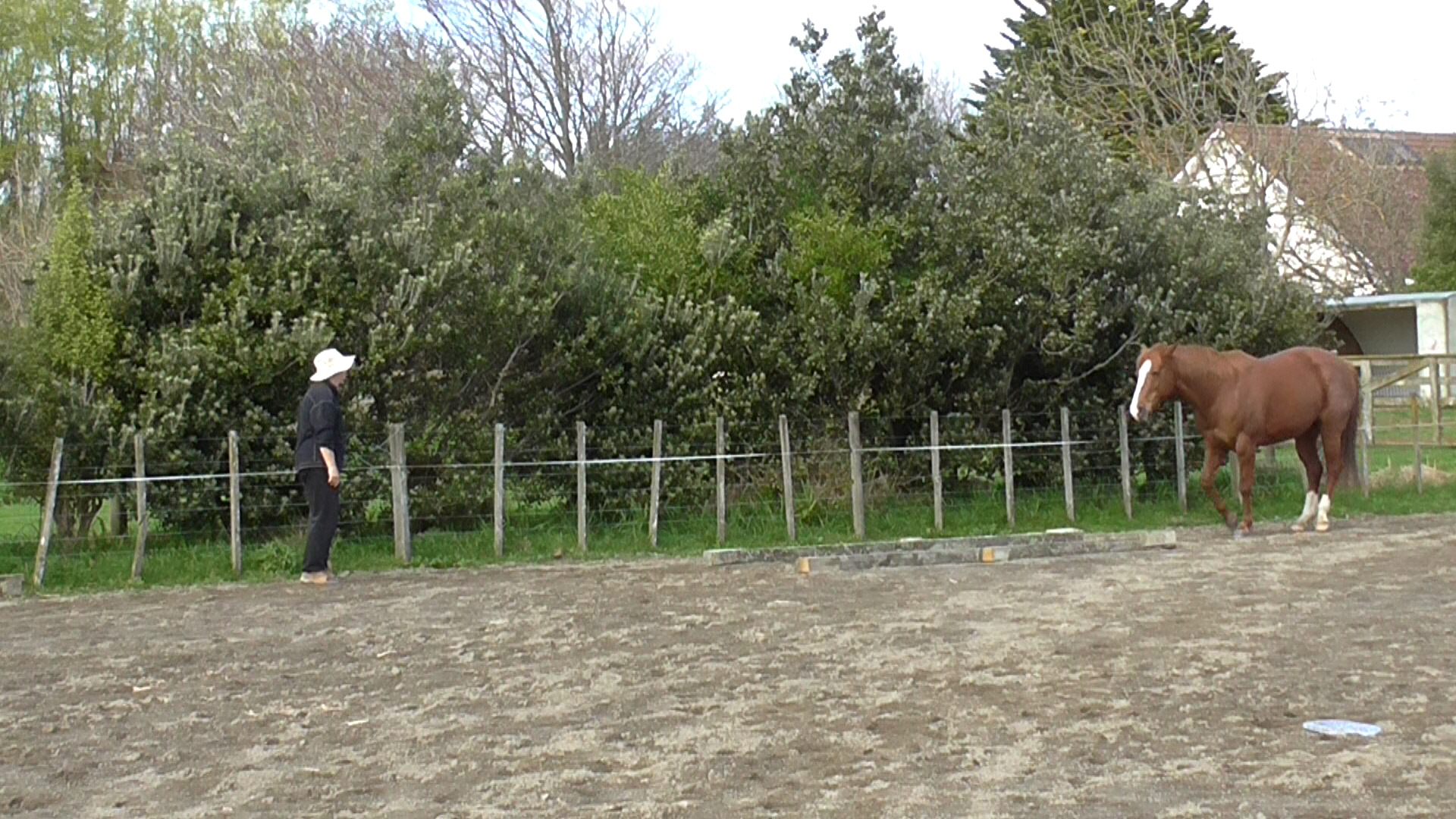
Leading Position 7: Face to face: I asked Boots to wait so we could do a recall. She is just beginning her recall. We also use face to face when we want the horse to back up away from us.

Leading Position 8: Facing the side of the horse. I’m in relaxed mode while waving the flag over her for a Horse Agility task. She is more interested in what is going on next door. Obviously grooming and foot care, tacking up and mounting also require this position.
Conclusion
An awareness of leading positons allows us to include ‘position’ as one of the key elements of any signal we use to communicate with the horse. By dissecting each leading position we can see the training possibilities it presents.
We often drift from one position into another without realizing that the shift can have a lot of meaning for the horse.
 herthamuddyhorse
I worry about using a long stick for tapping or influencing the horses movement. Does it create instinctive anxiety in the horse even if it’s never been used as a whip?
LikeLike
Hi Susan,
In my experience, horses see any sticklike object we may carry as just a body extension. They have their own body extensions they can use as they deem necessary – neck, swishing tail, striking front leg, kicking hind leg. Extensions they use to communicate with herd members.
I think that the horse reads the intention behind the body extension. We can use it for rubbing or scratching an itchy spot or to make our intent clearer with a large gesture or a light tap. Above all, I think horses value clarity of meaning. If the stick signal is removed as soon as the horse complies, all is good.
Which is not to say that a horse can’t have been traumatised in the past with whips and sticks, leaving a long-term fear. But if not traumatised, there is usually no problem unless we create one.
Hope that helps.
Hertha
LikeLike
Thank you so much for your thoughtful reply!
LikeLike