
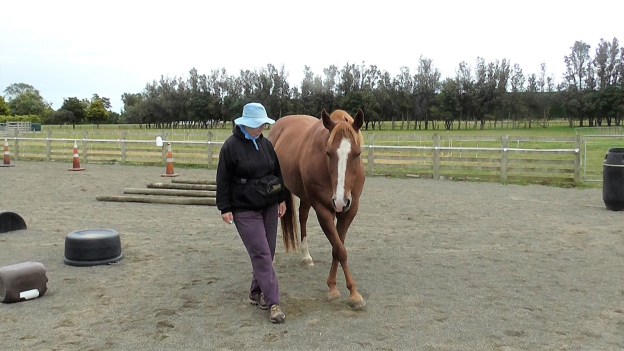
Photo: I’m teaching my horse, Boots, to back up to a mounting block. My parameters include backing straight (hence the guide rails for this early lesson), backing for 6-8 steps (she started at the fence on the right) and halting with her withers just in front of the two tubs. This time she moved back an extra step, but it was a very good response for early in the training of this task. I’ve stepped off the black tub so I could deliver the treat while she stayed in the position I wanted.
Parameters: Setting the Rules for the Games we Play
Because of their role in the web of life — to be a meal for predators — horses are so much more observant than we are. They read our mood the moment we appear. They read our body language with exquisite care. When something in the environment is different from last time, they notice instantly.
If we want to become good at communicating with our horse, it helps to become more aware of what our mood, our body orientation and our body energy may be saying to the horse. Horses get confused and worried when our body language does not agree with what we are asking them to do. Or if we use a similar message to mean two different things.
As horsemen often say, “Nothing means nothing to a horse”. So if everything means something, it is good to be aware of the parameters we are setting when we interact with a horse. Here is a bit more detail about what parameters are, and things to remember to become better teachers for our horse.
A parameter is something we decide to keep the same or constant.
For example:
- Walking on the horse’s left side would be a constant or parameter you have chosen.
- If you then change to walking on his right side, that is a new parameter.
- If you decide to walk beside the horse’s ribs (where you will be if you ride) rather than beside his neck, you have changed a parameter.
- If you decide to walk behind the horse rather than beside him, you have changed a major parameter.
- When you ask the horse to walk with you on the road rather than at home in his paddock or arena, you have changed a major parameter.
- Walking on an unfamiliar road or track is changing a parameter.
- If you are walking together toward a familiar destination, where he knows he will halt to earn a click&treat, the first time you ask him to halt before he reaches the destination, you have changed a parameter.
- If you are walking and change to asking for a trot or jog, you are changing a parameter.
Whenever we change a parameter, it is important that we increase the rate of reinforcement (i.e. click&treat more often) and work our way forward again until we and the horse are both confident in the new situation, with one click&treat at the end of a task or a series of tasks. For example, relating to the photo above, once Boots confidently backed up in a straight line to stand between the two tubs, I removes the rails (one at a time) and ask her to back up for just a step or two, then work forward again to get 6-8 steps straight back.
Horses are super observant of all changes, large or small, and can often be ‘thrown’ by them if we proceed too fast or ask for too much too soon. They also immediately pick up if we are unsure about what we are doing.
This is why it’s important to have a written Individual Education Program suited to this horse in this environment before we delve into teaching our horse something new. If we are clear in our mind about what we are working on, that confidence will be picked up by the horse.
If you want to look at 20+ training sessions to achieve the objective outlined in the photo above, done at liberty with no extra props, here is the link to the very first session (lessons were mostly one a day, weather willing and lasted about three minutes each day). I can’t ride any more (dodgy hips & knees) so we did this as a just an interesting training project. The second video clip below takes you to the last clip in the series, in case you don’t want to see all the others in between!

 herthamuddyhorse