
Free-shaping means clicking and treating the moment the horse naturally displays a behaviour you want to encourage. The click&treat encourages the horse to repeat the behaviour that earned the treat.
The first free-shaping exercise most handers use is to hold (or set) out a target and wait for the horse to investigate it with his his nose = Click&Treat. Most horses pick this up quite readily. Many equine clicker trainers use it to teach their horse the meaning of the ‘click’ or whatever marker sound they are using. My older mare (with a chequered background before I got her) took nine short sessions over a week before she made the connection between her nose touching the target, the click, and the treat that followed.
Because it is the horse’s choice to do the task, they learn it readly because it was their idea in the first place. It gives them a sense of ‘agency’ – being in control. Like us, horses like to be in control of their lives.
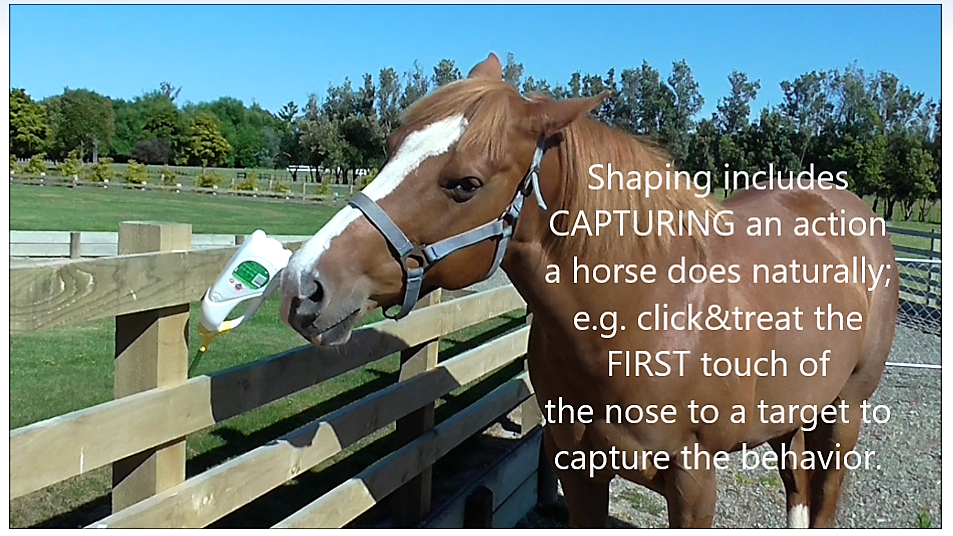
Boots has to her nose on a stationary target. I clicked as her nose touched it and I walked to her to deliver the treat. Once the horse loves to do this for a click and treat, we can put such objects all around our training area and walk or trot between them to earn a click&treat at eachone. Also useful for ‘destinations’ when we begin leaving home. We can use destinations for groundwork and riding.

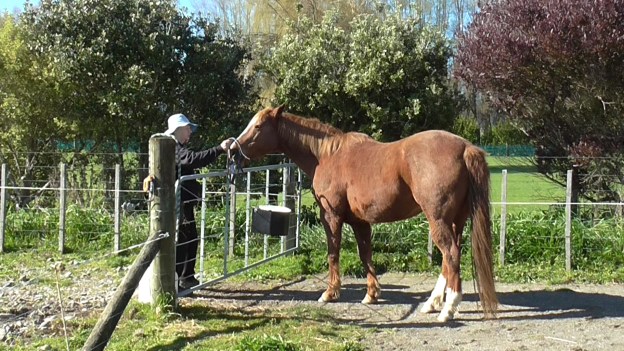
Using a hand-held target, It’s always wise to start out with ‘protected contact‘, i.e., the horse on the other side of a barrier. Until we begin clicker training, we have no idea how the horse will react to food treats from our hand. This is also the time to try out different treats .
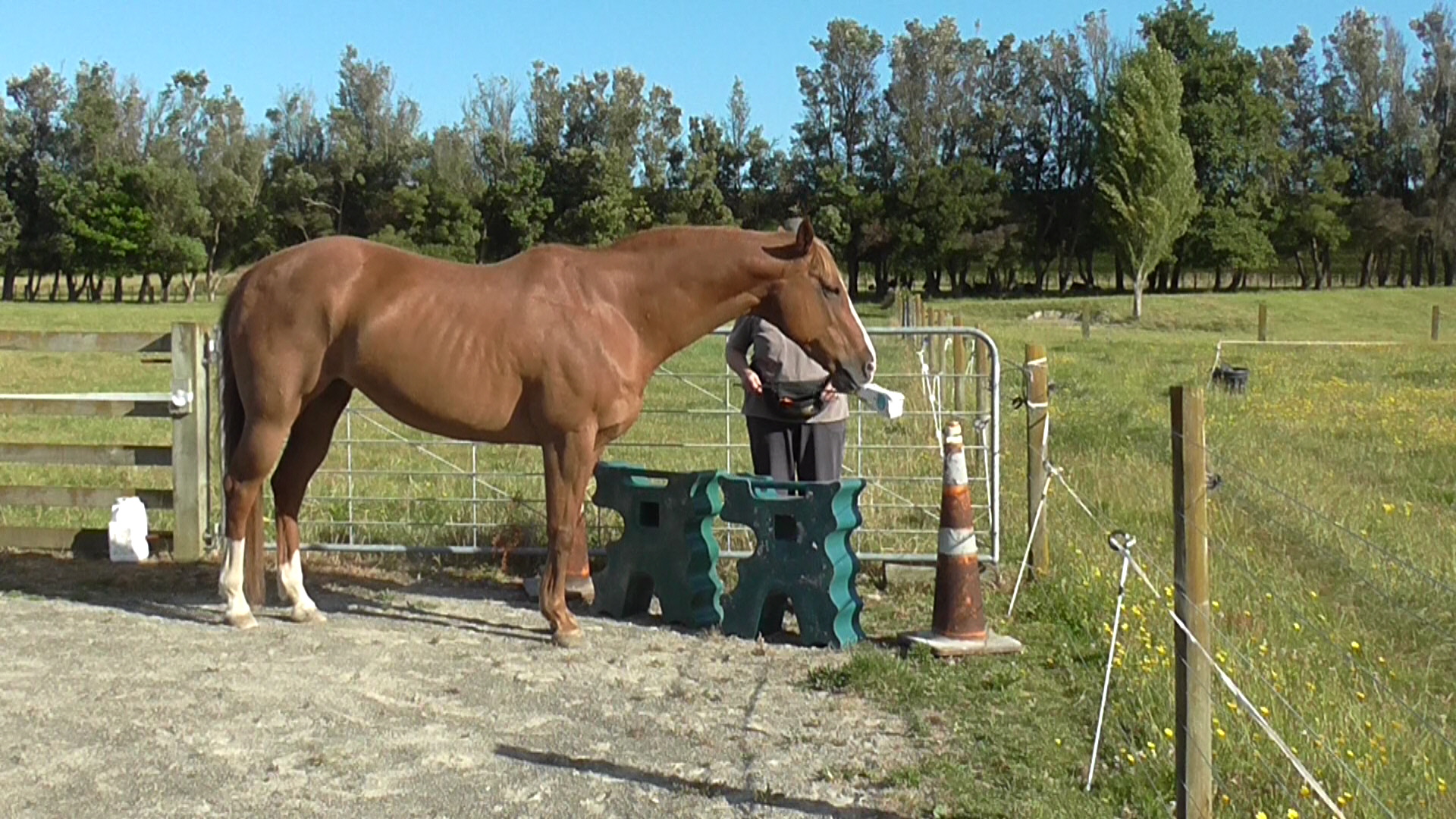
Here I’ve created a barrier in a corner, which is another option if you don’t have a suitable fence handy, but with a new horse – maybe make the person’s space a bit bigger!

Your safety barrier for PROTECTED CONTACT does not necessarily have to be fancy.
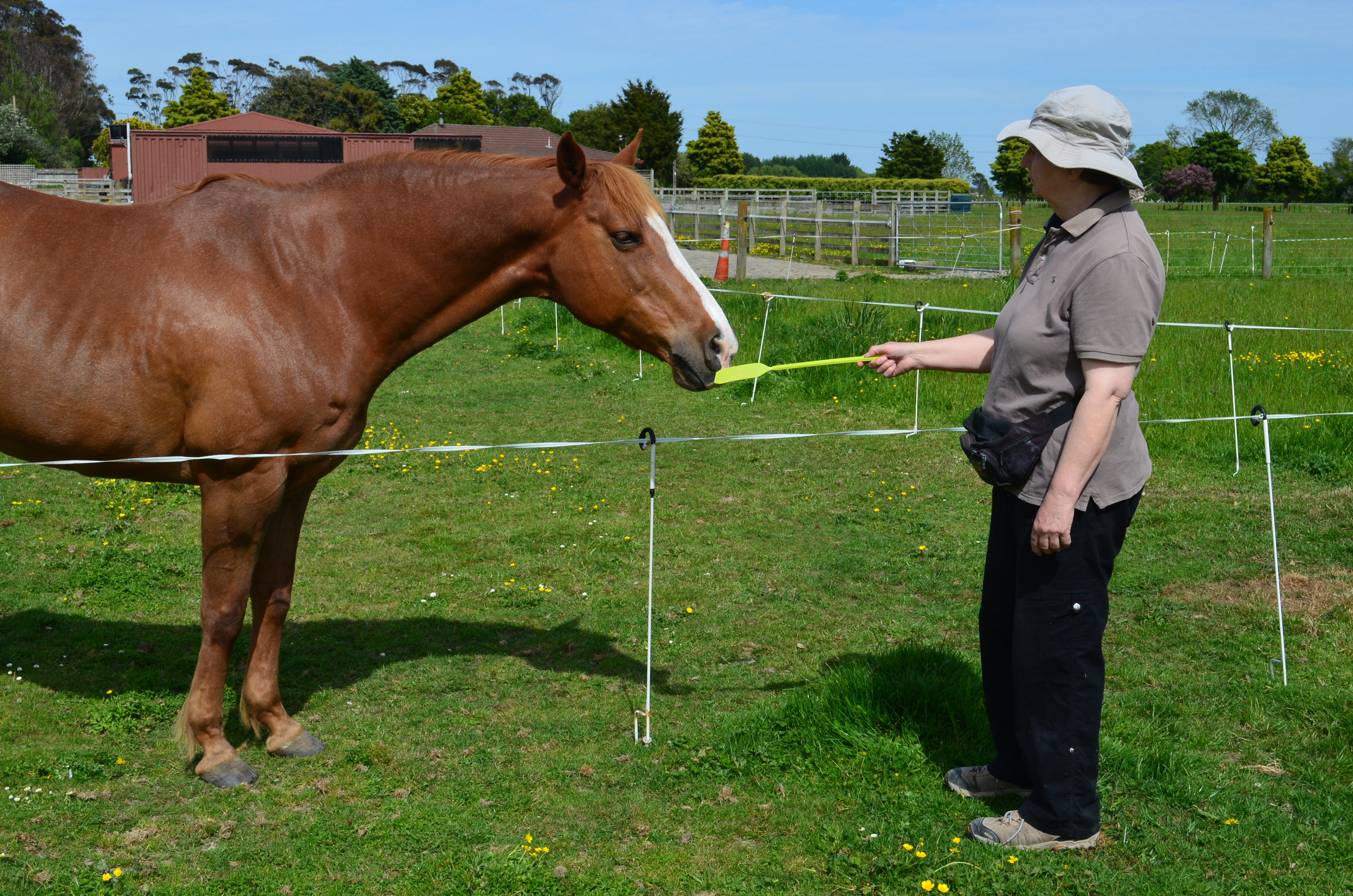
If you can use electic fence tape for training, make sure the power is turned off during training time.
In this clip, I’m free-shaping head lowering.
Eventually we added a verbal signal, and a body language signal, so when I bowed, she bowed.

The following clip shows an alternative to hand-feeding while teaching the TARGET = CLICK = TREAT process.
In the next clip, I free-shaped step aerobics.
In the next clip we are doing the 20 Steps Exercise. Depending on your starting point, it could take a few or many short sessions to get 20 smooth steps with one click&treat at the end. All you need is for the horse to willingly walk one step with you, click&treat, and work forward from that.
The next clip is a very early lesson in free-shaping Boots’ confidence moving along with a bicycle.
The following clip with the bicycle is much later.
The next clip is a demo of tummy crunches.
I learned this from Alex Kurland.
1. I began with the horse behind a low barrier. I stood at neutral (zero intent = Number 10 in the Blog Contents Quick Links) and watched casually (not staring at the horse) with a relaxed stance, watching to click&treat any upward or backward shift of weight.
2. I did this IN THE SAME SPOT for a minute or two once or twice a day, mainly right before afternoon feeding time. And as a ‘last thing’ at the end of a play session. Having usual times in the same place seems to make the horse look forward to having ‘another go’.
3. Once we were getting a purposeful weight shift back because she realized that’s what earned the click&treat, I sat down to bring the horse’s head a bit lower. Previously we had ignored head position as the horse was experimenting with different possibilities. When I sat down, she lowered her head position because the treats were offered lower. This developed over months and months.
4. At some point, the crunches became a part of her personal repertoire because she would offer them if she wanted to initiate an interaction. At this point I added a verbal signal/cue.
5. I’d never do more than about what is on this clip at one time.
6. Eventually I could ask for the crunches standing her shoulder, her butt and behind her, using the verbal signal (zzzip) plus my body language of leaning backwards. We had such a long and strong history of reinforcement that she readily adjusted to my different positions. She happily did it with a rider aboard as well.
Free-Shaping Boots doing a STRETCH:
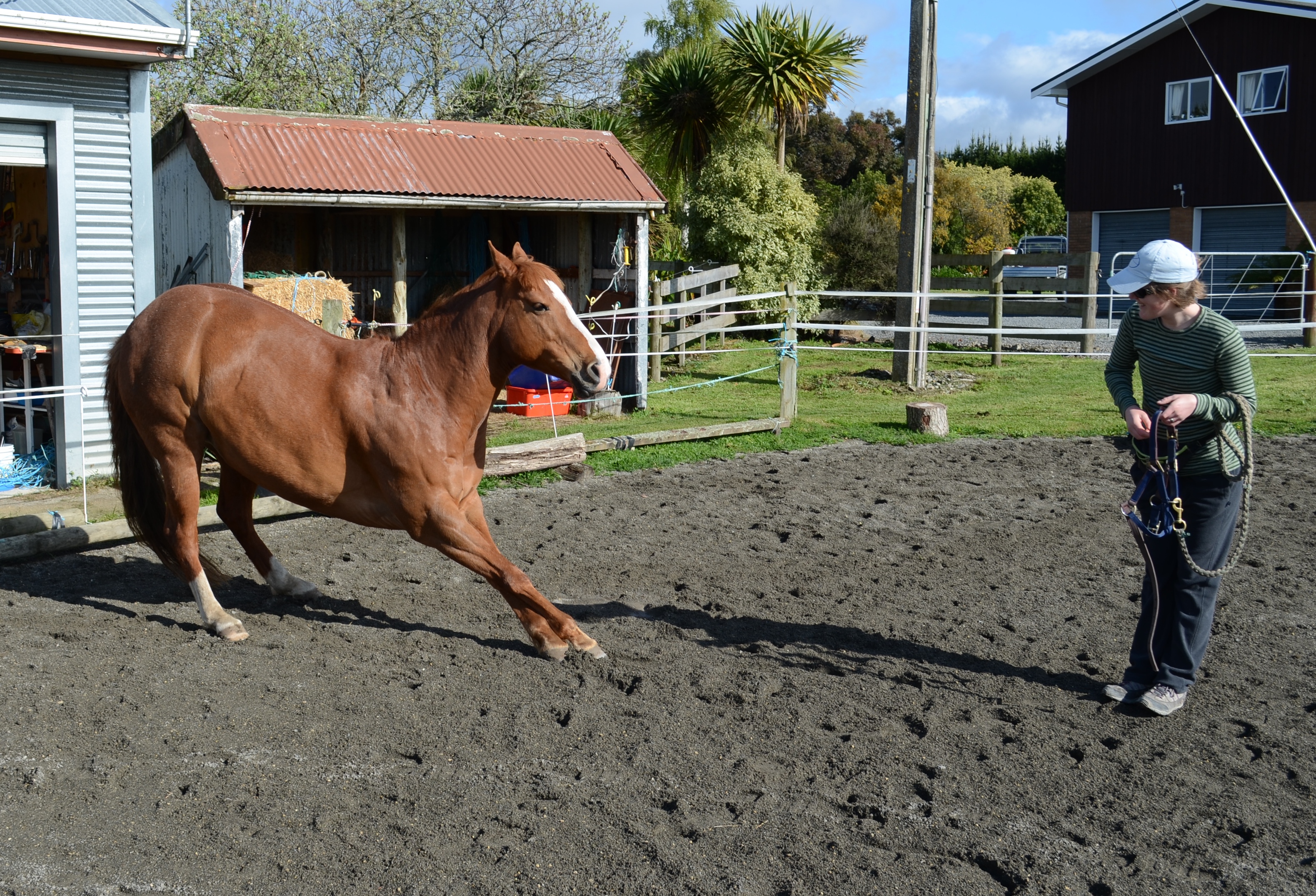
Once Boots realized that her ‘downward dog’ stretch earned a click&treat every time she did it, she offered it frequently. I initially free-shaped it by noticing that she often stretched like this after getting up from a nap. I managed to ‘capture’ the behavior two days in a row, and she then began to offer it often enough so I could put a verbal cue to it – ‘Stretch’.
What sort of things have you free-shaped?
 herthamuddyhorse