Tag Archives: horses

Leading Position 4 – Beside Ribs

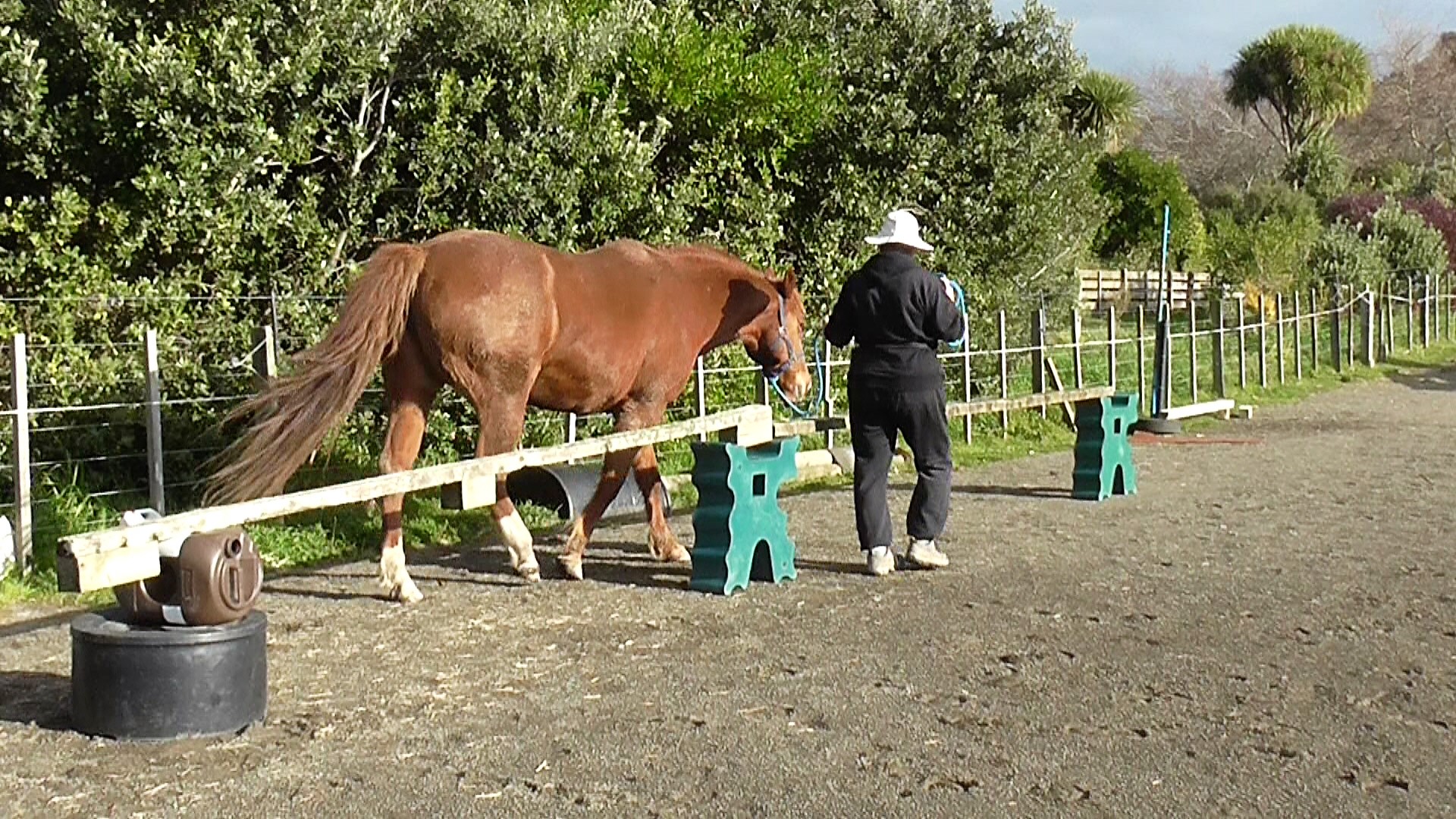
If we have first taught and consolidated and generalized Leading Position 3 (beside neck/shoulder), it’s usually easy to move from LP3 into LP4 (beside ribs).

This leading position encourages the horse to move with us with his shoulder well out in front. The handler is where he or she would be when riding. In fact, riding is Leading Position 4 sitting on the horse rather than walking on the ground with him.

I sometimes use a body extension to clarify the task for the horse from a distance. A light touch signal just behind the withers for ‘walk on’, (as well as all the ‘walk on’ body language – big breath in & raised energy, step off with outside leg, voice cue) helps to make our intent clear – ie. we want to stay beside the horse’s ribs while we walk along together. The other use of a body extension is to indicate, by bringing it forward, that we don’t want the horse to turn toward us, but to walk on straight.

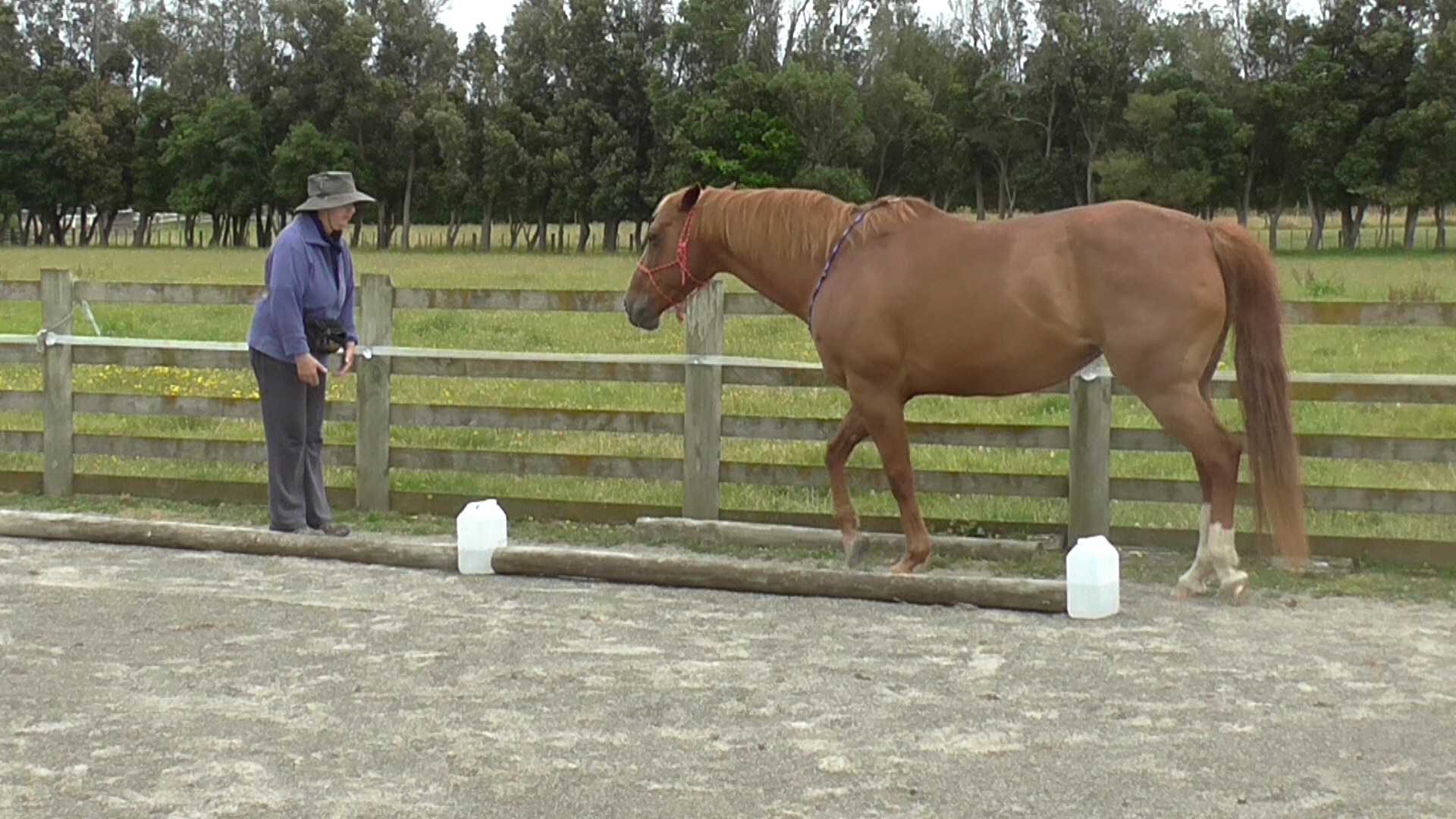
We also ensure walking straight by using a lane (horse in the lane, handler outside the lane) and by walking in straight lines between a series of targets. Once the horse understands the task, a small finger tap behind the withers and our voice signal, are usually all that is needed.

to summarise, if we have taught the horse that a tap behind the withers (with our fingers, eventually phasing out the body extension), the tap, a deep breath in and a voice ‘walk on’ – are all signals to move forward, these will continue to make sense to the horse when we mount up if we intend to ride.

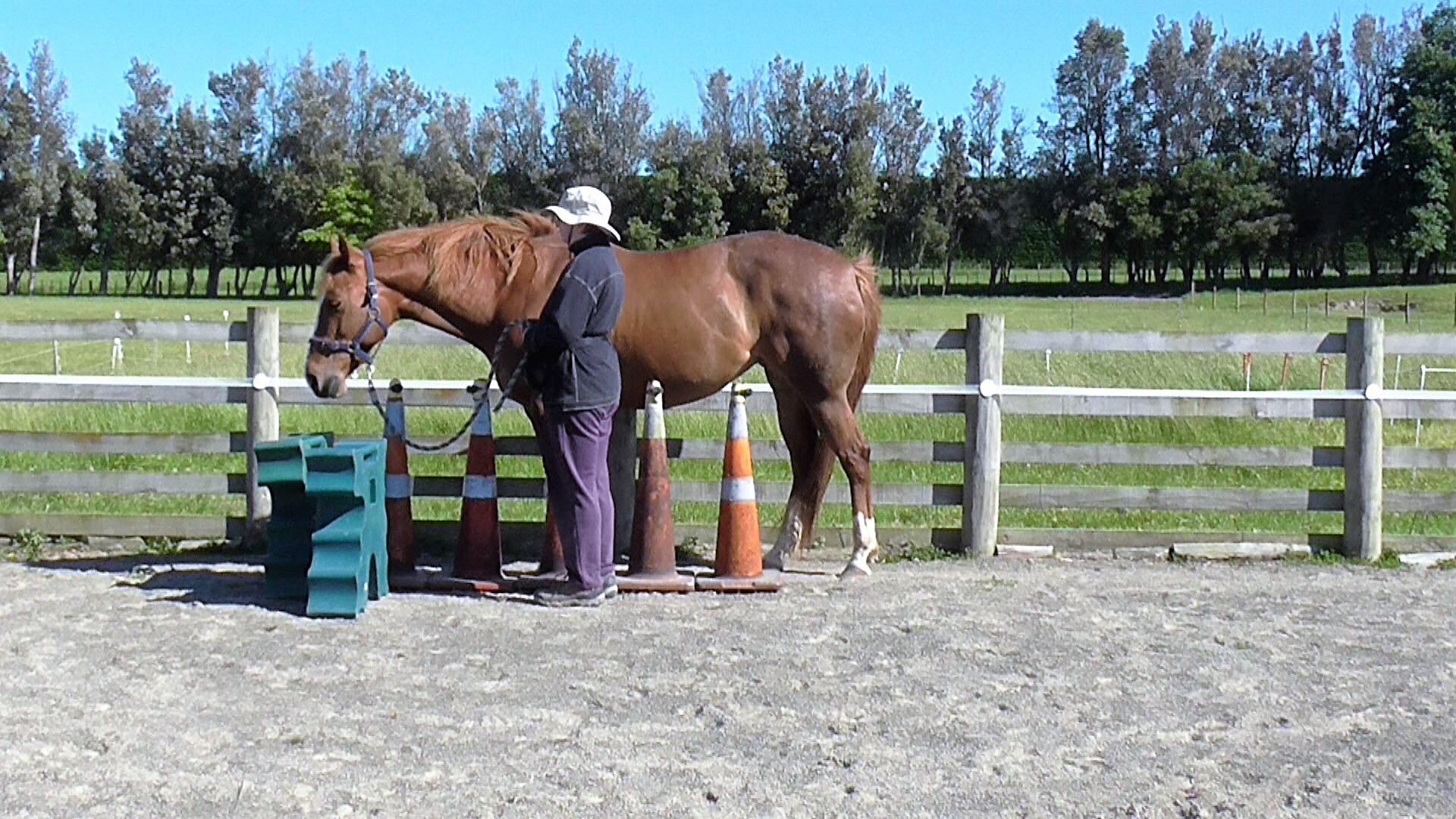
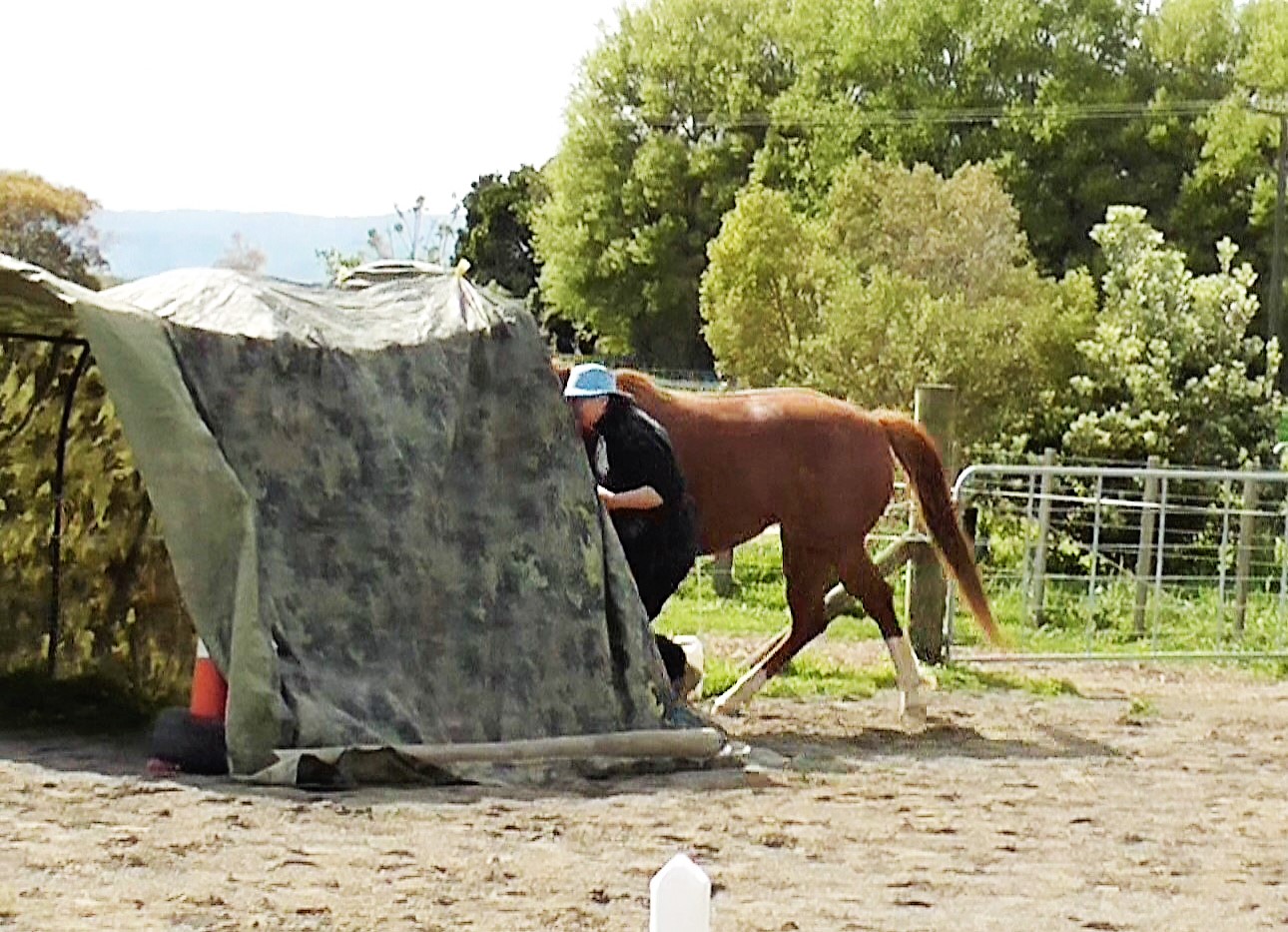
The main concern for the horse when we ride is that most of our body language suddenly becomes invisible to him. Here Boots is intent on targeting the body extension which I’ve left on the ground.

The rider suddenly disappearing from view is a big deal for horses because horses are, by nature, strongly tuned in to visual body language. Body language plays a key role in equine culture. An empathetic trainer will give the horse ample time and opportunity to adjust to the new touch and weight shift signals, plus the many balance adjustments that the horse has to learn.

Riding has us in Leading Position 4, behind the horse’s withers. If we teach moving forward in this position on the ground, we are building the horse’s confidence in having half his body out in front of us. For timid horses, this can be challenging. The cues/signals we teach on the ground will stand us in good stead if we intend to ride. If we are working with a young horse which will be ridden, this training gives him a major head start with the ridden experience.

Training Plan 18

Aim:

To have the horse comfortable walking along with the handler when the handler’s position is behind the horse’s withers, alonside the horse’s ribs.

Environment:

  • Horse in an area where he is usually relaxed and confident.
  • Herd buddies not able to interfere but in view if possible.
  • Horse in a learning frame of mind.
  • A safe stretch of fence or a waist-high lane.
  • Series of destination mats or nose targets for the teaching phase, .
  • Body extension to clarify signal as necessary.
  • Halter and lead.

Slices:

See clips #55 and #56 in my HorseGym with Boots playlist. Clip 55 also looks ahead to when we want to walk alongside the hindquarters, which is the topic of the next blog.

Click here for Clip #55.

Click here for Clip #56

  1. Ensure the horse is comfortable walking between you and a safe fence (or in a lane) in LP3 (beside neck/shoulder).
  2. When the horse is relaxed in LP3, glide back so you are walking just behind his withers. After a step or two, relax (click&treat). Be sure to let the lead rope flow out to keep a float (smile) in it as you drift back, so you don’t give him a ‘slow down’ text message up the rope without realizing it. Move promptly up to the horse’s head to deliver the treat so he is not tempted to turn toward you. Walk on again in LP3 and glide back into LP4. It can be quite difficult for us to remain in LP4. For some reason, most people, including me, have a tendency to creep up toward the horse’s neck and shoulders.
  3. This smooth letting out of the rope is another skill it’s good to practice first with another person standing in as the horse.
  4. Repeat 2, adding a few more steps in LP4 each time before you relax (click&treat).
  5. If we are working along a fence rather than in a lane, using a body extension makes it easier to keep our position behind the withers because we can bring the body extension forward to gently block any tendency to turn toward us. The instant he goes straight, put the body extension back in neutral by your side or lying lightly behind the horse’s withers.
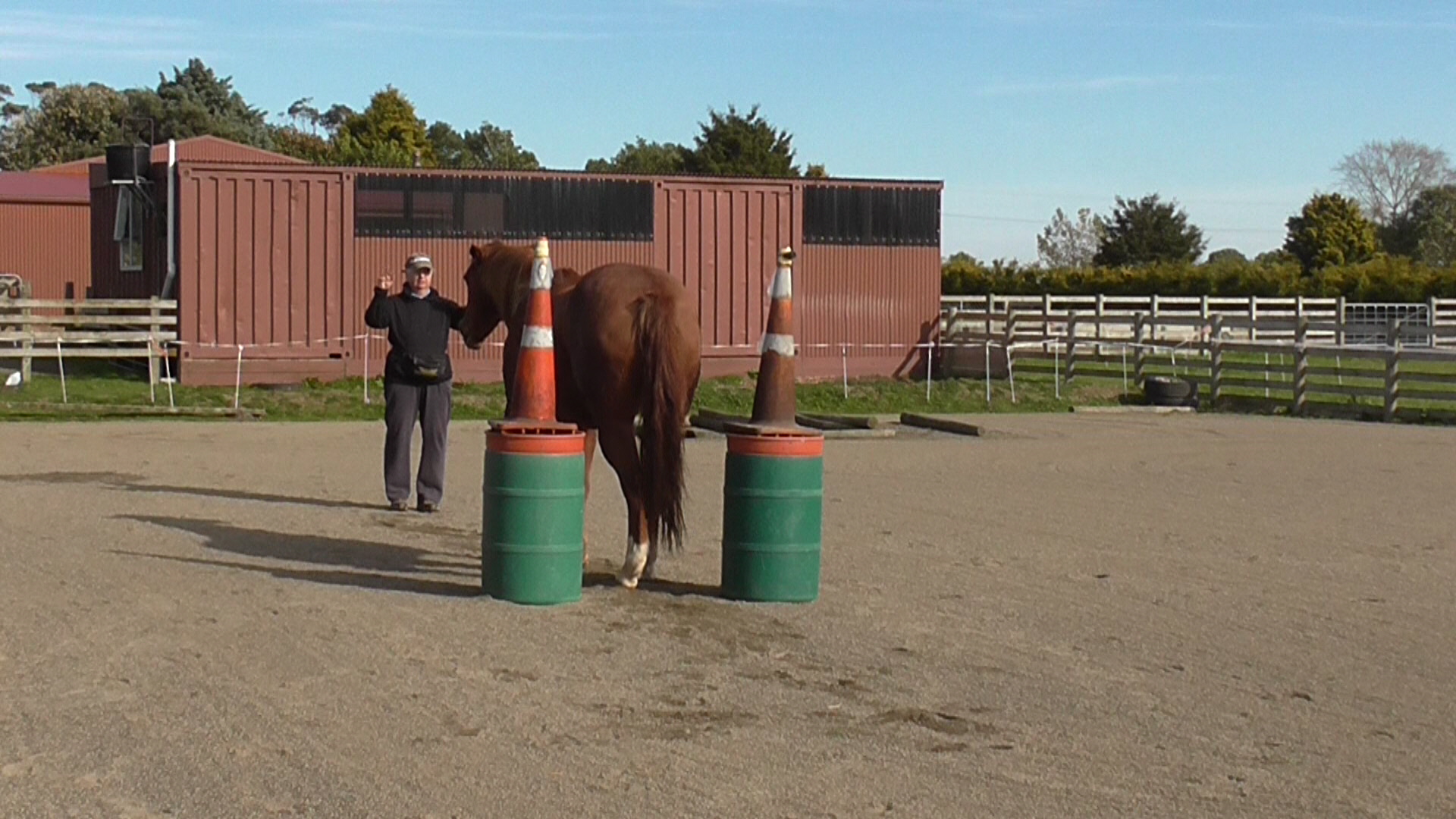
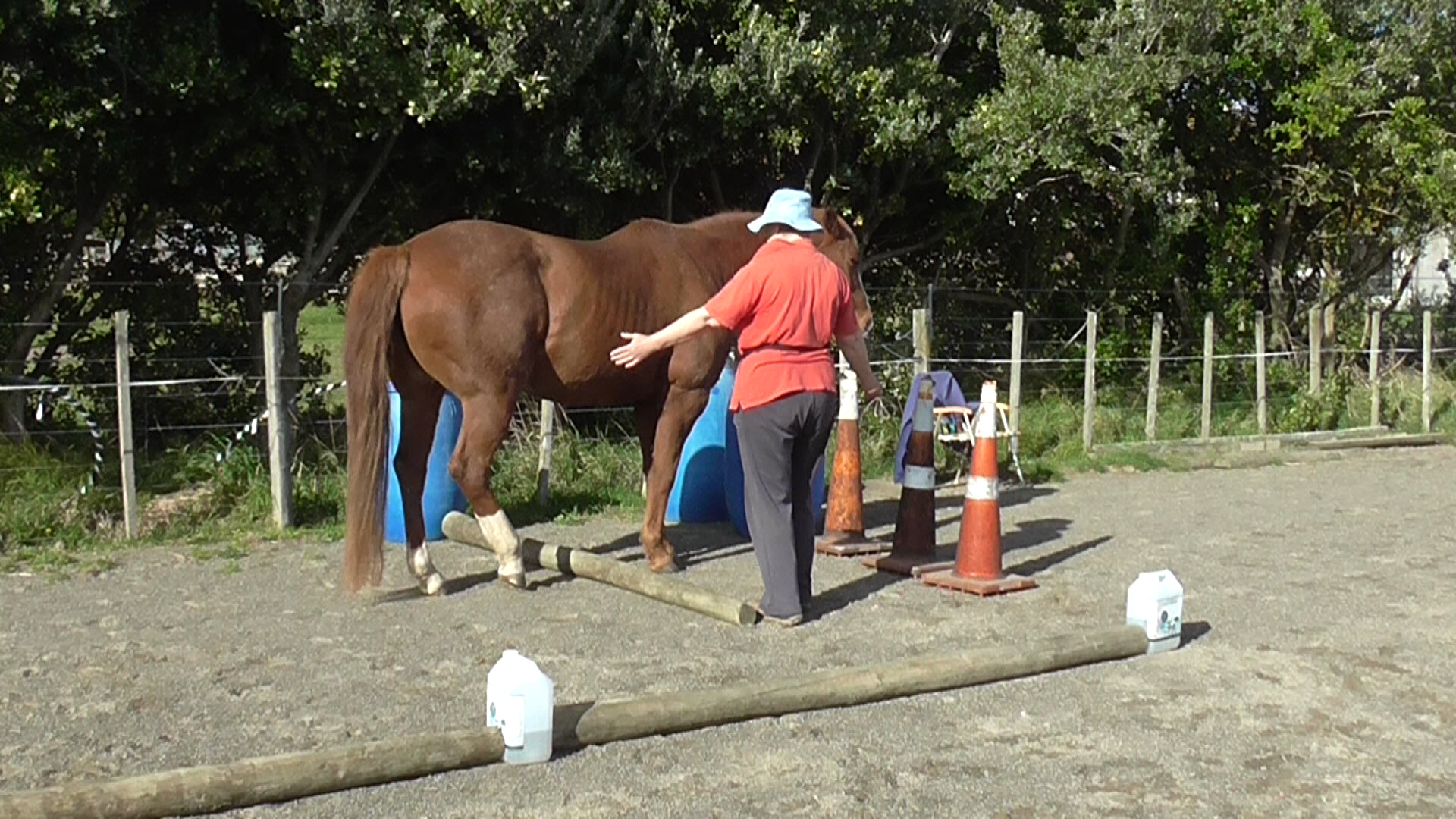
  6. It can help to keep our hand behind lying gently behind the withers as we walk with the horse, as Bridget is doing in the final photo of the blog. This might not be an option if the horse is very small or very tall.
  7. If you use mat or nose targets, set these out and ask the horse to walk between them, stopping for a click&treat as he reaches each one. Return to LP4 after delivering each treat and ask for the ‘walk on’ with a gentle tap behind the withers.
  8. If the horse tends to move his shoulder toward you rather than stay straight along the fence, use your body extension to disturb the air alongside his neck.
  9. If the horse has a habit of moving his shoulders into you, create an Individual Education Program to address just this issue. It would include a release (click&treat) the instant the horse responds to the signal pressure from the body extension swung forward in the air next to his neck, inhibiting his shoulder movement toward you. Once he realizes that the release/click point is when he stays straight, you can begin to gradually add more steps forward before you relax (click&treat).

LP4 asks the horse to have his eyes, nose and shoulders well out ahead of us. That can be worrying for an anxious type horse who is more comfortable following than being out in front. Bolder, more confident horses will may find it easier. If you are developing a riding horse, it is important to understand this lack of confidence to ‘be out in front’.

By setting up mats or nose targets, we can make this a much more interesting game. The horse will begin to look for the next target so he can earn his next click&treat.

For horses who are anxious about leaving their home area or their herd mates, this is a great exercise to give them a brand new focus for going out and about with their handler.

We can collect plastic drink bottles for nose targets and hang them around our training area. Then we can devise different walking patterns between the various targets, including turns and weaves. A series of rags hung on fences or shrubbery can also make interesting targets (be aware of horses who may try to eat them).

The activity of walking along together with the hand or stick behind the withers needs to become comfortable and ho-hum for the handler and the horse.

If we want to ride out or walk out, setting up a series of nose targets along the way gives the horse something to seek out. His mind will be engaged in the next target rather than the fact that he is moving further away from his friends or barn area.

At first we’d have the targets close together. As the horse gets keen on the game, we can gradually spread them further and further apart. It also works to use something like a Frisbee or a ball as a target. We can throw it out ahead of us, move to target it, throw it again, and so on.

If the horse is very barn or buddy sweet, we can lay out the target destinations in an arc. The arc will first guide the horse away from where he sees his ‘safety’, and then closer again. Over days and weeks, we can gradually set the top of the arc further and further away. One day the horse’s desire to seek out his targets will eclipse his need to get back to the barn or his buddies.

If the horse has developed the habit of rushing home or rushing to the field, we can slow the rushing by having him seek out targets on the way home or on the way to the field.

Summary of LP4

Leading Position 4 became important to me when I was preparing my horse for riding. When I came to teach long-reining, it was an excellent intermediate position to having the horse comfortable with me walking right behind.

Mat or nose destinations enable us to play the nose or mat target game, which gives the horse an incentive to move smoothly from halt into walk (or trot) and back to halt at the next destination. Since ‘go’ and ‘whoa’ signals are the backbone of all of our communication with horses, the targeting games have many positive outcomes.

When we move the horse around us on a long line (lunging), our position usually moves between LP3, LP4 along with LP8 when we face the horse’s side.
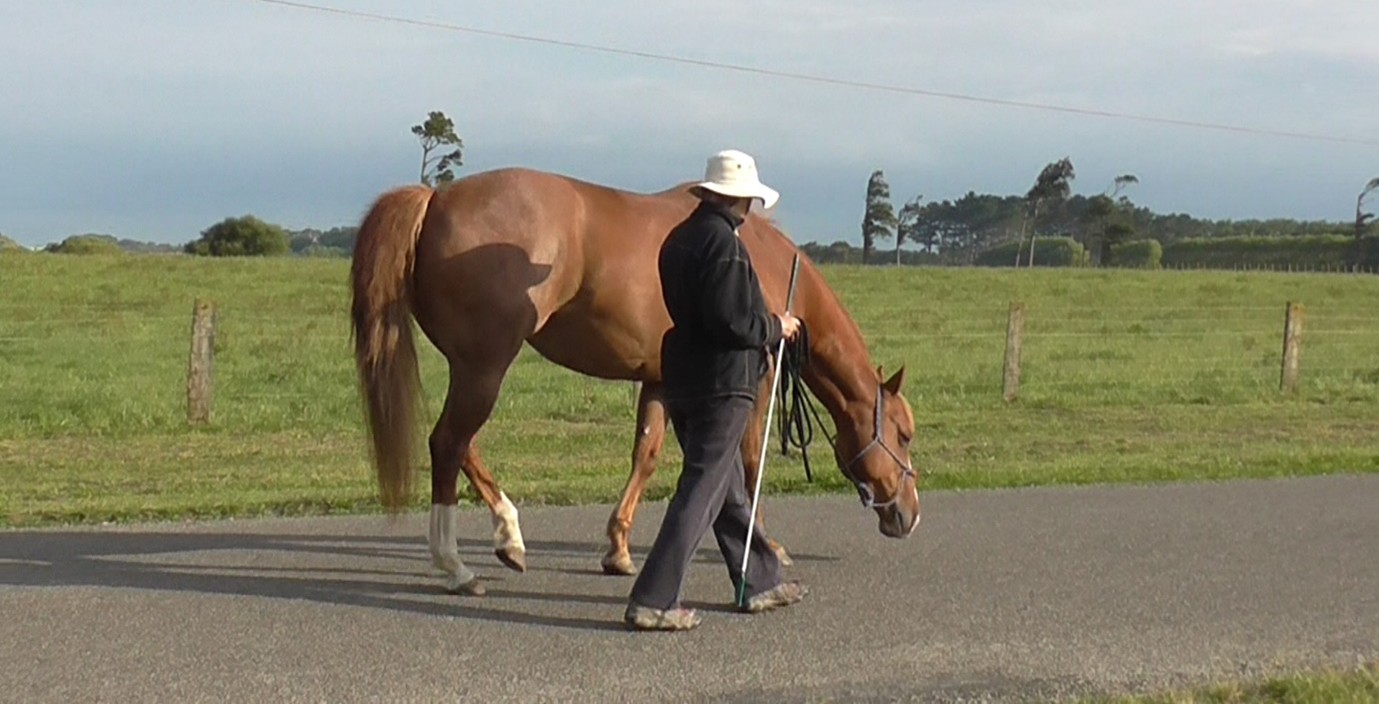
Walking out and about on the road in LP4.

Leading Position 8b: Rope Texting and Sidestepping

Things get a little complex here. At times I have backed up to to highlight the skills needed to make sure the horse is confident with all the prerequisite bits before introducing the new bits.

Please be aware that at this point in our training of more complex maneuvers, where Boots has already learned many things over many years, I use a body extension to make my intent as clear as possible for her to understand. It is a visual aid for the horse. It compensates for our strange upright posture so different from the ‘long’ postue of a horse.

A. Rope Relaxation

Before we do anything else, we have to ensure that the horse is relaxed with long body extension such as a stick&string combination or a lunging whip which we use merely to clarify our intent. The horse needs to totally cool with such things moving around him. If he has been traumatized by such things in the past, it will take time and patience. The Most we need to do with a body extension is to create air disturbance with it. (See video clips #121 and #22 below.)

B. Rope Texting Signals for the Back-Up and the Halt

A clip called Rope Texting in my Thin-Slicing Examples playlist gives a visual demonstration of parts of this process. 

When you write your Individual Education Program, decide whether you want to use a lane rather than just a fence to help keep the horse straight during the teaching and learning (acquisition) phase.

Slices: to start

  1. Ensure the horse has a good understanding of a voice back-up’ signal.
  2. Begin at halt, standing in LP3 (shoulder to shoulder). Position the horse facing a barrier so it makes sense to step back because it is the only choice.
  3. Holding the rope straight up toward the horse’s ears and wiggle it gently and rhythmically while using your ‘back-up’ voice signal. Drop your hand plus click&treat the moment the horse even shifts his weight back. Then work toward getting one step, and so on. Most horses seem to quickly work out that stepping back will immediately stop the wiggle pressure plus earn a click&treat.

Back-up: Lift the rope straight up and jiggle it and use your voice cue, starting extremely gently and amplify until the horse even thinks, “back”, at which point, click, drop your hand, and deliver the treat. By teaching this with positive reinforcement, we don’t need to put a lot of energy into the rope, since horses feel everything.4. Gradually ask for a few more steps before you relax (click&treat). However, each time you begin again, be sure to stop the rope jiggling the very instant the horse begins to move back. It’s the removal of the signal energy plus the click&treat that teaches the horse what you want.

Slices: to continue

  1. When the horse takes one or more steps back, walk backwards along with him.
  2. When the horse can back smoothly with a light jiggle of the rope lifted up toward his ears, gradually jiggle as lightly as possible to get the response. If you start feather light, you can amplify as necessary. If you start heavy-handed, the horse does not have a chance to be sensitive to the light signal. Eventually just your raised hand will be all the signal the horse needs.
  3.  LP 8: When the horse backs up readily with a light rope text (jiggle) gradually stop moving with him. Instead, glide into LP8 facing his ribs and keep your feet still as he moves.
  4.  Gradually step back a bit in LP8 so you can give the rope text signal from further away.
  5.  Work along a fence minus the mat destinations if you were using mats. Tap behind the withers for ‘walk on’ (plus your ‘walk on’ voice cue, and use rope texting to signal a halt; relax (click&treat).
  6.  Repeat the ‘walk on’ gentle tap and ‘halt’ gentle rope texting until they are smooth.
  7.  When 6 above is good, after the halt, use rope texting again for ‘back up again please’. Release (click&treat) for the smallest sign of backing at first, then gradually ask for a bit more before the release (click&treat).
  8.  When you can use a gentle tap signal behind the withers (or just your voice cue) to ask the horse to walk forward, light rope text to ask him to halt: relax (click&treat), then use light rope text to ask him to step backwards; relax (click&treat), you have almost achieved the whole behavior.
  9.  When 8 above is smooth, ask for the ‘walk on’ and the halt before you relax (click&treat). You have chained two separate parts of the overall task together.
  10.  When 9 above is smooth, ask for all three parts of the whole task: the ‘walk on’, the ‘halt’ and the ‘back-up’ before your release (click&treat).
  11.  When it is all smooth on one side of the horse, teach it again, from the beginning, on the other side.
  12.  Generalize by working away from the fence, using a lane of rails on the ground.
  13.  When that is smooth, use one rail. You can vary having the single rail on the far side of the horse or between you and the horse.
  14.  Work away from fences with no props. If each slice of the overall task is in the horse’s deep memory, it will have become a habit. If the task falls apart at any point, go back to where it is still successful, and work forward from that point again.

As mentioned earlier, teaching the ‘walk on’, ‘halt’ and ‘back-up’ signals from LP8 can make it easier for the horse to learn to confidently work in a circle around us.

There are a variety of suppling exercises we can do on the long line or lunge. See clip #37 in my HorseGym with Boots playlist for a short overview of some of the things we do on the lunge.

C. Stepping Sideways with LP8

I’ve included this here because it is fun to work with and a great suppling exercise for the horse. But it’s important to take all these things slowly and build them up over weeks and months, depending on how often you can play with your horse.

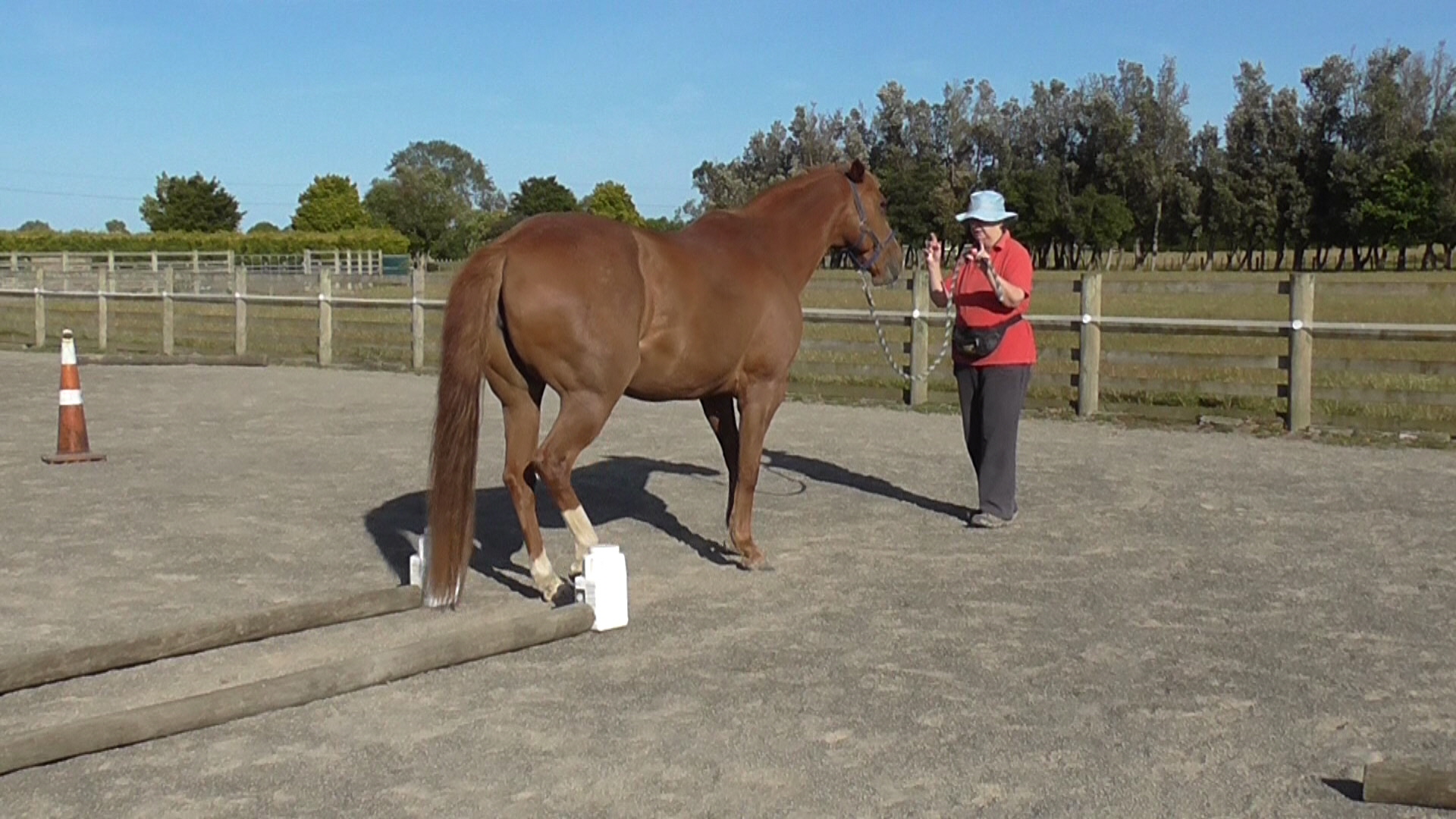
Horses move sideways by crossing one pair of feet while the other pair is spread. If they crossed both at the same time they would be very unstable!

Stepping sideways: When horses step sideways, one pair of legs is stretched apart while the other pair crosses over. In this photo Smoky is crossing his front legs.In his next step they will separate and he will cross over his hind legs.

#52 and #53 (further down the blog) illustrate a process for developing the ‘moving sideways’ task.

We can begin by asking the front and rear legs to move over independently and build up his skill until we can ask the horse to move both hind end and front end in rhythm, ideally keeping his body in one plane.

Moving sideways is not something horses do much in their everyday life. It may therefore take the horse a while to get his legs organized smoothly when we first ask for such movement.

You can get a sense of this if you step sideways crossing your legs. While your legs are crossed, spread out your arms. While your legs are apart for the next step, cross your arms. If you’ve never done this before, it is quite hard to synchronize at first. I’ve seen horses having to think very hard to get this sorted, so be especially patient, give it lots of time and celebrate small successes.

A few background points

  1. An angle of up to 45 degrees is fine at the beginning. Most horses will find this easier on one side. Aim to eventually become equally smooth on both sides.
  2. Yielding sideways is the basis for many ridden maneuvers right up to flying changes of lead.
  3. Moving sideways helps suppleness by gymnastic stretching of the muscles.
  4. Moving sideways will enable the horse to do other things better. It helps develop his spatial awareness and his body awareness.
  5. It teaches isolation of forequarter and isolation of hindquarter movement, to lead into graceful movement sideways in one plane as well as the ideas that relate to shoulders in and haunches in.
  6. It’s useful for all safe maneuvering on the ground. It’s useful to negotiate gates and when asking the horse to line up with a mounting block for mounting and dismounting.
  7. Doing a little bit often gives the most reliable results. As usual, we are teaching a habit in response to a signal. We don’t want to make the horse sore.

Aim: Teaching Sideways in Motion.

Environment:

  • Horse in an area where he is usually relaxed and confident.
  • Herd buddies not able to interfere but in view if possible.
  • Horse in a learning frame of mind.
  • A safe, straight stretch of fence. Electric fence turned off if using that.
  • Good footing for the horse.
  • Halter and about 12 foot leadrope.
  • Ensure the horse is warmed up.

Slices:

There are a few steps in the teaching of this movement. Be careful not to do too much of this at once. You don’t want to make the horse sore. Break up the training with other familiar activities inbetween working on sidestepping.

  1. Ask the horse to move the front end over; click&treat(see Blog 84 via the Blog Contents List link at the top of the page).
  2. Ask the horse to move the hind end over; click&treat ( See Blog 83)
  3. Quietly, with the horse facing a barrier, ask for font end over, then back end over. Click&treat and treat each movement until they feel easy. Then begin to ask for both ends to move over (still one at a time) before you click&treat.
  4. At some point, it will feel like you can link these two movements together with a touch signal where your leg would be if riding, and get a smooth step sideways. Celebrate.

Generalizations

  1. Practice in other spaces where there is a safe barrier.
  2. Set up intermediate exercises by using a row of barrels laying down or a rail set at knee height as a barrier to stop forward motion.
  3. When that is perfect, move to doing it with a rail on the ground and then without any barrier. Using a road or driveway can also be helpful to keep the line straight.
  4. Eventually advance this game by asking the horse to move sideways around things like cars, trailers, logs set out as a square or shapes made out of cones, barrels or plastic bottles of water. 
  5. When the side-pass is smooth at the walk, you may like to ask for it at the trot. To teach it at the trot, go back and work through the slices again.
  6. Generalize by asking for sideways straddling a rail, log or barrels.

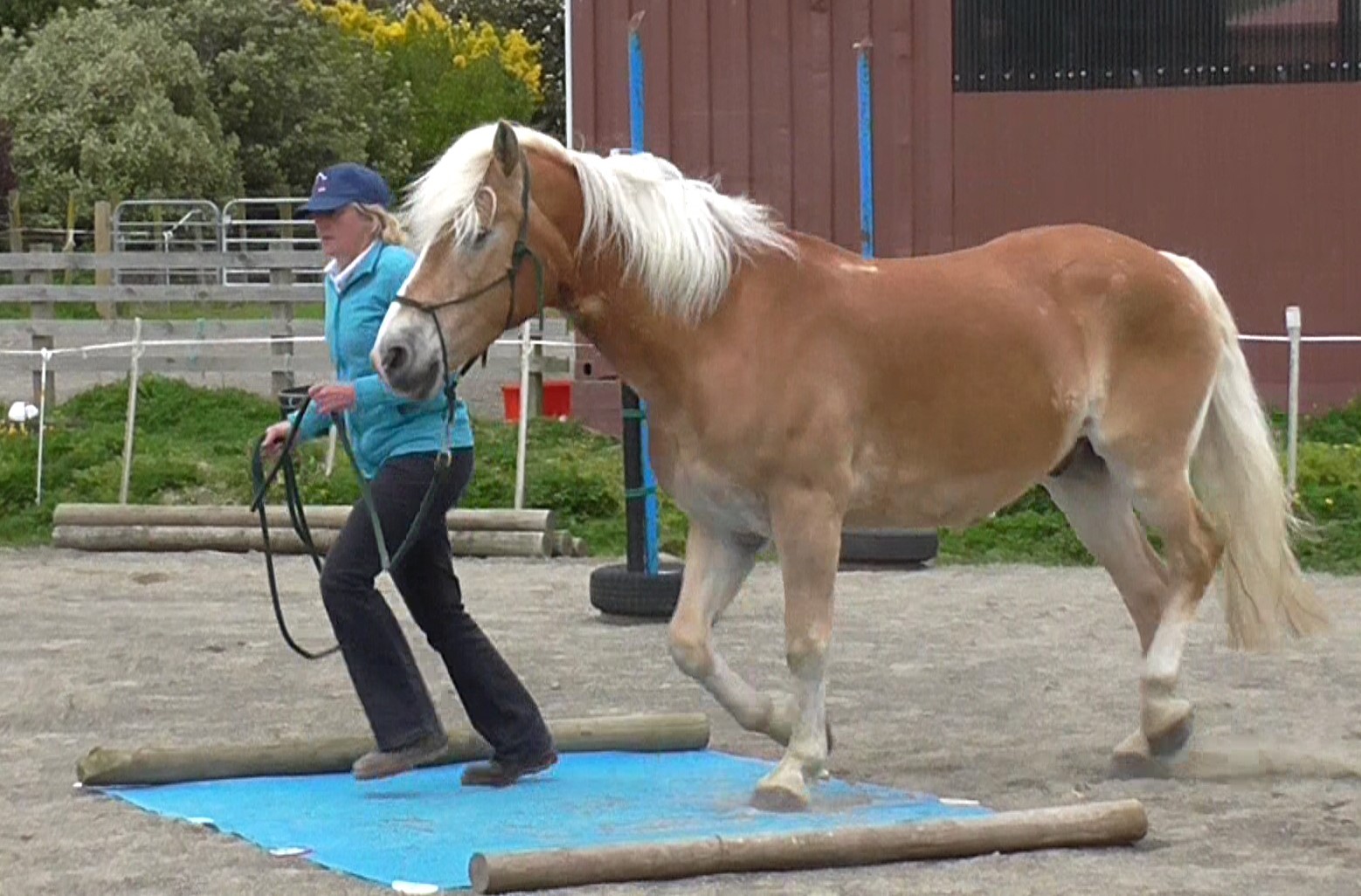
LP8: Side-stepping straddling a rail.

In LP8 as Boots steps over a wagonwheel obstacle for Horse Agility.

Note:

To teach ‘straddling a rail’ as in the cover photo, see Blog Number 67.

Using Lanes

Lanes are incredibly useful for teaching horses about:

  • *leading without the horse blocking you (i.e. movement work in protected contact)
  • *trailer loading
  • *careful foot placement
  • *building suppleness for turns
  • *backing up straight
  • *recall
  • *sideways (lateral movement)
  • *backing up toward handler
  • *confidence with unusual narrow spaces, eg. walking between parked vehicles or narrow tracks
  • *backing harness horse between shafts
  • *lateral movement

Leading without Blocking the Handler

We are walking toward a mat where a click&treat will happen. This keeps the horse focussed on moving forward and he knows what will happen on reaching the mat.

Charging direction with this set-up is great for developing supple turns in both directions. Obviously the arrows in the lane should have an arrowhead on either end LOL.

Trailer Loading Prep

Getting the horse used to walking in a narrow space for pre-trailer loading confidence. We’ve set the lane up right next to the trailer and walk through it many times in both directions. Evenutall ask for a halt in the lane, then walk out. Evenutally ask for a halt and then back out.

Here we are stepping over a rail into the lane and out of the lane. Again, building in a confident halt plus forward again. Followed by a halt and backing up over the rail to get the horse used to seeking where to put his hind feet, as he will have to do when backing down a ramp. The next step would be to block off one end of the lane so it becomes a dead end space like the trailer.

Backing up Straight

This includes backing up out of trailer.

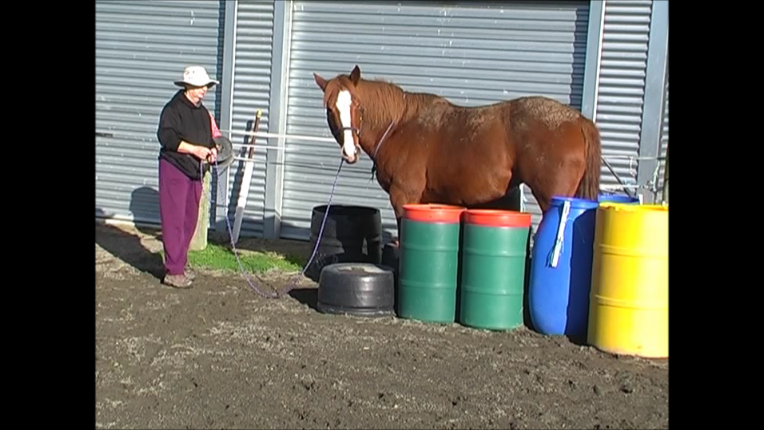
Walk into a dead-end lane, click&treat, and pause for dwell time.

Raised rope and signal with outside hand are our cues for backing up out of the space.

We have graduated to the same movement using just ground rails. Once that is solid, we can use just a fence or a line of single rails on the ground to avoid the hind end swinging away from us.

Backing up with the Handler in Front

The white markers make it easier for her to see the entrance to the narrow lane. Sill using halter and rope here.

A raised lane and she understands my raised hand signal for backing up.

Eventually we could back up from in front with great accuracy. This took a while to achieve, doing a little bit most days.

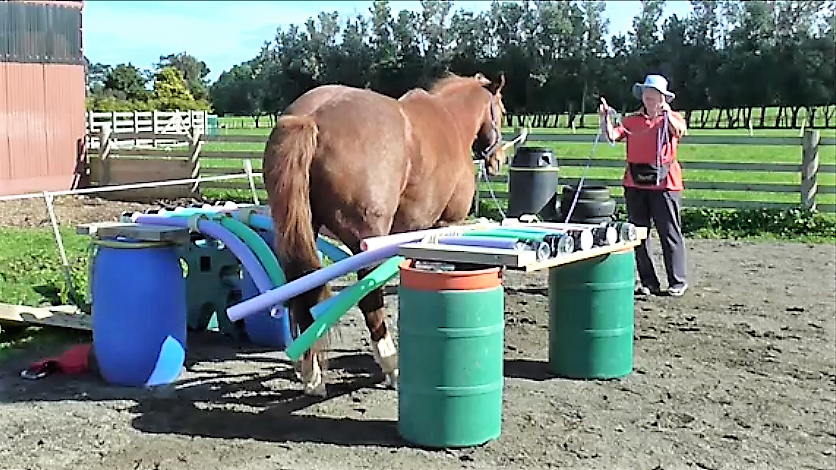
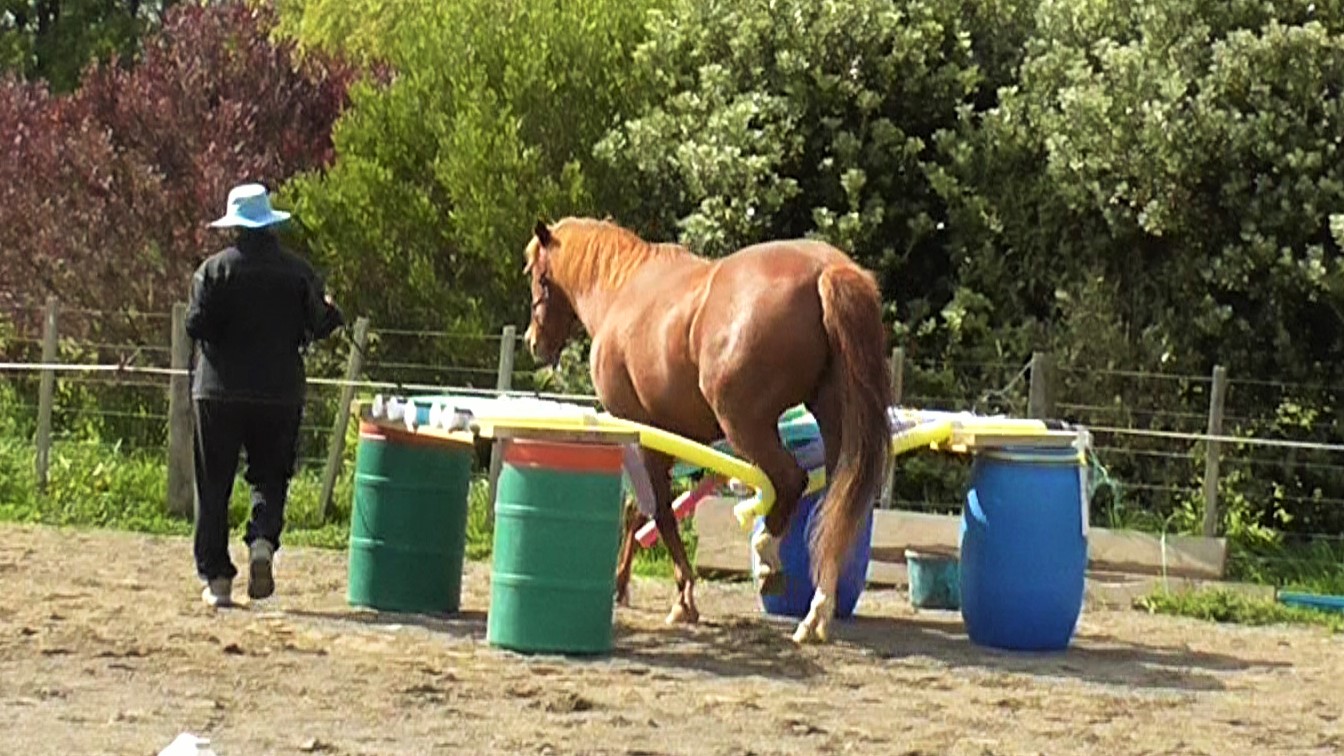
Backing through a series of pool noodles for a Horse Agility task.

Another way to set up a lane.

Backing Prospective Harness Horse Between Shafts; i.e. tight spots

Confidence with unusual narrow spaces

It pays to start wide and narrow the lane gradually.

Long-reining

Walking into the lane and backing out with long-reining.

Careful Placing of Feet

Careful foot placement with long-reining. We can start trotting poles in a lane to make it and easier for the horse to know our intent.

Weaving a series of parallel rails for careful foot placement and supplesness.

Using a lane to teach Back-Up to Target my Hand with her Withers.

Eventually we no longer needed the rails and she is learning to back up with a signal when I am behind her.

Lateral Movement

Once it’s easy with a lane, use just one rail to help the horse keep straight.

Recall

First I teach the ‘wait’ game at the end of the lane. Probably started by using a mat.

My recall body language signal is bending forward slightly and making a circle with my arms.

Would love to hear in the comments what you have taught, are teaching, or intend to teach using lanes.