Category Archives: body language awareness,

Leading Position 4 – Beside Ribs

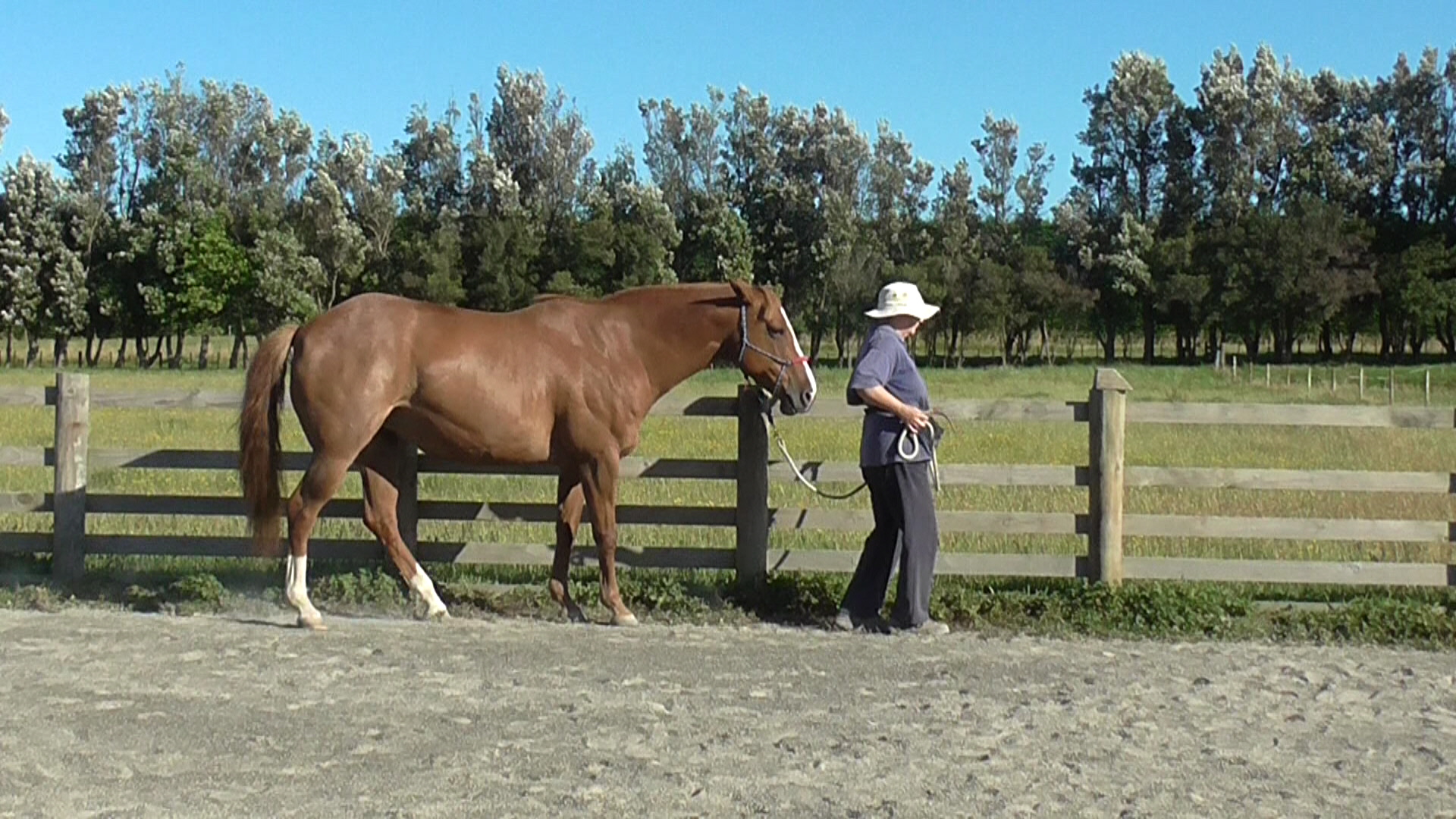
If we have first taught and consolidated and generalized Leading Position 3 (beside neck/shoulder), it’s usually easy to move from LP3 into LP4 (beside ribs).

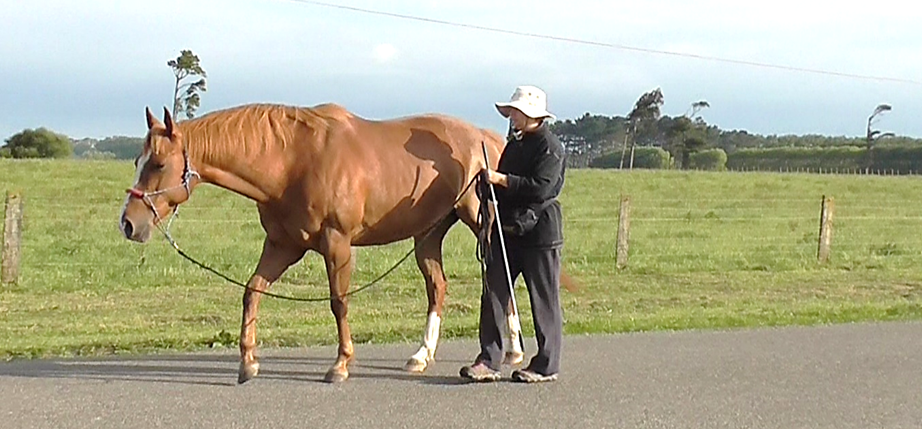
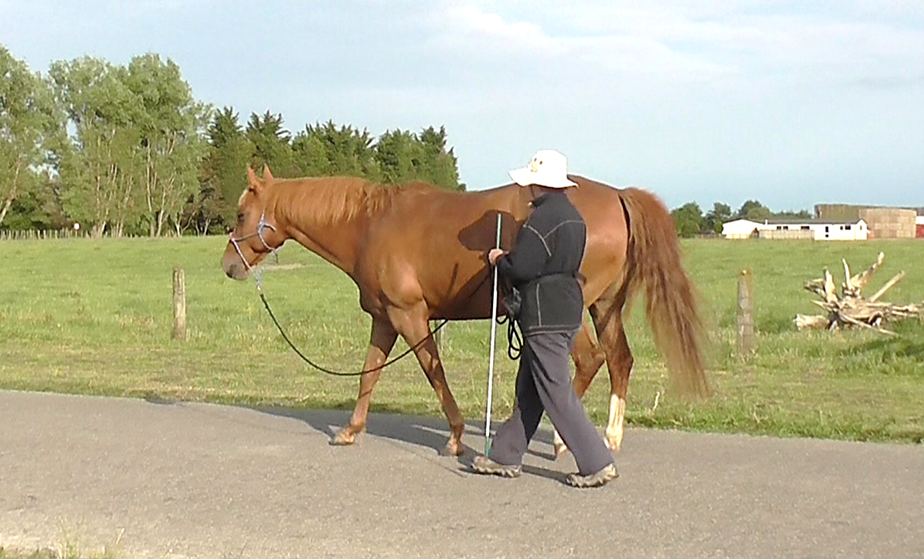
This leading position encourages the horse to move with us with his shoulder well out in front. The handler is where he or she would be when riding. In fact, riding is Leading Position 4 sitting on the horse rather than walking on the ground with him.

I sometimes use a body extension to clarify the task for the horse from a distance. A light touch signal just behind the withers for ‘walk on’, (as well as all the ‘walk on’ body language – big breath in & raised energy, step off with outside leg, voice cue) helps to make our intent clear – ie. we want to stay beside the horse’s ribs while we walk along together. The other use of a body extension is to indicate, by bringing it forward, that we don’t want the horse to turn toward us, but to walk on straight.

We also ensure walking straight by using a lane (horse in the lane, handler outside the lane) and by walking in straight lines between a series of targets. Once the horse understands the task, a small finger tap behind the withers and our voice signal, are usually all that is needed.

to summarise, if we have taught the horse that a tap behind the withers (with our fingers, eventually phasing out the body extension), the tap, a deep breath in and a voice ‘walk on’ – are all signals to move forward, these will continue to make sense to the horse when we mount up if we intend to ride.

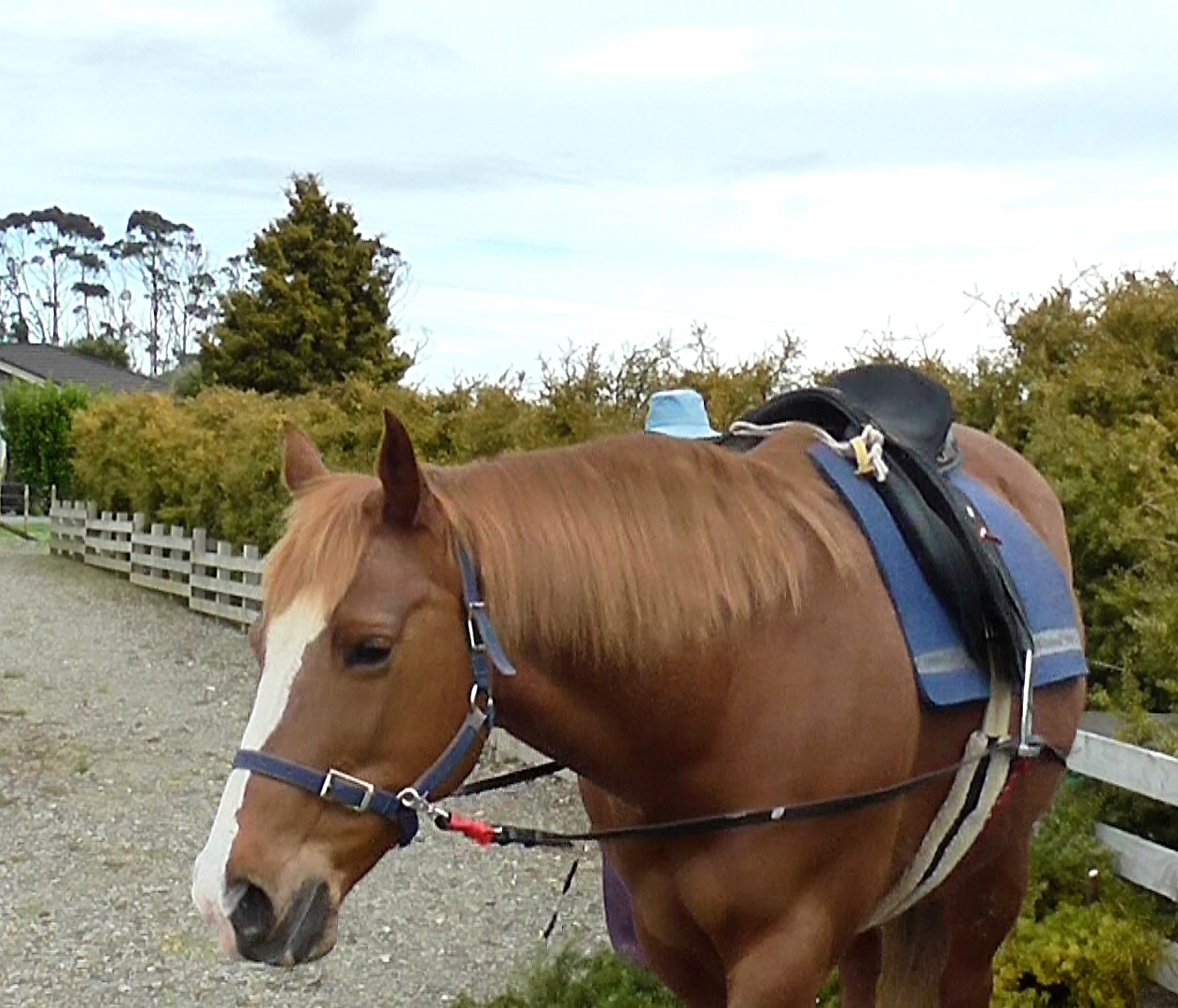
The main concern for the horse when we ride is that most of our body language suddenly becomes invisible to him. Here Boots is intent on targeting the body extension which I’ve left on the ground.

The rider suddenly disappearing from view is a big deal for horses because horses are, by nature, strongly tuned in to visual body language. Body language plays a key role in equine culture. An empathetic trainer will give the horse ample time and opportunity to adjust to the new touch and weight shift signals, plus the many balance adjustments that the horse has to learn.

Riding has us in Leading Position 4, behind the horse’s withers. If we teach moving forward in this position on the ground, we are building the horse’s confidence in having half his body out in front of us. For timid horses, this can be challenging. The cues/signals we teach on the ground will stand us in good stead if we intend to ride. If we are working with a young horse which will be ridden, this training gives him a major head start with the ridden experience.

Training Plan 18

Aim:

To have the horse comfortable walking along with the handler when the handler’s position is behind the horse’s withers, alonside the horse’s ribs.

Environment:

  • Horse in an area where he is usually relaxed and confident.
  • Herd buddies not able to interfere but in view if possible.
  • Horse in a learning frame of mind.
  • A safe stretch of fence or a waist-high lane.
  • Series of destination mats or nose targets for the teaching phase, .
  • Body extension to clarify signal as necessary.
  • Halter and lead.

Slices:

See clips #55 and #56 in my HorseGym with Boots playlist. Clip 55 also looks ahead to when we want to walk alongside the hindquarters, which is the topic of the next blog.

Click here for Clip #55.

Click here for Clip #56

  1. Ensure the horse is comfortable walking between you and a safe fence (or in a lane) in LP3 (beside neck/shoulder).
  2. When the horse is relaxed in LP3, glide back so you are walking just behind his withers. After a step or two, relax (click&treat). Be sure to let the lead rope flow out to keep a float (smile) in it as you drift back, so you don’t give him a ‘slow down’ text message up the rope without realizing it. Move promptly up to the horse’s head to deliver the treat so he is not tempted to turn toward you. Walk on again in LP3 and glide back into LP4. It can be quite difficult for us to remain in LP4. For some reason, most people, including me, have a tendency to creep up toward the horse’s neck and shoulders.
  3. This smooth letting out of the rope is another skill it’s good to practice first with another person standing in as the horse.
  4. Repeat 2, adding a few more steps in LP4 each time before you relax (click&treat).
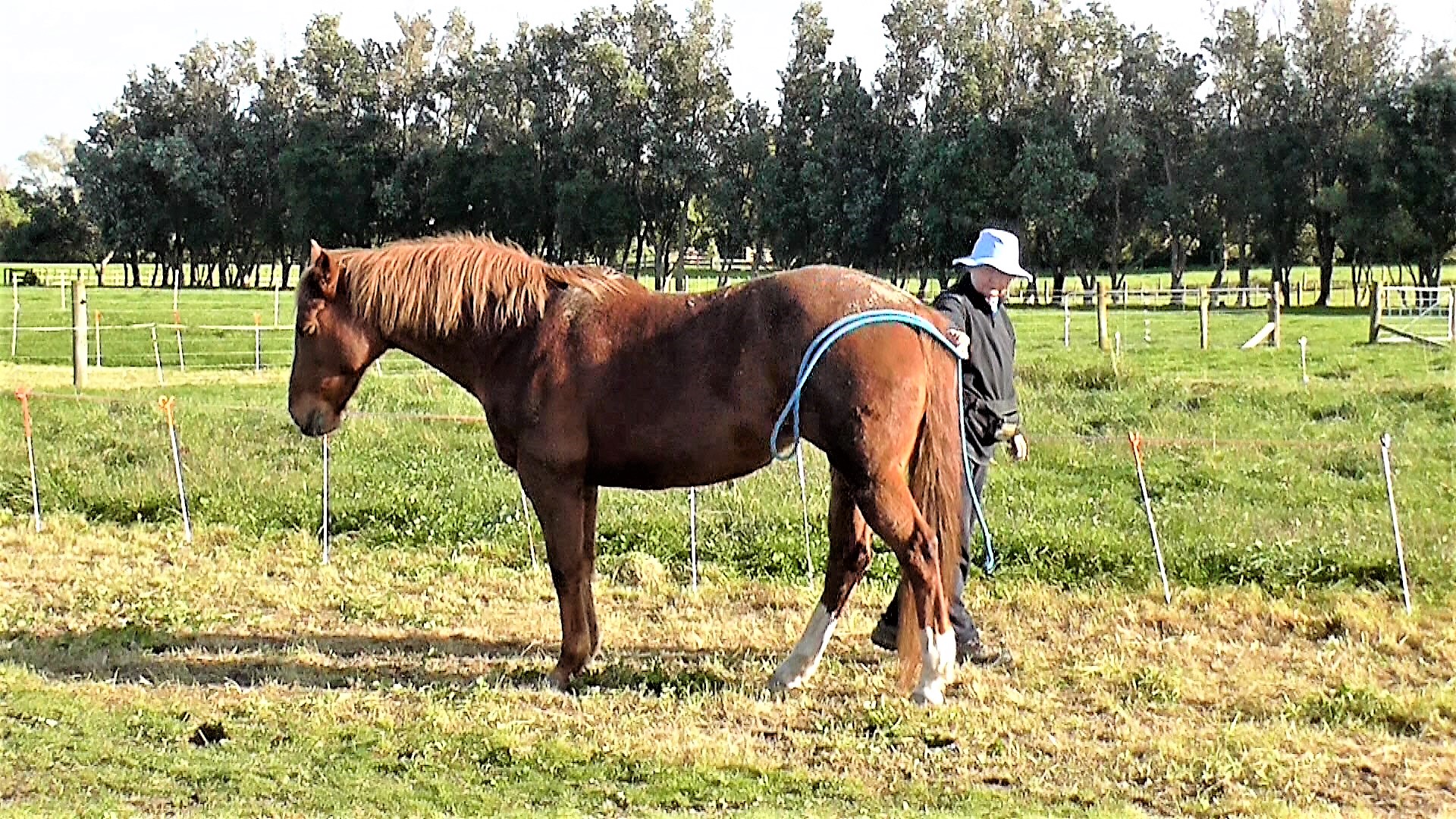
  5. If we are working along a fence rather than in a lane, using a body extension makes it easier to keep our position behind the withers because we can bring the body extension forward to gently block any tendency to turn toward us. The instant he goes straight, put the body extension back in neutral by your side or lying lightly behind the horse’s withers.
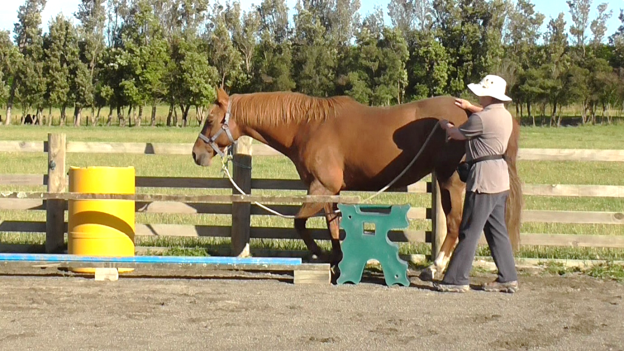
  6. It can help to keep our hand behind lying gently behind the withers as we walk with the horse, as Bridget is doing in the final photo of the blog. This might not be an option if the horse is very small or very tall.
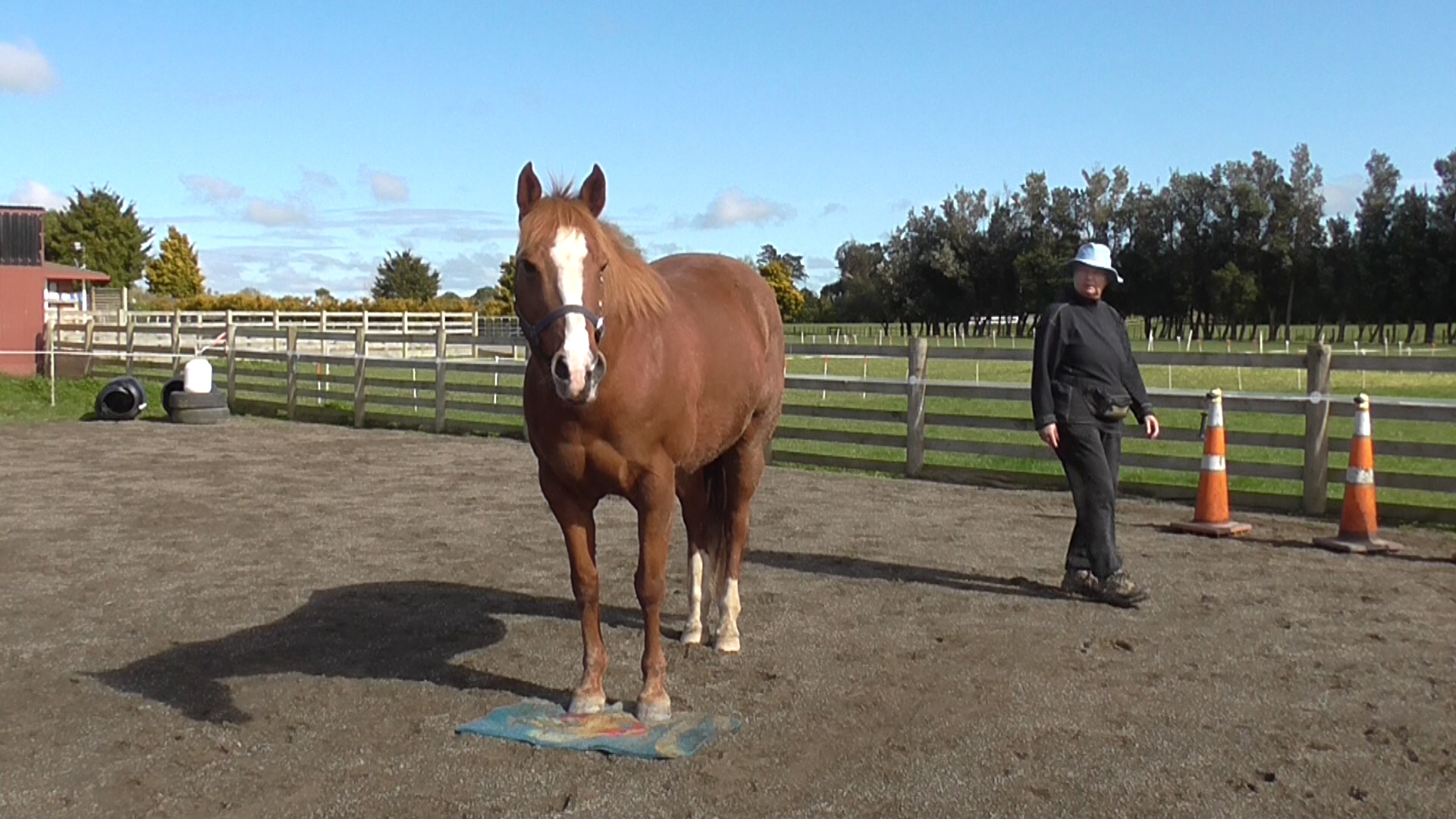
  7. If you use mat or nose targets, set these out and ask the horse to walk between them, stopping for a click&treat as he reaches each one. Return to LP4 after delivering each treat and ask for the ‘walk on’ with a gentle tap behind the withers.
  8. If the horse tends to move his shoulder toward you rather than stay straight along the fence, use your body extension to disturb the air alongside his neck.
  9. If the horse has a habit of moving his shoulders into you, create an Individual Education Program to address just this issue. It would include a release (click&treat) the instant the horse responds to the signal pressure from the body extension swung forward in the air next to his neck, inhibiting his shoulder movement toward you. Once he realizes that the release/click point is when he stays straight, you can begin to gradually add more steps forward before you relax (click&treat).

LP4 asks the horse to have his eyes, nose and shoulders well out ahead of us. That can be worrying for an anxious type horse who is more comfortable following than being out in front. Bolder, more confident horses will may find it easier. If you are developing a riding horse, it is important to understand this lack of confidence to ‘be out in front’.

By setting up mats or nose targets, we can make this a much more interesting game. The horse will begin to look for the next target so he can earn his next click&treat.

For horses who are anxious about leaving their home area or their herd mates, this is a great exercise to give them a brand new focus for going out and about with their handler.

We can collect plastic drink bottles for nose targets and hang them around our training area. Then we can devise different walking patterns between the various targets, including turns and weaves. A series of rags hung on fences or shrubbery can also make interesting targets (be aware of horses who may try to eat them).

The activity of walking along together with the hand or stick behind the withers needs to become comfortable and ho-hum for the handler and the horse.

If we want to ride out or walk out, setting up a series of nose targets along the way gives the horse something to seek out. His mind will be engaged in the next target rather than the fact that he is moving further away from his friends or barn area.

At first we’d have the targets close together. As the horse gets keen on the game, we can gradually spread them further and further apart. It also works to use something like a Frisbee or a ball as a target. We can throw it out ahead of us, move to target it, throw it again, and so on.

If the horse is very barn or buddy sweet, we can lay out the target destinations in an arc. The arc will first guide the horse away from where he sees his ‘safety’, and then closer again. Over days and weeks, we can gradually set the top of the arc further and further away. One day the horse’s desire to seek out his targets will eclipse his need to get back to the barn or his buddies.

If the horse has developed the habit of rushing home or rushing to the field, we can slow the rushing by having him seek out targets on the way home or on the way to the field.

Summary of LP4

Leading Position 4 became important to me when I was preparing my horse for riding. When I came to teach long-reining, it was an excellent intermediate position to having the horse comfortable with me walking right behind.

Mat or nose destinations enable us to play the nose or mat target game, which gives the horse an incentive to move smoothly from halt into walk (or trot) and back to halt at the next destination. Since ‘go’ and ‘whoa’ signals are the backbone of all of our communication with horses, the targeting games have many positive outcomes.

When we move the horse around us on a long line (lunging), our position usually moves between LP3, LP4 along with LP8 when we face the horse’s side.

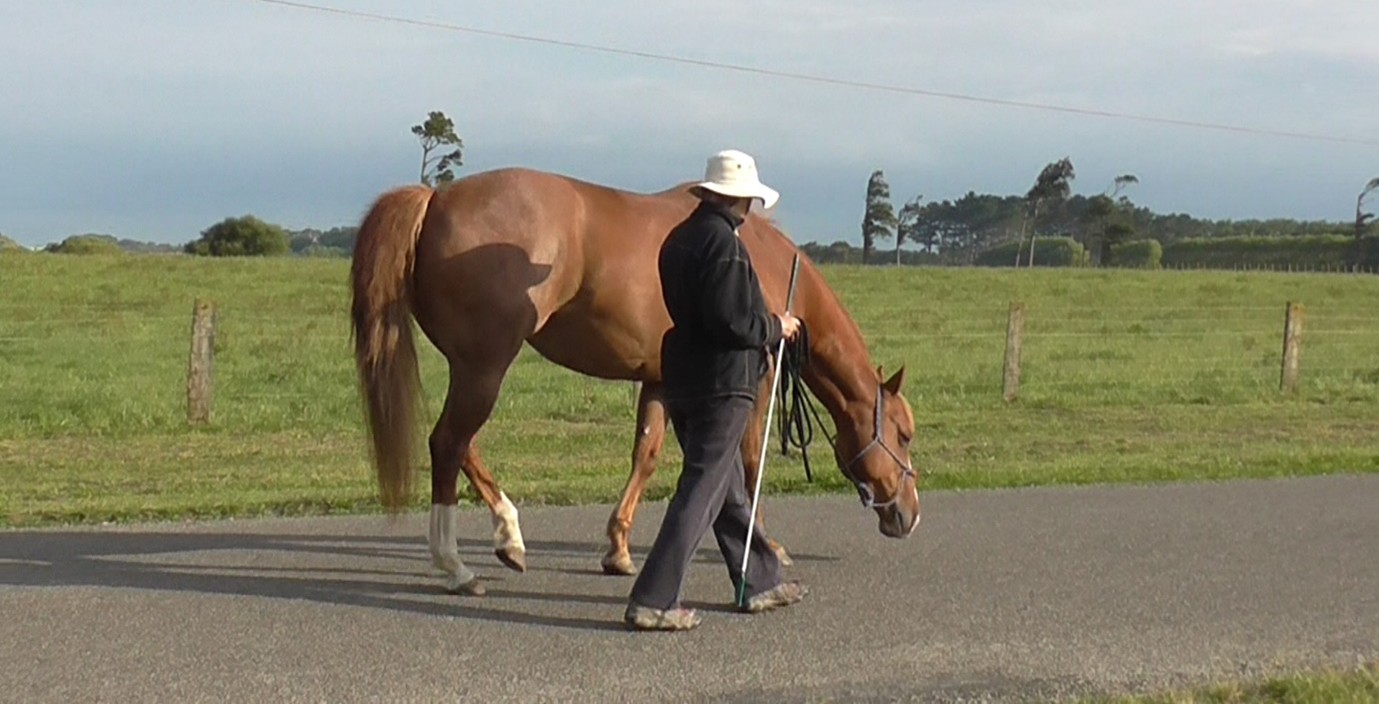
Walking out and about on the road in LP4.

Leading Position 8-a

In the photo above, Bridget is using Leading Position 8 to ask Boots to go through a gate.

Leading Position 8 (LP8) is anytime we are facing the side of the horse. We can be in LP8 facing his ribs, his head/neck or his hindquarters. Still to come in future blogs are notes about LP7 – facing the front of the horse, and then LP6 facing his tail, as when walking behind him (long-reining) or sending toward something away from us, or asking for a back-up from behind the horse.

Remember, when we say ‘leading position’ we mean any position we use to orchestrate the horse’s feet, whether we want them to move or to remain still.

I want to look at LP8 next, because it is the Leading Position we often use for grooming, saddling/unsaddling, mounting and dismounting. For all of these, we need the horse to be comfortable standing still while we move around him.

We are in LP8 when we saddle the horse as well as for mounting and dismounting.

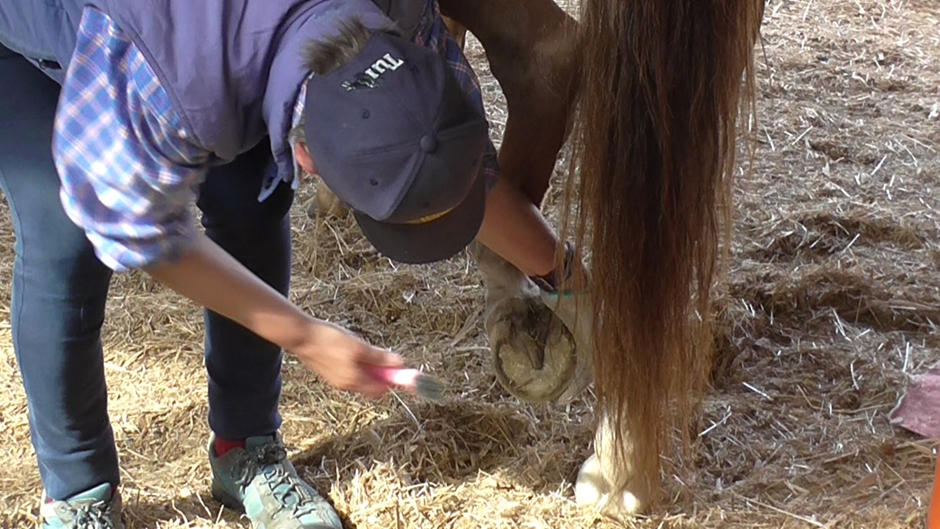
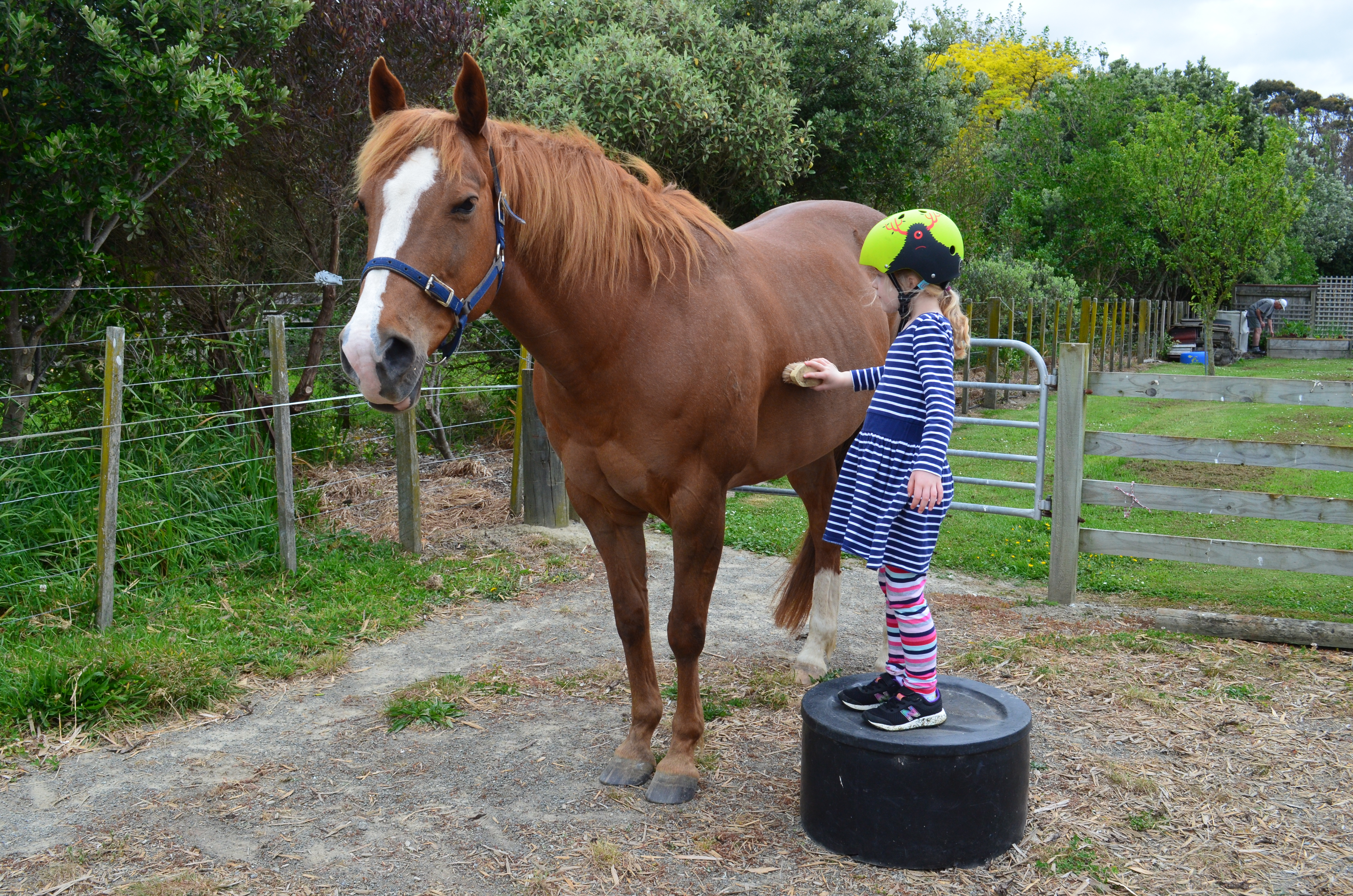
Clip #49 in my HorseGym with Boots playlist looks at our position when we are grooming, saddling and checking for relaxation.

Boots is not always relaxed about being brushed. It’s not something she experienced early in life before I got her. Giving her something else to think about, like the cloth in the video clip,  seems to act as a ‘soother’.

Some horses love rubbing and cuddles while others are much more aloof. When Smoky and Boots lived together, the difference was very obvious. Smoky adored being groomed and fussed with. When we sat with him Sharing Time and Space, he would nibble and lick and want to be very close.

Boots learned to tolerate being touched all over for grooming, but sometimes finds it hard to relax into being brushed or massaged without a lot of licking, chewing and yawning. In summer, when we groom every day, she is able to settle into it a bit more.

When Smoky and Boots indulged in mutual grooming, Smoky was very tentative because after a few mutual nibbles, Boots would have had enough and give him a nip.

Any time we are along the horse’s side and pointing our belly button toward him, we are in Leading Position 8.

We can use signals behind his withers to ask the horse to move forward, shift his hindquarters or move his whole body sideways.

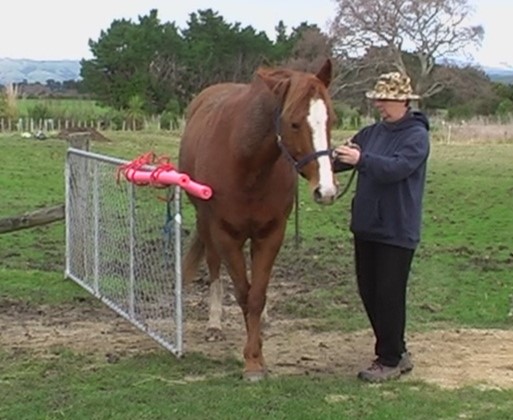
To get Boots used to the idea of shafts in a cart, I asked her to move sideways to push the gate along. Another LP8 position.

LP8 allows us to use signals in front of withers (the base of the neck) to ask the horse to yield his shoulders to change direction.

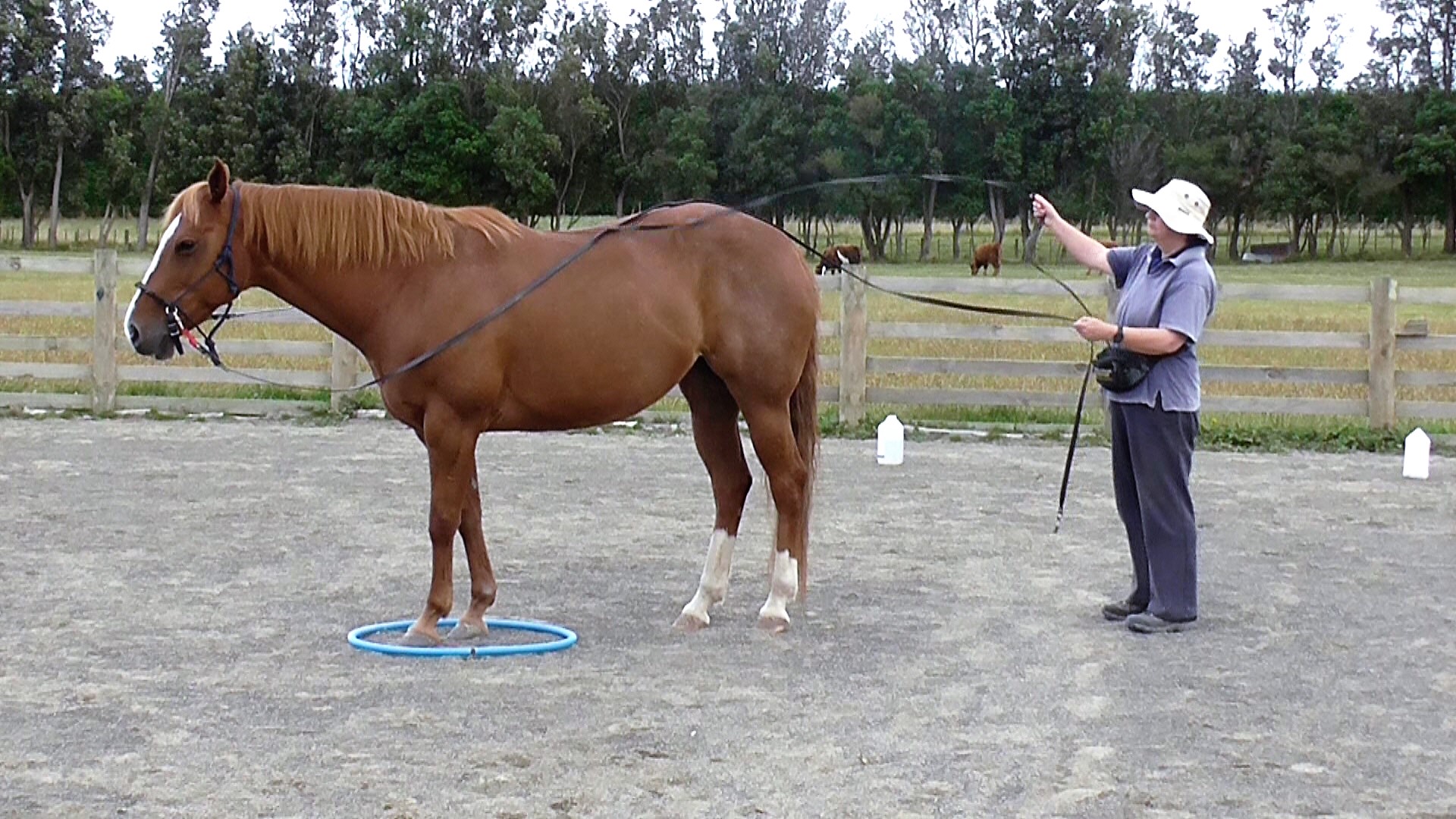
LP8 is handy for teaching a horse to become fluid with ‘walk on’, ‘halt’ and ‘back-up’ signals when we are facing him side-on. These skills lead nicely into teaching the horse to work in a circle on a long line or reverse pen.

Teaching circles has us facing the side of the horse.

Slices:

For illustration, please see clip #48 in my HorseGym with Boots series. Please note that I use a body extension only to make my signal clear for the horse and be able to give a clear signal from further away. Once the horse understands the ‘tap behind the withers signal’, a finger tap is all that’s needed. The rope texting at the end of the clip is next month’s theme.

‘Walk On’ Signal

  1. Ensure the horse is comfortable halting in the lane or alongside the fence (on a mat if you like).
  2. Stand facing the horse’s withers, at a distance which allows you to easily tap him gently behind the withers with your fingeers or your body extension.
  3. Move into and out of this position a few times with click&treat for the horse remaining in a relaxed halt.
  4. When 3 is ho-hum, rub the horse all over with your body extension or your hands; click&treat for relaxation. To encourage relaxation, pause and turn your energy away from the horse at every indication of relaxation (lowering head, sighing, softer ears, more relaxed lower lip, cocking a hip).
  5. For this part of the training, it helps a lot to have a mat or cone at which the horse knows he gets a click&treat, just a few feet in front of the horse.
  6. When the horse can stay relaxed as you move into position facing his ribs and you can rub him all over, tap him behind the withers, then ask him to walk forward to the mat or cone, click&treat.
  7. If the horse does not understand at first, just tap, then guide him to the cone or mat. He will quickly pick up that the tap means, move foreward to the cone or mat.
  8. As his confidence increases, stop moving with him to the cone or mat. Wait until he gets there before you click&treat.
  9. When the horse reliably steps forward when you tap gently, gradually increase the number of steps before you click&treat by moving the destination mat or cone further away. Always stop tapping the very instant the horse moves and relax your body language.
  10. Eventually, set out a circle of cones or mats and and ask him to move between them with a click&treat at each one, followed by a wither tap to move to the next one.
  11. If you are using a leadrope, keep a float (smile) in the lead rope. At first you may find yourself changing from LP8 into LP3 (shoulder to shoulder) or LP5 (beside hindquarters) and back to LP8 again.
  12.  Once he understands the tap signal, add in your usual ‘breathe in strongly’ and voice signal (e.g. ‘walk on’) that you will always use. You could include these earlier, but I like to make sure the horse understands the tap signal on its own. (See Number 16 in the Blog Contents link at the top of the page for details about smooth ‘walk on’ and ‘halt’ transitions.)
  13.  When he is smooth on one side, teach it from the beginning on his other side.
  14.  Generalize using this ‘walk on’ signal in other venues and situations.

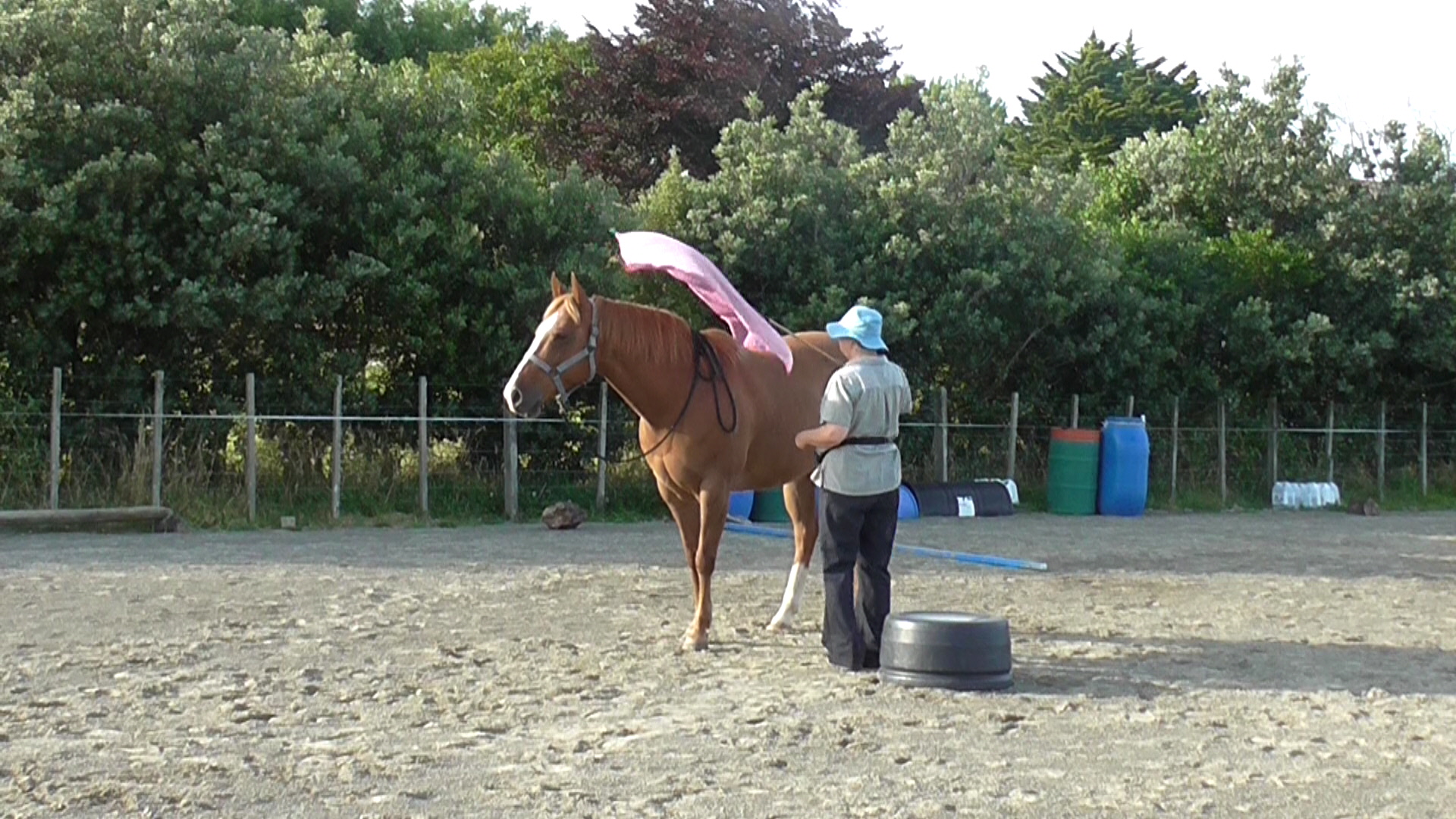
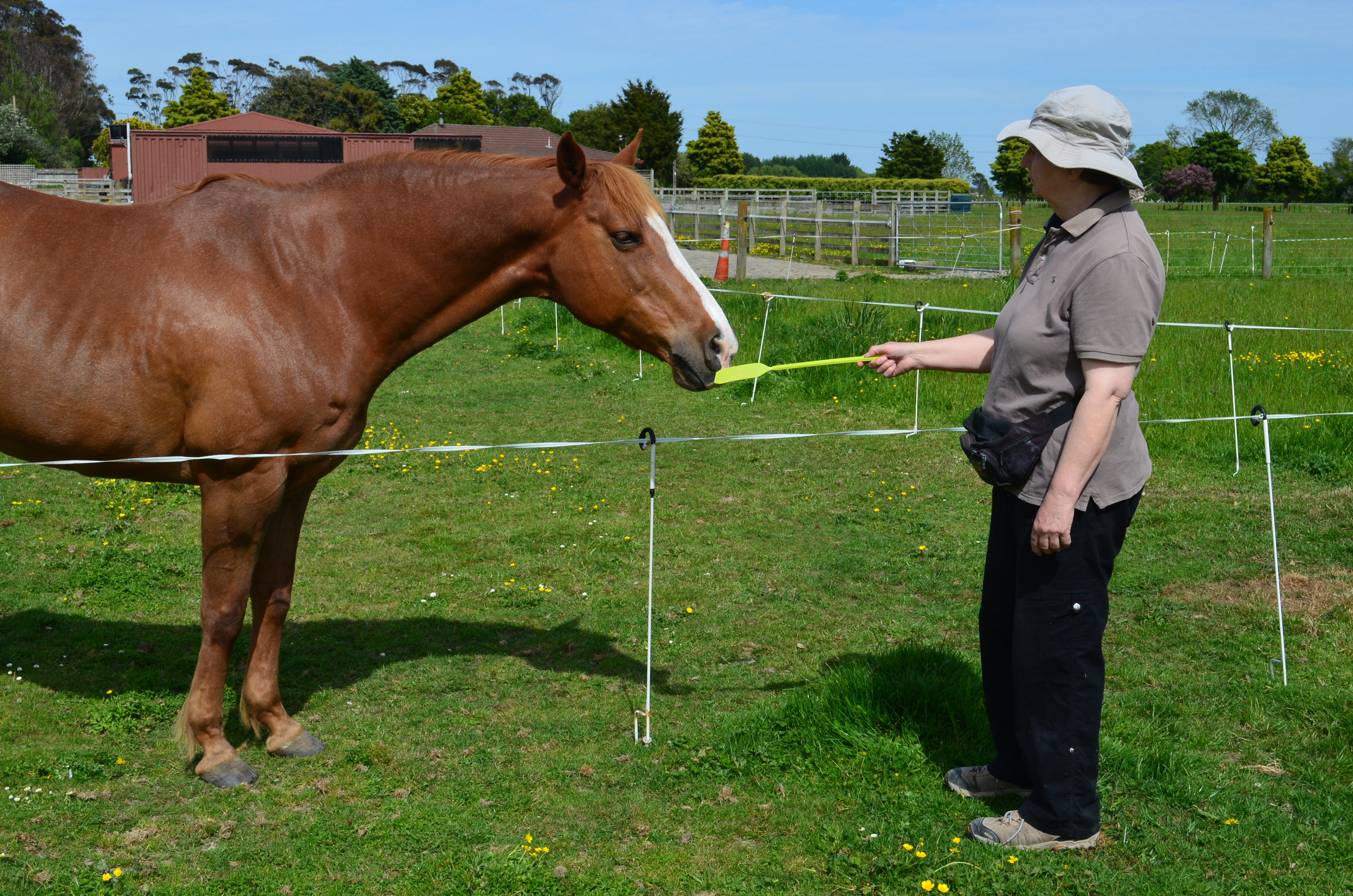
Here I am in LP8 getting Boots confident with flapping things moving across her for a Horse Agility course.

Leading Position 1

Leading Position 1 (LP1) has the handler in front of the horse, facing the same way as the horse.

Bridget is walking right in front of Smokey with a nice loop or ‘smile’ in the lead rope.

This concept of ‘Walking Away’ can also be useful whenever we want to get our horse used to something new. Horses have a tendency to follow anything moving away, and move away from anything coming toward them.

Leading a horse on a narrow track or road, spooky things can happen behind, so having the horse walk a meter or so behind you on a loose lead means the horse can spook right or left without running into you. For casual walking out, this can be a useful position.

However, Leading Position 1 is especially interesting because horses have two ways of looking at it.

Concept One: the horse is happy to mosey along behind.

We can cruise along together like horses following each other on their way to water or new grazing. The horse in front watches for snakes or other dangers, allowing the horse or horses filing behind to relax their guard a little bit.

Boots is happy to mosey along behind me knowing I will keep a lookout for dangers ahead.

Concept Two: The horse is ‘driving’ us from behind.

The second concept the is that horse sees it as an opportunity to haze (drive) the person along. Horses often haze each other from behind. Stallions use hazing to gather up and move their mares if they feel the need to shift them, and mares do the same with their foals.

Horses higher in the social order do it to move a horse lower in the social order if it is in their way or being annoying – something that is very noticeable in domestic horse situations.

When we taught Smoky to walk behind us through the S-bend for Horse Agility, we had to be watchful because he loved to catch up with us and give us a solid nudge with his nose to ‘move us along’.

It’s definitely best if the horse is happy to work with the first concept – follow behind in a relaxed mode. We’d also like the horse to know signals for slowing down or stopping when we are walking in front of him. It’s quite different from when we ride or long-rein, and are guiding from behind.

So: We can teach the horse clear signals to indicate when we intend to walk out in front of him, and that we’d like him to maintain a polite distance behind us, slow when we slow, and stop when we stop.

The following Training Plan looks at a possible way of teaching clear boundaries with Leading Position 1.

TRAINING PLAN

Aims:

  1. To develop a signal that lets the horse know when we are going to move from LP3 (beside neck) into LP1 (in front facing away from him).
  2. To have the horse comfortable with us in front and moving in single file.
  3. To develop clear signals while in Leading Position 1, to let the horse know when we are slowing into a halt and when he needs to halt or back up.

Environment:

  • Horse in an area where he is usually relaxed and confident.
  • Herd buddies not able to interfere but in view if possible.
  • Horse in a learning frame of mind.
  • Body extension during the teaching/learning phase if we need to emphasize a signal.
  • Halter and lead.
  • Lane 10-12 feet long with one high side (e.g., a safe fence) and one side a rail on the ground which the handler can easily step over.
  • If using destinations, set a mat or nose target destination several meters beyond each end of the lane.
  • Prerequisite: horse is confident with various ways of backing up in a lane. https://youtu.be/XcKSrz8feN8,
  • https://youtu.be/rMN5jWSn-HU
  • Consciously look for signs which indicate that the horse is reaching the limit of his ability to keep trying. Aim to stop while he is still engaged and willing. You can stop at any time on any slice of the process.

Slices of the Plan: 

For each slice, begin walking with the horse in LP3 – beside neck. Move on when each slice is smooth and ho-hum for the horse.

  1. Refresh the three basic lane tasks using LP3 – beside neck: a) walk through; b) walk in, halt and walk on out; c) walk in, halt and back out. Make sure these are all smooth when you are leading the horse on his left side and on his right side.
  2. Walk the horse into the beginning of the lane, halt, and step over the rail into the lane, pivoting into LP7 which is facing the horse. Give him an arm’s length of space. Turn off your body energy; relax (click&treat). Check for any signs of anxiety (looking away, shifting feet, backing away, stepping toward you, nudging you or stepping over the rail out of the lane). Stay with this slice until the horse can remain totally relaxed as you move into position and stand facing him (which is Leading Position 7), with your energy turned off, for a few seconds before the click&treat. Gradually work up to about ten seconds.
  3. When 2 is good, repeat but now step in front of the horse facing away from him after the halt. Give him a couple of feet of space behind you as you step into the lane to stand in front of him; relax (click&treat – turn to deliver the treat, then turn away again), pause.
  4. Ask the horse to walk forward out of the lane while you stay in the single file facing away position in front of him. You may need to create a new ‘walk on’ signal for this context. Hopefully you have already established a strong vocal ‘walk on’ cue. Walk to your destination; relax (click&treat). Walk a loop in LP3 (beside neck) to return to the lane.
  5. Repeat 3-4 until it is ho-hum for the horse.
  6. Repeat 3-4 but gradually stand in front of him (facing away) a bit longer before walking on. Increase the time in one second intervals. Ten seconds is a good time to aim for.  When he can do ten seconds before a click&treat, vary how long you wait facing forward before walking out of the lane.
  7. Once the horse is cool about having you step in front of him into the lane, decide on a clear signal you can use in motion to let the horse know you are about to step in front of him. I used a raised outside arm because that seemed easiest for the horse to see. The signal Boots and I eventually developed is more like a half halt in my body, change in breathing and a small hand gesture. Each horse and handler will work out and refine something that makes sense to them.
  8. First use your new signal to let him know you are going to step in front of him when he is halted in the lane.
  9. Then walk alongside his neck/ears and step in front of him while he is still in motion, using the signal you worked out in 8. above. After stepping in front of the horse, keep walking along in LP1 (facing forward) all the way to your destination mat or nose target; relax (click&treat).
  10. When 9. is smooth, we can start to build in the back-up. Check that the back-up is in good shape by asking for it first while you remain outside the lane.

Building in the Back Up

Step into the lane into LP1, then gently turn and ask the horse to back-up. Ideally the horse will quietly step back as you make the request; relax (click&treat).

11. When 10. is smooth, you can begin to teach the horse to back up while you remain facing away in LP1. First, refresh 8 above: as you approach the lane, move from LP3 into LP1 and walk right through the lane in LP1 to the destination mat for a release plus (click&treat).

12. When 11. is smooth (over however many sessions, this is not something to rush) gently slow down your walking pace in the middle of the lane for a few steps, then pick up your original pace. This should give you feedback about whether your horse easily keeps a safe distance behind you, or might barge into you. You might need your body extension to wave behind you to remind him to keep a nice space between you when you slow down. Safety is always first.

If you are unsure, it is smart to carry a body extension in neutral. You may or may not need to activate it. Having it there allows you to be clear for the horse the first instance he needs clarification. You don’t want him to nudge you, push through you, step out of the lane or push past you.

13. The most straightforward body language signal I’ve found, to let the horse know I am slowing down, halting and backing up from LP1, is flapping my elbows sideways. It’s possible to flap elbows and wave a body extension toward the horse’s legs or chest at the same time. If we can be crystal clear right from the beginning, that he needs to keep space between us, the horse usually picks this up easily.

14. Introduce your flapping elbow signal as you slow down, then pick up pace and walk to your destination; relax (click&treat). Repeat until smooth and ho-hum.

15. When the horse easily keeps his distance during 14 above, slow down gradually into a halt in the middle of the lane. If the slices have been taught carefully, the horse will also slow down and halt; relax (click&treat – turn around to deliver the treat). Repeat until smooth and ho-hum. Also use your ‘whoa’ verbal cue.

16. Now that the horse knows that flapping elbows means ‘slow down’ and possibly halt, we want to add a back-up while remaining in LP1. As you approach the lane, step into LP1 (using your signal). Walk into the lane, slow down, halt, and then energetically flap your elbows to ask the horse to move back a step or two before you halt. Drop your elbows; relax (click&treat – turn to deliver the treat). In the beginning, reward any indication that the horse is thinking ‘back’. Then use your voice and body languate ‘walk on’ signals to walk on out to your treat destination.

17. When 16. is smooth, ask for a few more steps of back-up before you relax (click&treat).

18. When you are smoothly getting several steps of back-up, work up to a series of ‘walk forward, slow to halt, back-up’ sequences before you walk to your relaxation and click&treat destination.

By now you may not need the rail on the ground but it is a good idea to work along a fence for a bit longer, to put the ideas into deep memory.

Ideally you can now signal the horse that you would like him to ‘follow you’ and he will slot in behind you. He will stay in LP1, slow as you slow and step back when you step back.

Generalization

Generalization often requires us to go back to early slices in order to build the horse’s confidence in new situations.

A horse’s confidence is highly dependent on context. He may do something perfectly ‘at home’ or in his initial training environment but be totally thrown by the same request in a different environment.

For generalization of LP1 we can play with:

  1. Different safe fence lines
  2. Away from fences
  3. New places
  4. Following us through narrow spaces
  5. Following us over water and unusual surfaces
  6. Following us through a pattern such as a weave, a U-bend, Z-bend or S-bend
  7. Following us in a circle
  8. Following us at liberty
  9. Following us at trot
  10.  Halt – walk – trot – walk – halt – back up transitions

I’m flapping my elbows to indicate to Boots that I would like her to back up.

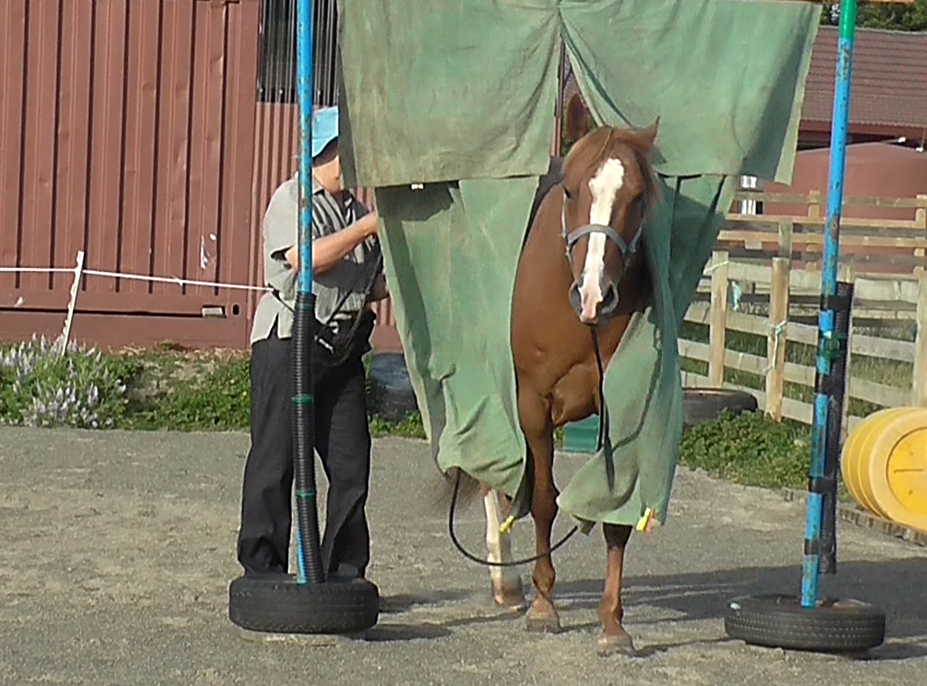
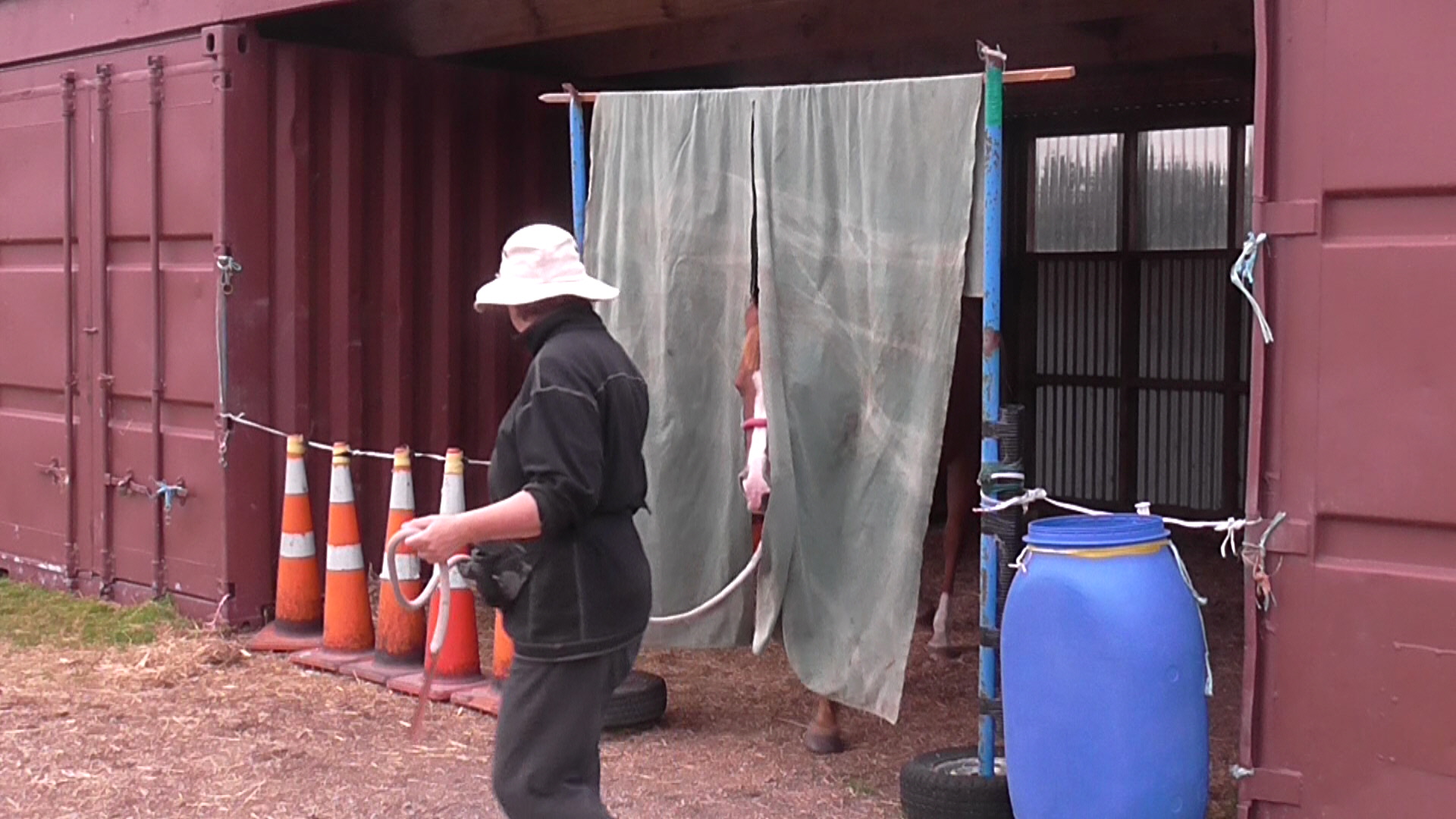
Using LP1 to teach a new skill. She learned this quickly when coming through the curtain earned a click&treat.

Do let me know if you decided to take up this big piece of training or have already trained something similar.

Leading Position Seven

I’m going to focus on Leading Position 7 next because Leading Positions 1 and 2 require us to be in front of the horse, facing away from him.

Leading Position 7 (LP7) has the handler face to face with the horse, either directly in front or a bit to the right or left of the horse’s head.

Remember that horses have a blind spot right in front of them for about 3 feet or a meter, due to the way their eyes are positioned at the side of the head. You can check this out for yourself by cupping your hands in around and in front of your nose to imitate a horse’s long nose. You will notice that you can no longer see right in front of yourself.

In order to feel safe in front of the horse facing away, we want to know that the horse backs up easily whenever we ask him to do so.

Face to face interactions include:

  • Greeting (horseman’s handshake).
  • Teaching the horse to put his nose on a hand-held target often has us standing facing. him, maybe at a bit of an angle.
  • Recall, e.g., asking the horse to come to us from the paddock.
  • Recall across unusual surfaces, and in a variety of other situations.
  • Rope Relaxation: tossing the rope around the horse’s head left to right and right to left.
  • Asking for back-up.
  • Protecting our personal space bubble while sharing time and space.
  • Backing up over a rail and recall over a rail.
  • Teaching sideways with the mirroring technique which can grow into a ‘square dance’ when it is paired with back-up and recall.
  • Teaching poll relaxation and flexion.
  • Tummy crunches

Greeting

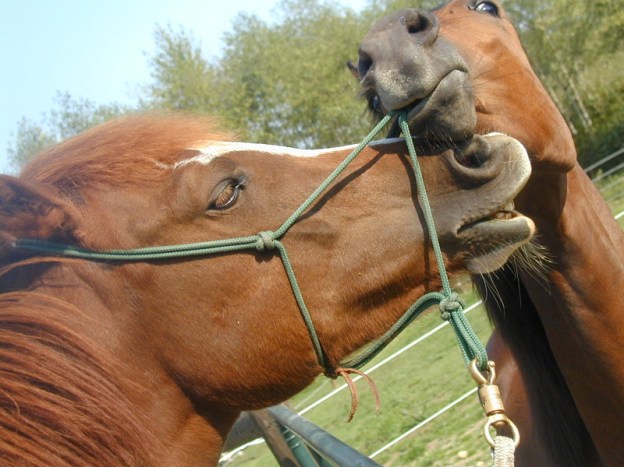
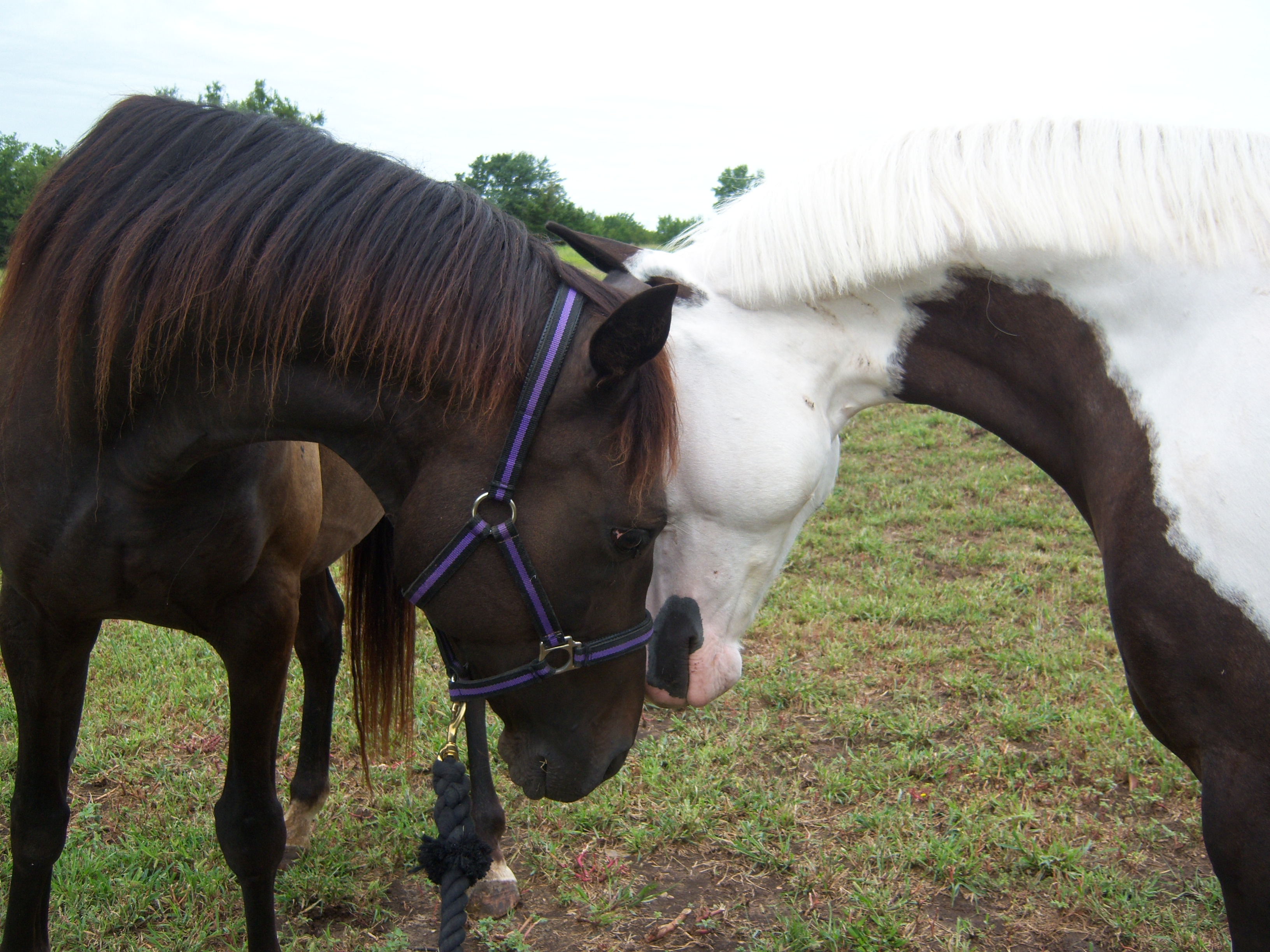
When horses approach each other front-on, they usually greet by sniffing noses. If they don’t know each other, a sparring match might follow. If there is a sparring match, typically, one horse will strike out with a front leg. The other horse then retaliates or backs away.

Eventually one will capitulate and move out of range of the other. They may play a chasing game. Or they might both tire of the game and go back to eating or snoozing.

Two horses carefully checking each other out.

So it appears that a face-on approach from the front can be recognized as a greeting or a challenge/confrontation. If the horses belong to the same ‘in-group’, the approach from the front is usually a friendly greeting showing recognition. It resembles the smile and nod we exchange with colleagues at work. 

Once we have established a positive relationship with our horse, we can maintain the bond by offering the standard ‘Greeting’ every time we approach. We extend the back of our hand – which stands in for another horse’s nose. We allow the horse to close the last inch of the gap to touch our hand, then we carry on with our business, as would another horse in the herd.   

OLYMPUS DIGITAL CAMERA

We must let the horse close the final gap between his nose and the back of our hand.

If the horse is not interested in closing the gap to touch our hand, we have powerful feedback. For some reason, at that moment, the horse is not in the mood to greet us. The horse has spoken, but are we listening? We have an opportunity to reflect on why this might be.

We want to develop this into a habit for each time we visit with the horse. To teach the horse, we use the Greet & Go procedure. This seems deceptively simple, but it is extremely powerful to both establish and maintain the connection between the horse and the person.

Generally, horses are not comfortable with having people’s hands all over their faces to ‘say hello’. Horses don’t go around patting each other on the head. Getting people to stop doing this is quite a challenge.

This desire that people have to rub on a horsse’s face is a factor in the biting urge that some horses exhibit around people.

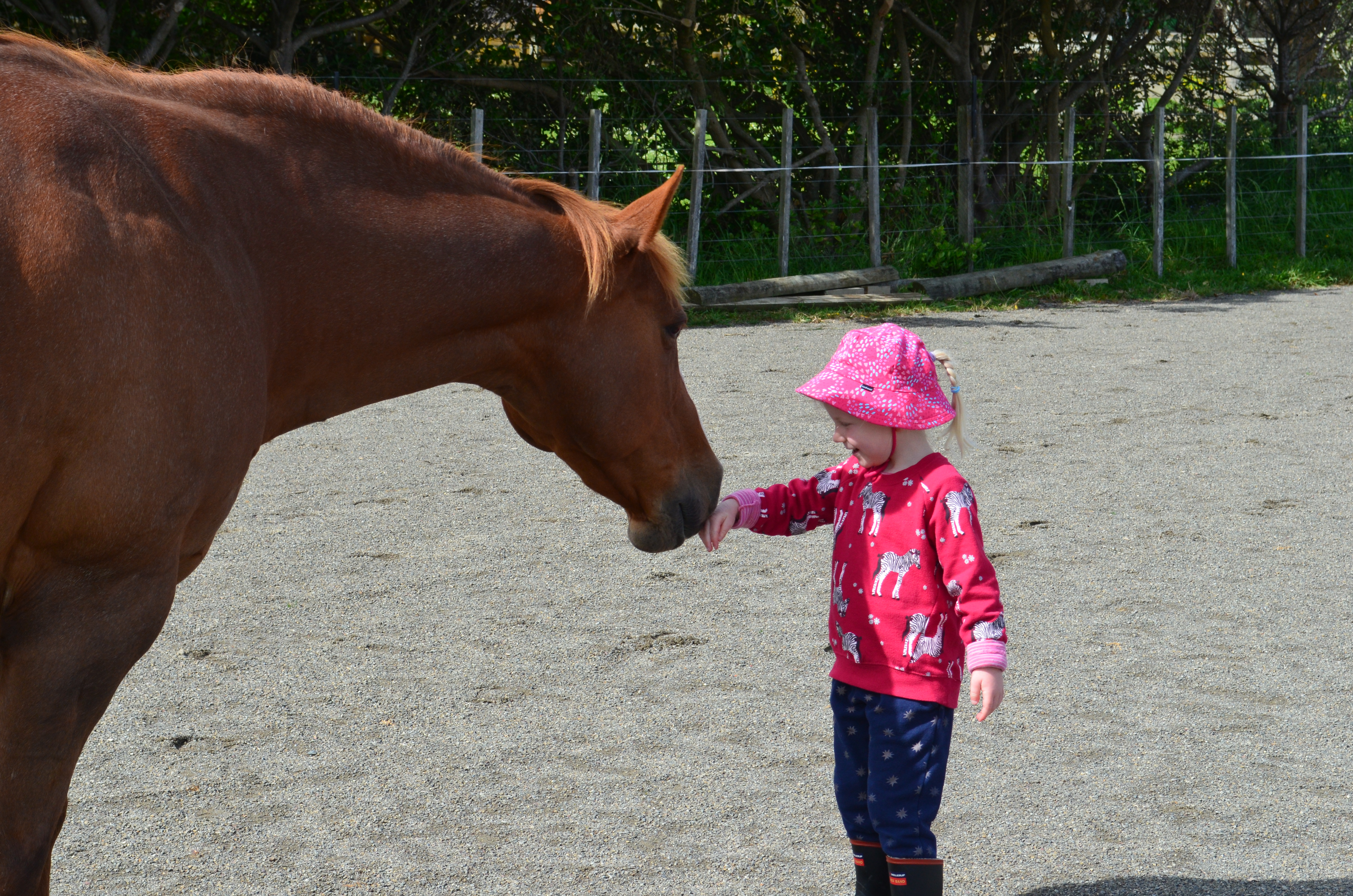
This is sometimes called “The Horseman’s Handshake”. As soon as Boots touched the back of Ada’s hand, Ada walked away. She is using the “Greet and Go” procedure. A greeting like this is the polite way to approach any horse. Once the “Greet and Go” procedure is well established, we can “Greet”, then carry on with what we plan to do with the horse.

Targeting: Teaching the horse to put his nose on a hand-held target often has us standing facing him, maybe at a bit of an angle.

We need to remember that horses have a blind spot right in front of them for about 3 feet or a meter, due to the way their eyes are positioned at the side of the head.

Teaching Back-Up Signals

Straight body with raised fingers tapping the air, plus a voice signal are our cues for backing up while in front of the horse. Here we are working on a straight back-up between two rails.

The following four short video clips show the many ways we can play with Leading Position 7. Be aware that sometimes I use a body extension to help amplify my signal to make it clearer for the horse. Once the horseunderstands what I am asking, the body extension is no longer needed. Eventually we can do most things at liberty with gesture and voice cues.

The body extension is never a ‘punishment’. It merely makes it easier for the horse to understand what behaviour will both remove the signal presssure (negative reinforcement) and earn the click&treat (positive reinforcement). It’s easy to use both methods of reinforcement at the same time. For some tasks, it makes out intention much clearer for the horse. Horses thrive an clarity. I know some people in the clicker training world find this highly problematic, but it doesn’t need to be. It depends on how much finesse, and how many different moves, we want to build into our training program.

Recall

Once the horse knows that a ‘recall’ signal (my rounded open arm position, leaning forward slightly, and voice cue) will result in a treat, we can practice from further and further away. For paddock recall, I use a whistle and reward the coming with an ample treat.

Boots likes to show off her ‘bow’ because she knows it always results in a treat .

Be sure to check out my blog number 13 (see the ‘Blog Contents Quick Links’ at the top of the page) for using thin-slicing to plan a Training Program. Each task or move you want to teach your horse needs careful consideration of how you will make it easy for the horse to understand what you want – you need to design a Training Plan for each task.

I’d love to hear which move you have chosen and how it is going.