Tag Archives: body language

Leading Position 4 – Beside Ribs

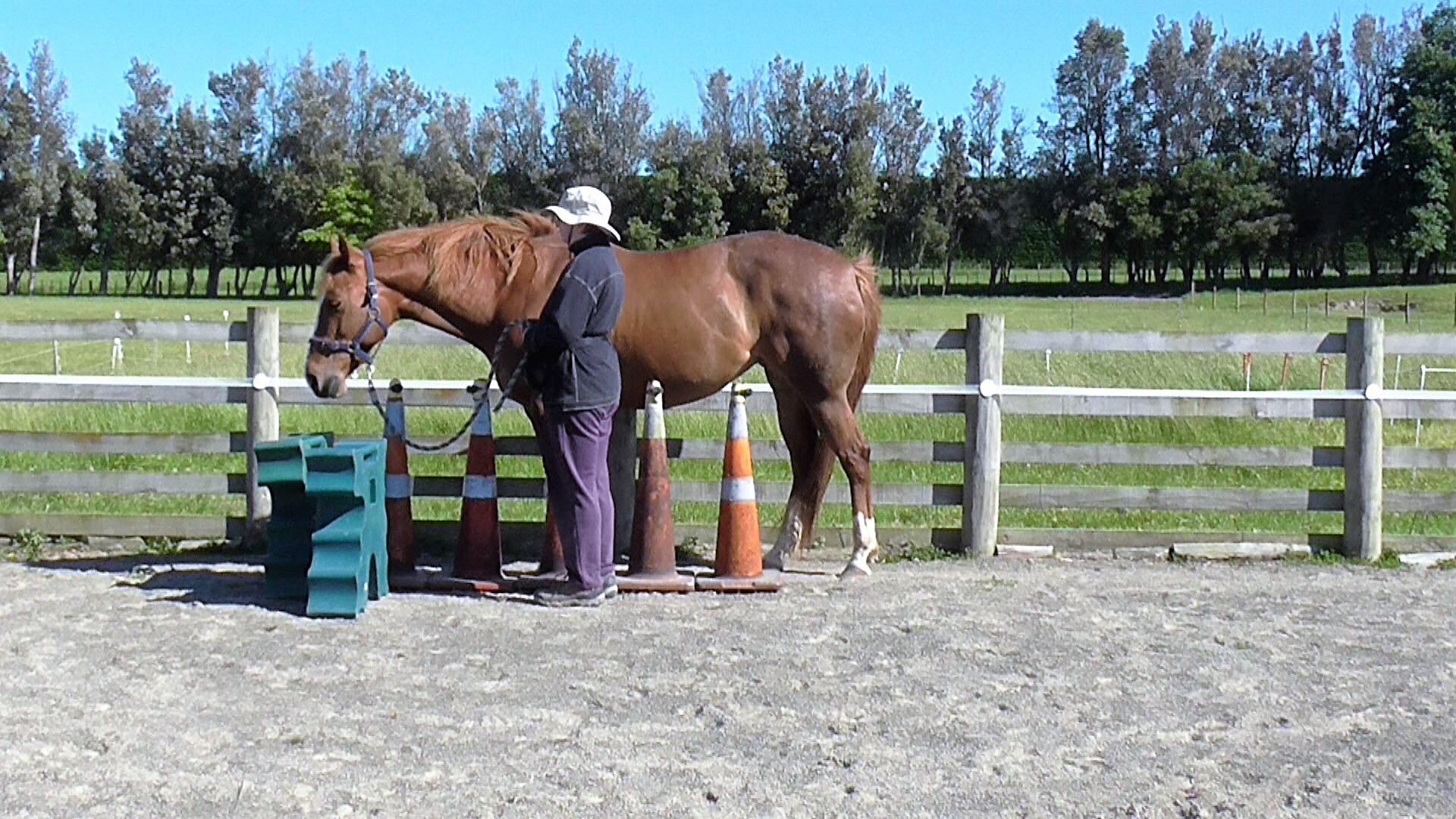
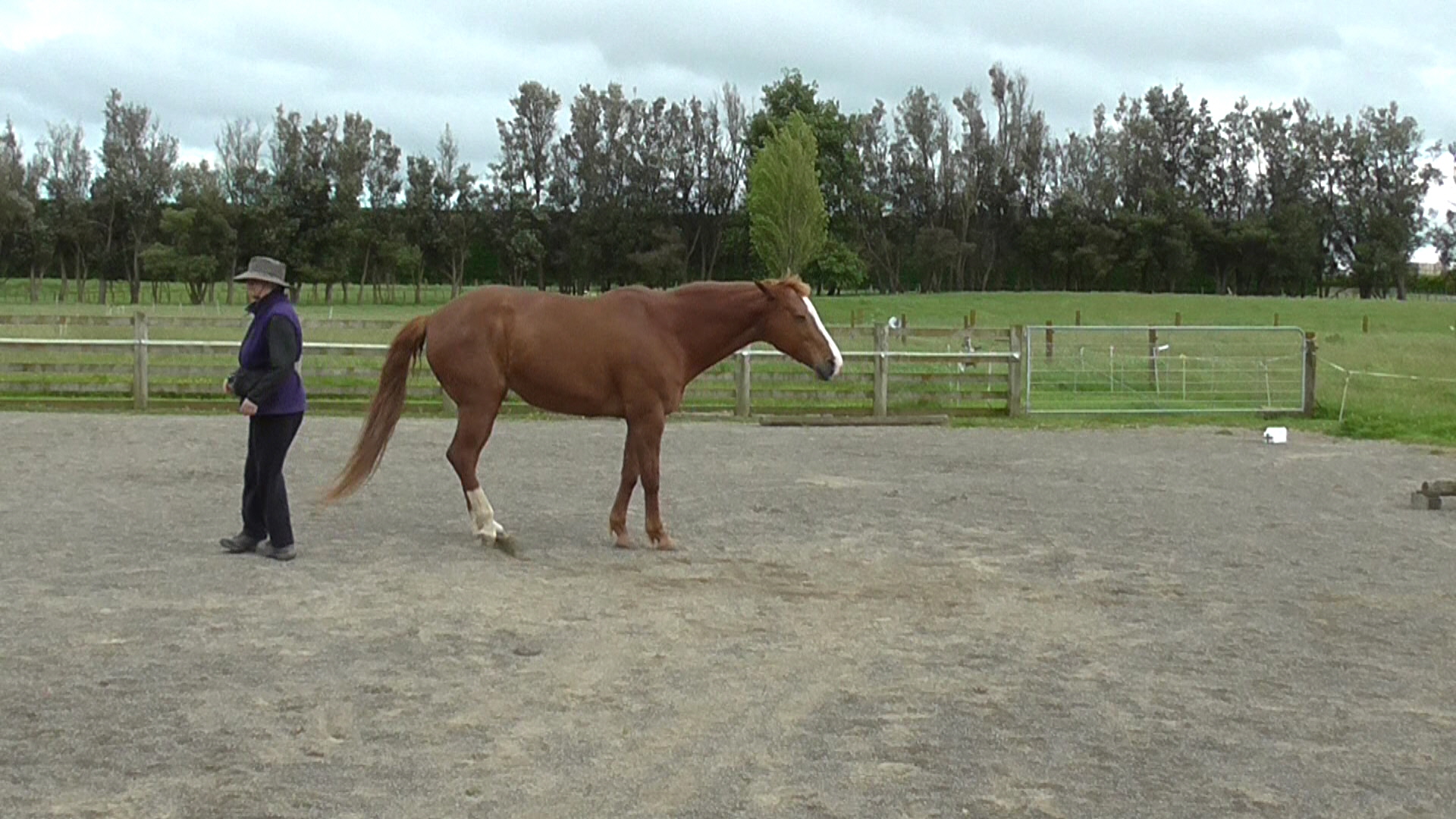
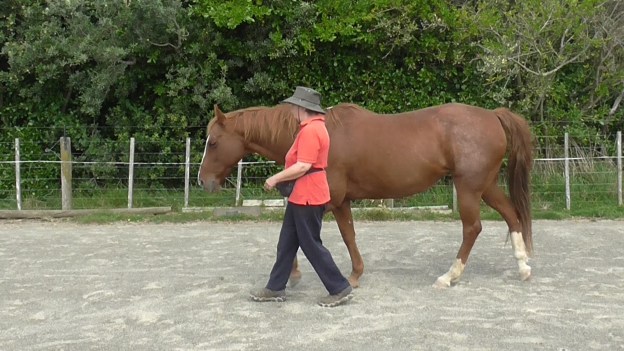
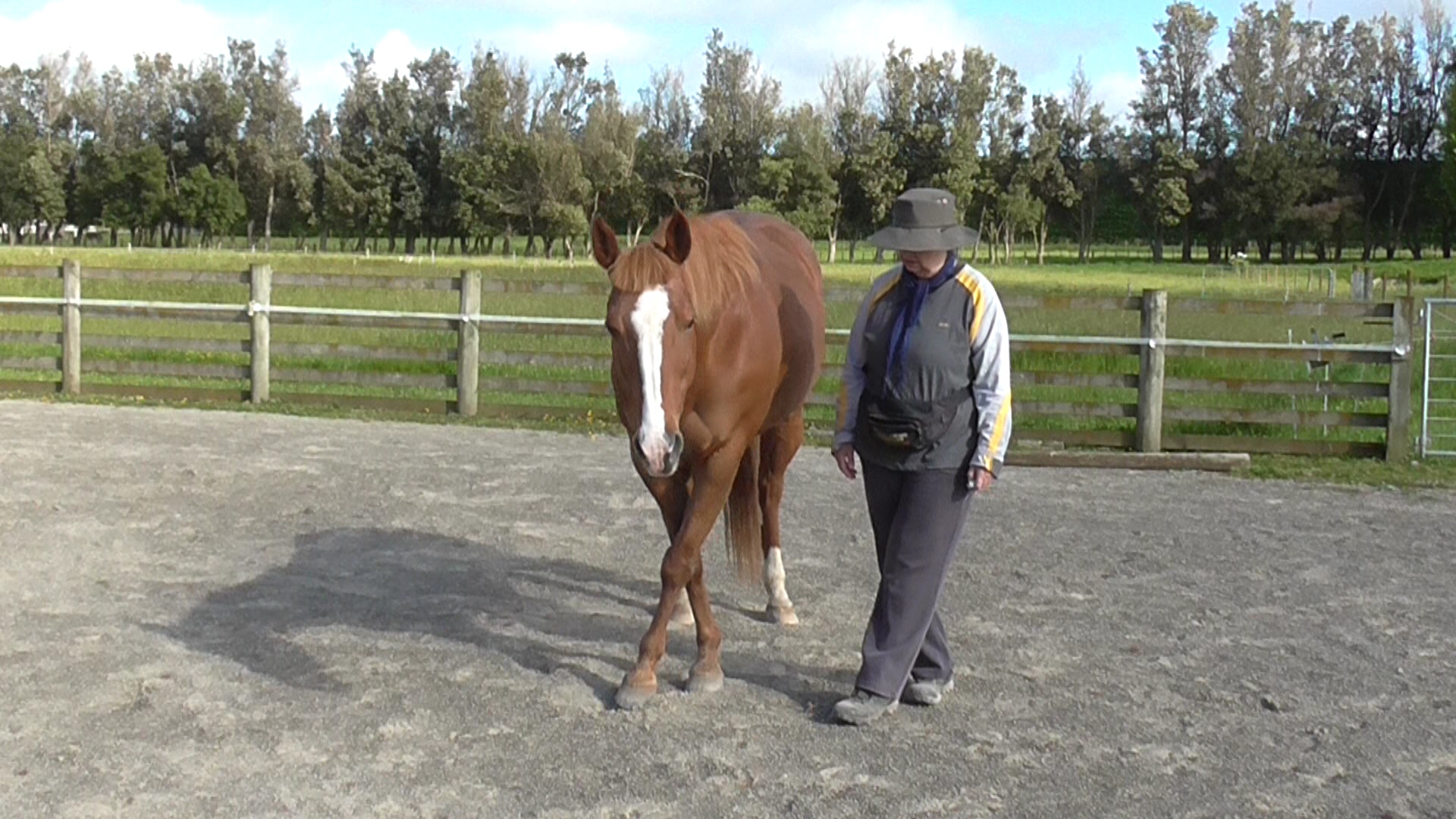
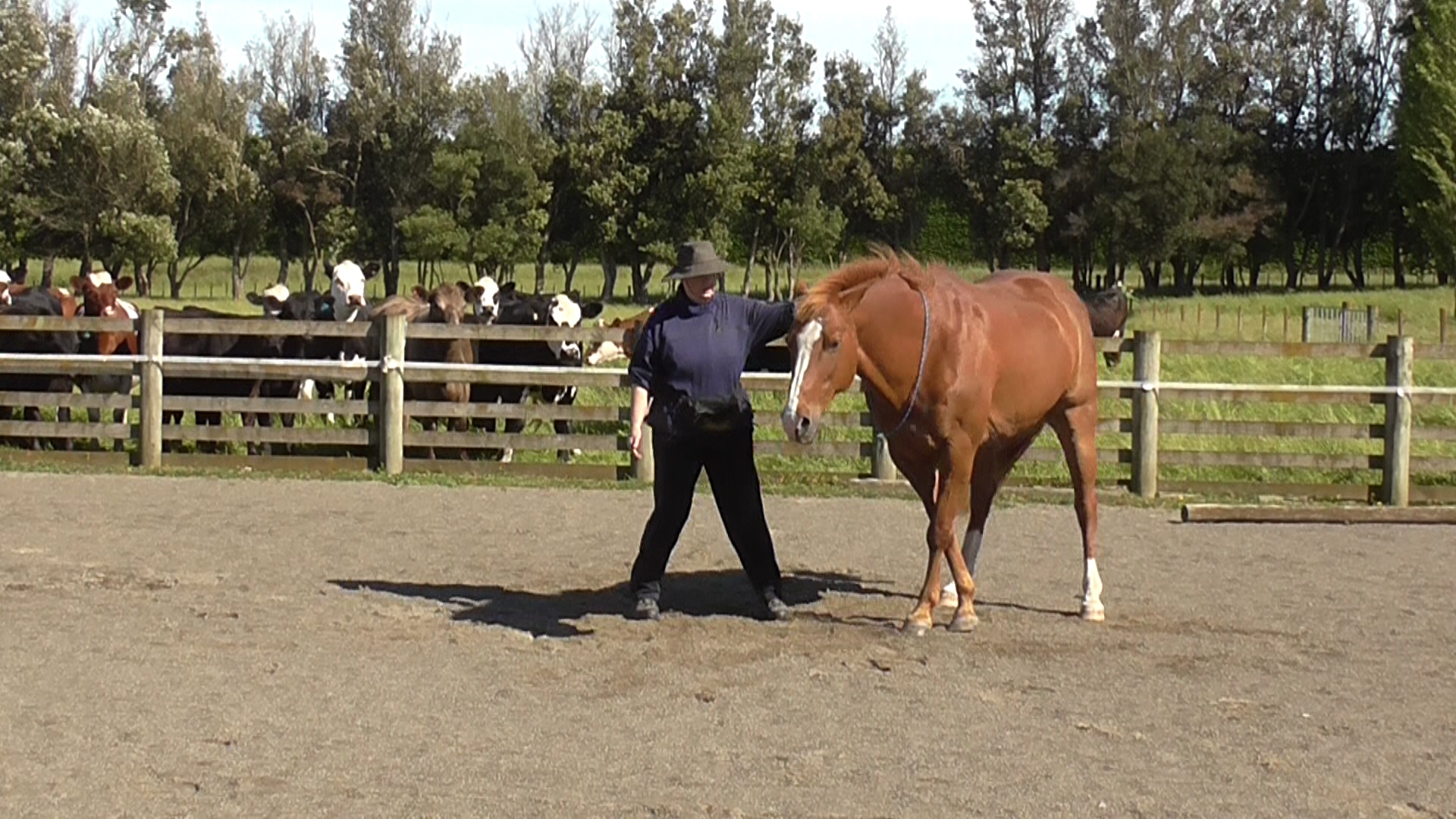
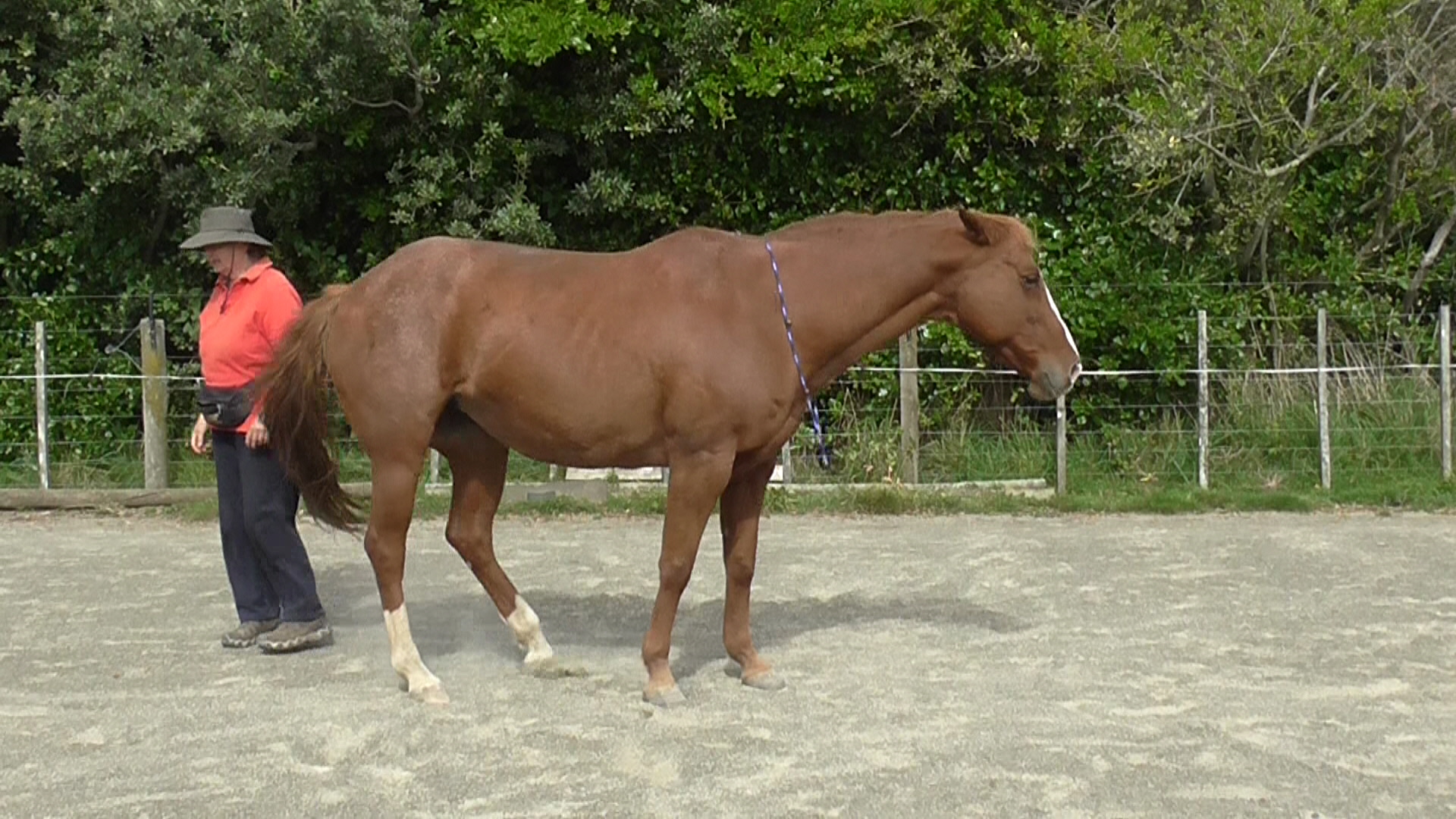
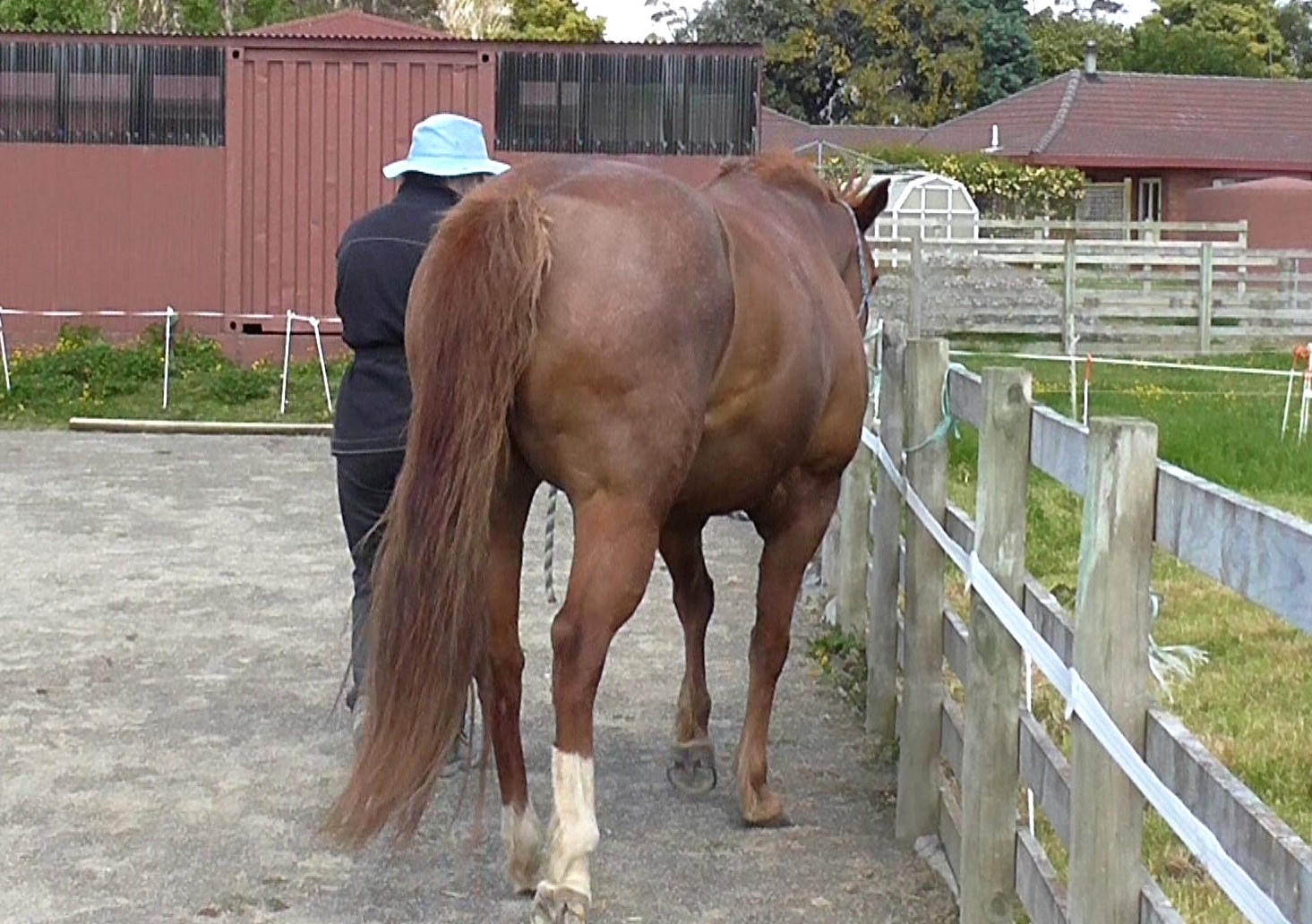
If we have first taught and consolidated and generalized Leading Position 3 (beside neck/shoulder), it’s usually easy to move from LP3 into LP4 (beside ribs).

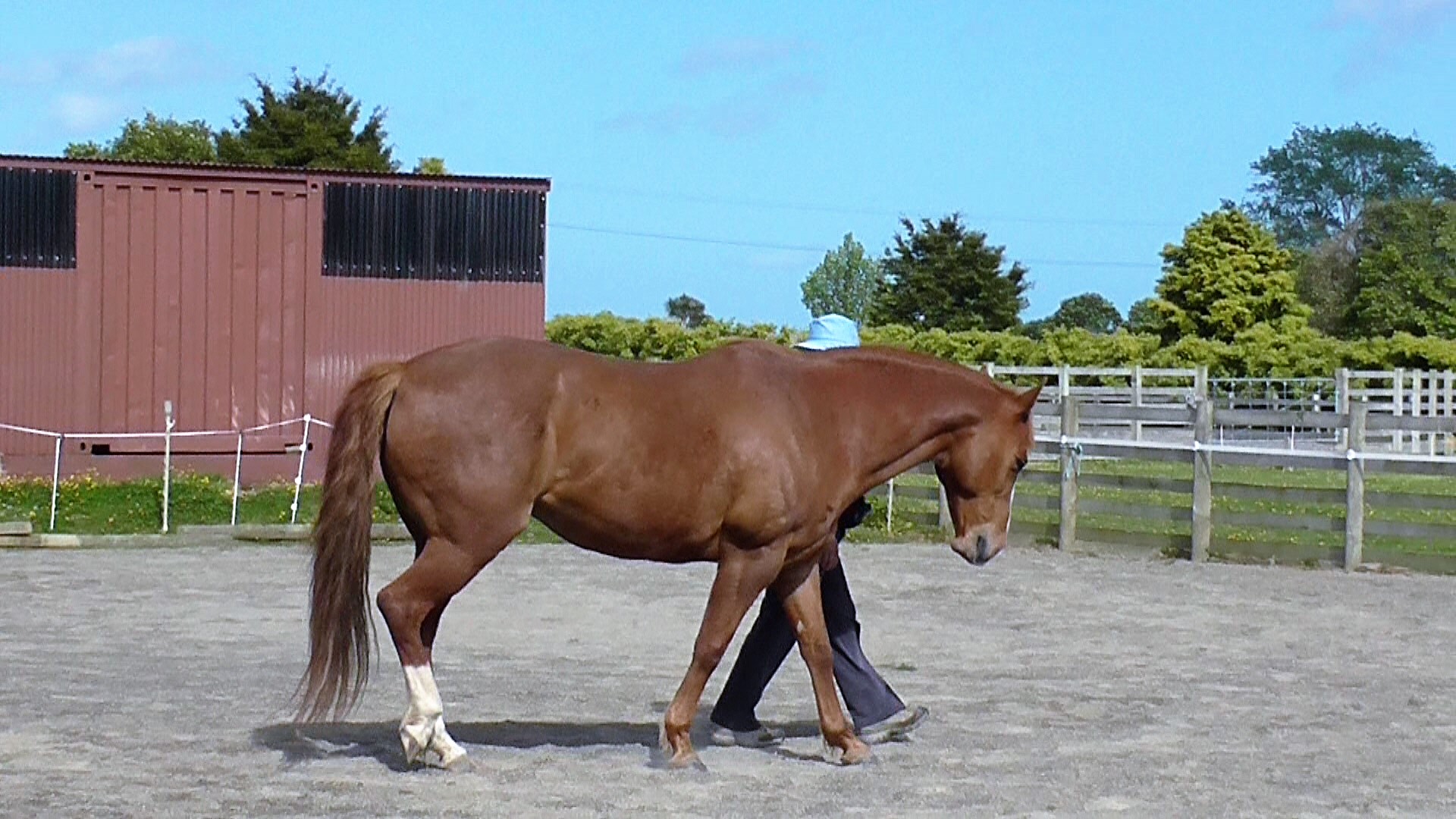
This leading position encourages the horse to move with us with his shoulder well out in front. The handler is where he or she would be when riding. In fact, riding is Leading Position 4 sitting on the horse rather than walking on the ground with him.

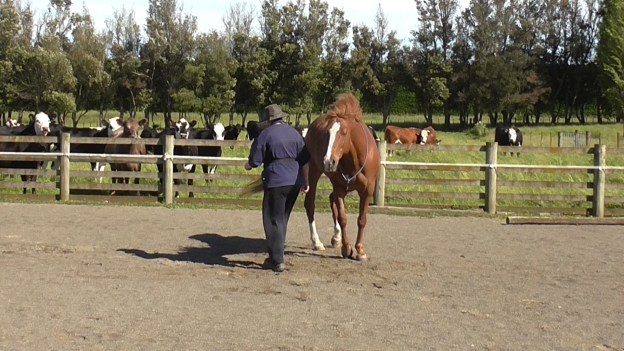
I sometimes use a body extension to clarify the task for the horse from a distance. A light touch signal just behind the withers for ‘walk on’, (as well as all the ‘walk on’ body language – big breath in & raised energy, step off with outside leg, voice cue) helps to make our intent clear – ie. we want to stay beside the horse’s ribs while we walk along together. The other use of a body extension is to indicate, by bringing it forward, that we don’t want the horse to turn toward us, but to walk on straight.

We also ensure walking straight by using a lane (horse in the lane, handler outside the lane) and by walking in straight lines between a series of targets. Once the horse understands the task, a small finger tap behind the withers and our voice signal, are usually all that is needed.

to summarise, if we have taught the horse that a tap behind the withers (with our fingers, eventually phasing out the body extension), the tap, a deep breath in and a voice ‘walk on’ – are all signals to move forward, these will continue to make sense to the horse when we mount up if we intend to ride.

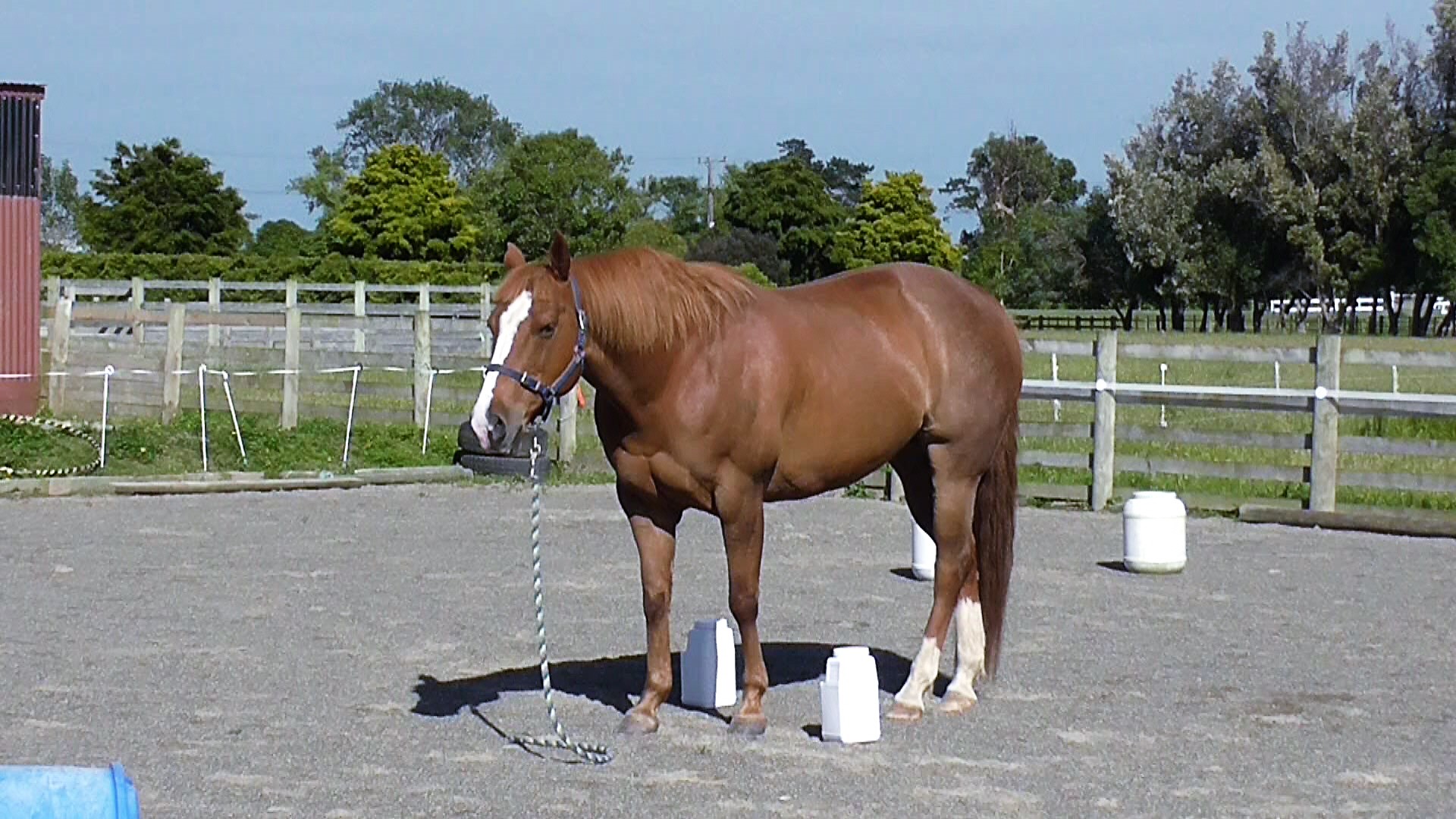
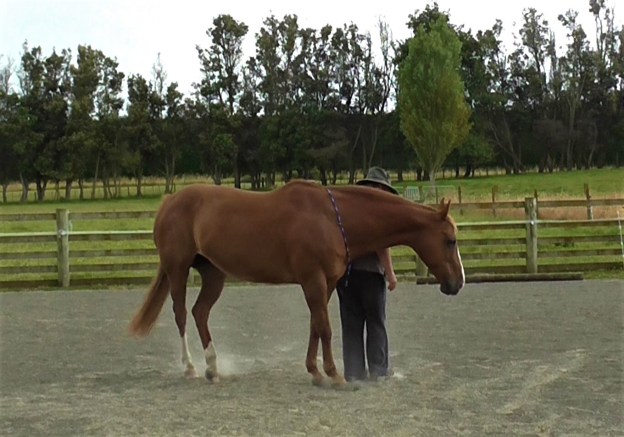
The main concern for the horse when we ride is that most of our body language suddenly becomes invisible to him. Here Boots is intent on targeting the body extension which I’ve left on the ground.

The rider suddenly disappearing from view is a big deal for horses because horses are, by nature, strongly tuned in to visual body language. Body language plays a key role in equine culture. An empathetic trainer will give the horse ample time and opportunity to adjust to the new touch and weight shift signals, plus the many balance adjustments that the horse has to learn.

Riding has us in Leading Position 4, behind the horse’s withers. If we teach moving forward in this position on the ground, we are building the horse’s confidence in having half his body out in front of us. For timid horses, this can be challenging. The cues/signals we teach on the ground will stand us in good stead if we intend to ride. If we are working with a young horse which will be ridden, this training gives him a major head start with the ridden experience.

Training Plan 18

Aim:

To have the horse comfortable walking along with the handler when the handler’s position is behind the horse’s withers, alonside the horse’s ribs.

Environment:

  • Horse in an area where he is usually relaxed and confident.
  • Herd buddies not able to interfere but in view if possible.
  • Horse in a learning frame of mind.
  • A safe stretch of fence or a waist-high lane.
  • Series of destination mats or nose targets for the teaching phase, .
  • Body extension to clarify signal as necessary.
  • Halter and lead.

Slices:

See clips #55 and #56 in my HorseGym with Boots playlist. Clip 55 also looks ahead to when we want to walk alongside the hindquarters, which is the topic of the next blog.

Click here for Clip #55.

Click here for Clip #56

  1. Ensure the horse is comfortable walking between you and a safe fence (or in a lane) in LP3 (beside neck/shoulder).
  2. When the horse is relaxed in LP3, glide back so you are walking just behind his withers. After a step or two, relax (click&treat). Be sure to let the lead rope flow out to keep a float (smile) in it as you drift back, so you don’t give him a ‘slow down’ text message up the rope without realizing it. Move promptly up to the horse’s head to deliver the treat so he is not tempted to turn toward you. Walk on again in LP3 and glide back into LP4. It can be quite difficult for us to remain in LP4. For some reason, most people, including me, have a tendency to creep up toward the horse’s neck and shoulders.
  3. This smooth letting out of the rope is another skill it’s good to practice first with another person standing in as the horse.
  4. Repeat 2, adding a few more steps in LP4 each time before you relax (click&treat).
  5. If we are working along a fence rather than in a lane, using a body extension makes it easier to keep our position behind the withers because we can bring the body extension forward to gently block any tendency to turn toward us. The instant he goes straight, put the body extension back in neutral by your side or lying lightly behind the horse’s withers.
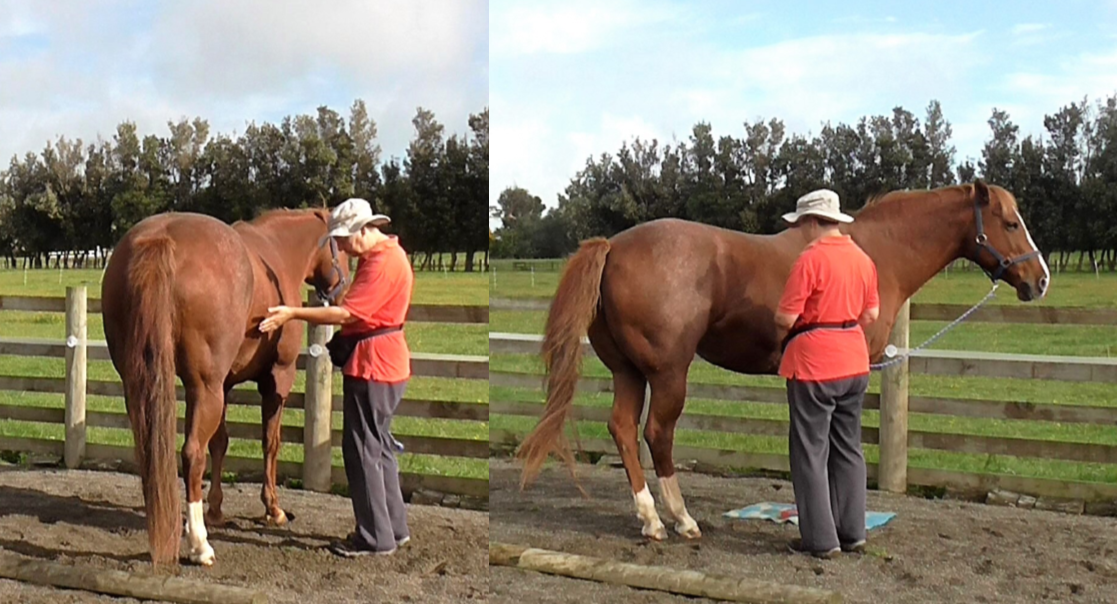
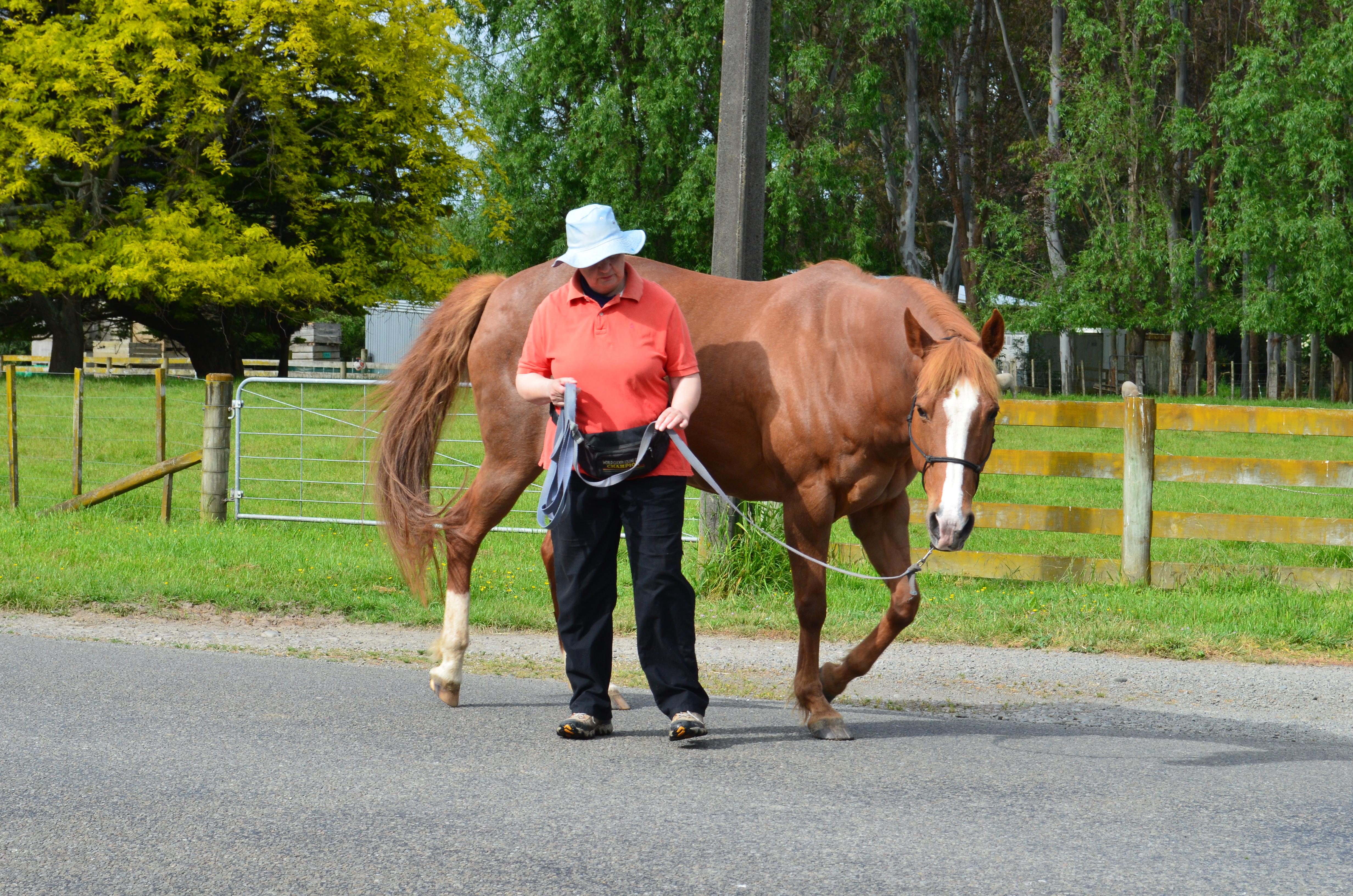
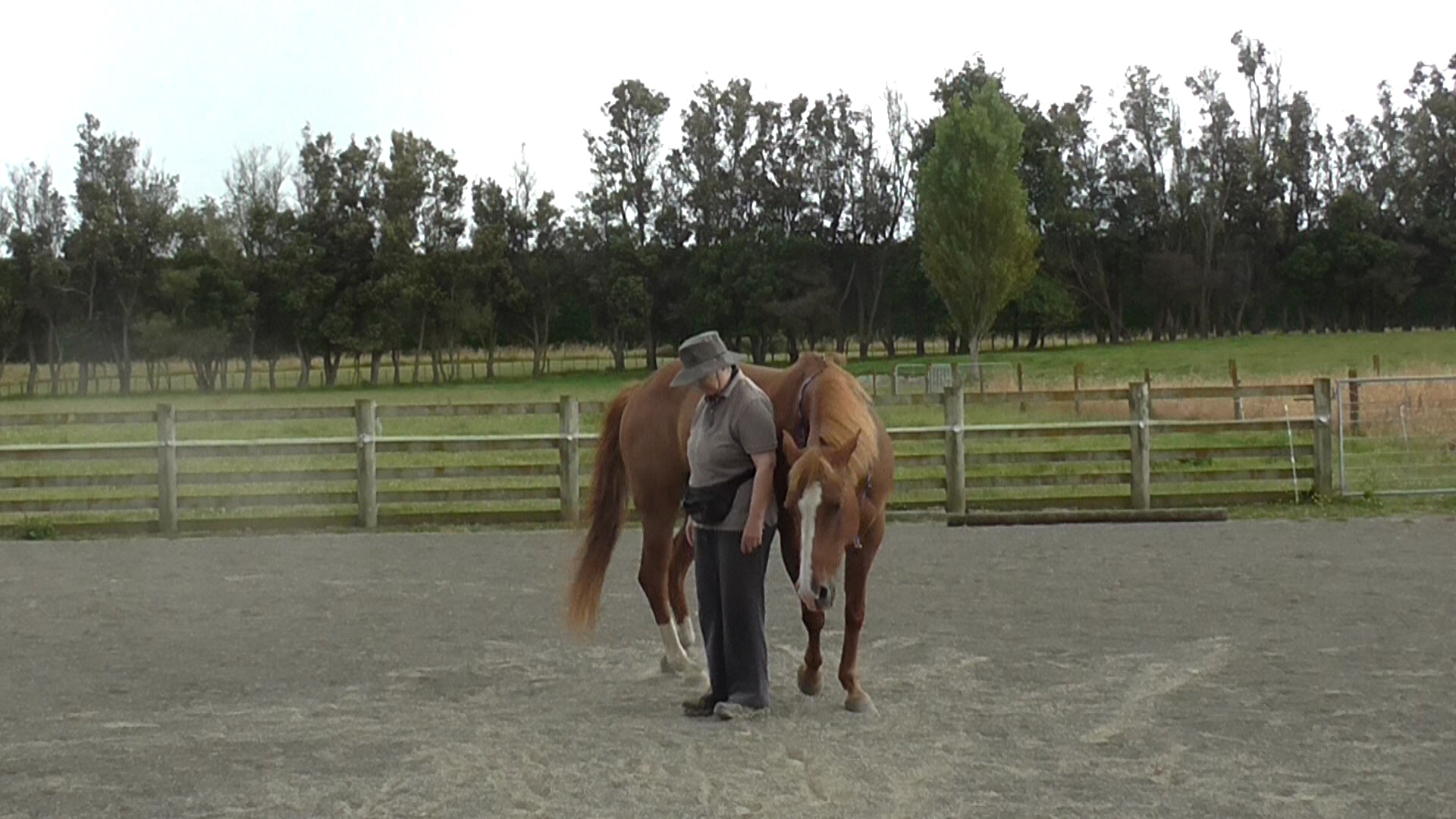
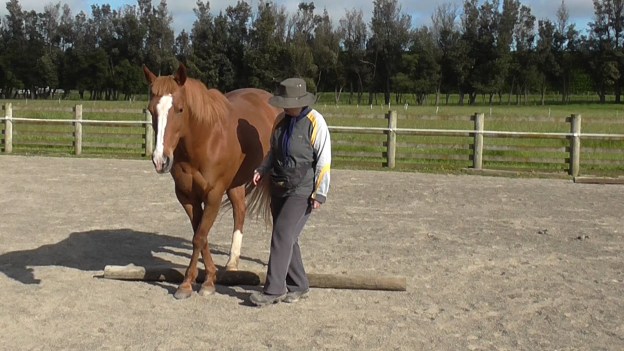
  6. It can help to keep our hand behind lying gently behind the withers as we walk with the horse, as Bridget is doing in the final photo of the blog. This might not be an option if the horse is very small or very tall.
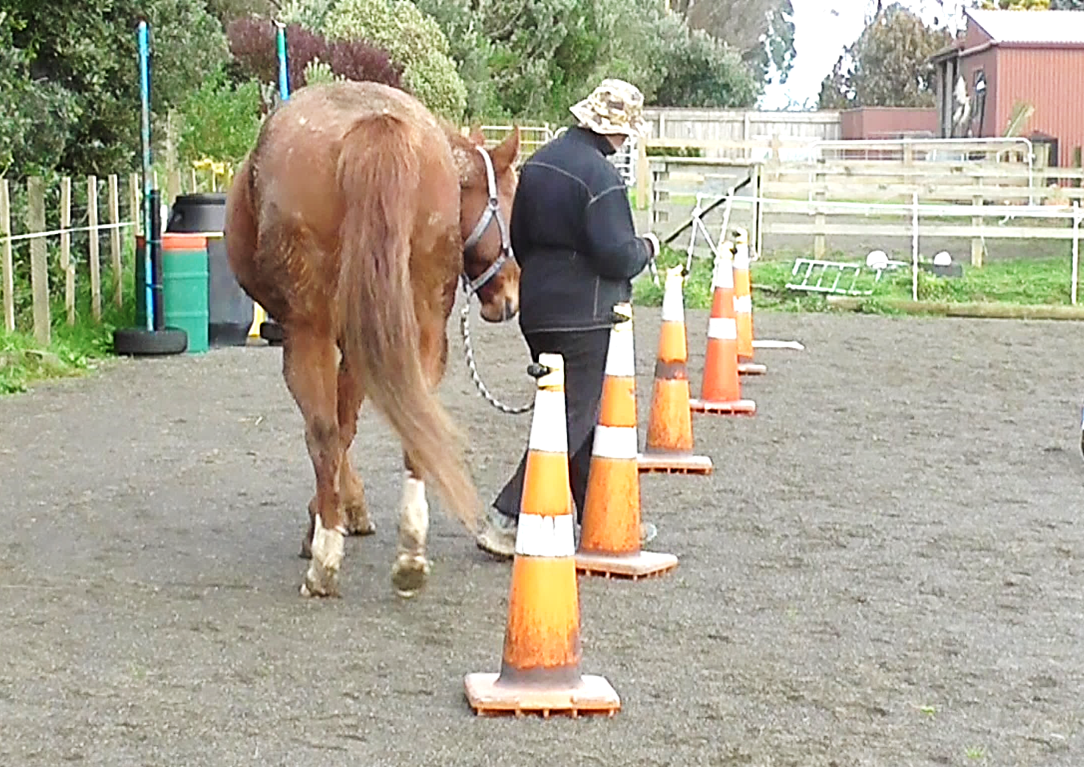
  7. If you use mat or nose targets, set these out and ask the horse to walk between them, stopping for a click&treat as he reaches each one. Return to LP4 after delivering each treat and ask for the ‘walk on’ with a gentle tap behind the withers.
  8. If the horse tends to move his shoulder toward you rather than stay straight along the fence, use your body extension to disturb the air alongside his neck.
  9. If the horse has a habit of moving his shoulders into you, create an Individual Education Program to address just this issue. It would include a release (click&treat) the instant the horse responds to the signal pressure from the body extension swung forward in the air next to his neck, inhibiting his shoulder movement toward you. Once he realizes that the release/click point is when he stays straight, you can begin to gradually add more steps forward before you relax (click&treat).

LP4 asks the horse to have his eyes, nose and shoulders well out ahead of us. That can be worrying for an anxious type horse who is more comfortable following than being out in front. Bolder, more confident horses will may find it easier. If you are developing a riding horse, it is important to understand this lack of confidence to ‘be out in front’.

By setting up mats or nose targets, we can make this a much more interesting game. The horse will begin to look for the next target so he can earn his next click&treat.

For horses who are anxious about leaving their home area or their herd mates, this is a great exercise to give them a brand new focus for going out and about with their handler.

We can collect plastic drink bottles for nose targets and hang them around our training area. Then we can devise different walking patterns between the various targets, including turns and weaves. A series of rags hung on fences or shrubbery can also make interesting targets (be aware of horses who may try to eat them).

The activity of walking along together with the hand or stick behind the withers needs to become comfortable and ho-hum for the handler and the horse.

If we want to ride out or walk out, setting up a series of nose targets along the way gives the horse something to seek out. His mind will be engaged in the next target rather than the fact that he is moving further away from his friends or barn area.

At first we’d have the targets close together. As the horse gets keen on the game, we can gradually spread them further and further apart. It also works to use something like a Frisbee or a ball as a target. We can throw it out ahead of us, move to target it, throw it again, and so on.

If the horse is very barn or buddy sweet, we can lay out the target destinations in an arc. The arc will first guide the horse away from where he sees his ‘safety’, and then closer again. Over days and weeks, we can gradually set the top of the arc further and further away. One day the horse’s desire to seek out his targets will eclipse his need to get back to the barn or his buddies.

If the horse has developed the habit of rushing home or rushing to the field, we can slow the rushing by having him seek out targets on the way home or on the way to the field.

Summary of LP4

Leading Position 4 became important to me when I was preparing my horse for riding. When I came to teach long-reining, it was an excellent intermediate position to having the horse comfortable with me walking right behind.

Mat or nose destinations enable us to play the nose or mat target game, which gives the horse an incentive to move smoothly from halt into walk (or trot) and back to halt at the next destination. Since ‘go’ and ‘whoa’ signals are the backbone of all of our communication with horses, the targeting games have many positive outcomes.

When we move the horse around us on a long line (lunging), our position usually moves between LP3, LP4 along with LP8 when we face the horse’s side.
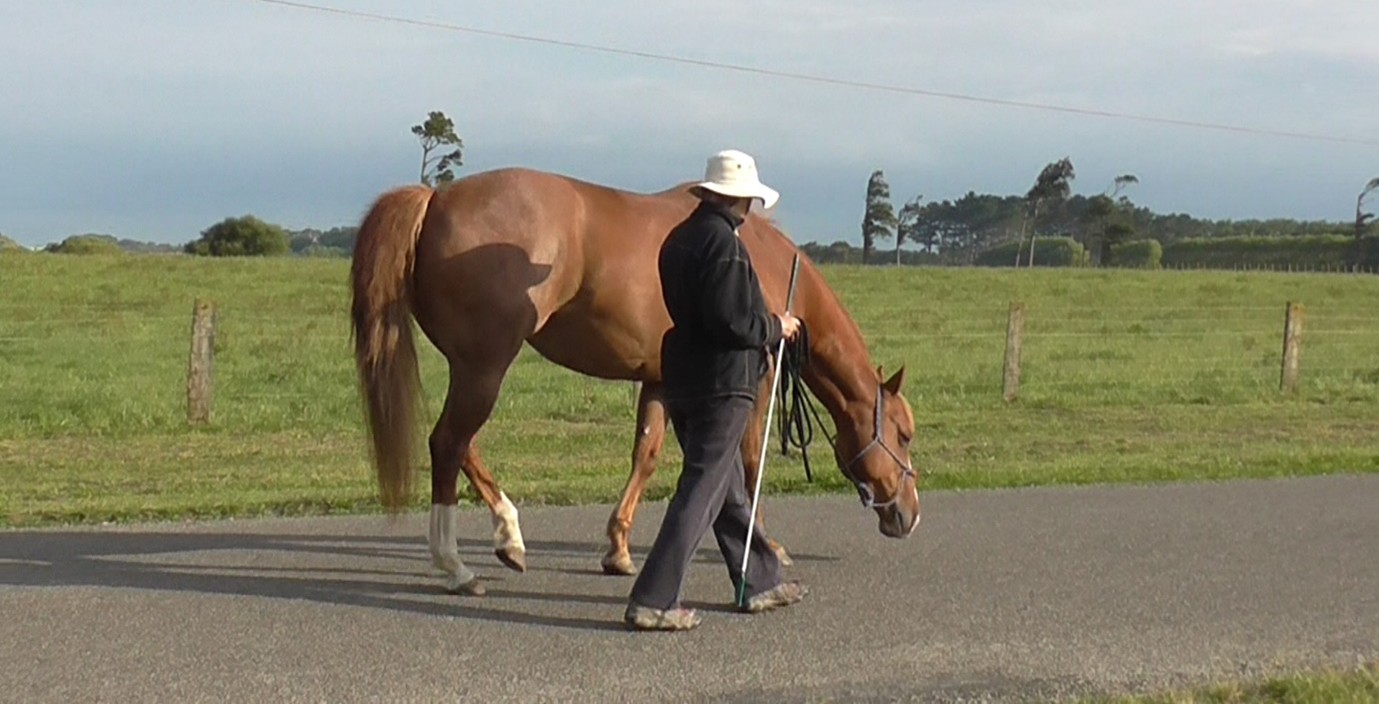
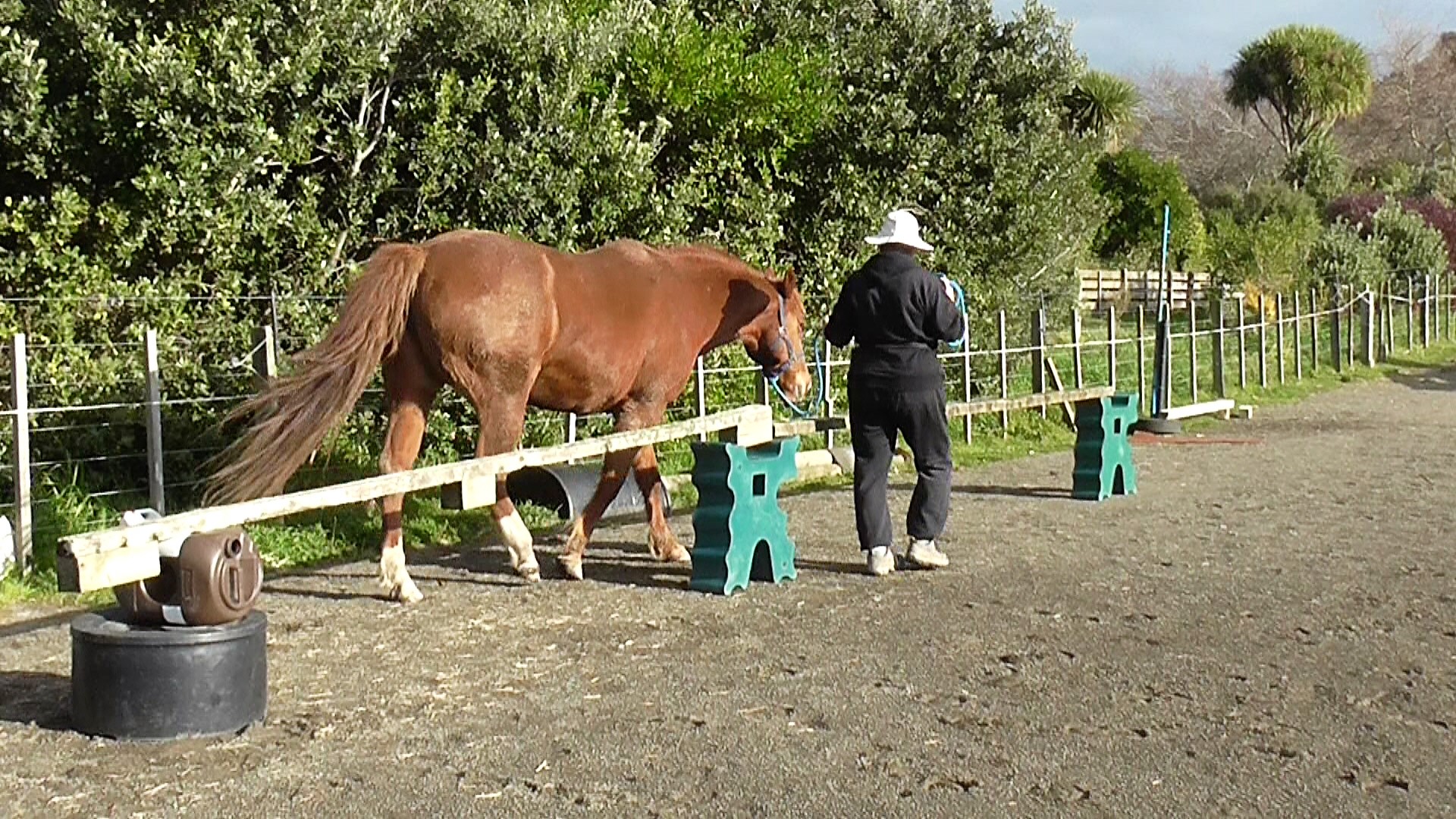
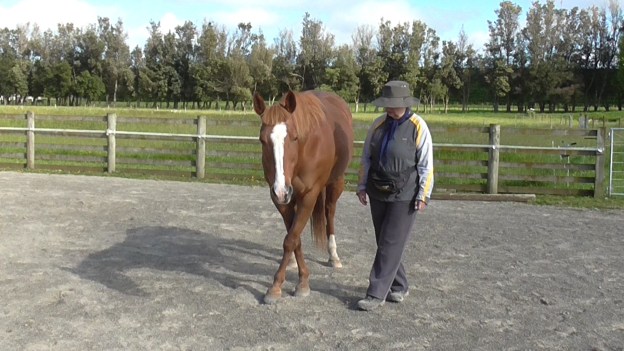
Walking out and about on the road in LP4.

Leading Position Seven

I’m going to focus on Leading Position 7 next because Leading Positions 1 and 2 require us to be in front of the horse, facing away from him.

Leading Position 7 (LP7) has the handler face to face with the horse, either directly in front or a bit to the right or left of the horse’s head.

Remember that horses have a blind spot right in front of them for about 3 feet or a meter, due to the way their eyes are positioned at the side of the head. You can check this out for yourself by cupping your hands in around and in front of your nose to imitate a horse’s long nose. You will notice that you can no longer see right in front of yourself.

In order to feel safe in front of the horse facing away, we want to know that the horse backs up easily whenever we ask him to do so.

Face to face interactions include:

  • Greeting (horseman’s handshake).
  • Teaching the horse to put his nose on a hand-held target often has us standing facing. him, maybe at a bit of an angle.
  • Recall, e.g., asking the horse to come to us from the paddock.
  • Recall across unusual surfaces, and in a variety of other situations.
  • Rope Relaxation: tossing the rope around the horse’s head left to right and right to left.
  • Asking for back-up.
  • Protecting our personal space bubble while sharing time and space.
  • Backing up over a rail and recall over a rail.
  • Teaching sideways with the mirroring technique which can grow into a ‘square dance’ when it is paired with back-up and recall.
  • Teaching poll relaxation and flexion.
  • Tummy crunches

Greeting

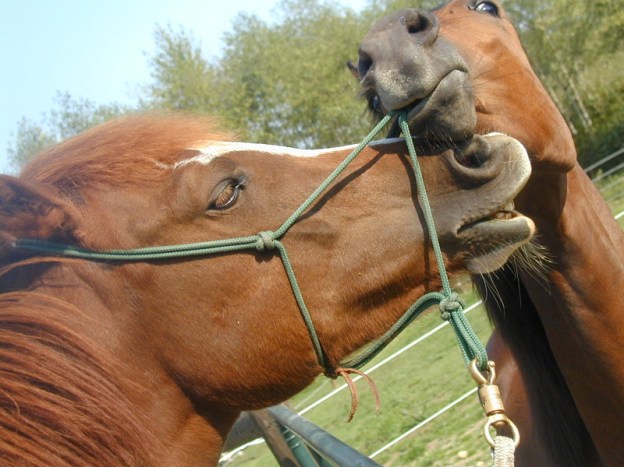
When horses approach each other front-on, they usually greet by sniffing noses. If they don’t know each other, a sparring match might follow. If there is a sparring match, typically, one horse will strike out with a front leg. The other horse then retaliates or backs away.

Eventually one will capitulate and move out of range of the other. They may play a chasing game. Or they might both tire of the game and go back to eating or snoozing.

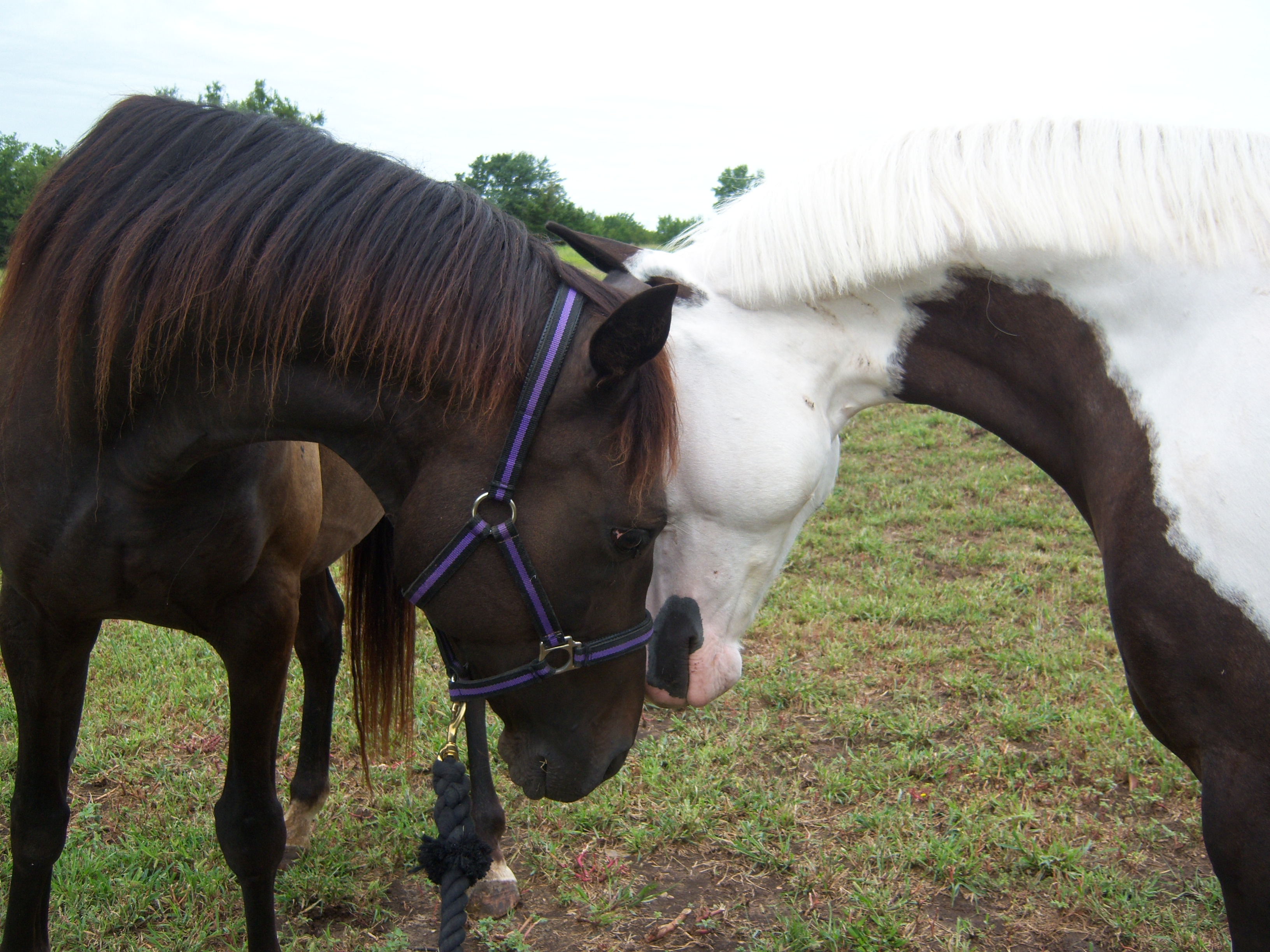
Two horses carefully checking each other out.

So it appears that a face-on approach from the front can be recognized as a greeting or a challenge/confrontation. If the horses belong to the same ‘in-group’, the approach from the front is usually a friendly greeting showing recognition. It resembles the smile and nod we exchange with colleagues at work. 

Once we have established a positive relationship with our horse, we can maintain the bond by offering the standard ‘Greeting’ every time we approach. We extend the back of our hand – which stands in for another horse’s nose. We allow the horse to close the last inch of the gap to touch our hand, then we carry on with our business, as would another horse in the herd.   

OLYMPUS DIGITAL CAMERA

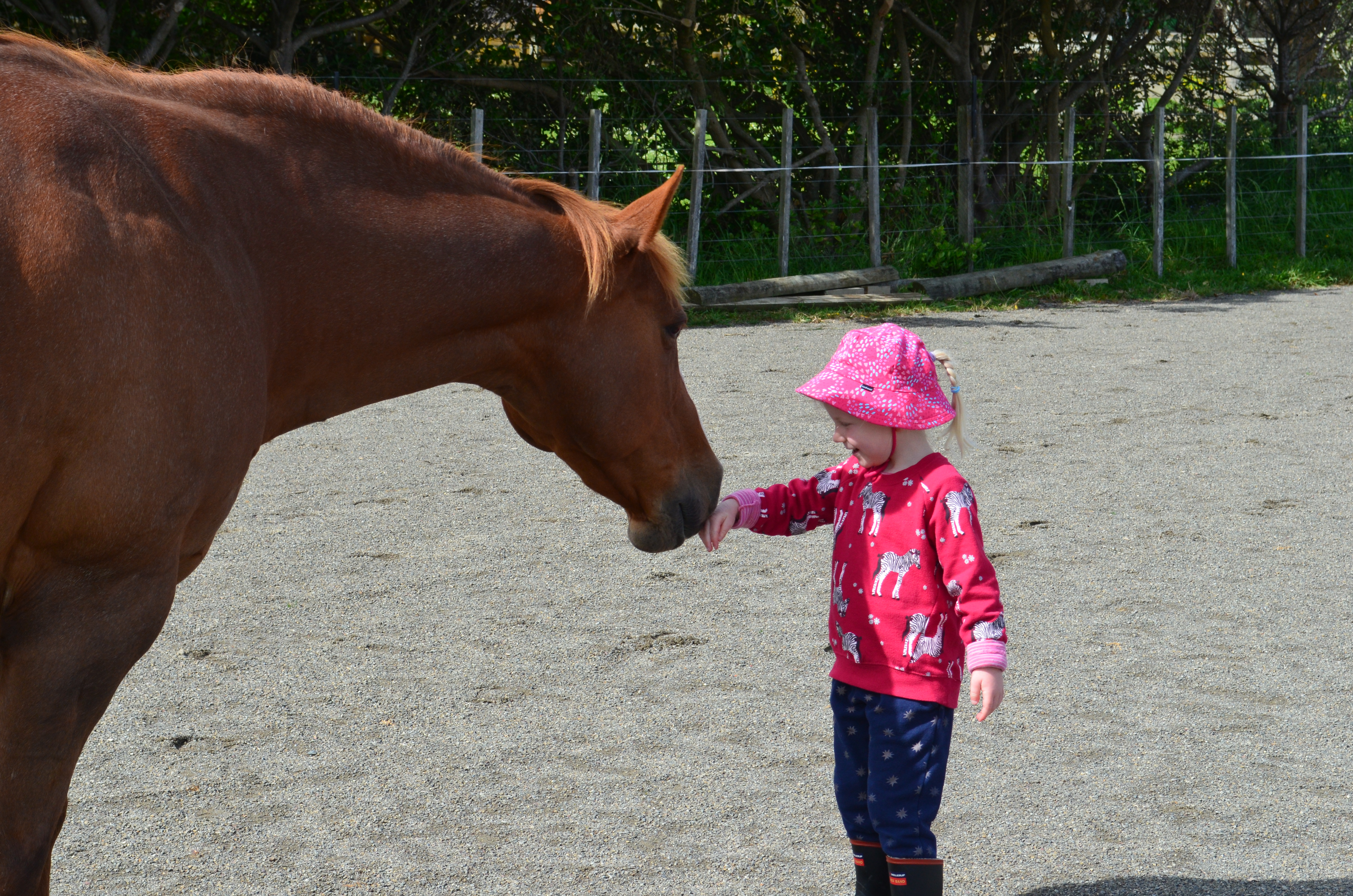
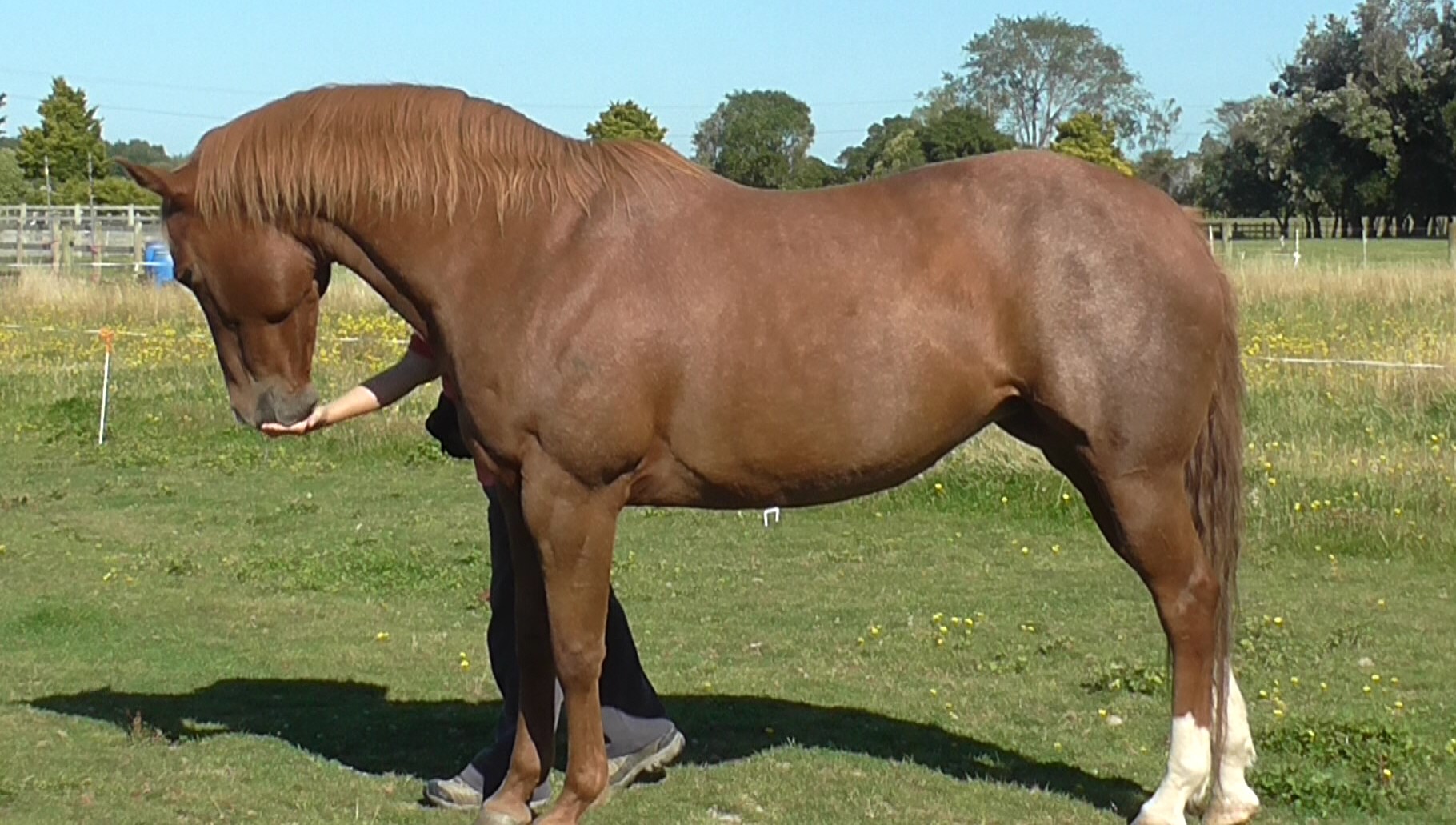
We must let the horse close the final gap between his nose and the back of our hand.

If the horse is not interested in closing the gap to touch our hand, we have powerful feedback. For some reason, at that moment, the horse is not in the mood to greet us. The horse has spoken, but are we listening? We have an opportunity to reflect on why this might be.

We want to develop this into a habit for each time we visit with the horse. To teach the horse, we use the Greet & Go procedure. This seems deceptively simple, but it is extremely powerful to both establish and maintain the connection between the horse and the person.

Generally, horses are not comfortable with having people’s hands all over their faces to ‘say hello’. Horses don’t go around patting each other on the head. Getting people to stop doing this is quite a challenge.

This desire that people have to rub on a horsse’s face is a factor in the biting urge that some horses exhibit around people.

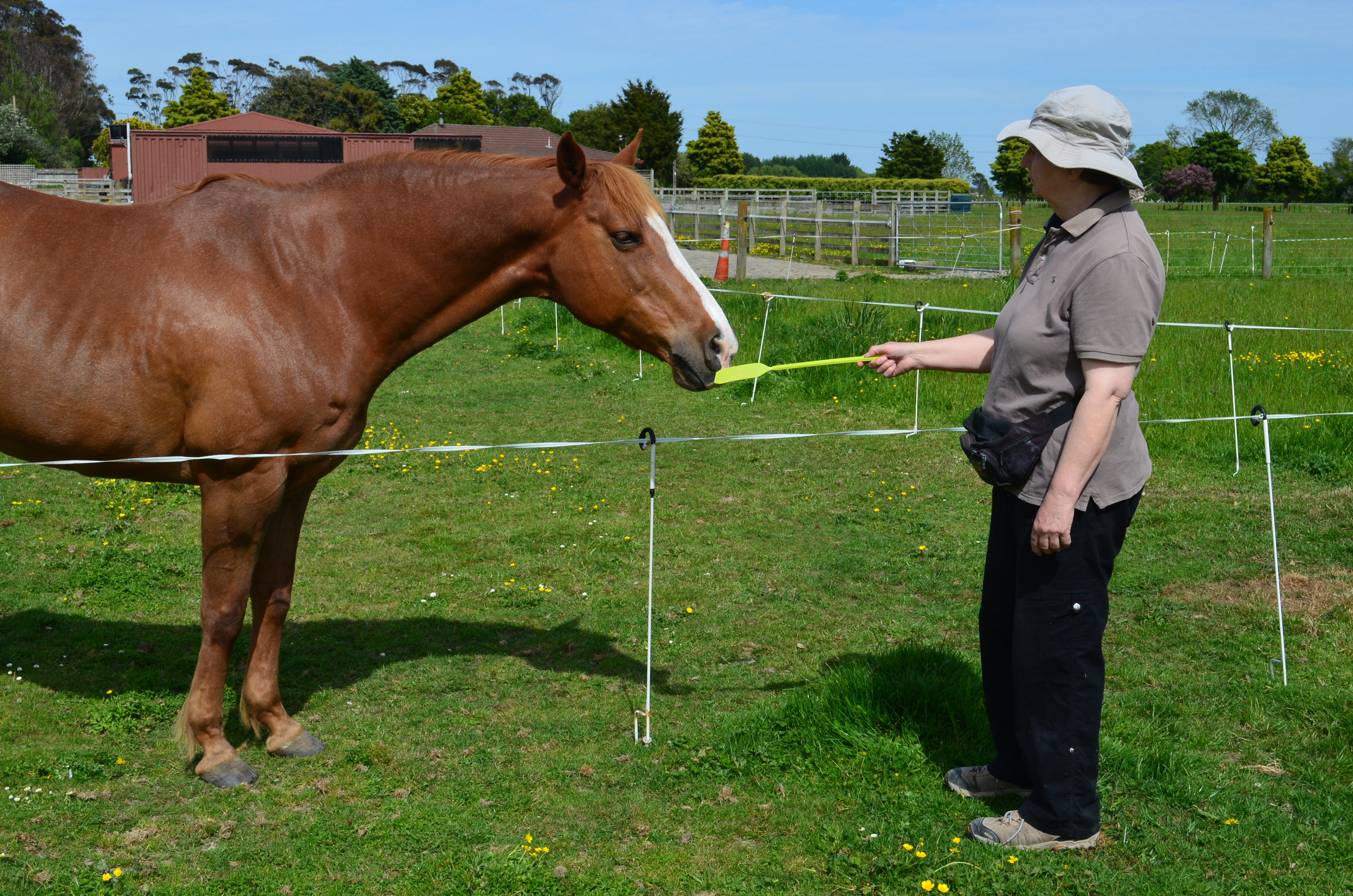
This is sometimes called “The Horseman’s Handshake”. As soon as Boots touched the back of Ada’s hand, Ada walked away. She is using the “Greet and Go” procedure. A greeting like this is the polite way to approach any horse. Once the “Greet and Go” procedure is well established, we can “Greet”, then carry on with what we plan to do with the horse.

Targeting: Teaching the horse to put his nose on a hand-held target often has us standing facing him, maybe at a bit of an angle.

We need to remember that horses have a blind spot right in front of them for about 3 feet or a meter, due to the way their eyes are positioned at the side of the head.

Teaching Back-Up Signals

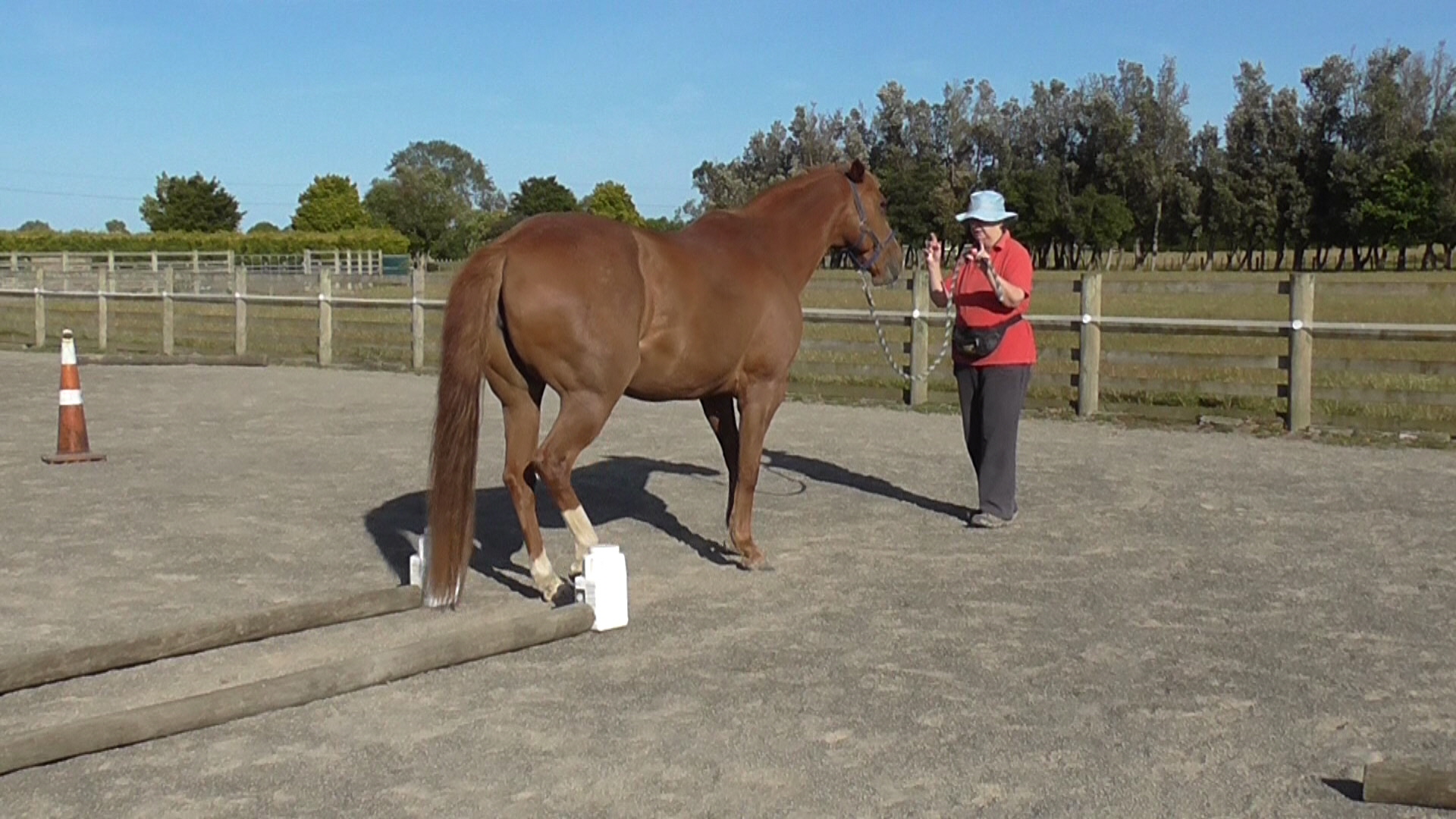
Straight body with raised fingers tapping the air, plus a voice signal are our cues for backing up while in front of the horse. Here we are working on a straight back-up between two rails.

The following four short video clips show the many ways we can play with Leading Position 7. Be aware that sometimes I use a body extension to help amplify my signal to make it clearer for the horse. Once the horseunderstands what I am asking, the body extension is no longer needed. Eventually we can do most things at liberty with gesture and voice cues.

The body extension is never a ‘punishment’. It merely makes it easier for the horse to understand what behaviour will both remove the signal presssure (negative reinforcement) and earn the click&treat (positive reinforcement). It’s easy to use both methods of reinforcement at the same time. For some tasks, it makes out intention much clearer for the horse. Horses thrive an clarity. I know some people in the clicker training world find this highly problematic, but it doesn’t need to be. It depends on how much finesse, and how many different moves, we want to build into our training program.

Recall

Once the horse knows that a ‘recall’ signal (my rounded open arm position, leaning forward slightly, and voice cue) will result in a treat, we can practice from further and further away. For paddock recall, I use a whistle and reward the coming with an ample treat.

Boots likes to show off her ‘bow’ because she knows it always results in a treat .

Be sure to check out my blog number 13 (see the ‘Blog Contents Quick Links’ at the top of the page) for using thin-slicing to plan a Training Program. Each task or move you want to teach your horse needs careful consideration of how you will make it easy for the horse to understand what you want – you need to design a Training Plan for each task.

I’d love to hear which move you have chosen and how it is going.

Using Lanes

Lanes are incredibly useful for teaching horses about:

  • *leading without the horse blocking you (i.e. movement work in protected contact)
  • *trailer loading
  • *careful foot placement
  • *building suppleness for turns
  • *backing up straight
  • *recall
  • *sideways (lateral movement)
  • *backing up toward handler
  • *confidence with unusual narrow spaces, eg. walking between parked vehicles or narrow tracks
  • *backing harness horse between shafts
  • *lateral movement

Leading without Blocking the Handler

We are walking toward a mat where a click&treat will happen. This keeps the horse focussed on moving forward and he knows what will happen on reaching the mat.

Charging direction with this set-up is great for developing supple turns in both directions. Obviously the arrows in the lane should have an arrowhead on either end LOL.

Trailer Loading Prep

Getting the horse used to walking in a narrow space for pre-trailer loading confidence. We’ve set the lane up right next to the trailer and walk through it many times in both directions. Evenutall ask for a halt in the lane, then walk out. Evenutally ask for a halt and then back out.

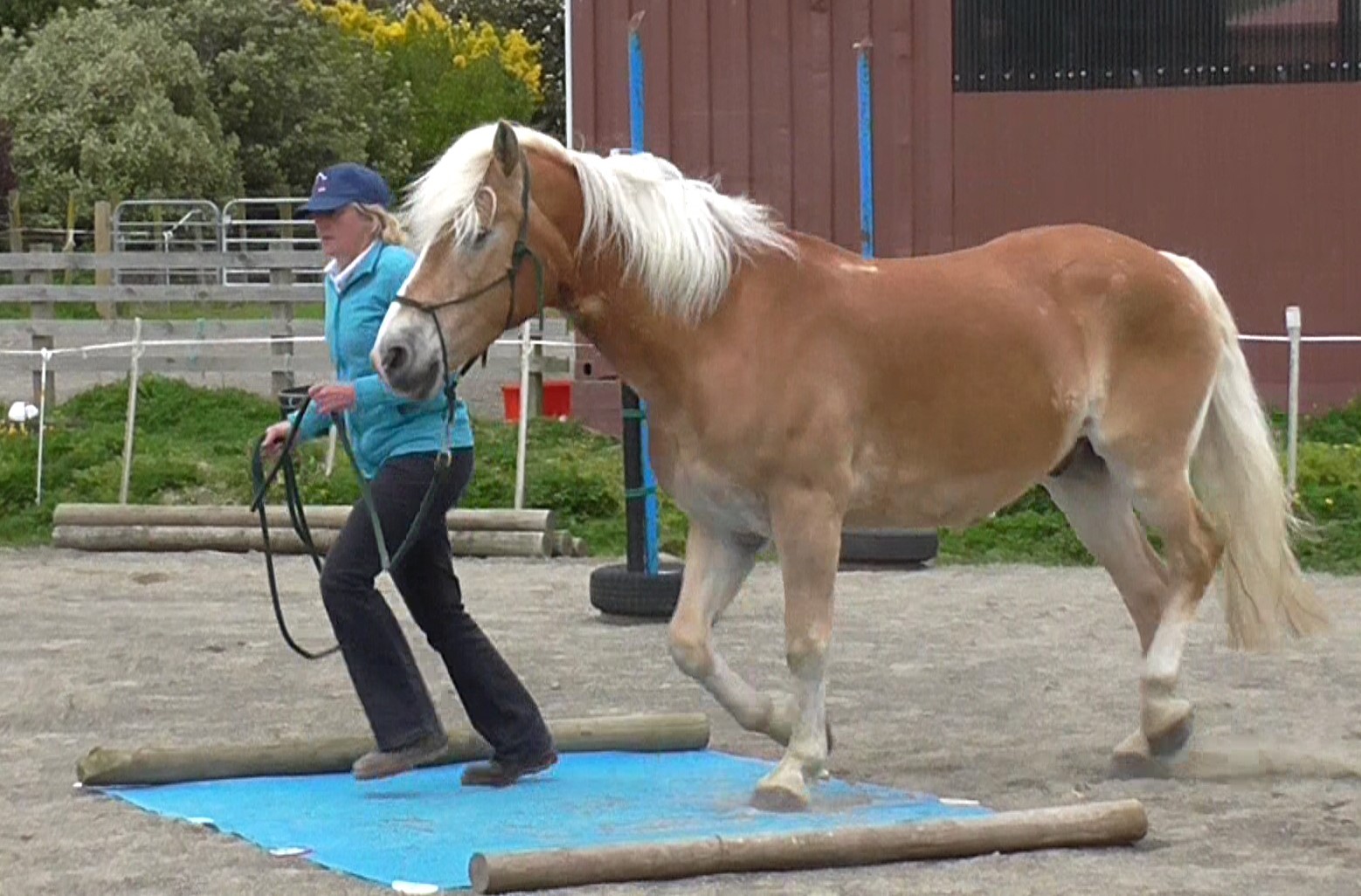
Here we are stepping over a rail into the lane and out of the lane. Again, building in a confident halt plus forward again. Followed by a halt and backing up over the rail to get the horse used to seeking where to put his hind feet, as he will have to do when backing down a ramp. The next step would be to block off one end of the lane so it becomes a dead end space like the trailer.

Backing up Straight

This includes backing up out of trailer.

Walk into a dead-end lane, click&treat, and pause for dwell time.

Raised rope and signal with outside hand are our cues for backing up out of the space.

We have graduated to the same movement using just ground rails. Once that is solid, we can use just a fence or a line of single rails on the ground to avoid the hind end swinging away from us.

Backing up with the Handler in Front

The white markers make it easier for her to see the entrance to the narrow lane. Sill using halter and rope here.

A raised lane and she understands my raised hand signal for backing up.

Eventually we could back up from in front with great accuracy. This took a while to achieve, doing a little bit most days.

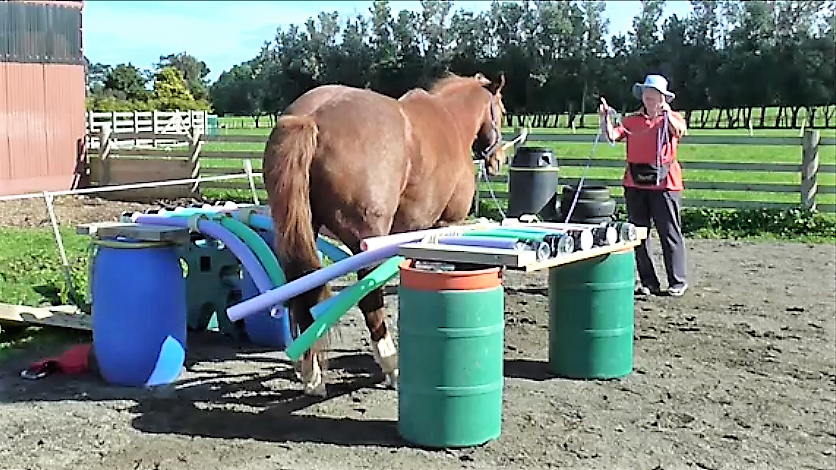
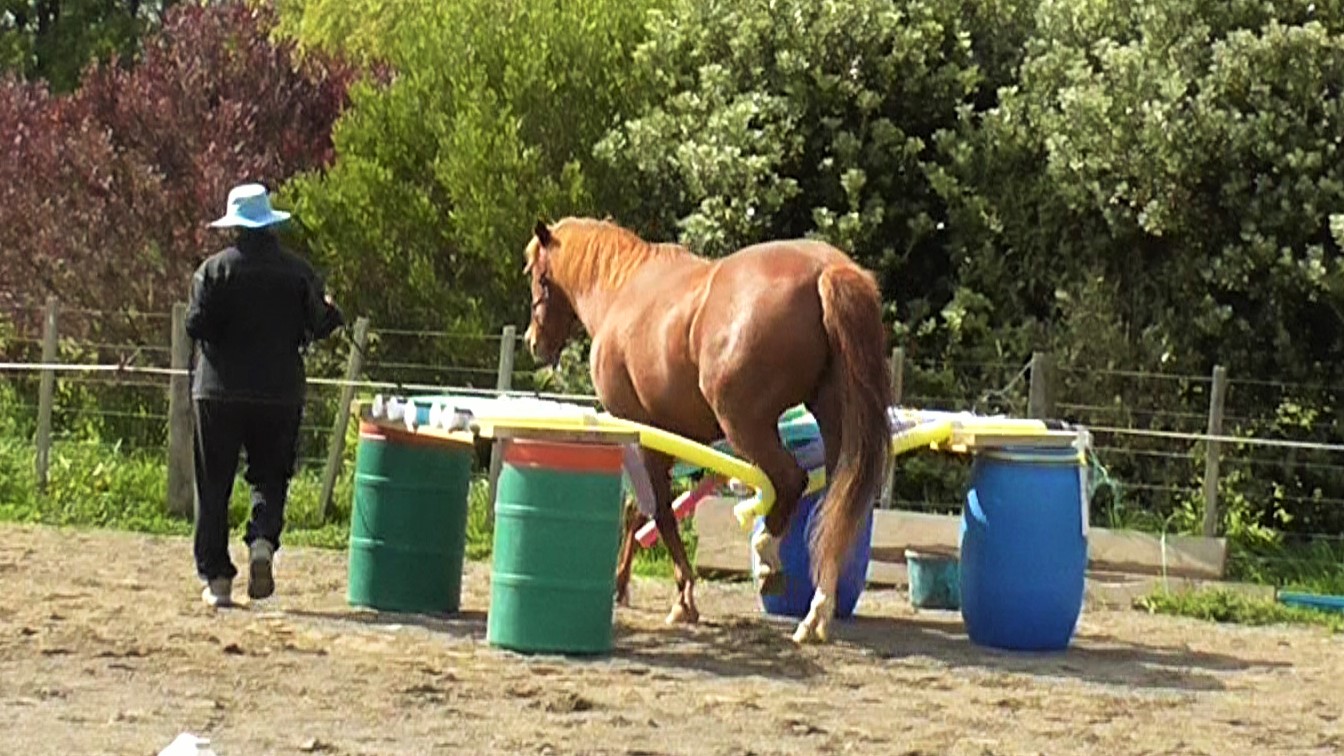
Backing through a series of pool noodles for a Horse Agility task.

Another way to set up a lane.

Backing Prospective Harness Horse Between Shafts; i.e. tight spots

Confidence with unusual narrow spaces

It pays to start wide and narrow the lane gradually.

Long-reining

Walking into the lane and backing out with long-reining.

Careful Placing of Feet

Careful foot placement with long-reining. We can start trotting poles in a lane to make it and easier for the horse to know our intent.

Weaving a series of parallel rails for careful foot placement and supplesness.

Using a lane to teach Back-Up to Target my Hand with her Withers.

Eventually we no longer needed the rails and she is learning to back up with a signal when I am behind her.

Lateral Movement

Once it’s easy with a lane, use just one rail to help the horse keep straight.

Recall

First I teach the ‘wait’ game at the end of the lane. Probably started by using a mat.

My recall body language signal is bending forward slightly and making a circle with my arms.

Would love to hear in the comments what you have taught, are teaching, or intend to teach using lanes.

Multi-Signals or Signal Bundles

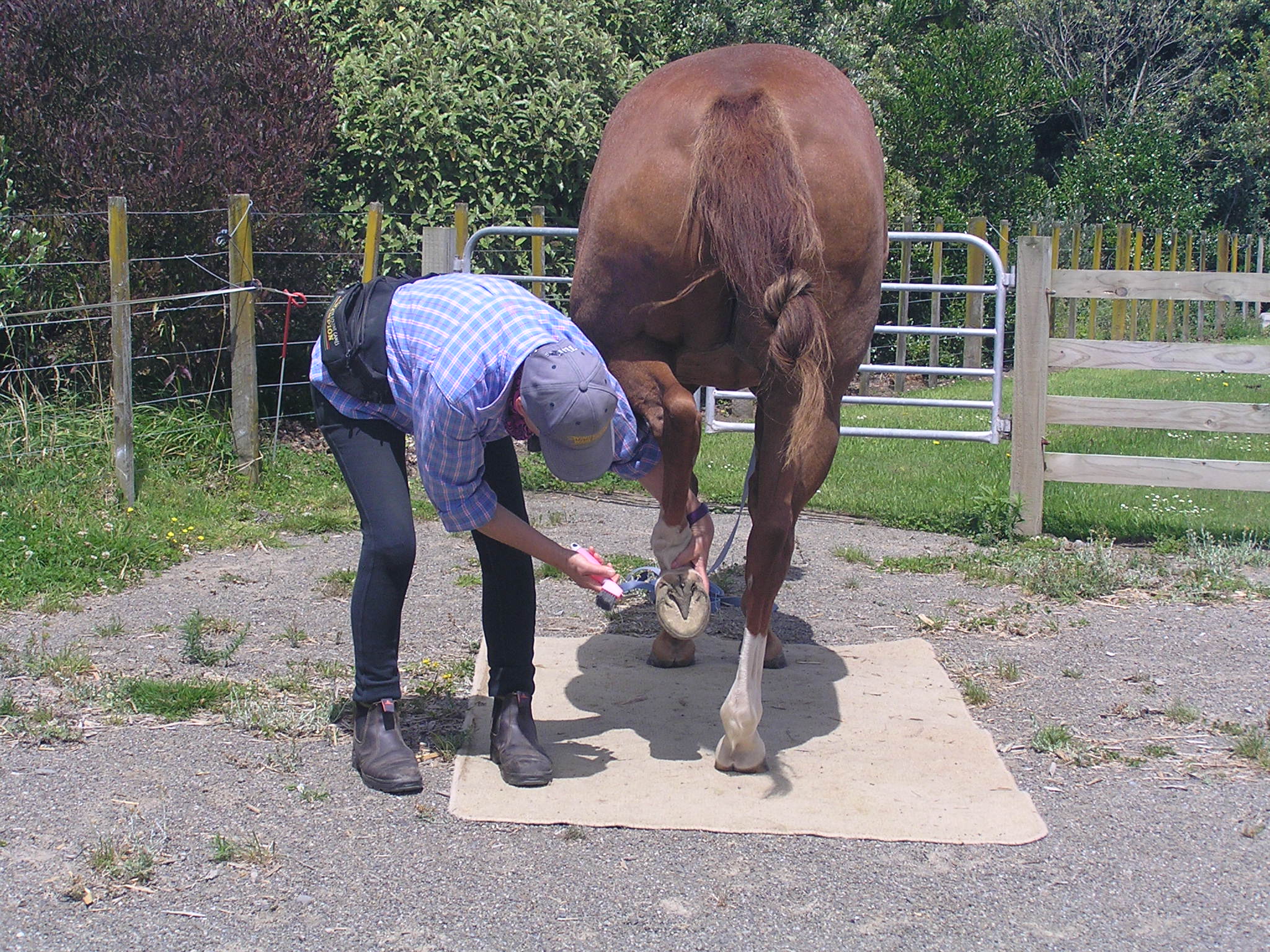
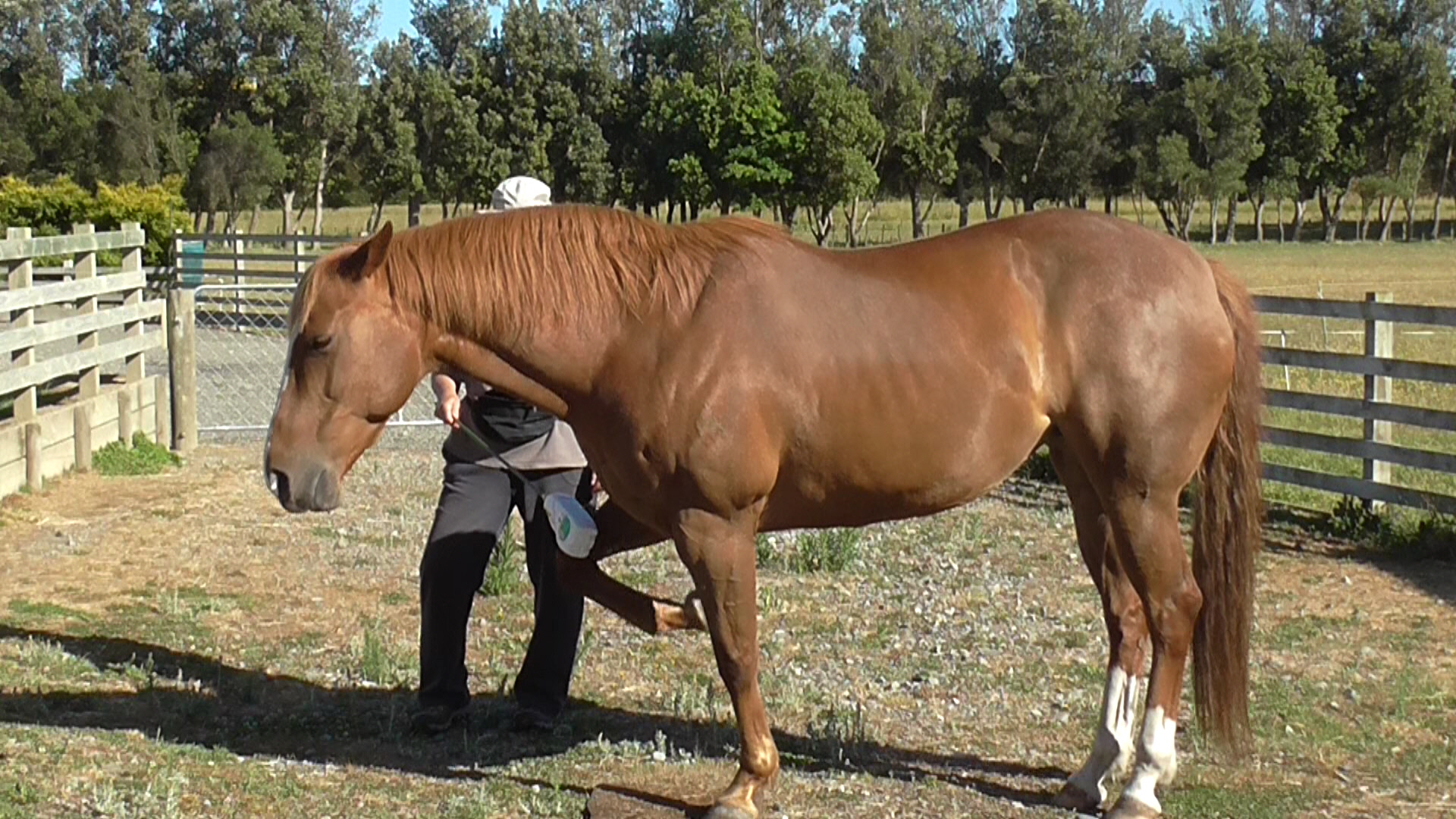
In the photo above, I am using a multi-signal. In terms of environment, I’ve asked Boots to park on the mat. My body orientation is beside her butt, facing backwards. My hand is giving a touch gesture on her hock to ask her to lift her leg. I also say, ‘Lift.’ Because I use this signal bundle or multi-signal consistently, she can link them reliably to foot care.

Behaviors Must be ‘On Signal’

Once we have taught a horse a response, either by free-shaping it or through careful application of approximations to reach a desired ‘finished’ behaviour, it is essential that we put the behaviour ‘on cue’ or ‘on signal’.

Often the last thing we taught our horse is his favorite because it has a recent high level of reinforcement. When I taught Boots to target her hindquarters to my hand, it became her favorite thing. But when she keenly wanted to show it off while I was talking to visitors, it became a bit of a problem.

Let’s look in detail at the topic of signal or cues. It’s imprtant that we are aware of everything that the horse may be observing.

Sometimes we use one type of signal in isolation, but often our signal is a mixture of body orientation, body language and gesture, energy change in our body, and often it has a verbal component. We are in essence using a ‘multi-signal’. 

In this photo Bridget is using a signal bundle or multi-signal to ask Smoky to exit the trailer. She is in position behind the trailer, using touch on the tail, a clear ‘back up’ hand signal, and body energy indicating ‘backwards’. I’m in the front of the trailer using a ‘back up’ signal Smoky already understands.

We may think we are giving a clear signal but our energy, orientation and intent may not match what we want the signal to say. The horse will always do what he believes to be the right thing to do at that moment.

Even if we think we are giving one clear signal, the horse is noticing everything that is happening. That is why it is so easy to inadvertently teach horses things we didn’t intend them to learn. 

One reason Clicker Training is so powerful is because it allows us to pinpoint exactly what we want the horse to do and teaches us to be more consistent. Horses appreciate this clarity enormously. It removes much of the guesswork for them.

The marker signal (click) tells the horse that what he just did is what we wanted and that he can go into treat-retrieval mode. The treat is offered right after sounding the marker signal.

 We must remember that body language is a big deal with horses. It is their first and essential language. It’s what they use with each other. It helps explain why horses who do marvelous groundwork may suddenly become ‘lost’ when their handler mounts up. Suddenly the horse can no longer see all the body language signals that accompany groundwork.

Looking at signals in isolation can make it easier to become more mindful about exactly how we are using:

  • our environment
  • our whole body orientation
  • our gestures
  • our voice
  • our hands
  • any of our body extensions (ropes, reins, lanes, etc.)
  • our energy
  • how and where we present the treat after the clicker.

#38 HorseGym with Boots illustrates some of these ideas. You will notice that Boots is so clued in to some of my body orientations that she offers a belly crunch while I face her front on, a front leg lift when I stand shoulder-to-shoulder facing backwards, and a wee back-up when I face her. Now and then I do make a request but mainly I’m asking her to stay parked on the mat and not do anything else. It’s important that I keep my body energy low.

As an exercise, you could work out what you usually ask the horse to when you are in each of these body orientations.

The Concept of ‘Feel’

In the photo above, Bridget can FEEL that Boots is relaxed enough for her to carry on with foot care.

Feel is an aspect of horsemanship that sometimes seems elusive, but it doesn’t have to be. It is closely linked with the idea of empathy. Empathy itself is the ability to ‘feel’ what another being is probably feeling.

When dealing with horses, empathy and feel are involved with everything we do. The more we understand about the nature of horses as a prey species that depends on rapid moving away from danger and group life for security, the more empathetic we can be when our horse shows us that he is uncomfortable about something we are asking him to do.

The more we understand that the horse’s digestive system is geared toward a steady flow of low nutrient forage, the better job we can do at providing such forage. We know that to keep the horse comfortable, we must feed the bacteria in the gut in a way that keeps them happy. 

OLYMPUS DIGITAL CAMERA

Horse have evolved to reqire a constant supply of low-energy forage to keep their microbiome in good working condition.

Horses have small stomachs and a large caecum where bacteria break down the food so it can be absorbed by the horse. These bacteria need a constant flow of food and do not like sudden changes of diet.

The more we understand how the horse’s circulation system depends on slow, regular walking movement over 24 hours, the less inclined we will be to confine horses in boxes. After all, they are not chocolates.

The horse’s feet compress and expand with each step the horse takes. Foot movements work like four extra pumps to help send blood the very long way up the legs back to the heart. 

Horses step along as they graze. The only time they are still is for the few hours that they sleep, which are spread over 24 hours. Consistent movement is an integral part of horse circulation health.

Horses are naturally active on a 24-hour rhythm, not a day/night rhythm like we are. By ‘putting them in at night’ and by ‘feeding them meals’ in one place, we are seriously mucking about with their movement, their blood circulation and their natural biorhythms.

Many horse ‘problems’ stem from unnatural housing and unnatural feeding regimes as well as the damage caused by nailing inflexible steel shoes to a dynamic live foot mechanism.

As we develop empathy and ‘feel’ about what a horse is experiencing in the strange human-based world in which he finds himself, it becomes easier to know what we should do to ensure the horse is as comfortable as possible.

A horse high on adrenalin will find comfort in being allowed to trot or run the adrenalin out of his system. When he becomes high-headed and agitated, a handler with feel gives him the opportunity to move until he can switch from reactive mode to responsive mode.

A strong-spirited, low-energy horse can be extremely frustrating. A handler with feel for this sort of horse will use click&treat motivation as much as possible. Then it is easier to appreciate the reliable nature of this type of horse once he is on-side with the handler rather than trying to outwit him or her.

As soon as we can see our horse, he can see us. As soon as he can see us, he is gauging our energy level. He is ‘feeling’ us. A person with ‘feel’ will be doing the same with the horse – gauging his mood, the way he is moving or grazing, checking for anything out of the ordinary.

As soon as a horse sees us, he is feeling our mood, our energy level and our intent.

When a handler develops ‘feel’ of this sort, s/he is not frustrated by undesirable horse behaviors. S/he seeks the cause(s) and adjusts the horse’s lifestyle plus his Individual Education Program (IEP) to accommodate the horse. This is the essence of a handler’s emotional neutrality. 

Horses don’t do things just to annoy us. At any moment in time the horse is doing what he believes is the best thing do.

With careful education, we can enlarge the horse’s comfort zone and areas of expertise. We can expand his repertoire of things he can do with confidence.

It takes considerable time and effort, but done at the horse’s pace, he will gain skills to help him through his whole life.

27-1: Some concepts of ‘feel’

‘Feel’ comes in many guises.  Here are some of them.

  1. Feeling the difference between reaction and response
  2. Realizing that every horse will feel different, and that to the horse, each handler feels different
  3. Knowing the precise moment to release signal pressure (click&treat)
  4. Acknowledging the difference between teaching and forcing
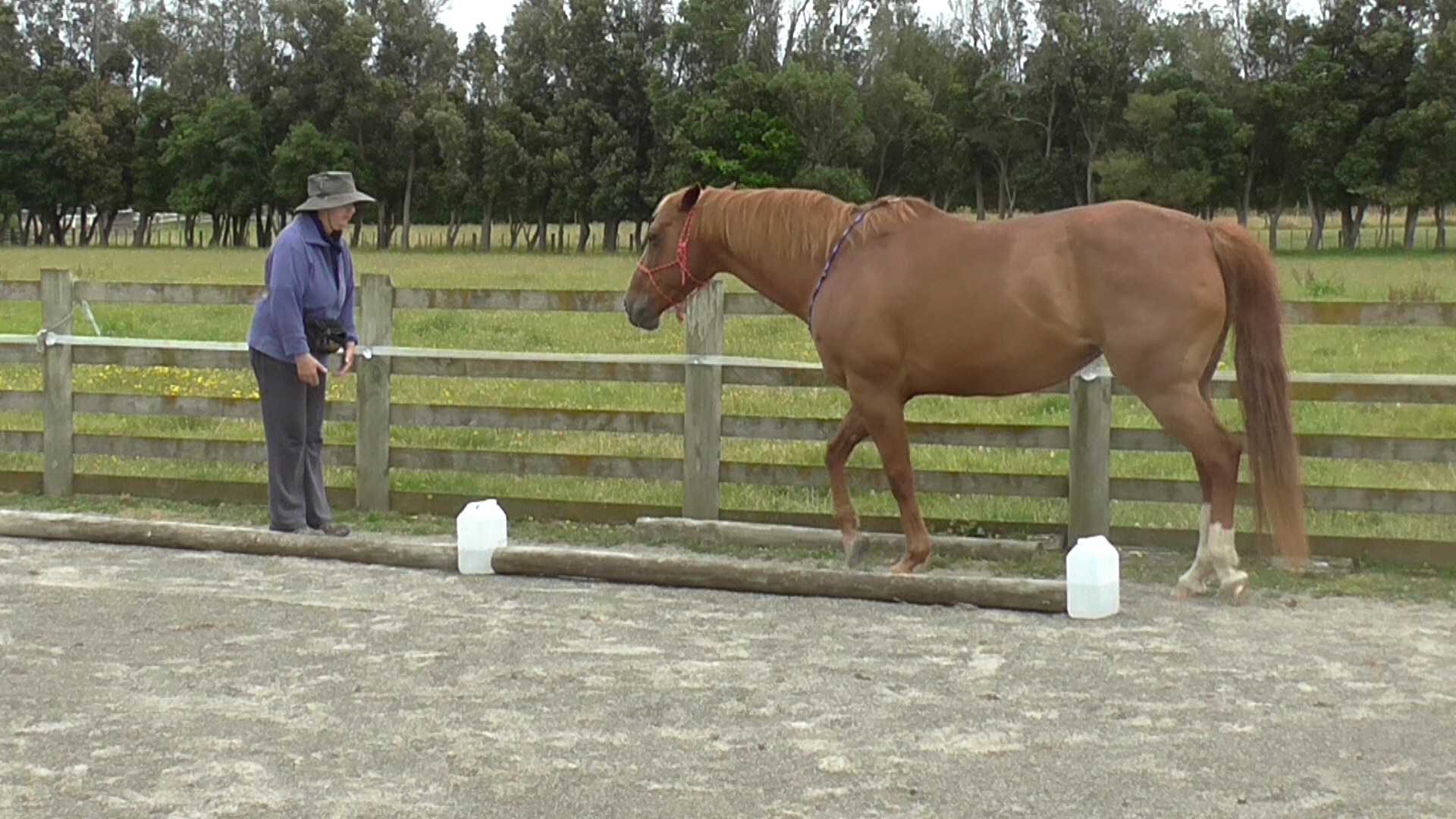
  5. Knowing when we are pushing too much, resulting in a loss of willingness
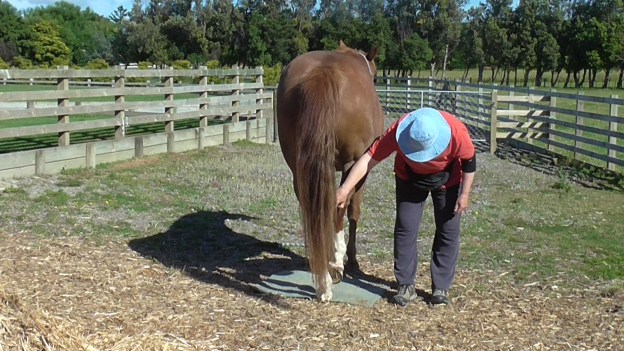
  6. Knowing when we are pausing too much, resulting in a loss of interest
  7. Recognizing physical well-being, so that lack of wellness stands out
  8. Finding the ‘balance’ between the two extremes of ‘unbalanced’
  9. Able to cause a subtle shift in the horse so he regains balance
  10. Staying grounded when the horse loses his physical, mental and/or emotional balance
  11. Able to pause for lesson absorption or for a shift in balance
  12. Able to ignore unwanted behavior and quietly ‘re-set’ a task
  13. Understanding a specific horse’s underlying character type
  14. Recognizing when the horse is ready to move on to the next slice of the new learning
  15. Recognizing when the horse-human connection is present and when it is absent
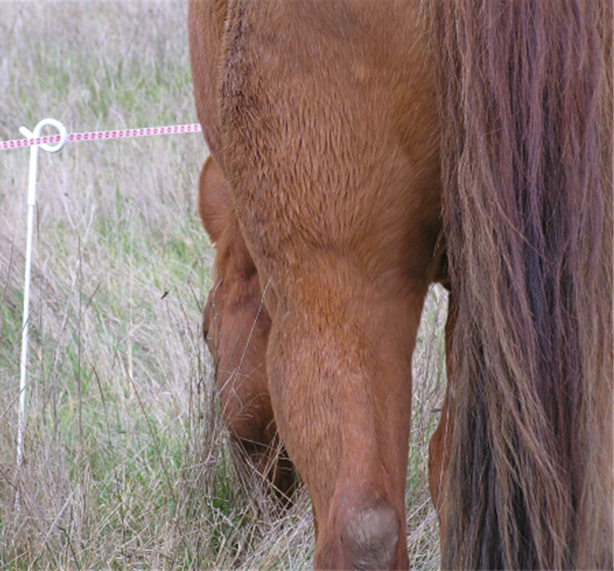
  16. Not taking the horse’s trust for granted
  17. Understanding the lives of horses in the wild; their natural 24 hour and seasonal rhythms
  18. Understanding physical, mental and emotional thresholds of a specific horse
  19. Understanding how habituation works
  20. Understanding how desensitization works
  21. Understanding how sensitization works
  22. Physical feel through the rope
  23. Physical feel through the reins
  24. Physical and emotional feel through the whole body when riding
  25. Feel for two-way communication playing at liberty. If the horse decides to leave, knowing how to motivate him to join up again or deciding to call it a day
  26. Knowing when to stop a session, or a part within the session
  27. Understanding that the way the handler feels is instantly picked up by the horse, good feelings and bad feelings equally.

Confidence with Unusual Surfaces

The key prerequisite for all the tasks shown in the clips below about UNUSUAL SURFACES is having first mastered smooth ‘walk on’ and ‘halt’ transitions. If we have to first work on this prerequisite, we can do it using target destinations and training ourselves to be really clear when we are requesting ‘walk on’ and when we are requesting ‘halt’. Blog Number 16 in my Blog Contents Quick Links demonstrates. Below is a quick revision.

Walk-on Body Language

These four things are done all together – a ‘multi-signal’.

  1. Breathe in deeply (horses hear this) plus raise your torso and body anergy.
  2. Forward gesture with your outside hand. If you are using a hand-held target to first teach this, as in the video below, the action of moving the target forward into play will soon morph into just an arm signal.
  3. Step off with your ouside foot. It’s easier for the horse to see your outside foot moving forward.
  4. Use your chosen voice signal for ‘walk-on’.

Halt Body Language

These four things are done together – again, a multi-signal.

  1. Drain the energy from your body while you –
  2. Drop your weight down into your butt (as we want the horse to do when he halts)
  3. Breathe out loudly (horses hear this)
  4. Use your ‘halt’ or ‘whoa’ voice signal

The following clip was made to support relaxed foot care, so there is a bit at the very end about backing up to shift the horse’s weight

When ‘walk-on’ and ‘halt’ are solidly in place, we can carry on with unusual surfaces.

Thin-Slicing the 1m Board

Thin-Slicing Walking on Plastic Bottles

More About Unusual Surfaces and Backing Up

Other related blogs: You can find the links easily on my Blog Contents Quick Links page.

  • No. 9: Mats: Parking or Stationing and Much More
  • No. 10: ‘Zero Intent’ and ‘Intent’
  • No. 17: Destination Training
  • No. 26: Getting a Smooth Halt in Many Situations
  • No. 33: Willing Response to a Halt Voice Signal
  • No. 51: Reverse Pens
  • No. 68: 20 Steps Exercise
  • No. 101: Precision Leading

Also, all the routines in my book, Companion Horse Training Using Positive Reinforcement, refine the skills of walking with a handler. The book works through a series of activities that require minimal equipment (set of rags and a fence). They are designed to make the horse ‘handy’ and happy following our clear body language including turns and backing up.

Moving Away From Touch or Gesture

In the photo above, Boots is lifting her foot in response to Bridget’s arm signal gesture and the intent of her body language. It makes hoof care so much easier.

Shaping with Touch Guidance

Research on dopamine release shows that knowing how to avoid or decrease a stimulus we don’t like gives a ‘reward hit’ to the brain, similar to how achieving something desirable feels rewarding. For example; stopping in time for a red light gives an instant feeling of relief and accomplishment.

This is why the training system made popular by Pat and Linda Parelli gave such ‘good’ results in teaching horses how to respond to human requests. People who have been considered ‘good’ horsemen over the years have used the same principle for millenia.

The principle is basically this: Use a consistent touch/gesture signal and remove the touch/gesture the instant the horse complies even just a little bit. Build from there with repeats until the horse responds readily because it understands the cue and the system. This is negative reinforcement – called negative because the touch or gesture energy is removed when the horse responds. The term ‘negative’ is here used in the mathematical sense. It is not related to it’s other common meaning of something ‘bad’.

BUT: It takes considerable skill in reading horses – to know when the horse remains in the learning zone, i.e. under threshold (see Number 107 in the Blog Quick Links for more about this) or has been pushed beyond threshold. Is the horse responding or reacting? If the handler is not sensitive and/or lacks experience helped by a good teacher, it can end up with a confused and unhappy horse. Also, the touch or gesture signal needs to be totally consistent so the horse can depend on it being the same each time.

Pressure is not a dirty word. Horses understand pressure. They use it with each other all the time. It is the nature of the pressure, plus when it is removed, that makes or breaks good training to create a horse confident with people.

Using touch/gesture pressure followed by a click&treat immediately the horse responds, is an essential step in teaching a horse to be resilient in a variety of human environments. We can’t know the future, If our personal situation changes, the horse may have to go elsewhere. If confronted by flood, fire, earthquake, the horse may need to be moved quickly.

Such teaching with negative reinforcement, backed instantly by positive reinforcment, is often called ‘combined reinforcement’. Some people refer to it as negative reinforcement ‘with a cherry on top’, as a way of discounting it. Yet, if we use a neck rope or headgear or our legs for riding, we usually want the horse to move away from our touch. It’s convenient to be able to touch the horse’s chest lightly to get a back up. Or to touch his leg for a lift if we want to tend the hoofs.

Gesture

Horses interacting with each other use gesture as a first communication. If the annoying horse does not move away, the gesture escalates gradually via touch with nose, teeth or hooves. The first suggestion might be a just a ‘look’ or an ear/tail flick. Play between youngsters is full of touch and gesture.

Because horse are super sensitive to movement, they easily pick up the meaning of a specific gesture if we use it with total consistency.

Once a horse understands our meaning:

  • Reaching down to his foot will have him lift a leg.
  • Fingers raised in front of him (far enough back to be out of his blind spot) and tapping the air at his eye level will have him back up.
  • A light touch or gesture to his shoulder will have him move it into a turn on the haunches.
  • A light touch or gesture (or even a focussed look) to the side of his rump will have him move it away into a turn on the forehand.
  • A light touch at (or gesture toward) his ribs will have him sidestep.
  • A light touch to his chest or nose will have him back up.

I taught moving the front end away into a turn on the haunches with touch to the neck and shoulder, but eventually only my focus and a gesture were enough of a cue.

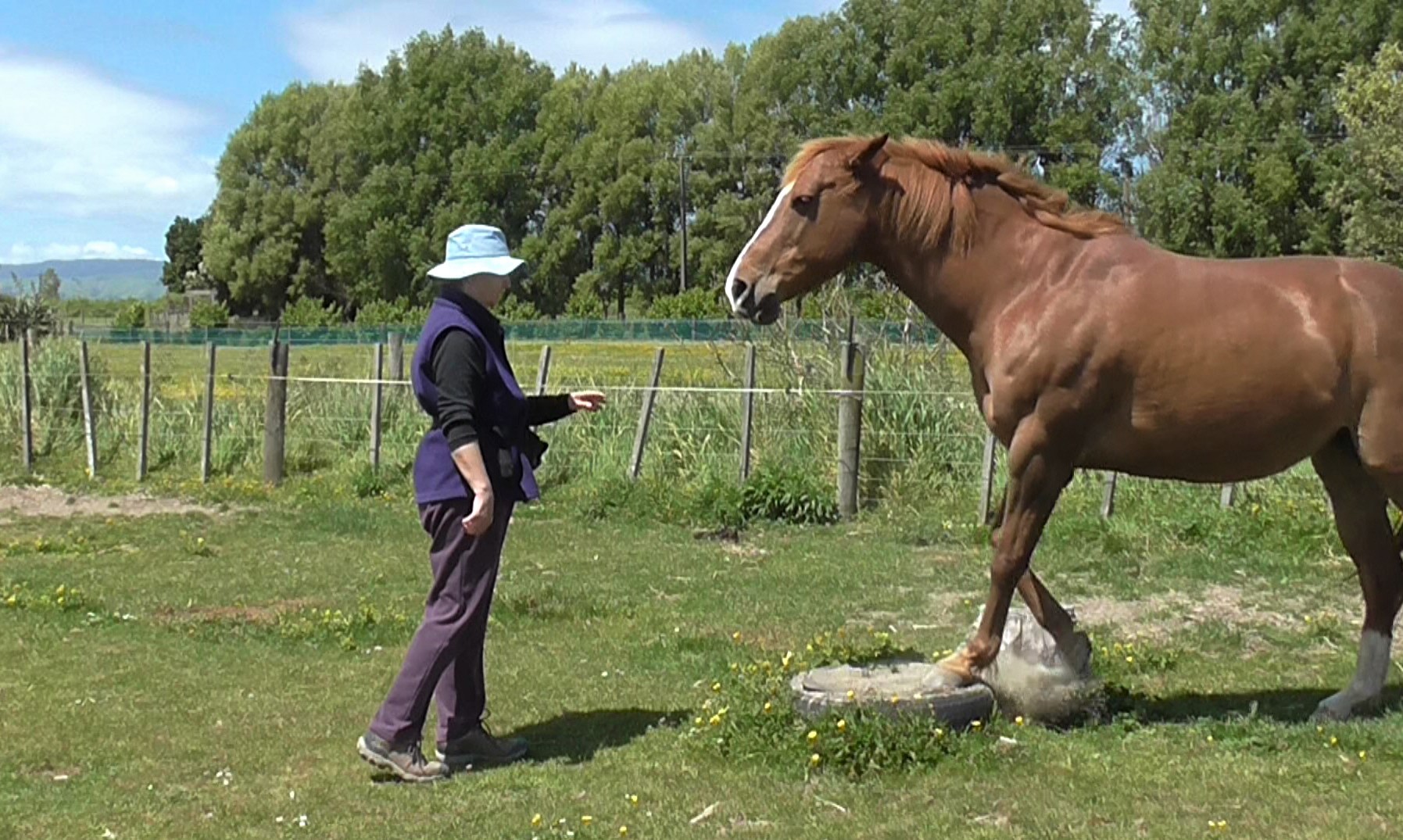
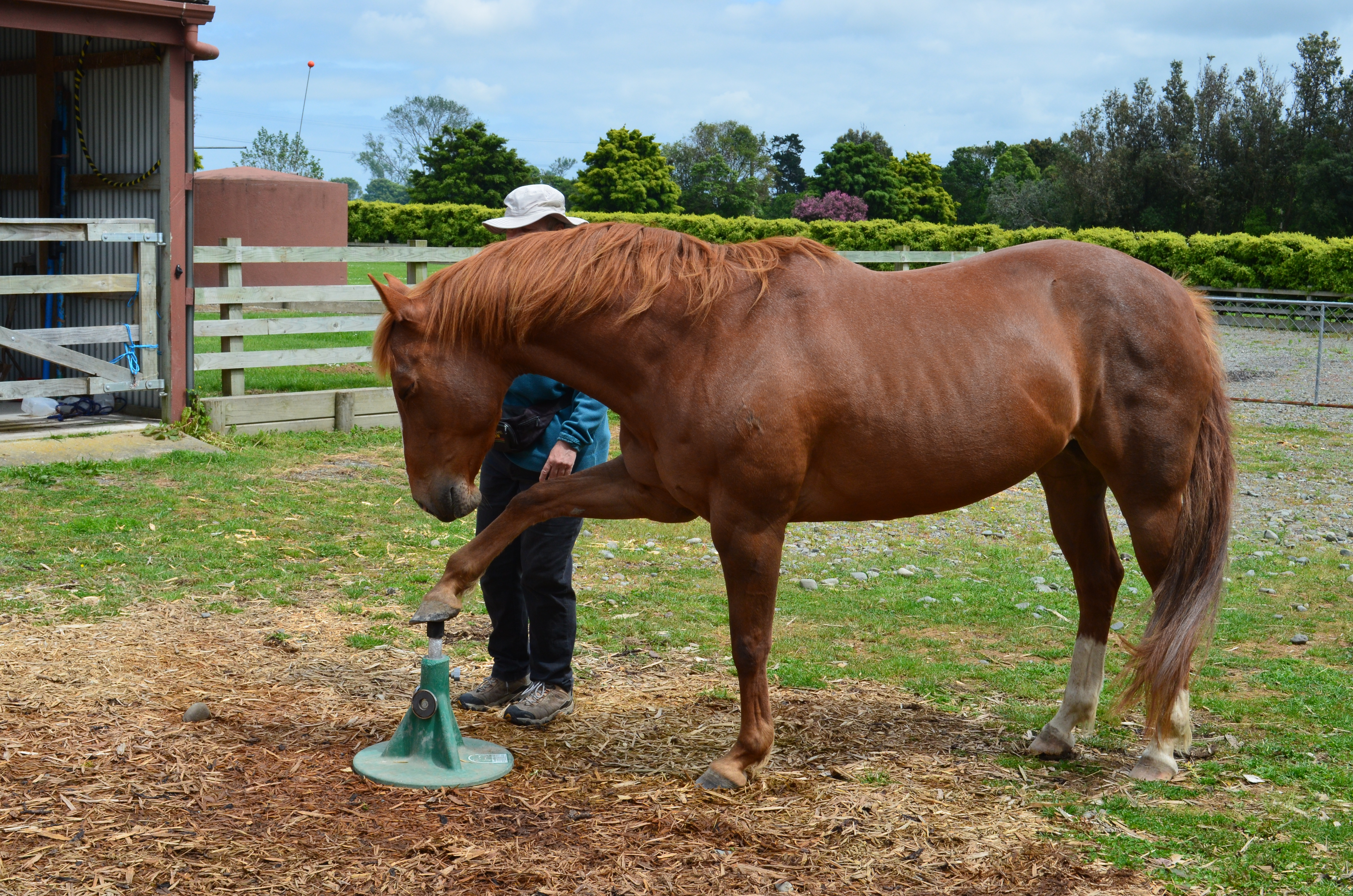
Likewise, I used touch to teach a signal for moving the hind end away from me, but after a while my body orientation. intent and gesture, even from quite a distance, was enough of a cue, even when her front feet were on a pedestal.

A simple arm/hand gesture is enought to tell Boots that she will earn a click&treat for backing off the pedestal.

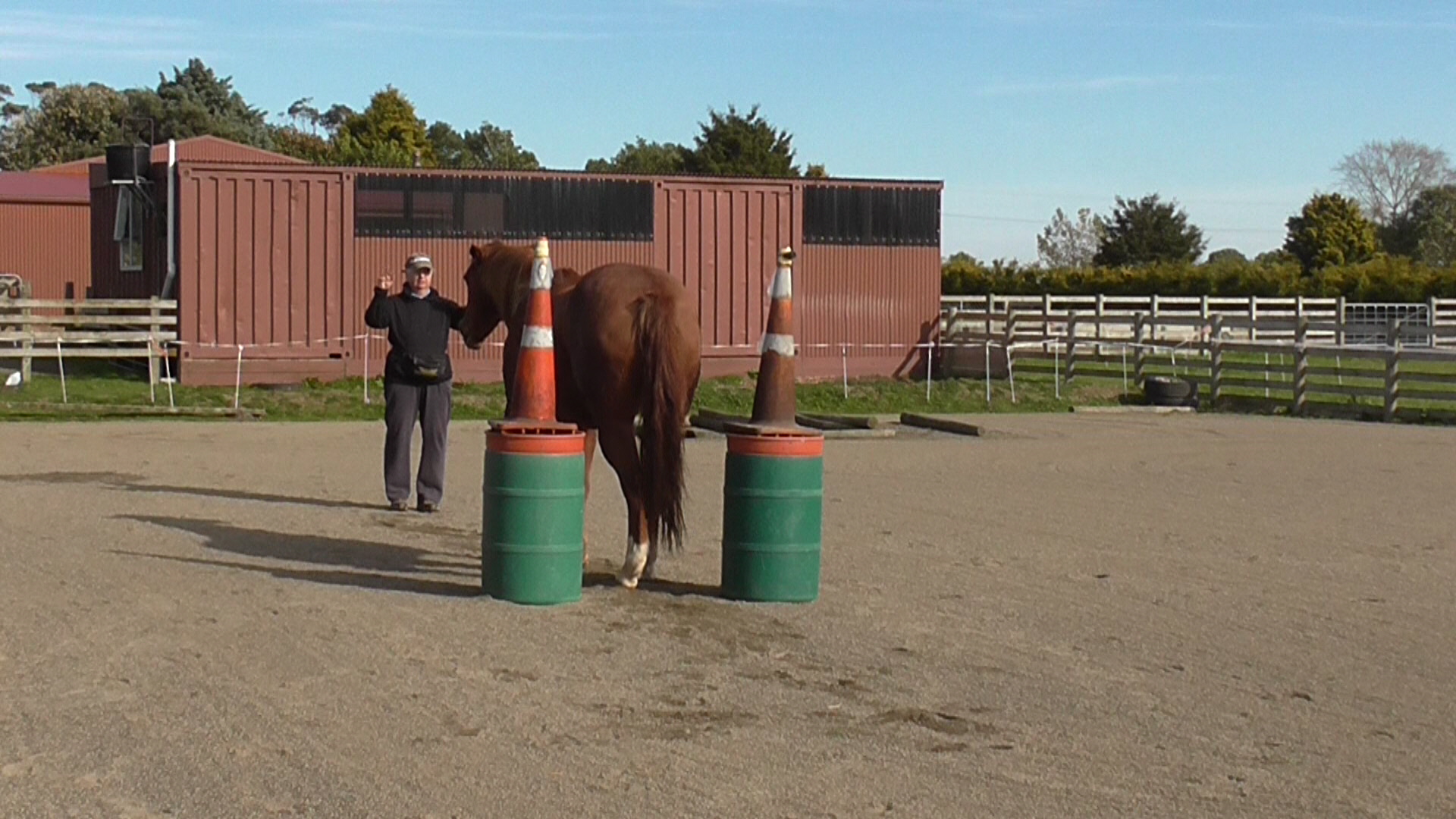
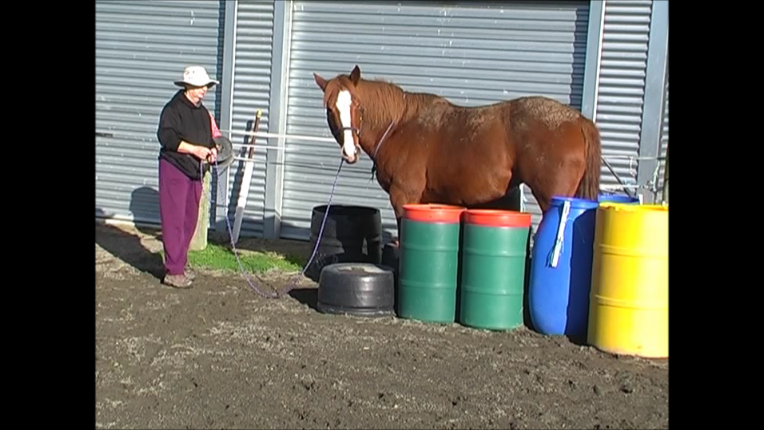
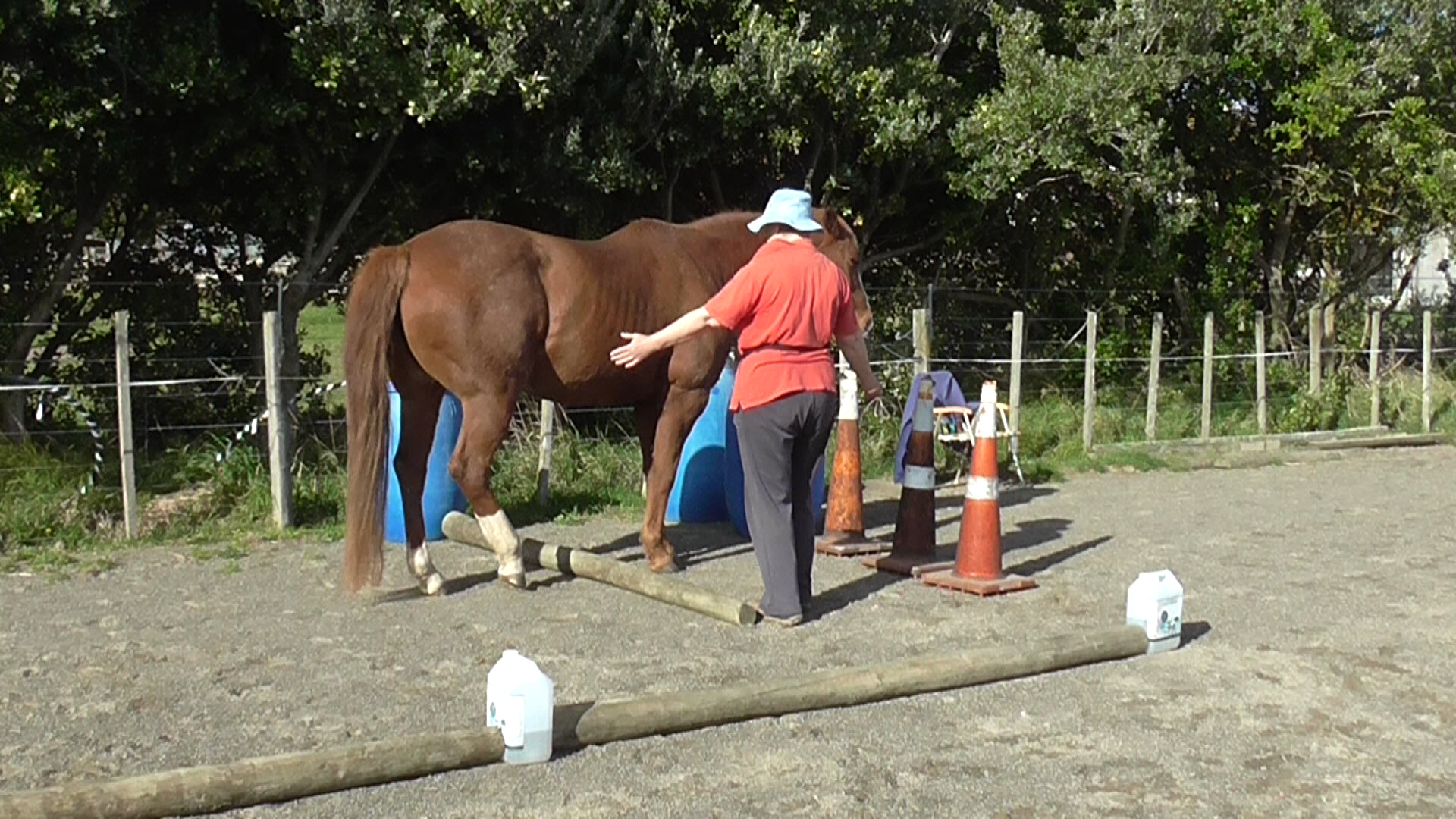
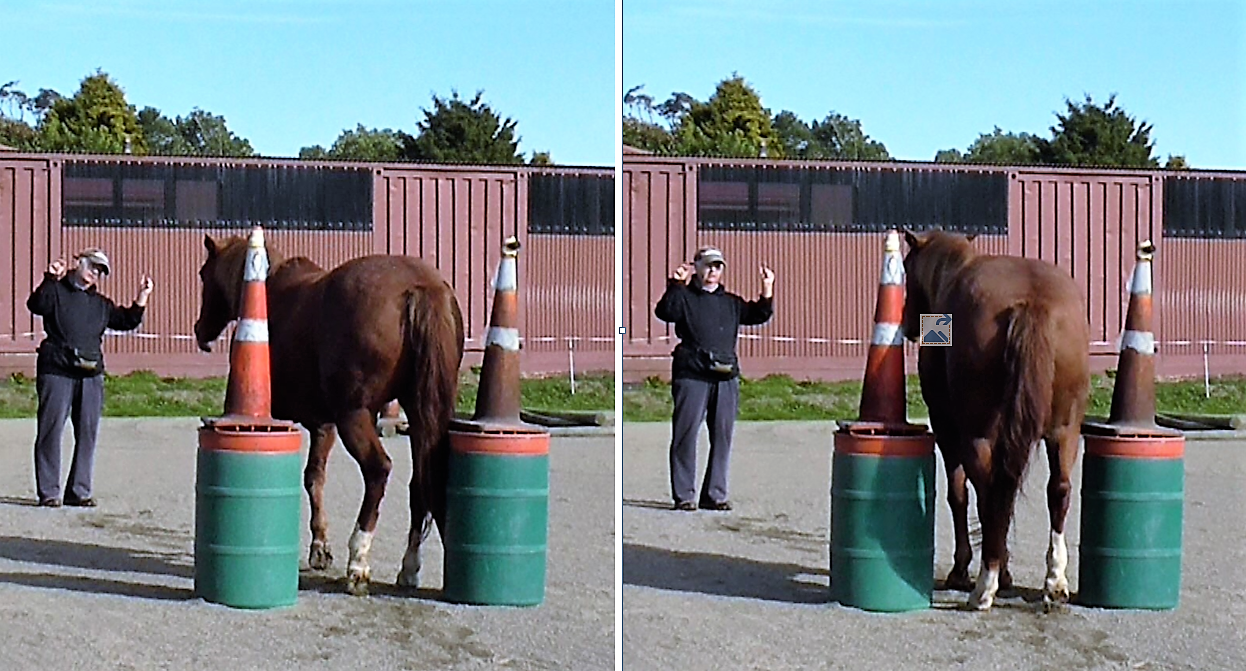
We spent several weeks perfecting backing between two tall objects at greater and greater distances. In the first photo I am looking toward her right butt to get it to straighten out so she doesn’t knock the barrel. No doubt this one earned a triple treat or a jackpot.

If you have an interest in seeing how we reached this stage in the photo above, I filmed most of the days we worked on this. We did a few repeats over many, many days. Here is the link: https://www.youtube.com/playlist?list=PLHJTeGrtF98Pjy3zvmPhgBxBP6V3lwhkh

First we learned sidestepping along a rail with touch to shoulder and butt in rhythm. Once she had the idea, a light touch to the ribs became the cue. Eventually it only needed a gesture and my focus toward her ribs.

Eventually we didn’t need a rail to do side-stepping, which is a good suppling exercise.

Here I’m using a gesture as well as the idea of ‘follow the feel of the rope’ to teach a twirl. (See Blog Number 116 in the Quick Links.) Confidence with ropes touching the legs is another essential skill we should teach in a gradual, nuanced way. (Not starting with the above photo!). Before long, a voice and gesture signal were enough information for her and she would happily insert a couple of twirls into a recall. It became one of her favorite things to show off. Ample click&treat during the teaching process made it a favorite.

Here we are both doing a twirl or spin during our dancing routine. We are both turning to our right and seem to be in step. As she comes around I will click&treat. What began as a ‘follow the feel of the rope’ exercise morphed into just a combined hand and voice signal at liberty. It’s easiest for the horse if they are already in motion in a recall.

All these skills take time to develop, but are so much fun.

Following the Feel of a Touch Signal

Application

In the photo above, we are doing a long-reining ‘change direction’ exercise. Because Boots knows how to ‘follow the feel’ of the slightest touch on the halter, we can long-rein a cloverleaf pattern using four rails. I only need to change my hand position slightly to give her the directional signals.

In the photo we’ve started at rail 2, will wallk across rail 4, arc right to walk over rail 1 followed by rail 3 (plus the other two rails lying there); arc right to walk over rail 4 followed by rail 2. Then arc right over rails 3 and 1; then arc right again and we’ve done the last leaf of the pattern and are in front of rail 2 ready to repeat turning to the left this time.

Following the feel of a touch signal is an essential skill the horse needs for leading with a rope and for using reins either riding or long-reining. And it is especially important if we go places where we have to tie up the horse.

Since we have no control of what the future may bring, for ourselves or the horse, it’s a skill we must teach early and to a high standard, so that in a situation of stress, or new ownership, the horse knows this response well.

With Positive Reinforcement

Ideally we teach a horse at liberty with targets, using body language, gesture and voice signals. This is what is shown in the four short video clips that follow.

When the horse shows us that he is ready, we add halter with rope and repeat the exact same exercises. In this way we teach that rope or rein pressure means move toward the pressure, so releasing it. The voice and hand gesture signals are excellent aids if we want to eventually ride bridle-less.

Teaching Soft Rope or Rein Response.

These clips look at teaching soft rope/rein response with the horse standing still. Once he understands this well, we introduce walking toward stationary targets at liberty, adding gesture and voice signals for ‘walk on’ and ‘whoa’, and changes of direction. Then we add the rope. By using our body language and voice signals, the rope basically stays slack most of the time. When we do use it to indicate change of direction, it takes just the hint of a touch.

It’s important to stay with each step of the training until the horse is comfortable with it, and responding ‘correctly’ each time. Be aware that external distractions can take his attention. If that happens, simply wait until his attention turns back to you. Boots, in the clips, was very focussed on what was earning each treat, and hightly experienced with clicker training.

Prerequisites

  1. If you don’t already have your horse loving to target mats with his feet, you start with targeting mats first (Number 9 in the Blog Contents Quick Links).
  2. if you have been using a long-handled target, get the horse hooked on a short, hand-held target.
  3. You may need to first spend time getting the horse comfortable standing in a corner by using your hand-held target. Standing in a corner makes it easier for the horse to understand the option (turning just his head toward you) that you want him to choose.
  4. The Anchor Task: in this case the the anchor task is horse standing beside you with his head forward. It is the key part of this exercise. It has to be solid before you begin asking for the ‘turn head’ request. It must be kept solid throughout the teaching exercises. Later, once you are moving with the horse, it’s no longer needed as much.

Clip 1

Clip 2

Clip 3

Clip 4

Let me know if you have a go at teaching this, and how it is going. You can do it with a horse that already leads well, or with a horse new to training.

Free-Shaping

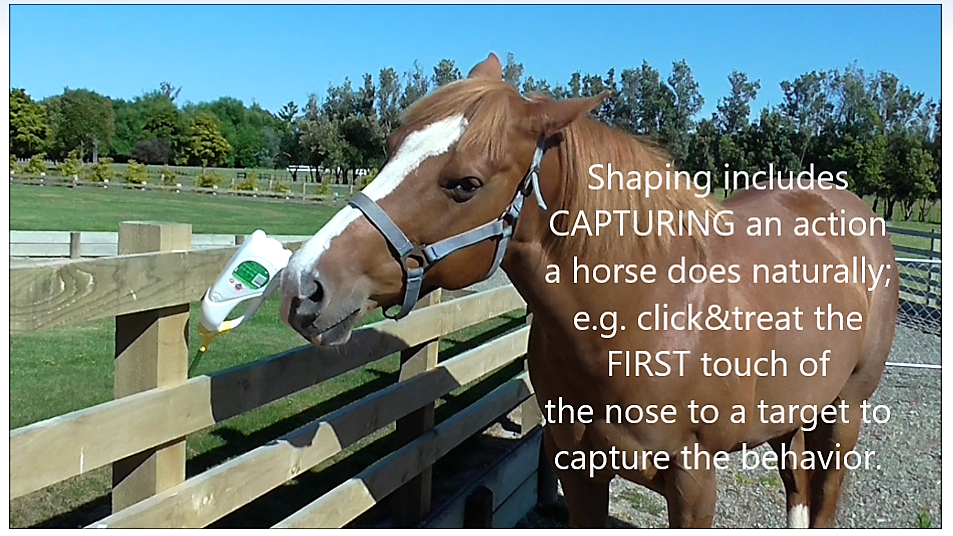
Free-shaping means clicking and treating the moment the horse naturally displays a behaviour you want to encourage. The click&treat encourages the horse to repeat the behaviour that earned the treat.

The first free-shaping exercise most handers use is to hold (or set) out a target and wait for the horse to investigate it with his his nose = Click&Treat. Most horses pick this up quite readily. Many equine clicker trainers use it to teach their horse the meaning of the ‘click’ or whatever marker sound they are using. My older mare (with a chequered background before I got her) took nine short sessions over a week before she made the connection between her nose touching the target, the click, and the treat that followed.

Because it is the horse’s choice to do the task, they learn it readly because it was their idea in the first place. It gives them a sense of ‘agency’ – being in control. Like us, horses like to be in control of their lives.

Boots has to her nose on a stationary target. I clicked as her nose touched it and I walked to her to deliver the treat. Once the horse loves to do this for a click and treat, we can put such objects all around our training area and walk or trot between them to earn a click&treat at eachone. Also useful for ‘destinations’ when we begin leaving home. We can use destinations for groundwork and riding.

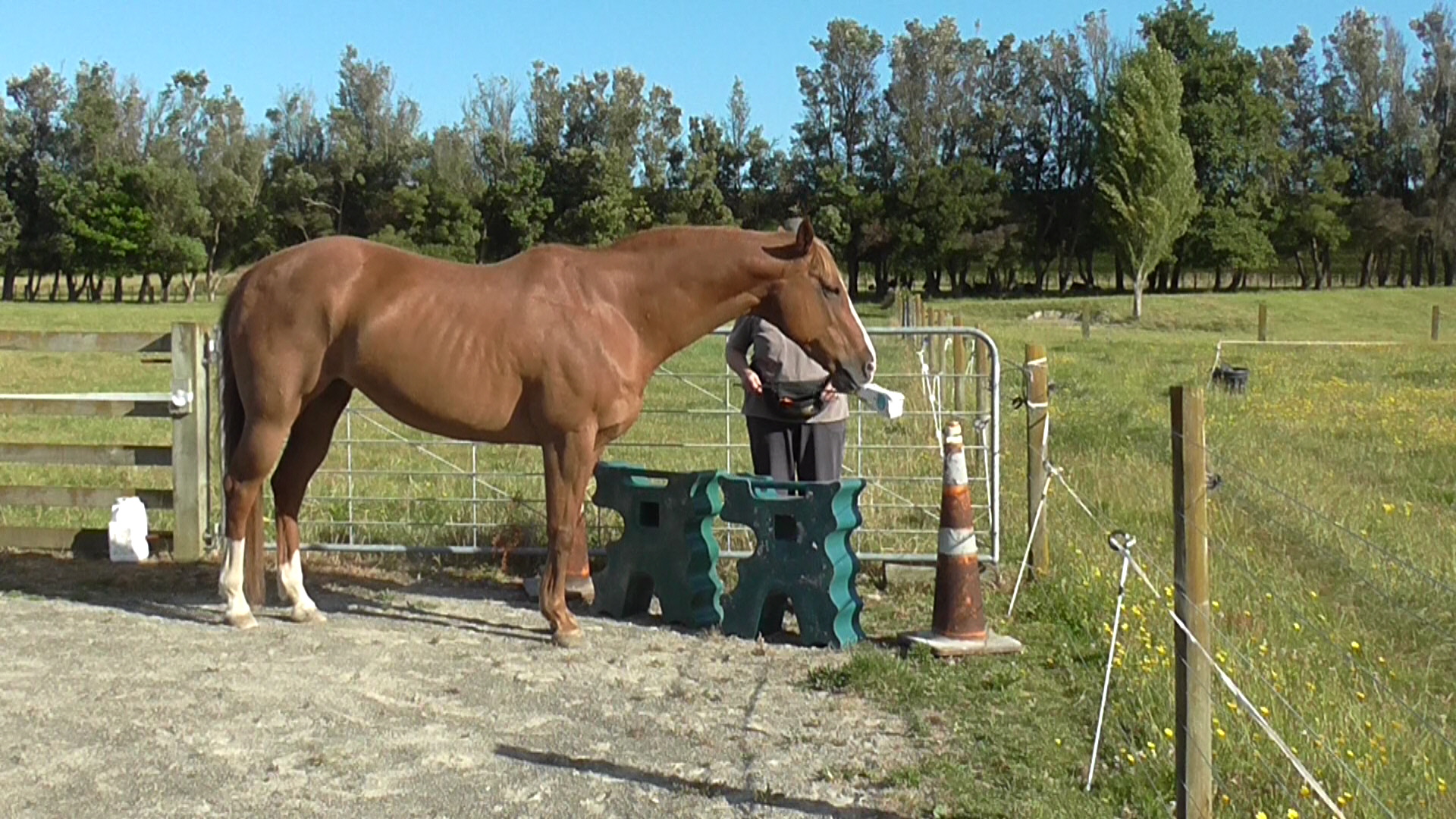
Using a hand-held target, It’s always wise to start out with ‘protected contact‘, i.e., the horse on the other side of a barrier. Until we begin clicker training, we have no idea how the horse will react to food treats from our hand. This is also the time to try out different treats .

Here I’ve created a barrier in a corner, which is another option if you don’t have a suitable fence handy, but with a new horse – maybe make the person’s space a bit bigger!

Your safety barrier for PROTECTED CONTACT does not necessarily have to be fancy.

If you can use electic fence tape for training, make sure the power is turned off during training time.

In this clip, I’m free-shaping head lowering.

Eventually we added a verbal signal, and a body language signal, so when I bowed, she bowed.

The following clip shows an alternative to hand-feeding while teaching the TARGET = CLICK = TREAT process.

In the next clip, I free-shaped step aerobics.

It’s also a possible way to build confidence with any tight space or a trailer.

In the next clip we are doing the 20 Steps Exercise. Depending on your starting point, it could take a few or many short sessions to get 20 smooth steps with one click&treat at the end. All you need is for the horse to willingly walk one step with you, click&treat, and work forward from that.

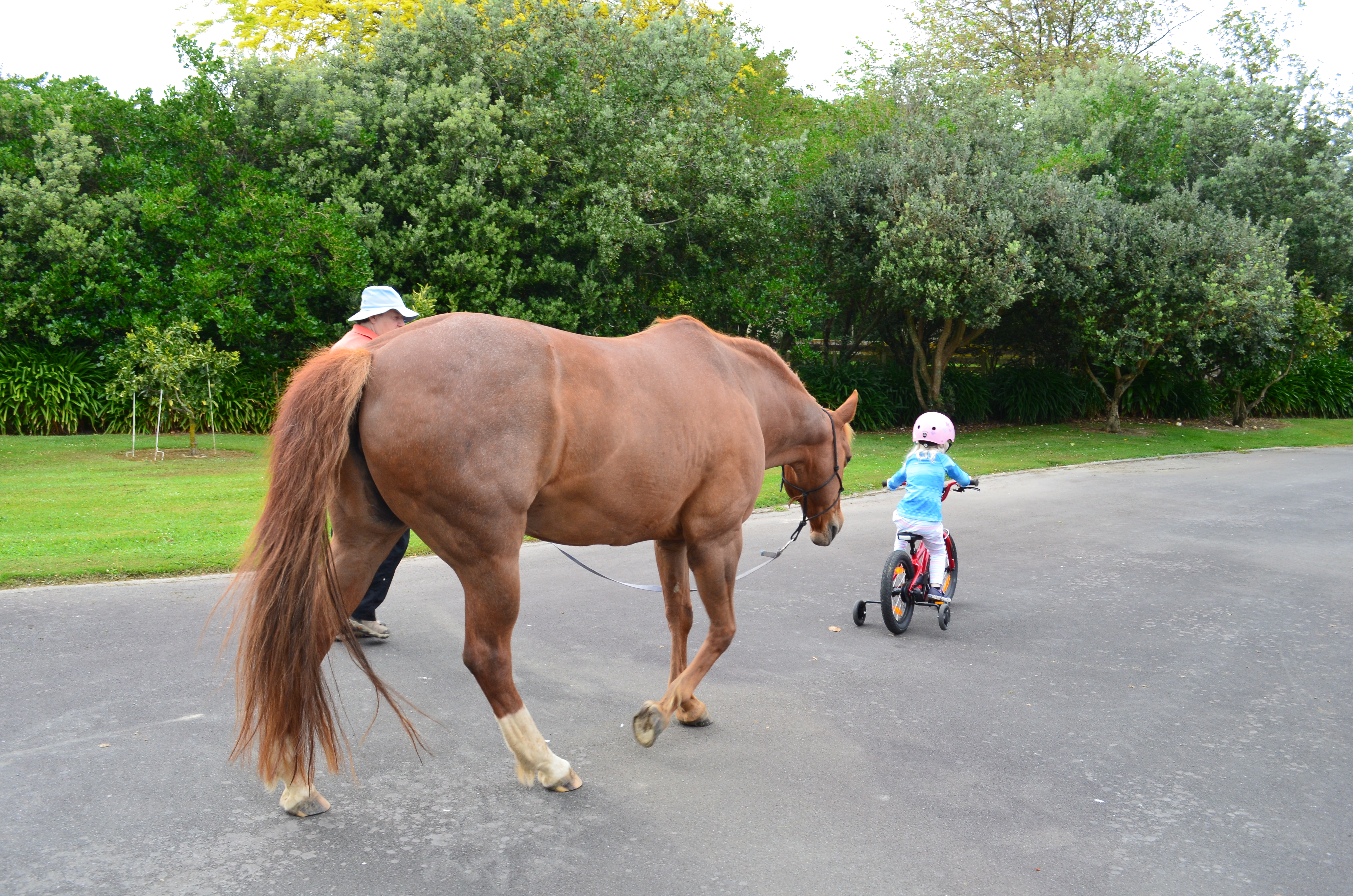
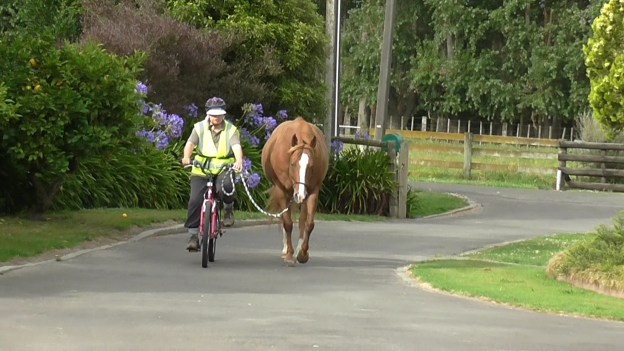
The next clip is a very early lesson in free-shaping Boots’ confidence moving along with a bicycle.

The following clip with the bicycle is much later.

The next clip is a demo of tummy crunches.

I learned this from Alex Kurland.

1. I began with the horse behind a low barrier. I stood at neutral (zero intent = Number 10 in the Blog Contents Quick Links) and watched casually (not staring at the horse) with a relaxed stance, watching to click&treat any upward or backward shift of weight.

2. I did this IN THE SAME SPOT for a minute or two once or twice a day, mainly right before afternoon feeding time. And as a ‘last thing’ at the end of a play session. Having usual times in the same place seems to make the horse look forward to having ‘another go’.

3. Once we were getting a purposeful weight shift back because she realized that’s what earned the click&treat, I sat down to bring the horse’s head a bit lower. Previously we had ignored head position as the horse was experimenting with different possibilities. When I sat down, she lowered her head position because the treats were offered lower. This developed over months and months.

4. At some point, the crunches became a part of her personal repertoire because she would offer them if she wanted to initiate an interaction. At this point I added a verbal signal/cue.

5. I’d never do more than about what is on this clip at one time.

6. Eventually I could ask for the crunches standing her shoulder, her butt and behind her, using the verbal signal (zzzip) plus my body language of leaning backwards. We had such a long and strong history of reinforcement that she readily adjusted to my different positions. She happily did it with a rider aboard as well.

Free-Shaping Boots doing a STRETCH:

Once Boots realized that her ‘downward dog’ stretch earned a click&treat every time she did it, she offered it frequently. I initially free-shaped it by noticing that she often stretched like this after getting up from a nap. I managed to ‘capture’ the behavior two days in a row, and she then began to offer it often enough so I could put a verbal cue to it – ‘Stretch’.

What sort of things have you free-shaped?

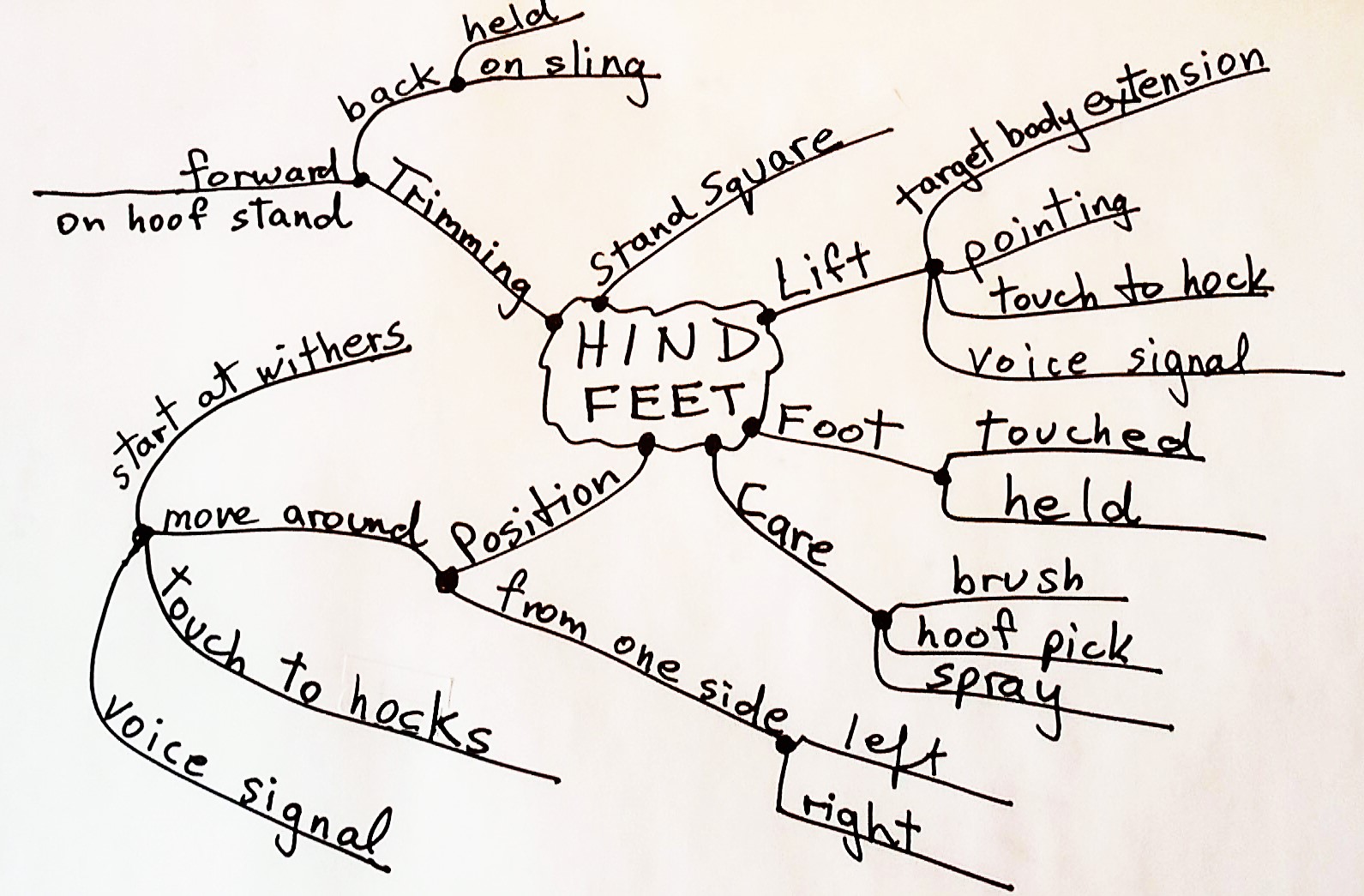
Part 2 of Relaxed Foot Care – the Hind Feet

When the horse is comfortable picking up the front feet on request, we can proceed in a similar way with the hind feet.  We start as usual with the horse willingly targeting a familiar mat and able to stay parked on it.

Then we make sure the horse is comfortable being rubbed all over with a body extension, paying special attention to the belly and hind legs.

If the horse expresses concern about being touched with a body extension or with having a rope swung lightly around his hind legs, we’ve found a big training hole. It’s essential to go back and build the horse’s confidence about standing still while we do things around him.

Before we proceed with picking up feet, we need the horse calm and relaxed having his legs brushed with a soft brush right down to his feet. We want him to remain calm and relaxed when we rub and massage his legs all the way down.

To develop the idea of lifting a hind leg on signal, we can touch the hock gently with a target such as a pool noodle or a tomato stake with bubble wrap taped around it. Click&treat as we touch the hock. Repeat until we can hold the target a little above the hock and the horse lifts his leg to touch the target because he’s figured out that’s what causes the click&treat. Be careful to click as the leg is coming up, not on its way down.

The hock is a convenient point at which to teach a touch signal for lifting the hind feet. Bridget has asked Boots to target her hock to the body extension which is bubble wrap taped to a tomato stake.

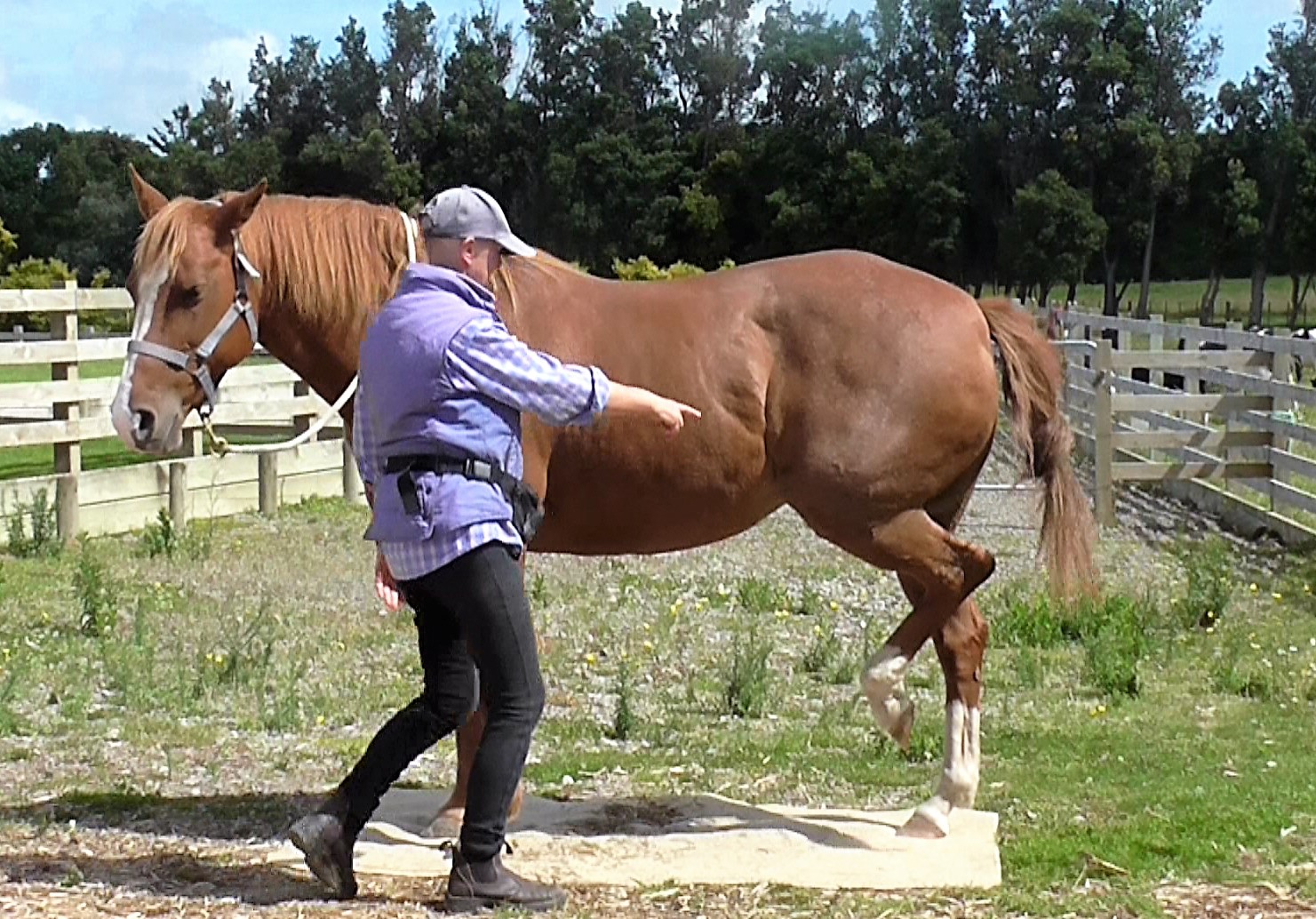
Eventually we just have to point to the hind leg we want lifted.

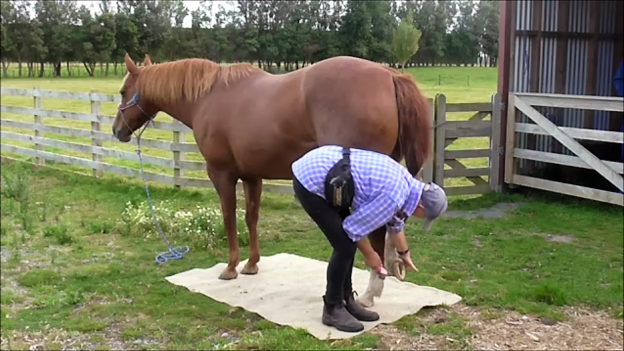
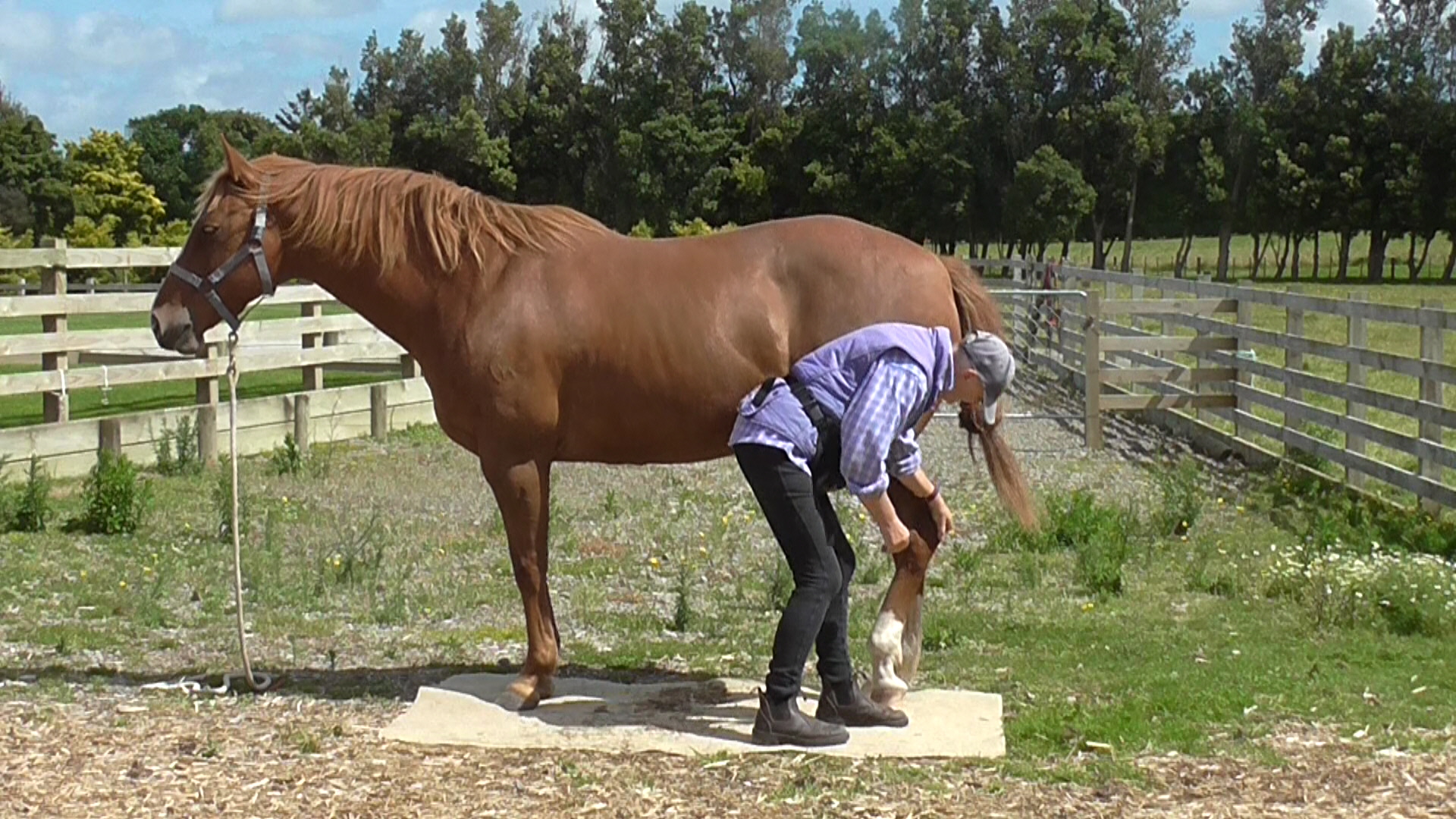
Once leg lifting is well established, we generally use touch when we want to do foot care, like a farrier or hoof trimmer would expect. We always start with our hand at the withers, and run it across the horse’s back and down to his hock. This gives the horse time to shift his weight so he CAN pick up the leg on that side.

Bridget is running her hand down to the hock. Touching the hock is our signal to ask for a foot lift.

By the time Bridget reaches the hock, Boots has already taken her weight off that leg so she can pick it up and stay balanced.

Lifting feet is all about weight shifts. It needs to be taught carefully and systematically, making sure that the horse understands each slice of the process. By teaching targeting a body extension first, the horse figures out how to shift his weight and balance on three legs without other complications thrown in – like the foot being held, cleaned, trimmed.

Bridget has a willing hind leg lift and the horse looks balanced. Gradually, one second at a time, we built duration of keeping the foot up so we can clean, inspect, rasp, spray it.

Teaching relaxation with a hoof stand is the next set of slices. It can be helpful to have a calm helper to deliver the treats when you click.

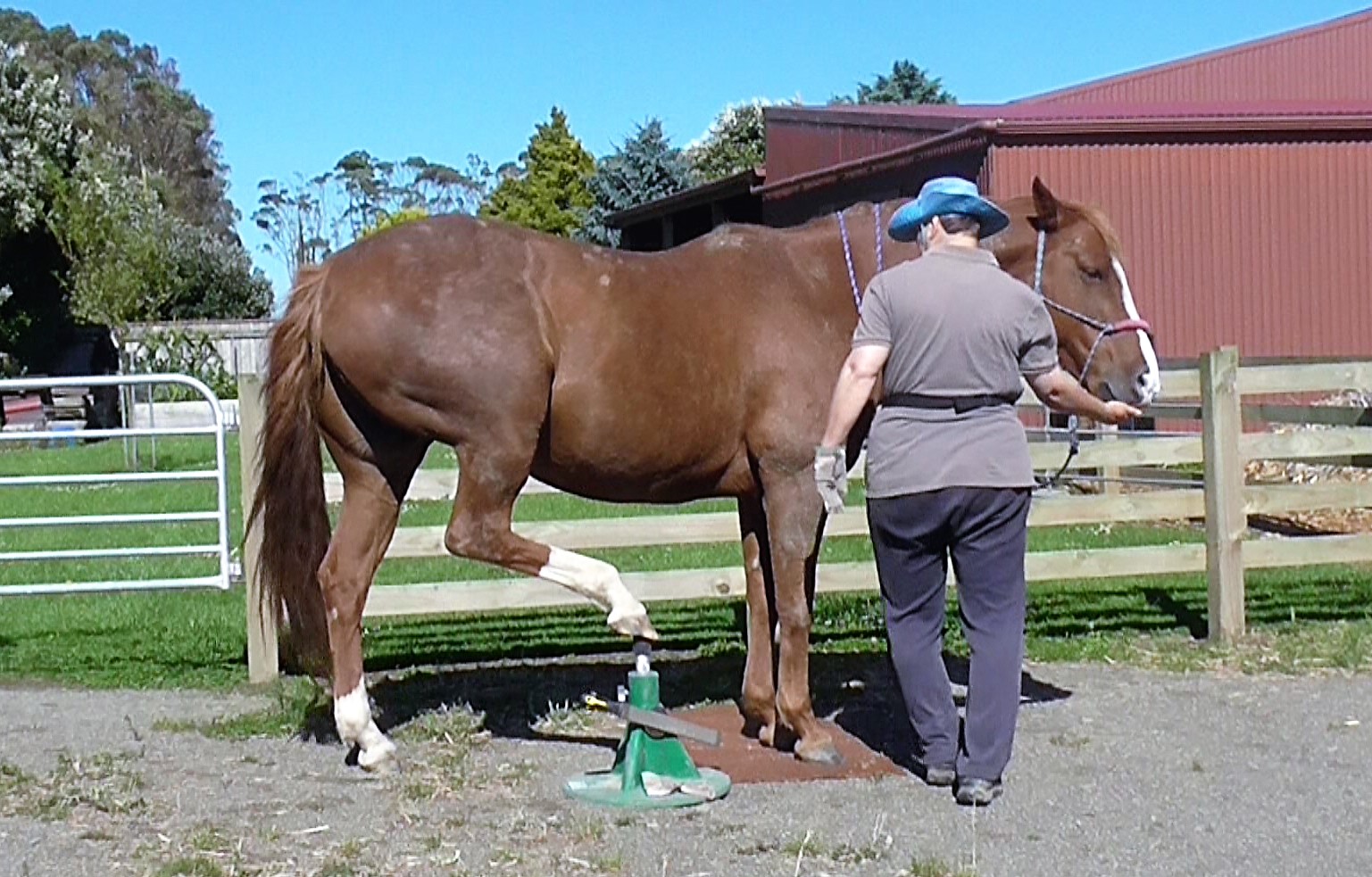
Here I’m working on duration having the foot up and forward. For hoof officianados, you might notice how much better Boots’ heel buttresses are compared to earlier pictures.

Teaching the foot to lie backwards on the hoofjack. Note she is not standing squarely in front, which makes it harder for her.

It can be helpful, timewise, to be able to clean all the feet from one side. We draw the far foot, once offered, across behind the near leg.

Checklist

No.DETAILSTick
Prerequisites
1Handler & horse are clicker-savvy 
2Leads easily, halts promptly & backs up readily 
3Horse can park & be rubbed all over 
4Foot awareness with mats & other exercises 
5Brush legs 
6Rub legs with hands 
7Comfortable ‘foot care’ spot sorted 
8Stand squarely 
Major Slices for Building Front Foot Behaviors
1Lift knee to target an object: click for foot rising 
2Lifts knee to hand 
3Add in consistent voice signal 
4Handler faces tail to ask for knee to target hand 
5Catch & hold foot briefly: click before releasing 
6Hold foot for one second 
7Hold foot for two seconds 
8Gradually hold foot longer, one second at a time 
9Clean foot with stiff brush 
10Clean foot with hoof pick 
11Teach spray bottle confidence 
12Set foot in sling (or on knee) 
13Build duration of foot in sling or on knee 
14Bring foot forward onto a hoof stand or stump 
15Build duration of hoof brought forward 
16Back foot off hoof stand (no click&treat, just praise) 
Major Slices for Building Hind Foot Behaviors
1Confident with body extension rubbed over legs 
2Confident with brush and hands rubbing legs 
3Touch cap of hock with body extension for lift 
4Add voice signal 
5Lift hind foot with pointing 
6Run hand from withers to cap of hock – relaxed 
7Lifts foot with tap on hock & voice signal 
8Hold foot briefly; click; go to head to give treat 
9Hold foot one second; click; go to head to treat 
10Hold foot two seconds; click; go to head to treat 
11Gradually hold foot longer one second at a time 
12Clean hoof with brush 
13Clean hoof with hoof pick 
14Spray hoof 
15Clean both hind feet from one side 
16Rest hind foot in a sling 
17Bring hind foot forward onto a hoof stand 
18Build duration on the hoof stand 
19Teach ‘back’ signal for foot off stand (no click&treat) 
Generalizations
1Familiar mat in new spots 
2Familiar spot without mat 
3New spots without mat 
4Away from home 

Number 74 in the Blog Contents Quick Links (at the top of the page) takes you to the blog about ‘Counting with the Hind Feet’, which goes into detail. Here is the video from that blog, which is a quick summary of a year’s work.

Reading Ears

It’s hard for us to understand how much better horses hear than we do. Our sounds or words easily become signals if we use them consistently. Sounds can also become environmental signals the horse adopts according to the routines of his captivity.

  • house door opening if the horse lives near the handler’s house
  • person’s car arriving at the paddock (with special feed, treats or anticipated adventures)
  • rattle of food buckets or pellets in a tin
  • whistle to recall for a treat or a feed

When we use Clicker Training, we refine this response to sound when we use a click or other unique sound to mark the precise response we want.

Horse ears have ten muscles each, which means they can move their ears almost 180 degrees. The shape of the ear allows horses to capture more sound, and from further away, than our ears. On top of that, horses can pick up sounds at higher and lower frequencies than we can.

The shape and mobility of the two ears allows accurate gauging of the direction of a sound. Sound and vision are obviously linked, but sound serves better when vision is restricted. Due to the horse’s ecosystem role as a prey animal, he is wired to notice any sound, especially sneaky, sudden, or unusual sounds.

Horses have strong emotional responses to sounds. Anxious type horses will find the sounds and tense atmosphere of shows and events over-stimulating and problematic. It helps to gradually habituate them to this sort of environment rather than depend on flooding (overstimulation until the horse ‘shuts down’) to get a horse more able to cope with noisy, unfamiliar surroundings.

Ears, it seems, can give us a large range of signals, ranging from curiosity, acceptance, concentration, irritation, fear, dominance and submission. All we have to do is work out which is which – and when – for each horse in our life!

It seems that horses also pick up vibrations from the ground through their feet or through their whiskers and teeth while grazing. No doubt this relates to the ‘early warning’ horses and other animals can give us about earthquakes and other catastrophes. It might also be why they are waiting at the gate before they can see our car. But that could also be a function of their hearing.

Ear postions might be categorized as:

Alert — forward, scanning in observant or anxious mode.

Alert ears. Probably she is watching for someone to appear with treats to entertain her.

Curious/Interested — forward with head movement up or down to focus the eyes.

Because the lens in the horse’s eye does not adjust like ours, horses have to lower and raise their head to get a good focus on an object – like a person wearing bifocal or trifocal glasses.

Attentive — total focus on what she is doing.

She is extremely focussed on the task. It has her full attention.

Back/Sideways – Tension or Anxious — only the context of the situation and the rest of the horse’s body language can tell us if the ears are back due to anxiety (very stiff), or back/to the side because the horse is strongly focusing on a task, causing natural tension (not as stiff). See also, ‘Working Ears’ below.

Ears are sideways and lower lip is a little bit tight, so Boots is putting a lot of concentration into this task which she is just learning. There is some tension, but the rest of her body language does not, which suggests that she is in focus mode, rather than anxious.

Back/Sideways – Floppy — a chilled out, resting, or casually moseying along horse often has the ears half back in a relaxed state. 

Smoky is dozing beside a favorite person. His eyes are partly closed and his lower lip is floppy. His ears would be soft for the ear-bending test described below.

Pinned — truly pinned ears are a very strong signal that all is not well, and other action will follow if things don’t change immediately. Some horses lay their ears almost flat when they are strongly focusing on a complex task.  This can be more like a ‘frown’ of concentration and we must be careful not to presume the ears are pinned and take evasive/inhibitory action that will confuse the horse who was just busy thinking his way through a problem. 

Truly pinned ears. Boots is giving Smoky a clear message that his presence near the treats is not wanted. Her next move, if there wasn’t a fence between them, would be to lunge at him.

We should always give the horse the benefit of any doubt and read the overall situation and body language rather than just the ears. Truly pinned ears are unmistakable, once seen. They are usually accompanied by a very angry face overall and are often followed by snaky-neck movement toward the cause of annoyance, lunging at the intruder, or wheeling around ready to a kick.

Working Ears:  Back or Sideways, – Focused/Thinking — horses often put their ears to the back or side when they are in ‘thinking mode’.

We often see these sorts of ear positions in horses doing their ‘job’ of the moment; e.g., cutting horses, calf-roping horses, dressage horses, horses doing an agility course or a gymnastic routine.

Because they are carrying out a learned pattern in a known environment, their mind is focused on the task at hand and the precise signals coming from their handler.  Their ears often resemble the ears of a dog working sheep. Back and full of concentration on the job.

Such ears may resemble that of an irritated or disgruntled horse, but if the horse is doing his ‘job’ and his overall tension and body expression suggest that he is focused, we are probably seeing his personal ‘working’ expression. 

Often, as soon as the horse has finished a part of his ‘job’, the ears pop forward before the next obstacle or cow or whatever.

It’s helpful to watch video clips focusing just on the horse’s ears. Usually they are constantly in motion and give us an insight into what may be going on in the horse’s mind. Obviously, we can never be sure, but we can get an idea. 

The Ear Test:

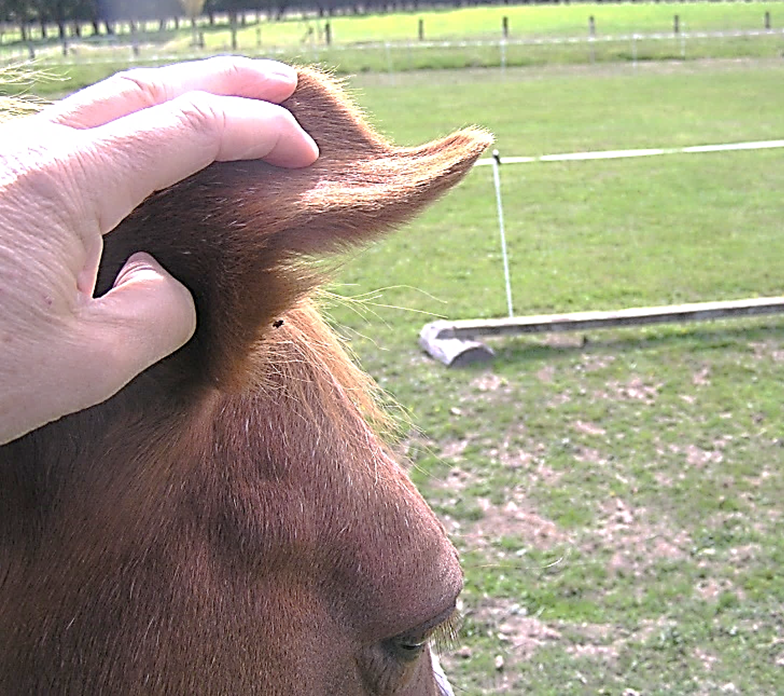
The Ear Test: how easily we can bend the tip of the ear is a good indicator of the                        horse’s overall tension or relaxation.

If we can easily bend the tip of the ear, the horse is generally relaxed. If the ear is too stiff to bend easily, it tells us that the horse has tension in his whole body and lacks confidence or is anxious at the moment.

Each horse’s ear expressions will follow the same general pattern, but at the same time be unique, so we should be careful about generalizing too much between horses.

Ear Expression Summary Chart

More about ears

A. Ear differences between mares and geldings/stallions.

It’s interesting to study the ear differences between mares and geldings or stallions.

I watched YouTube clips of the Pignon brothers Frederic and Jean-Francois. Frederic and his wife, Magali Delgado, were the original stars of Cavalia (2003-2009).

Below is the link if you would like to watch Frederic playing with three of his young stallions. It is interesting to note the way they respond to Frederic’s energy levels. He uses a body extension to help communicate with the horses.

https://youtu.be/w1YO3j-Zh3g (accessed 15.03.24)

In another clip, Jean-Francois Pignon played with a troupe of mares.  

https://youtu.be/qncbDfT5KsU (accessed 15.03.24)

I didn’t know they were mares when I first watched, but their behavior was so different from that of Frederic’s stallions, I presumed they were mares. The message was in the ears.

The mares were constantly using their ears to maintain their individual bubbles while performing their routines which often had them very close together.

Mares in a natural herd situation determine much of the social structure of their group. Social order within a group needs a ready language with all sorts of nuances. Mare’s ears have these nuances.

Mares’ job of giving birth and caring for their foals means that they need to cultivate detailed knowledge of their environment when they live in the wild.

  • Best grazing spots
  • Safe water
  • The nature and habits of the local predators
  • Health of the herd stallion
  • Bachelor groups in the vicinity
  • Intrinsic awareness of their present rank in the group of mares

Horses give way to horses above them in rank, and they expect horses lower in rank to give way to them, just like people do in many situations. Mares need to keep track of many things.

Mares have a full complement of hormones and hormonal cycles. In wild herds, their position in the herd is closely linked with survival of themselves and their offspring during the annual hard times of summer drought and winter cold and snow.

We often like to romanticize wild horses, but there is not much romantic about a life lived in the environmental margins of the deserts, plains and mountains where they manage to survive.

Having had mares and geldings, I have found a distinct difference. All other things being equal (which they never are) mares tend to be more independent-minded, geldings more easy-going. That’s a generalization, but it’s not a coincidence that Cavalia uses only geldings and stallions for their shows. 

B: Ears and Horse Character Type

The detail about how a specific horse uses his ears will also relate to the innate character type of the horse.

We can never put horses into labelled pigeonholes, but often it is helpful to describe what we see and create categories so we can communicate our descriptions to each other more easily.

One way of categorizing horse character types is to look at their tendency to move their feet. A strong need to move suggests an extroverted character type. Less tendency to move suggest a more introverted character.

Another way of looking at horse character types is to note whether the horse is innately bold and curious or if he tends to stay out of the limelight and easily becomes anxious.

Quite likely, an extroverted bold horse will want to know where the party is and get going with it. He’ll often show forward, inquisitive ears. If the handler is not providing fun, he is inclined to create fun for himself.

An extroverted but anxious type of horse, who tends to weigh up the cost/benefit of every situation, may have ears moving through many expressions.

An introverted bold, imaginative horse is usually most interested in the next blade of available grass.  He sees little reason to move if his life is not in danger. He is strongly committed to his own ideas. He will learn things readily enough if we make it worth his while.

Such a horse tends to love food reward reinforcement and easily becomes a Clicker Training star. Once he learns something, he likes to make it his idea. He then tries hard to ‘get it right’. His focus during training may often include ears lying back or sideways as he thinks his way through a puzzle we’ve given him.

An introverted anxious type of horse may have active ears regularly checking out all points of the compass. He may appear externally ‘quiet’ but is heaving with emotions inside. Horses like this are more suddenly ‘explode’ with an inexperienced handler, so it is important to identify them and keep a close eye on where they are in relation to the edge of their comfort zone in a specific context.

These are generalizations but generalizations can help give us an overview. Ears are obviously highly personalized for each horse. In new situations horses behave differently than they do at home, just as we do.  

What I want to highlight is that it is easy to simplify how ears should look on a ‘happy horse’ when we really have little idea of what is going on in the horse’s mind and being expressed in his ears.

We should always read ears in the context of the rest of the horse’s body and the specific context of the moment.

A horse in an enclosed space with little stimulation will have different ear expressions than the same horse out and about with a wide view of things going on all around him.

Body Language Awareness

The main tool we have, to communicate with our horse, is our body language. We instinctively respond to the body language of other people because, like horses, we live in groups. But because people talk so much, we have become less aware of the effect of body language. 

Our awareness is still there, but it’s mostly subconscious. We may reflect on how an interaction with a specific person left us feeling good or not so good. Or we may get a ‘gut feeling’ about a person on first meeting. In these situations, we are tuning in to our instinctive understanding of human body language.

All species that live in groups need to be able to ‘read’ each other’s body language because the resources of the environment are finite and need to be used by all members of the group.

To prevent energy wastage by constant bickering or fighting within the group, animals that live together have invariably developed sophisticated body language communication.

With time and consistency, horses can get highly skilled at interpreting our body language.

In human terms, think of posture and intent:

  • Shoulders back versus slouched/slumped.
  • Head high and eyes focused versus head bowed/downcast.
  • Meeting someone’s eye rather than avoiding it.
  • Standing firm rather than moving away.
  • Striding purposefully rather than reluctantly.
  • Chest expanded rather than shrunken/subdued.
  • Handshake firm rather than limp or aggressive.
  • Offer handshake rather than wait for the offer.
  • Approach assertively rather than timidly.
  • Unsmiling to passer-by versus smiling at passer-by.
  • Ignore group member versus acknowledging him/her.
  • Determined versus dubious.
  • Confidently neutral versus jittery or nervous.

When a teacher and a class of students meet for the first time, the students have the teacher sized up in the first few seconds of visual contact. Horses are the same. As well as visual signs, people (and horses) give off an aura of energy that spells confidence, timidity, or anxiety.

Interestingly, with a few adjustments, the body language we already instinctively know and acknowledge in other people can be transferred to our interactions with other group animals such as dogs and horses. On the other hand, it doesn’t transfer nearly as much to solitary-living animals such as cats and bears.

This is a ‘relaxation’ or ‘no intent’ body language posture. Energy drained out of body, hands crossed over treat pouch, looking nowhere. Boots has learned that this posture means we are having a ‘rest’ and nothing is expected of her at this moment.

Body language postures are similar whether we consider people, dogs or horses. A horse willing to touch our outstretched hand with his nose is willingly ‘shaking hands’. A dog who rolls over and exposes his belly is volunteering a very timid handshake.

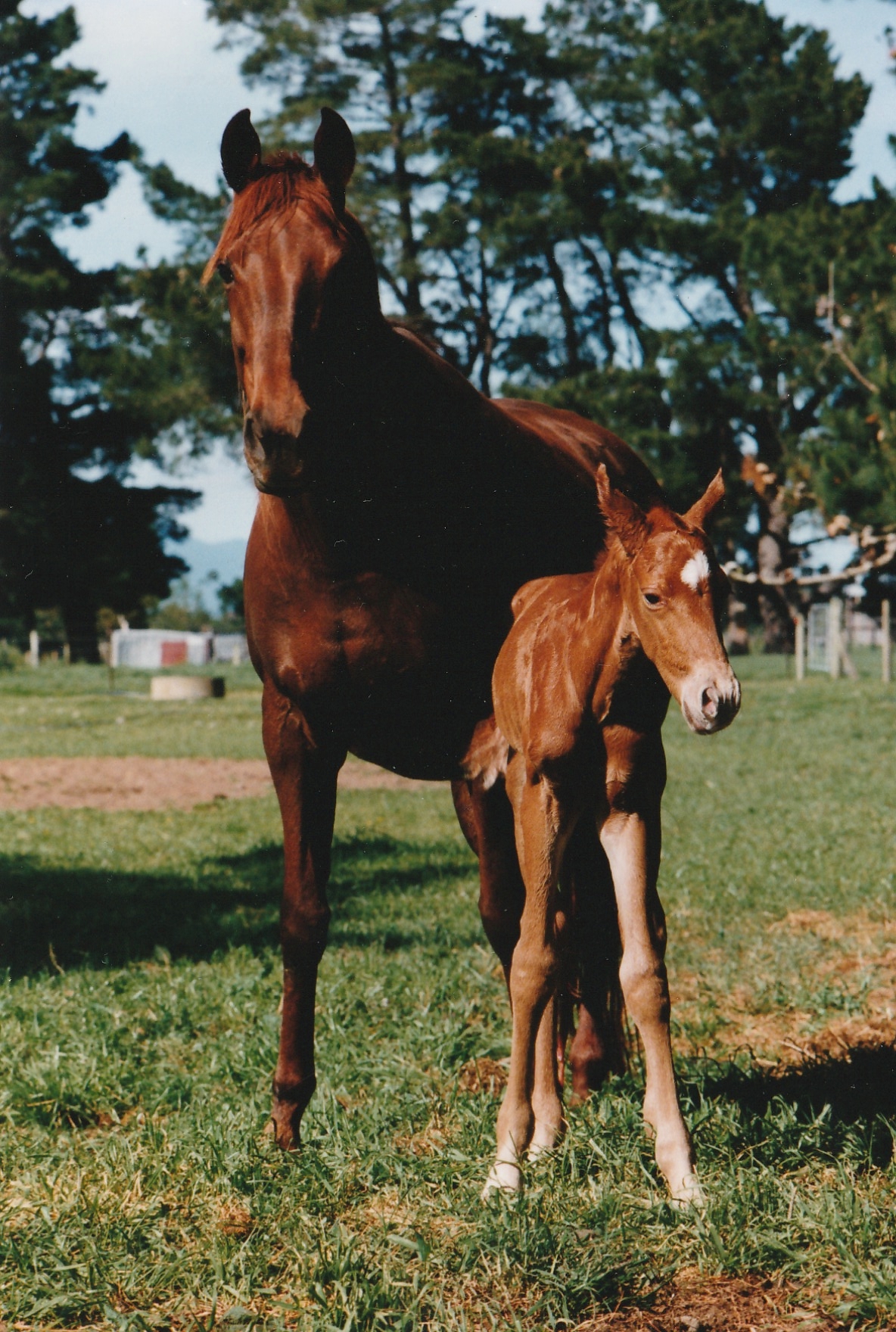
This foal is learning to greet a person. We hold our hand near the horse and must be sure to let the horse close the last inch of space to initiate the contact.

Here is a small horse experiment that could be illuminating.  It may be interesting to use with your horses or a horse you are thinking of buying.

  1. Stand in a roomy area or paddock where the horse can see you. Stand very quietly with a slumped and despondent posture. Wait. Observe what your horse does (casually, don’t stare at him).
  2. While the horse is minding his own business in a roomy area, make your body language large and assertive (not aggressive), focus on him strongly and walk briskly toward his shoulder in a straight line. What happens?

Some people may, without realizing it at first, slip from assertive to aggressive. As with horses and dogs, human aggression often arises from fear and is a defense mechanism. This is important to remember when we are around horses. 

What looks to us like aggressive, intimidating horse behavior is often grounded in fear if the horse is contained with ropes or in a small pen. A horse’s only way of regaining a feeling of safety is to move himself away as far as he needs to go. When we restrict his ability to move away, his remaining options are limited.

Some people (and some horses) are naturally on the timid end of a ‘timid-bold continuum’. A person may want to learn to be confident with their horse, but quickly slips from confidence to nervousness. This creates a problem for the horse when he is relying on the person’s clear communication, and it is suddenly fuzzy and incomprehensible to him.

The strength of the relationship we build with a horse depends on how clearly we can present ourselves to the horse as another being who is confident, trustworthy and fair. 

Emotional Neutrality

Our body language is intimately linked with our emotions. The more we can lay aside emotional responses, especially stress-related and negative emotional responses, the more we can be ‘in the moment’ with our horse. The more we are ‘in the moment’, the more open we are to noticing the signals the horse is sending us. 

The more we can be open to his signals, the better we can ‘stay with the horse’ and give him time to work out how he can earn his next click&treat.

If we are totally focused on our own agenda, it is hard to also be mindful of the horse’s signals and take them on board so that we can quickly act in the most appropriate way.

The more negative emotion a horse feels from the handler, the harder it is for the horse to focus on what we are asking. He will either withdraw into himself or seek to escape by looking away and moving his feet away as far as a rope or fence allows.

Emotional neutrality relates to the ‘aura of energy’ mentioned earlier. A horse can pick up our pleasure and joy when he does something well. He equally picks up every hint of frustration or annoyance. By the time we recognize we are annoyed or angry, the horse will have withdrawn from accepting our communication at that moment.

It takes a long time to build the trust of a prey animal wired for flight. A moment of aggression can erase a lot of trust. If the horse is contained with rope, reins or small enclosed spaces, he perceives human aggression as a threat to his life.

Horses don’t have a concept of ‘punishment’. In the wild, a horse always has the option to move away from assertive or aggressive behavior by herd mates. We must never forget that they are prey animals and their key defense is flight. We must accept that nothing a horse does is ever a personal affront to us. What a horse does at any one moment is what he feels he needs to do because he is a horse.

Body orientation, Gestures, Touch, Voice, Intent are all things we an refine to make it easier for the horse to understand our requests.

Successive Approximations and Resets

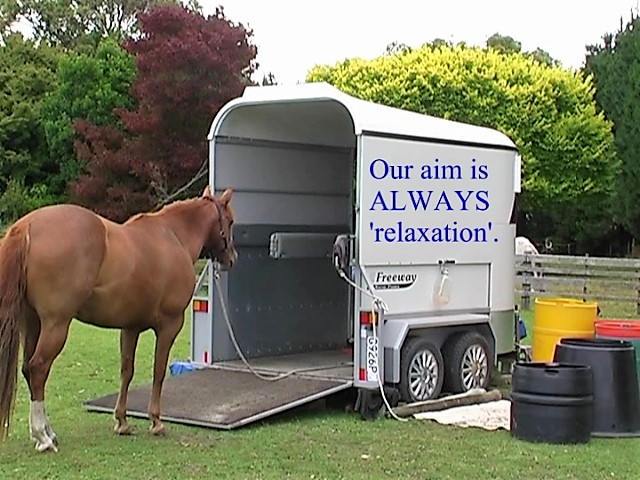
The photo above shows one of the approximations we use when teaching trailer loading. Navigating a narrow space alongside the trailer, confidently, is a major step along the way to gaining confidence to enter a trailer.

Successive approximations, simply put, mean that we start with what the horse can offer already and gradually direct and reward each tiny move in the direction of the final behavior we want.

In other words, at the beginning of teaching something new, we click&treat for the slightest approximation of what we want as our final result. Each improved approximation is one tiny slice of the overall task.

When the horse feels ready, we encourage him to do a tiny bit more to gain the click&treat. This whole process of rewarding successive approximations is called ‘shaping a behavior’.

Shaping a Behavior: This is our second session of Free-shaping Head-Lowering

Putting a behaviour on signal/cue: In the next clip, you will see me re-setting the task repeatedly as I show Boots that a click&treat will only be forthcoming if I give the signal/cue for this behaviour, which is dropping my head and shoulders forward. We don’t want the horse forever putting his head down.

Putting Head-Lowering on Signal/Cue

A human example of shaping a behavior is teaching a child to write. The child starts with holding a pencil and using it to make random marks on paper. At some point the random marks become conscious curves and straight lines.

When the time is right, we introduce writing letters of the alphabet. Eventually the child can group letters to make words. Words are then arranged into meaningful sentences. Some children go on to write coherent paragraphs, essays, stories and books.

If the child loses confidence with any of the slices of the process, an element of discomfort creeps in, along with typical avoidance behavior. Not enough practice then results in a poorly shaped skill.

When a horse loses confidence in his ability to understand what we want him to do to earn a click&treat, we get typical avoidance behavior. He shuts down, stops trying – moves away if he can. Keeping the learner’s confidence is the essential role of a teacher.

Writing is an interesting human endeavor that starts at two years old and is still being shaped many years later at high school, tertiary education and beyond. There is always room for improvement.

Another way to look at successive approximations is to think of a sculptor starting with a piece of stone. He works in careful stages until the shape in his mind is visible to the rest of us in the shape of the stone.

In the same way, we gradually tease a series of movements (or stillness) out of a horse to yield the task we want. This is a bit harder than shaping stone because horses have minds of their own!

General Key Points

  1. The more quickly you click&treat, and simultaneously stop any signal/cue, when the horse complies, the faster the horse can learn to recognize just what it is you want.
  2. Once the horse understands your intent, refine your signals/cues and be TOTALLY CONSISTENT with them.   
  3. If you keep nagging with a signal/cue by repeating it, you will desensitize the horse and make him disregard the signal. Nagging is an easy habit to get into and hard to break. If the horse does not understand the first time you use the signal/cue, back up in your teaching until he does.
  4. The energy you use to communicate with a signal/cue will change with the situation and what you are asking the horse to do.
  5. To teach with the free-shaping, the horse learns without a direct signal/cue from you to initiate an action because you have set up the environment to make the action you want likely to happen. The horse does the action of his own free will. You mark the action with a click and reward it with a treat. Once the horse offers the behavior reliably, add a signal/cue to it. The signal/cue is usually determined by the nature of the task. It will be unique to you and a particular horse. For the haltering task in the video clip at the end of the blog, I started with the horse’s natural curiosity about the hoop, and shaped the haltering procedure from that.
  6. Just when everything is feeling really good is the time to STOP. Avoid at all costs the urge to do it again to see if we can. Change to something relaxing instead.
  7. One of the key skills of horsemanship is to read the horse accurately to be able to decide on the best activity (or rest) for the moment we are in. It is part of the concept of ‘feel’.
  8. When things go awry (which they will), always go back to where both you and the horse feel confident again, and gradually work forward from there.

When we watch a horse and his trainer perform a complex task, it is not always easy to see the steps the handler took to reach the smooth end behavior. Even if we can find out how the horse was trained, that only tells us about what worked for that horse and that handler.

Here are some questions we have to ask ourselves.

  • What did the horse know already before learning that task?
  • How experienced is the handler?
  • What method(s) of reinforcement does the handler use?
  • How long have the horse and handler worked together?
  • How long did it take them to reach this point?
  • What were the tricky bits along the way?
  • How often did the horse get confused?
  • How often did the handler have to go back a few steps and work forward again?

Seeing a horse carrying out a task that grabs our fancy is the beginning of our own adventure. It gives us the inspiration to teach our horse something new. The starting point for any Individual Education Program we set up for a horse will be unique to us.

Here is the definition of thin-slicing again.

Thin-slicing is a shorthand way of saying: split the overall task we want the horse to learn into its smallest teachable parts and teach each part in a way that makes it as easy as possible for the horse to understand.

Resetting a Task

When we teach something new, we are experimenting with our signals/cues and the horse is also experimenting to work out what it is we want him to do. It’s not unusual for things to get a bit complicated and messy.

If either you or the horse lose track of what you are doing, pretend it was perfect, relax (but no click&treat), pause. Count to ten and rotate your shoulders. Then go back to the beginning of the task and try again, starting with your visualization of how a good effort will look and feel.

The magic about pretending it went well (when it actually turned into a mess) is that it dissolves the natural frustration we feel when our communication is not getting through. Horses instantly pick up on the changes in our body when we are frustrated or angry, and will want to move away from the negativity, so any teaching/learning moment is lost.

If we can smile, breathe out and relax our body before the reset, we don’t upset the horse or make him anxious. We simply start again.

When someone tries to teach me something new on a computer or cell phone, they invariably go so fast that I have no idea what they did or what I should be doing. I think that is what often happens with horses.

The following two clips demonstrate teaching with successive approximations. Our sessions were never much longer than three minutes.

First Successive Approximations for Learning to Put on a Halter

In the next video clip, be aware that to make it shorter for easier watching, I cut out the bits where I reach into my pocket, after the click, so it is a bit jumpy. Everyone’s progress will be different.

From the Hoop to the Halter

Horse Vision is Different from Human Vision

Shape of the lens

The lens of a horse eye is not able to change shape as easily as the lens of a human eye. Horse vision more resembles looking through a trifocal lens. A trifocal lens supports distance focus in one part of the lens, mid-distance focus in another part and close-up focus in a third part.

This explains why horses need to do so much positioning of their heads to see clearly. They need to raise their head high for clearer distance vision and drop it down low to get a better view of something closer.

Horses need to lower their head to see things up close clearly. Long hair obstructing the eyes does’t help.

Forcing a horse to keep his nose vertical with the ground restricts his visual field a great deal. It is easy to try this yourself. Stand with your head up and note your field of vision. Then drop your head so your nose points to the ground.  Note your field of vision now.

For a prey animal who depends on early detection of danger and a flight response for survival, restricting the field of vision by requiring (or forcing) vertical flexion can cause a lot of mental anxiety and related damaging muscle tension all over the body.

Eyes set in the side of the head

Being set either side of a large head, horse eyes work more independently than human eyes. The positioning of the eyes limits the horse’s binocular vision (being able to focus on something in front with both eyes) to a triangular area in front.

The shape of his nose causes a blind spot that extends about three feet directly in front when his head is straight, so his field of binocular vision is beyond that. So if we are standing directly in front of the horse within three feet, he is not able to see us or any signals we may give. But he can smell us and be aware of our energy level.

As well as his zone of binocular vision straight ahead, the horse can see almost 180 degrees beside and behind with each eye, similar to a person using rear-view mirrors on a car or bike.

Eyes set well into the side of the head allow rear view vision at almost 180 degrees. This peripheral vision is highly tuned to movement. A startle response due to a sudden movement from behind is an adaptation to get a head start on any predator emerging suddenly. In this view, Boots is able to see me on the right side of her body with her left eye.

This side or peripheral vision is not as exact as binocular vision, but it is excellent at picking up motion. That is why horses often jump away sideways first if something moving to the side or behind startles them, then they rapidly sprint away before turning to assess the situation. How far the horse moves depends on the intensity of the adrenalin rush.

When the horse is strongly focused forward using his binocular vision, his mind is busy with that and not linked to his peripheral vision. This helps explain why we need to be careful approaching a horse from the side or the back, as he can be genuinely startled by movement behind, if his full attention was on something in front of him.

It also seems that horses can doze with their eyes open. If you come across a horse looking very relaxed, with low head, floppy bottom lip, relaxed ears and a cocked hip, he may be too asleep to notice a quiet approach even though his eyes are open. It always pays to give a warning ‘nicker’ or say something while approaching the horse.

Light Intensity

With their extremely large eyes, horses have excellent night vision as long as there is some environmental light. I can vouch for this, having once been caught on the far side of a hydro river, when water was unexpectedly released into the river from the dam upstream during a sunset ride. We had to ride in serious darkness on an unknown track to reach the dam and cross over to our home side.

Horse eyes take longer than our eyes to adjust from light to dark or dark to light. It’s important to remember this when we move a horse from a dark building into bright sunlight or from sunlight into a dark arena, stall, truck or trailer. We should allow him to stand with his head in the entrance while his vision adjusts.

Blind Spots

As mentioned, horses have a triangular blind spot that reaches about a meter in front of their nose. That is why they need to lower their head as they approach an object closely to inspect it. You can simulate what it is like, to have a long nose like a horse, by putting your hands in place as in the photo below. Note how it affects your ability to see right in front of your nose.

Colette demonstrates how to place your hands to imitate a horse’s long nose to let you see why horses have a blind spot when they are looking straight ahead. If you spread your fingers wider in this position, the blind spot gets bigger.

They also have a blind spot right behind their tail if their head is straight as well as under their belly when walking across things. 

Horses have a blind spot directly behind if their neck is straight.

If we are experimenting to find the best position to give our horses a visual signal, it pays to be aware of their blind spots as well as how their vision differs from ours.

Depth Perception

A horse’s small range of close-up binocular vision makes depth perception for stepping into or onto unusual surfaces tricky. They again need to raise and lower their head to compare the object of interest with things they have seen before.

This comparison of the look of ‘new things’ with things already in the horse’s memory, helps explain why horses are so sensitive to anything which has been changed – anything added or subtracted to what was there the last time they passed by.

Their limited depth perception explains why horses are often reluctant to step into a puddle. The reflected light and the ‘unknown’ surface’ under the water are both problematic. Dangerous footing compromises a horse’s ability to flee if the need arises.

Horses need to lower their head to investigate unsure surfaces visually. Often they also paw to check the stability of what lies underneath.

The horse eye has a ‘visual streak’ in the retina (sensory screen at the back of the eye) which is the area of most accurate vision. As mentioned earlier, horses must move their heads in order to bring the item of interest into the range of this ‘visual streak’ to improve the depth perception and detail of the image.

If the horse’s head is restricted by tight ropes or reins, his ability to see clearly is compromised. Not surprisingly, such restrictions cause tension that affects the whole body.

Horse eyes appear to magnify objects more than our eyes (maybe up to 50%).  The acuity (sharpness) of what they see is less than 20/20 human vision but seems to be better than that of dog and cat vision.

Training in Both Eyes

The way horse vision works helps explain why it is so important to teach everything we do on both sides of the horse. A horse that is only handled from the left side will suffer from ‘right eye neglect’. Handling procedures will be ‘strange’ to his mind on the right side because the neglect means no nerve pathways have formed to build his confidence with handling on the right side.

This links to all aspects of training and handling. Like us, horses are naturally either left or right-handed. In other words, like us, their bodies are asymmetrical.

Unless both sides of the horse’s body are coached gymnastically, it is hard for the horse to be straight in his body. Which means a saddle will always be misaligned to some extent. A symmetrical saddle on an asymmetrical horse is a perennial problem for riders and painful for horses. 

When teaching a new movement, the less agile side of the body needs at least two or three times more attention than the agile side of the body. Think about how hard it is to brush your teeth with your non-dominant hand.

Environmental visual signals

Horses living within sight of their owner’s house use the lights coming on during a winter morning as a signal that their morning feed is not far away. Part of the year I provided hay in the late evening. The headlamp I wore was a visual signal the horses used to meet me at the shelter.

During groundwork our body language and gestures are visual signals. If we are approaching from behind, the horse is usually able to see us by turning his head.

When my horse’s companion, a large white gelding, went to live elsewhere, her attention was often riveted on a white Charolaise cow in a distant paddock as she tried to figure out whether that was her old paddock mate.

My thoroughbred mare, Gypsy, was super conscious of anything on the distant horizon. A rabbit hunter toting a rifle, so far away that I could barely see him, caught her immediate attention.

Awareness Needed

Horses are genetically wired to pay close attention to anything which looks different to how it looked before, or if something appears that wasn’t there before.

Because their eyes are not the same as ours, it is important to be aware of the following situations.

  • Depending on the shape of the horse’s belly, there is also a blind spot under his hind legs and under his belly. If we ask a horse to back over a rail, he can’t actually see the rail at the time, but is working from memory or feel. Just because we can see it doesn’t mean the horse can see it.
  • When we approach the horse from the front, it is best to be a little bit off-centre, so we are not in his front blind spot.
  • If the horse is focused on something ahead in his area of binocular vision, his mind is not engaged with his peripheral vision. This means that something suddenly moving behind him can result in a startle response, often called ‘spooking’. As mentioned earlier, peripheral vision picks up movement rather than detail, so the horse will move first, then turn and inspect the cause of the spook. How far he moves before turning depends on the amount of adenalin shock he experienced.

If the horse is strongly focussed on distance vision, with a raised head and a concentrated look, his peripheral vision is ‘off’, so sudden movement from behind will cause him to spook. Spooking is a highly effective method for escaping from predators.

  • If we are doing groundwork behind the horse, we need to move between his right and left peripheral vision and teach him to adjust his head so he learns to confidently keep us in view as we move left and right into and out of his blind spot.

Playing the peek-a-boo game from behind. In this photo Boots can see me standing behind with her left eye.

In this photo I have moved to her right, so she is watching me out of her right eye.

I’ve moved back to the left and she tracks me with her left eye. It’s fun to play this peek-a-boo game when the horse has front feet on a pedestal.

When we begin long-reining, it’s a good idea to play a peek-a-boo game from behind, while the horse is stationed on a mat or pedestal, and make sure he is comfortable turning his head to track your movement.

  • When horses negotiate a jump, the jump disappears from their vision as they approach it, so they are jumping from their memory of where the jump was. If the horse was paying attention to something else on the approach to the jump, he will run right into it without realizing it is there. You see this sometimes at jumping competitions.

When jumping or stepping over rails, the obstalce disappears from the horse’s vision and they work from memory of where it was.

Riding – Visual Signals Mosty Disappear

When we move from groundwork to riding, the visual signals the horse has learned suddenly disappear. We need to teach the relevant replacement touch and verbal signals we will use during riding from the ground first. In this way, we make it easier for the horse to navigate the change to riding.

Once mounted, we need to carefully re-teach the replacement touch signals by at first pairing them with the voice and visual signals the horse already understands from his groundwork. 

If touch and voice signals are clearly taught with groundwork, the switch to riding can simply be part of a systematic progression rather than a major change.

When we mount up, the visual cues and signals we use on the ground suddenly disappear. We have to carefully transfer these to voice and touch signals to make the transition smoother.

Comfort Zones

In the photo above, one horse is within his comfort zone checking out the tarp. The new horse standing behind is unsure about what is going on. In this situation, the confident horse is helping to build the new horse’s confidence, which is a great way to proceed.

Beginnings are Hard

When we begin doing new things, it takes time and effort to get the feel of what we are doing. Getting this ‘feel’ for a new activity doesn’t happen in ten minutes. Same for horses.

Doing something new takes us out of our comfort zone. We know when we are out of our comfort zone because our heart rate and breathing speed up. We may sweat more and have feelings of un-ease, often beginning in our gut or stomach. Same for horses.

It’s important to recognise how we feel when we are out of our comfort zone, as well as how we feel when we are back in our comfort zone. And we need to recognize when our horse is out of his/her comfort zone.

Only desire, effort and application can make a comfort zone larger. Learning and education are all about expanding comfort zones.

Obviously, both the handler and the horse have comfort zones. If both parties are out of their comfort zones, it may not be a good horse day. So it’s important that when the handler is out of his or her comfort zone, the horse is in his comfort zone.

When we take the horse out of his comfort zone, we ideally want to remain in our own comfort zone so we can maintain our emotional neutrality. By understanding our own and our horse’s comfort zones, we’ll have more good horse days, until every day is a good horse day. (The bold items are in the Glossary page.)

For a horse at a particular time, ‘comfort’ can mean the freedom to move and run, using up adrenalin and enlarging his personal space.

At another time, the same horse may find ‘comfort’ in a quiet, restful state.

As the handler gets to understand the edges of a horse’s comfort zone, it becomes easier and easier to thin-slice tasks to suit that particular horse.

The diagram below has six arrows that illustrate the six situations that a person or horse will come across.

The inner circle with the smooth boundary is the existing comfort zone. We can call the boundary of this circle ‘Edge One’ because it is a threshold that determines our behavior, or the horse’s behavior.

To expand our comfort zone, we have to move out toward the wiggly, broken line. Out there is the world with all kinds of thresholds that challenge us. We can call the broken line ‘Edge Two’.

The numbered arrows following the diagram refer to the six situations that will arise whenever a person or a horse is faced with expanding their comfort zone.

Comfort Zones: All of us, horse or human, have a ‘comfort zone’ within which our heart rate is normal and we can allow ourselves to relax. Expanding a comfort zone takes active intent. The six numbers are explained below.

  1. Lacking confidence to leave the comfort zone.
  2. Can leave the comfort zone for a bit, but then has to hurry back.
  3. Able to leave the comfort zone for longer before going back.
  4. No longer needs to retreat to the former comfort zone. The comfort zone has expanded.
  5. Starting to feel comfortable well beyond the old ‘Edge One’ threshold.
  6. I can do this now. What is the next challenge? I’m ready to set a new ‘Edge Two’. ‘Edge One’ has moved out to encompass the original ‘Edge Two’. The comfort zone has expanded.

If we push ourselves, or our horse, toward ‘Edge Two’ too quickly or too soon, we, or the horse, will feel worried, anxious or fearful.

We will ‘run away’ in our mind and make up reasons to avoid going ‘out there’ again. The horse will indicate that he’d like to leave the situation or he will ‘shut down’. Either one means he has given up trying to understand what we’d like him to do.

This avoidance response is the brain’s way of keeping us safe. It’s a useful instinct in some situations, but in today’s human world, and with horses forced to live in captivity, we have to both find ways of successfully expanding our comfort zones.

As we learn to recognize where we and the horse are in relation to our comfort zones for any given situation, we will be able to take more control of where we are, in relation to where we want to be.

Safety is always the first priority. The horse has to learn how to respond appropriately to a variety of human pressures. The handler has to know how to influence the horse to keep everyone safe when a stressful situation occurs.

A stressful situation can arise in a split second. It helps a great deal if the horse has faith in us and if we know how the horse will probably respond when his adrenalin is up, so we can take pro-active measures.

With careful positive reinforcement training, stressful situations will become less common.

Boots is temporarily distracted out of her comfort zone as Smoky gallops around the paddock next door. Bridget waited quietly until the excitement was over, then carried on with trailer-loading skills.

Refining our Body Language

Horses are incredibly sensitive to body language because it is the language they use with each other. They are also highly aware of the body language of predators so they know if predators are in hunting mode or not. When our horse gets to know us well, and we are reliably clear and consistent, small changes in our body language can become a significant part of messaging with our horse.

Whole Body Language Signals

General Orientation of Our Body

  • Moving from A to B, the horse follows along or moves with us. 
  • When riding, the rhythm of our body in tune with the gait we are in, and our rhythm changes when we ask for a change of gait.
  • Facing the horse in front, we can draw him toward us by stepping backwards.
  • Facing the horse in front, we can ask him to back up by stepping toward him.
  • Facing the horse’s ribs, allows us to ask him to move past us or in a circle around us.

My body orientation is a large part of the signal that lets Boots know that I’d like her to move over the rails and continue in a circle while I pivot on the spot.

Specific Orientation – the alignment of our body axis in relation to the horse is a major part of the signal when we ask for:

  • Turning right or left
  • Weave pattern
  • Figure 8 pattern
  • S-bends, L-bends, U-bends, zigzag-bends
  • Hindquarter yields
  • Forequarter yields
  • Backing up with counter-turns (as in backing a square)
  • Standing on a mounting block as a signal for the horse to line itself up for mounting.

By shifting my body axis away from the horse, she knows we are turning right and no pressure on the halter is needed.

Gesture Body Language Signals

Large Gestures

We might sometimes use large body language signals if we are:

  • guiding from behind
  • sending the horse away into a circle
  • arm held out as a target to signal a recall.
  • Swing arms in front of us to signal end of a session, followed by jackpot on the ground or in a dish.

I’m holding out my arm as a large gesture for Boots to recall with my hat.

Medium sized Gestures might be ones we use as:

  • back up with hand signals
  • ‘walk on’ signal with arm and outside leg when walking together
  • facing the horse, hand put up for whoa
  • facing the horse, recall signal
  • please move sideways away from me
  • hand lightly on poll for ‘head down’ signal
  • please move your hip away
  • please move your hip toward me
  • please move your forequarters over
  • please move your forequarters toward me

Another recall signal is me leaning slightly forward and making a hoop with my arms. It works because it is clearly an unusual body position.

Small Gestures might include the following:

  • walking side-by-side, halt signal by handler dropping into her hips
  • hand positioned so horse can target the palm of the hand with his chin
  • stretching out hand, palm down, for the horse to complete the touch connection with his nose; often called the ‘horseman’s handshake’.

The horseman’s handshake. The back of our hand stands in for another horse’s nose.

Direct Touch Signals

Hand Touch:

  • Stroking
  • Massage & stretching exercises
  • Picking up feet, cleaning them and trimming
  • Backing up with touch to chest or nose
  • Sideways with touch to ribs
  • Yield hindquarters with touch to hip
  • Yield forequarters with touch to shoulder
  • ‘Walk on’ with finger tap behind withers or on butt.

We use body orientation and touch signals for foot care. Also often a voice signal.

Body Extension Touch: This involves all the things we have in our hand, or things we put on the horse. It might include:

  • grooming
  • cleaning and trimming feet
  • head gear put on/off
  • ropes all over body
  • saddles or harness on/off
  • guiding touch with a body extension, as for long-reining.

When we start using gear on our horses, we must remember how sensitive they are to touch.

Riding Touch:

Since horses are extremely touch-sensitive they feel every shift of weight and position. As long as we don’t desensitize the horse to touch signals by nagging, inconsistency, or rudeness, the horse learns to respond to the smallest of touch and weight placement variations.

Head Gear Touch Signals

Via rope while we are working on the ground:

  • poll pressure to walk forward when leading, although this can be replaced easily by using clear body language (breathe in, gesture with arm and step off with outside leg – easier for horse to see).
  • light nose pressure to halt, back-up (refined with voice signals)
  • light nose pressure for change of direction
  • light nose pressure for downward transitions, halt, back up
  • light nosepressure to ask for bend.
  • halter vibration to back-up.

A very light jiggle on the rope is one of our signals for backing up. By using props such as this, it makes sense for the horse to back up, making it easy to teach. The rope touch signal can then easily be morphed into gesture, body orientation and voice signals.

Verbal (Voice) Signals

  • “click or “yes” word
  • whoa” word or sound
  • upward and downward transition words or sounds
  • encouraging ‘keep going’ words or sounds
  • inhibiting warning words or sounds (squeal)

When I want to park the horse with ground-tying, I have first taught verbal ‘whoa’ and ‘wait’ voice signals to a high standard.

Before we deliver the treat, we have used a click (tongue click or mechanical clicker) or a special sound/word to let the horse know what he did at that moment, is what will earn a treat.

Breathing and Body Energy

  • breath in = raising body energy to prepare to ask for more movement
  • breath out = dropping body energy to prepare for slowing down
  • large sigh to encourage relaxation
  • relaxed posture during dwell or relaxation time between requests

This relaxed posture during ‘dwell time’ I learned from Alex Kurland. Shoulders relaxed, looking nowhere, facing away from the horse, hands quiet on belly. I’m also slowing my breathing and therefore my heart rate. Horses are incredibly tuned in to the body language of people they know well and who act consistently. They are also instantly aware of emotions. Body language is the key language between horses.

Intent

This links very closely with our breathing and body energy. Again, horses are incredibly perceptive. The more consistent our behaviour and emotional state, the more relaxed and willing the horse can be.

  • how we align the core of our body and our eyes
  • how strongly we are focused on what we want to happen
  • how we bring our breath and energy up in preparation for giving a signal
  • how firmly our inner belief backs up what our signal is requesting

In this photo I’m aligning my body axis to weave the obstacle in front of us. My energy and breathing are up. I’m strongly focussed on what I want to happen. As we round one obstacle I change my body axis alignment and my focus to weave the next obstacle. Because I’m consistent, the horse learns to read my intent and readily complies.

I hope you have fun seeing how small you can make your body language and touch requests and still be clear for your horse. They depend on us for so much.

By always starting at the withers when we want to ask for a foot to be picked up, the horse has time to shift his weight so he CAN pick up the foot we want. Here Bridget is about to ask for the left hind foot and Boots will shift her weight to make it possible – in fact, she will be lifting her foot as Bridget moves to her hindquarters, in anticipation. Just as we do, horses like to know what is going to happen next, before it happens.

ROPE RELAXATION

ROPES: It’s hard to overemphasize the importance of educating our horses to be totally comfortable with ropes. Our main enjoyment may be to play with our horse at liberty and teach everything using targeting, voice and gesture signals. But sadly, horses in captivity are totally dependent on people for their well-being. Other people may regularly handle our horse or something may happen so that help from other people is needed. In case of fire, flood, or if you are hurt, or your horse must be moved, he will need a solid foundation of rope confidence. If he is sold, we want him to be comfortable with ropes.

If we take our horse out into public places we need him to be relaxed on a lead rope. If we tie our horse up, we have to get him comfortable with that. Rope Confidence includes ropes moving around him, ropes constricting him and ropes touching all parts of his body. The same is necessary if you want to teach your horse long-reining and maybe driving. Sooner or later we are going to drop a rope or rein and it is better if the horse does not see this as a reason to panic, which can lead to running into or over fences, or danger on a road.

#121 HorseGym with Boots in clip called Stick and Rope Confidence shows a way to begin. https://youtu.be/WIpsT4PPiXo

We don’t have to begin with a rope.

There are several elements to Rope Relaxation. #22 HorseGym with Boots in a clip called Rope Relaxation shows some of the elements mentioned in the list coming up. https://youtu.be/6Y34VlUk0Iw

The last part of this clip shows building confidence with dragging ropes.

We want to gain the horse’s confidence to remain parked while we do the following activities.

  1. Swing a second rope (not attached to the horse) near him.
  2. Gently toss the end of a soft rope all over his body, including around behind, under the belly and around the legs. It should feel like horses standing tail to nose swishing flies off each other with their tails. Start with a second rope not attached to the horse, then graduate to using the end of a long lead rope.
  3. When the rope is attached to the horse, make sure you keep a constant drape in the part attached to his halter while you toss the other end around his body. You want to avoid putting touch pressure on the halter.
  4. Toss a coiled rope (not attached to the horse) in the air across him.
  5. Randomly drop a coil of rope (not attached to the horse) onto the ground in various positions around him.

We also want to continue building his confidence with the rope when we:

  • drag a second rope while we walk along with the horse on a loose lead as in the second video above.
  • attach a second rope to the horse’s halter which he drags while we walk with him on a loose lead, including walking curves and corners where the dragging rope may touch the horse’s feet or legs, as in the second video above.
  • If the horse has reason to move when his rope is attached and dragging, we want him to be calm about it.
  • And eventually, with careful shaping, we can leave the horse ground-tied in different situations.

I’ve created a reason for Boots to walk forward dragging her rope on her own, so if she is ever in that situation, it is not unfamiliar.

Eventually we can practice ground-tying in different situations. The dropped rope and the gesture/verbal WAIT signals tell her that staying in place will eventually earn her a treat.

Here is the link to the complete ‘Ground Tying‘ BLOG: https://herthamuddyhorse.com/2019/10/31/ground-tying/

The Importance of Pause and Wait

In the photo above, Bridget and Boots are at ‘pause and wait’ while I explain the next part of their task.

How does our horse know when we want him to stand relaxed beside us or when we want him to do something?

It is essential that we learn to manage our body langue to make it crystal clear to the horse when we are asking him to do something and when are in pause/no intent/ relaxed mode.

Horse sensitivity to the body language and intent of others is much more refined than ours because it is their primary language. In humans this ‘reading of body language’ has been dulled because we talk so much.

But we can stop talking and become aware of what our body language is saying to the horse. Body Language includes our orientation to the horse, our energy level, our breathing rate, our heart rate, our body temperature – these all communicate our level of calmness or agitation to the horse. To that we add the intent we hold in our mind.

Once we have a good awareness of our body language, we can begin to use its different aspects to communicate more clearly with our horse.

No Intent

In the photo above I am standing at ‘pause’. My orientation is not directed at the horse, my energy is down. I’m looking nowhere. My hands are quiet laid across my belly. My shoulders are relaxed. My breathing is slowed down, which also lowers my heart rate. My mind is quiet, not thinking of the next thing to do. This posture shows the horse I have no ‘intent’, allowing her to also relax into the ‘wait’ time.

Intent

In the photo above, my body language expresses clear intent that I would like Boots to step across the barrels. My focus is where I want her to go. I’m indicating ‘walk on’ with my outside arm and I’m stepping along with her.

Emotion Exercise

Find a stick and an inanimate object you can hit hard with the stick.

First, hit the object as hard as you can three times. Channel a time when you were angry or frustrated and put those feelings into thrashing the object. Your breathing, blood pressure and temperature will go up.

Second, kneel down beside the object and caress it lovingly. Channel your soft feelings for your horse or any other living creature. When you feel nicely relaxed, go back to hitting the object violently three times. Then kneel down and caress it lovingly.

Repeat a few times. Be sure to do this where it won’t upset your horse, dog, chooks, children, friends, partners, passer-byes or and other farm animal in the vicinity.

Take note of how your emotions mirror your actions. Keep this awareness. Horses need us to be calm and collected, especially when things go awry. If we are not calm and collected then the horse has no chance of being so.

No Intent

We can express ‘pause’ or ‘no intent’ sitting down.

Intent

My energy is up, I’ve asked her to walk with me and and while I maintain the increased energy and keep moving, she will move with me. When I come to a halt, I first drop my energy, release a long breath out and drop my weight down into my butt. And because I’m human, I also say, “Whoa”.

Strongly Reward the Pause or Wait Time

It makes sense to click&treat when the horse moves in the way we are asking. It makes equal sense to reward when the horse can relax into a pause/wait. We are not doing nothing. We are teaching active inaction. It can be difficult for horses to learn when most of their interactions with people caused movement or pain or restriction.

If you have already taught your horse to enjoy putting his front feet on a mat to earn a click&treat, use the mat to start building duration of the pause/wait.

Eventually we can incorporate ‘parking spots’ and have the horse WAIT while we stand in different positions around him. I am in my ‘no intent’ pose in a position where she can see me in her peripheral vision. It takes time to build up the duration. In each new spot start again with a few seconds and work forward from that.

Use a High Rate of Reinforcement

If the horse can stand still for 1 seconds, click&treat. Pay attention to your own body language. Start with whatever time the horse can offer, adding one second at a time before a prompt click&treat. Make sure the horse is not hungry and not needing to move to release pent-up energy.

Keep sessions short enough to maintain calm (you and the horse). Do some ‘pause and wait’ every time you are with the horse.

This video clip looks at using a mat to build duration. Number 9 in the Blog Contents List (link at the top of the page) has a number of detailed videos about using mats.

This video looks at staying parked while the handler moves further away.

A couple of more recent clips.

Precision Leading

Synchronicity is a fundamental horse behavior. Horses living naturally stay in visual contact and move together. A warning snort by one horse will immediately alert all other horses within hearing. One horse startled into action will immediately be joined by the rest of his group. The body awareness of horses, like that of schooling fish and flocking birds is so acute that even at top speed on uneven terrain they don’t run into each other.

Horse body awareness is so well developed that even in full flight they do not run into each other.
Photo by Gigi on Unsplash

It’s possible for us to become part of this incredible sensitivity if we train ourselves to become clear and totally consistent with our body language. Once a horse realizes that our body language is significant and reliable, he tends to watch it closely. If we systematically strive to improve our body language, we will reap the benefits when we lead our horse.

We inevitably need to lead our horses from A to B. We might be leading our horse:

  • Between paddocks.
  • Between stable and paddock.
  • Into and out of stalls.
  • To and from our training area.
  • Along a road or track for a walk.
  • Alongside other horses.
  • On the uneven road verge or ditch if large or unusual traffic comes along.
  • Through gates of varying width.
  • Through a narrow space.
  • In a new area the horse has not seen before.
  • Into a familiar area which suddenly has new things in it.
  • Up and down slopes.
  • Around obstacles.
  • Through water.
  • Across ditches or gullies.
  • Into and out of a truck or trailer.
  • Around a vet facility.
  • Between cars and horse trailers.
  • Past or among strange horses and strange people.
  • Past pigs or donkeys or other animals unfamiliar to the horse.
  • Past loud or aggressive dogs.
  • Near children.
  • If we take our horse for walks, we may be in bush or forest with logs to step over, water to cross, other trail users to meet and pass.
  • If we trail ride, we may have reason to dismount and lead the horse in narrow, unusual and sometimes dangerous places with poor footing.

I’m sure this is not an exhaustive list, but it makes the point that it is definitely in our interest, and in the horse’s interest, to make precision leading part of our horse’s repertoire.

The ‘gates’ in this exercise are pairs of markers set up in a random pattern. The task is to organize the approach to each gate, so the horse can navigate it fluidly. We start with the gates well spread out and roomy to walk through.

I’m using a variety of markers to create a series of ‘gates’. The direction of our body axis is essential information for the horse to know whether he will be going straight, turning toward us or making a counterturn to head toward the next gate (as in video below).

This first short video looks at how we can use clear, consistent changes of our body’s axis as a major signal for the horse.

As always, there are quite a few PREREQUISITES. If you want/need to review any of the key prerequisites, I’ve put direct links to them at the end of this blog.

PREREQUISITES:

  • Horse responds willingly to ‘walk on’ and ‘halt’ signals in a relaxed manner.
  • Horse responds to soft rope signals.
  • Horse backs up willingly with the ‘finesse back-up’ and/or ‘shoulder-to-shoulder back-up
  • The horse understands the significance of the handler clearly changing his/her body axis to indicate direction.

ENVIRONMENT & MATERIALS:

  • A work area where the horse is relaxed and confident.
  • Ideally, the horse can see his buddies, but they can’t interfere.
  • The horse is not hungry.
  • Halter and lead. A shorter 8-foot lead makes it easier to keep a soft drape in the rope.
  • A series of five or more gates made with pairs of markers such as cones, tread-in posts, pieces of firewood, rocks, containers of water (5-liter plastic containers of water are especially useful), barrels, jump stands, rags – anything that is safe to use.
  • Each time we set up this exercise, we can put the gates in a different configuration. The number of gates is only limited by the size of the training area.
  • Once well established at home, we can expand the idea to new venues.

AIMS:

  1. Handler uses clear, consistent orientation, gesture, voice and halter-touch signals that allow the horse to smoothly navigate through each gate.
  2. Horse begins to seek out the next gate by reading the handler’s body language and gesture signals.
  3. Clear communication for:
  • Walk on through the gate.
  • Halt between the ‘gate’ markers.
  • Halt and back through the gate.

VIDEO CLIP:

#158 HorseGym with Boots: PRECISION LEADING

NOTES and SLICES:

  • Very short frequent sessions work best. Stay with each slice until it feels ho-hum to both of you.
  • Before asking the horse to negotiate the gates, walk through them yourself and visualize the order in which you will ask the horse to do them. Also explore the best way to approach each gate from various directions. The less hesitancy in your actions, the easier it will be for the horse to read your intent*. It’s fun, and hugely helpful, to have a second person be your pretend horse. Even better is for you to be the horse and have a friend guide you through the gates using body language only.
  • Set out five or more gates well spread out, with a good-sized gap for each gate so it’s easy for the horse to walk through.
  1. Walk to each gate in turn and ask the horse to halt between the markers; click&treat each halt. If he wants to stop to sniff and investigate any of the markers, allow him all the time he needs to satisfy his curiosity. Wait with zero intent* for an ‘okay to proceed*’ signal. [Terms with an Asterix (*) are defined in the glossary which you can access through the link at the top of the page.] In this situation, the ‘okay’ signal is when the horse brings his attention back to you. He may also sigh or breath out audibly.
  2. When 1 is smooth, halt in every second gate you come to; click&treat.
  3. When 2 is smooth, halt in every third gate you come to: click&treat.
  4. As the horse shows he is ready to do more, carry on adding one more gate before the halt followed by click&treat, until you can do a whole series with one click&treat at the end of the series.
  5. When 4 is good on one side of the horse, start again with slice 1 on the other side of the horse.
  6. When 4 and 5 feel smooth and light, ask the horse to back up two or three steps after a halt in a gate. Work up to a series of occasional ‘halts followed by a back-up’, in-between walking forward through the gates.
  7. Mix up:
    • Walking straight through gates.
    • Halting in a gate and walking on.
    • Halting in a gate and backing up.
    • Trotting through some or all the gates.
    • Put gates in different venues and/or use different markers.
  8. We can also use the gate as a stopping place to practice the WAIT.
Pausing in a ‘gate’ to play with increasing the duration of the WAIT GAME.

LINKS TO PREREQUISITES

Zero Intent and Intent: https://herthamuddyhorse.com/2018/11/30/dec-2018-challenge-no-intent-and-intent/

20-Steps Exercise: [#68 in the Blog Contents List] https://herthamuddyhorse.com/2020/09/05/20-steps-exercise/

Smooth Walk-on and Halt Transitions: [#16 in the Blog Contents List.] https://wp.me/p4VYHH-5TT

Soft Response to Rope Signals exercise: [#86in the Blog Contents List.] https://herthamuddyhorse.com/2022/01/03/developing-soft-response-to-rope-rein-pressure/

Smooth 90-degree Turns: [#31 in the Blog Contents List.] https://herthamuddyhorse.com/2019/06/29/smooth-90-degree-turns-handler-on-the-inside/

Smooth Counter Turns: [#35 in the Blog Contents List.] https://herthamuddyhorse.com/2019/09/30/smooth-counter-turns/

Weave Prep – more detail about using our body axis orientation. [My YouTube playlist called Weave and Tight Turns contains more clips about how I gradually developed these skills]: https://youtu.be/dQ4Qkz74pcQ

Finesse Back-Up: [#40 in the Blog Contents List.] https://herthamuddyhorse.com/2020/02/02/finesse-back-up/

Starting with a Shy or Timid Horse

Introduction

It’s tempting to think of horses as big, strong creatures – which they are. But in reality they are just giant squirrels, constantly on the lookout for danger and aware that flight is their best response to anything unusual. So building confidence with every new situation is everything.

Eternal vigilance is what keeps prey animals alive.

A Familiar Feed Dish

Using a familiar feed dish can help if we are working with a shy or timid horse, or one unused to humans. We can use free-shaping to capture the behavior of taking a treat from the feed bucket. If he is not yet interested in eating carrot or apple strips, use handfuls of soaked chaff or whatever bucket-food he is getting, or twists of good quality hay, or freshly plucked long-stemmed grass if you have access to this.

Here is the Thin-slicing for a Possible Training Plan.

  1. Place the feed dish between you and the horse. The horse’s response will show you how close you can be without causing him to move further away. 
  2. While watching the horse, be careful not to stare directly at him, but to turn a bit sideways to him and observe him discretely with your peripheral vision.
  3. Wait in a relaxed manner until the horse looks at the feed dish – click and quietly move to the feed dish and toss in a treat. Then immediately move twice as far away as your former position, giving the horse more than the personal bubble size he needs to feel safe enough to approach the feed dish. It’s good if the treat makes a sound when it hits the dish. If the wait time is quite long, take a chair. Sometimes a person sitting in a chair is less threatening than a standing person.
  4. Wait for the horse to retrieve the treat. If he can’t do it yet, move further away or go do something else and come back later. He’ll usually check the dish while you are away.
  5. Approach the feed dish until the horse moves away (if he hasn’t already). As soon as the horse stops moving away, stop as well and shift your body sideways so you are not directly facing him. Watch for him (without staring at him) to look at the feed dish – click as soon as he does and quietly move to the food dish and toss in a treat, then glide away again to a distance that respects the horse’s current personal bubble.
  6. Repeat 10-20 times or as long as the horse shows interest. He will gradually begin to connect the click with the food treat about to be tossed into his dish.
  7. Each horse is different. Some horses easily shrink the size of the space they need to feel safe and soon approach the dish readily. Others will find it harder to build confidence.
  8. It’s possible to do this procedure on the other side of a fence from the horse. This is protected contact for us, but it can also make the horse feel safer from his point of view.
  9. Gradually we can shift the ‘click point’ to wait for a step toward the food dish, then sniffing the food dish. At the same time, we may be able to gradually decrease the distance we have to move away before the horse will retrieve the treat.
  10. Eventually we can sit in a chair with the bucket near us, then right beside us, then on our lap and the horse will come to retrieve his treat from the bucket.
  11. From there, we can introduce our hand into the bucket and get him used to the idea that he can pick food off our hand.
  12. Eventually we can dispense with the bucket.
  13. It’s essential to work with each horse’s timeline, no matter how long it takes. Each horse is unique. If we give him the time it takes to make up his own mind that approaching the dish (and eventually us) results in good things, he will have a positive outlook to our presence.

The treat has been dropped into the green bowl and now the person will move away just a step or two because the horse is confident enough to come to the bucket as soon as he knows a treat has been put into it.

Reflections on the Influence of the Environment

Unless you are using cloned pigeons or cloned rodents in controlled laboratory conditions, the study of animal behavior is an inexact science. Each animal we interact with is a unique entity derived from its genetic make-up and the environment’s effect on those genes since the meeting of the egg and sperm.

All living things are the result of constant interaction between genetic possibility and the ever-changing environment.

And of course, the nature of the egg and sperm depends on the past genetic and environmental influences on the parents, and so on – back in time.

Ongoing research shows that environment has more influence on genetic expression than previously recognized. When we are with our horse, we are part of his/her environment.

For a domestic horse, each person is a unique part of his environment.

What he eats, drinks, breathes, his access to movement and mental stimulation (or lack of same) all underpin the nature of the horse standing beside us. Does the horse live among a group of horses? Did he grow up in a mixed-age herd?

Is the horse getting enough sleep? Can he fully relax often enough? Can he freely choose a comfortable temperature – shade, sun, out of the wind, protection from strong rain or bitter cold?

Is the horse getting enough good quality sleep?

Does he have the space to move at any gait whenever he feels the need? Is he able to eat and rest in the natural horse rhythm? Horse don’t do ‘square meals’ and 8-9 hours of continuous sleep. They observe/eat/rest, observe/eat/rest in a continuous rhythm over 24 hours.

And of course, what he feels directly relates to his behavior of the moment. Alert or relaxed? Vigilant and fearful can lead to panic. Perceived threat is just as real as actual threat.

Does he feel hungry, thirsty, too hot, too cold, or need to urinate or defecate? Is he in physical pain? Is he feeling separation distress, social isolation, loneliness?

We must remain constantly aware of the horse’s bodily functions rather than treat him like a bicycle.

Is he feeling frustration at containment and restraint, which can turn into rage and desperate actions seeking escape, often leading to injury? Is maternal care thwarted due to early weaning? Is the mare in season and coping with mating urges? Is the stallion in proximity to mares in season?

Have we carefully, safely, taught all about tying up and other restraints such as staying in small spaces? Is there an outlet for the play drive?

When We Turn Up with Food Treats

The ‘environment’ is not only ‘out there’. We are part of the horse’s environment. Both the handler and the horse have an external environment and an internal environment. Horses can sense a handler’s confidence or fear, anxiety or calmness, in a nanosecond. Before we interact with our horse, we need to become aware of our emotional state. If we are not feeling calm and accepting of what the horse is able to offer us today, we are best to sit quietly and bring these up before we inflict ourselves on the horse.

Horses are innate experts at reading body language. That skill developed over the millennia as an adaptation for herd life. Group life means that all the group members need the same resources. During some seasons, scarcity leads to competition between group members.

Humans have the same awareness of the significance of body language once we put aside the ‘noise’ of our talking. We have ‘gut responses’ to people which are based on their body language and the aura which surrounds them.

Horses know the difference between assertion and aggression. They understand approach and retreat. They understand warnings and capitulation. If we have a horse, it becomes our job to learn the details of horse body language and the specific nuances of the body language of the horse(s) we handle.

Horse body language is extremely nuanced.

All living creatures tend to repeat whatever they find rewarding. The reward might be physical comfort, company or no company, a restful situation, drink, food. This is because a rewarding situation activates a fundamental ‘seeking circuit’ in the brain – the bit that works in the subconscious to keep us alive. But we the learn to consciously seek out that reward again.

Horses, being designed to eat steadily over 24 hours, find food highly rewarding unless something in the horse’s external or internal environment is critically out of balance.

We can use food rewards with a horse without a CLICK or MARKER sound of our choice, but the click marker signal is a safety feature for the handler. It also, later on, allows us to build chains of individual behaviors with a CLICK at the end of the chain. I’ll reflect a bit more on that in another blog.

Videos

The following two videos look at some basics to consider when we delve into equine clicker training.

Setting Up Our Training Environment

Internal and External Environments

Putting Slow Dancing Together, plus Extras

When I teach these maneuvers, I teach them one at a time. Then we begin to link two of them together. For example, I do the Do-Si-Do so I can repeat the Line Dancing in Position with the Front Feet on the other side of the horse. But doing the line dancing on the other side could easily fit in after one of the Recalls to Heel, presuming we remember which side we did the first time – something I tend to forget.

Most days I practice a few of the tasks, or some aspects of a task, but I’m careful not to do too much of one thing. Now and then I put a lot of them together.

By regularly returning to each task on its own, as well as to different combinations of two or three of the tasks, we keep the whole thing fresh.

We can put the slow-dance routine together in any order that we like. We want to keep it fun for us, as well as keep our horse supple and interested.

Perfection is Not in the Equation

Perfection is never part of the equation. Some days things will go smoothly, other days they won’t. People and horses have good days and less good days.

Simple Bow

We developed the Simple Bow which gives us a consistent way to begin a series of Slow Dancing movements and a way to let the horse know that we’ve come to the end of a sequence.

The Simple Bow – fun to use as a start and finish for our Slow Dancing routines.

SUMMARY OF THE TASKS

This is a review of the ten Slow Dancing tasks we developed over the year. I’m sure there are others you can also incorporate.

This video clip shows an example of the whole routine. #282 HorseGym with Boots: Whole Slow Dance Routine at Liberty.

Accurate Placing of Feet

We started with a review of placing the feet accurately using a rail on the ground. As well as make the horse more aware of what each foot is doing, it is a nuanced exercise that helps the handler become more aware of their orientation to the horse as well as their body language, energy level, gesture, voice and touch signals.

We have halted with one front foot over the rail.

Line Dancing in Position with the Front Feet

Next we looked at Line Dancing in Position with the Front Feet. In moderation, this a good exercise to keep suppleness in the horse’s amazing shoulder musculature.

Line Dancing in position with the front feet. Doing it regularly on both sides gains and maintains symmetry.

Do-Si-Do

We then looked at the Do-Si-Do, which is a yield of the hindquarters, then bringing the front of the horse past us so we end up on his other side, followed with a yield of the forequarters. I often fit it in as our second task because it allows us to do Line Dancing in Position with the Front Feet on the horse’s other side.

It can take a while to get this flowing nicely but once it does, it’s a great stretching exercise. And it helps handlers develop super awareness of their body position and timing.

Do-si-do: This is hard to show with still shots. I’m asking for a hindquarter yield on the horse’s right side. As she comes around, I step back (third photo) so she she can bring her head in front of me and put me in her left eye, at which point I will ask for a forequarter yield. In this case we would finish up facing the cows.

From our position shoulder-to-shoulder with the horse, we can ask for half a hindquarter yield so we end up face-to-face with the horse, which sets us up for the Recall and Back-Up In Rhythm or any of the face-to-face tasks.

Recall and Back-Up in Rhythm

Once we have established a back-up signal while face-to-face with the horse, we add the recall. It is a fairly sophisticated exercise. It is valuable because it asks the horse to shift his weight and balance backwards and forwards in a quiet, no-stress context. Once the horse is adept at this, it’s fun to do a few of these whenever we have the horse warmed up.

We teach the ‘wait plus recall’ and the ‘back-up’ separately, then put them together.

Sidestepping Face-to-Face

While we are face-to-face with the horse, it is easy to morph from Back-Up and Recall into Sidestepping Face-To-Face. First we carefully teach the horse how to smoothly move sideways keeping his body straight while we are in position beside his ribs. Once the horse understands the concept and a voice signal, it is not hard to teach the same movement while we are facing him.

This exercise helps suppleness of the hip as well as the shoulders. If the horse finds it difficult in either direction (or both), it usually indicates chronic stiffness or possibly new or residual soreness. A little bit often (if the horse is not showing soreness) is a good idea, but only if the horse is already warmed up with straight-line walking and trotting.

You can see by her tail that this is demanding physical and mental work. She is doing such a good job of keeping her body straight. I only ask for a few steps each direction before a click&treat.

Recall to Heel

We ask the horse to WAIT and walk a short distance away. From WAIT, we Recall the horse who walks to us, then past us on one side, makes a U-turn behind us so he ends up standing beside our shoulder on the other side (‘at heel’).

Boots walked toward me, moved past my right shoulder, turned 180 degrees behind me to end up alongside my left shoulder.

We also sometimes play with making the U-turn staying on the same side. When the horse is standing beside our shoulder, we can easily move into The Spiral.

The Spiral

The Spiral is a task my horse Boots made up for us and for some reason she seems to like it a lot. We had spent quite a bit of time walking spiral circles, making each time round the circle either larger or smaller.

Just for fun one day I wanted to see how small we could get the circle. We ended up with my back tight against her shoulder, turning on the spot while she curved around me as much as a horse is able to curve. The big celebration and triple treats telling her how clever she was probably set it up as a future favorite exercise.

As long as we stay within the horse’s ability to bend comfortably at the hip area, and ensure that the horse is already warmed up, it is a fun task to do often.

We start with a large circle and gradually make the circle smaller until we can turn on the spot with the horse moving tightly around us. If the horse is not able to keep his hind end on the arc of the circle, we are asking more than he is able to do at the moment. Done regularly, flexion usually improves if pain or past injury is not a factor.

Balancera

The Balancera exercise is another of our favorites. We built it up slowly with many short practices over the years. It is physically the same as the Back-Up and Recall except that the handler is at the horse’s shoulder. The main difference is that we start with several steps forward (I use between 3 and 10) followed immediately by the same number of steps backing up.

To turn it into the Balancera task, we repeat with one less step forward and backward each time until we are rocking forward one step and rocking back one step. It is another unique ‘balance shift exercise’ done in the context of quiet concentration. I count the steps out loud and the horse seems to hone in on the sound of the numbers.

Here we are in the process of shifting our balance from walking forward to walking backwards. I have dropped my weight into my hips and am raising my outside hand to signal for backing up. We do one less step each time until we are doing one step forward and one step back. This exercise helps the horse become a master at reading our body language and intent. Start with a high rate of reinforcement and only a few steps.

Line Dancing Shoulder-to-Shoulder

The Balancera has us in position beside the horse’s shoulder, which is where we need to be to do Line Dancing Shoulder-To-Shoulder. Our usual body orientation when asking the horse to sidestep is probably facing his ribs.

It’s not too hard to stay shoulder-to-shoulder with the horse instead. We have to adjust the way we give the signal to let the horse know our intent. We need the signal different from the signal we use for Line Dancing in Position with the Front Feet.

In this frame, with the very interested cattle, Boots is sidestepping toward me. I found staying shoulder-to-shoulder for this part harder because our signal is my raised hand for her to target. It can get smoother once a voice signal is well established. We often practice this with a rail under the horse’s belly, which gives the horse a destination – i.e. click and treat once past the rail.

The Twirl

This brings us to the tenth Slow Dancing task, which is The Twirl. For this we leave the horse in a Wait and walk away so we can face the front of the horse with space between us (as we do for the Recall to Heel).

When Boots first learned this, it remained one of her favorites for a long time and she is always happy to do it. When we play the ‘Send Out at Trot, then Recall‘ game, she will easily do three twirls on the way back to me.

For the Slow Dance routine, we do The Twirl slowly. As she does her turn I also turn 360 degrees and we end up face-to-face again; click&treat. The task can be generalized across a longer distance and at trot.

Boots is doing a turn on the forehand (twirl) while I also spin around. Note how carefully she keeps her ear and eye on where I am. As she comes around we celebrate the effort with a click&treat. This became one of her favorites when we first learned it and I had to promptly put it ‘on signal only’, so she didn’t randomly show it off to people and startle them.

Extras

The Twirl and the Whole Sequence

INTRODUCTION

In the photo above I am doing my twirl at the same time as Boots is doing her twirl. She is always careful to keep an eye and ear back so she knows where I am. As soon as she comes around to face me again she earns a click&treat.

The ‘twirl’ in this context is a turn on the forequarters. A ‘spin’ usually describes a turn on the hindquarters.

It’s great fun to recall our horse and ask him to do a twirl as he comes in. Once Boots knew this task, she enjoyed showing it off, at walk and trot.

The Twirl is the last task of the dance sequence we worked on for the year. Now we can chain all the tasks together. At first we did the tasks in the same order each time. Eventually we could mix them up.

AIMS

  1. To have the horse able to remain calm and connected when we touch a rope to his legs and wrap a rope around his body.
  2. As the horse recalls at liberty, we have a signal for the horse to do one or more twirls during his approach.

PREREQUISITES

  1. As usual, we must have each of the prerequisites in excellent shape so we can smoothly build this multi-part task.
  2. Horse is relaxed with a long rope moved along and wrapped around his body and tossed over his head. #22 HorseGym with Boots: Rope Relaxation. https://youtu.be/6Y34VlUk0Iw. And #121 HorseGym with Boots: Stick & String Confidence. https://youtu.be/WIpsT4PPiXo
  3. Horse and handler have developed a good WAIT. Number 65 in my Blog Contents List. (The link to this is at the top of the page).
  4. Horse responds readily to handler’s ‘recall’ signal. Number 90 in my Blog Contents List. This training plan details mainly teaching the recall. https://herthamuddyhorse.com/2022/05/01/recall-back-up-in-rhythm/. Also: Simple Recall Part 1 at https://youtu.be/XuBo07q8g24. And #240 HorseGym with Boots: Wait and Recall. https://youtu.be/_gxXZ7J7eAE

VIDEOS

#256 HorseGym with Boots: Teaching the Twirl. https://youtu.be/tenhwp6tQmI

MATERIALS AND ENVIRONMENT for THE TWIRL

  • A training area where the horse is relaxed and ideally can see his buddies, but they can’t interfere.
  • Horse is not hungry.
  • Horse and Handler are clicker savvy.
  • Horse in a learning frame of mind.
  • Handler is relaxed.
  • Halter and long lunge line or similar, long enough to wrap right around the horse.

NOTES

  1. As with all our training, this is a task to build up slowly over time, so the horse looks forward to it because it results in a click&treat that he enjoys.
  2. Two or three repeats each training session is plenty. Over weeks and months, it will become a solid part of your repertoire.
  3. If things don’t go well, work out which of the prerequisites needs more development. Complex interactions with our horse simply consist of the basics done really well.
  4. The beginning of video #256 shows a fun way of doing a twirl using a food lure. But I don’t recommend this. To teach a twirl while the horse is moving toward us, or even from a halt standing in front of us, it is much easier for the horse to understand if food only appears at the end of the twirl via a regular click&treat.
  5. Often the most recent thing we are working with becomes the horse’s favorite thing to show off. Be aware that your horse may want to show off his twirl when you are not prepared for it, especially if other people are nearby. He can run his butt into you without meaning to. Also, other people might be threatened when the horse offers to move his butt this way. In other words, be prompt about putting the twirl ‘on signal’ or ‘on cue’. Don’t reward it unless you’ve asked for it.

SLICES

  1. Once the horse is comfortable with a rope touching him all over his body (Prerequisite 1), attach one end to his halter and bring the rope around behind him and along his other side as shown in the video clip.
  2. Ask the horse to wait with the rope around him. Click&treat staying at zero intent, starting with one second and building up to about five seconds.
  3. Face the horse and introduce an arm/hand gesture and a voice signal as you apply a halter touch signal via the rope to cause the horse to turn away from you and turn on the forehand until he faces you again. Click&teat (major celebration).
  4. Each session with the horse, repeat 3 above two or three times. As the horse begins to recognize your arm/hand and voice signals, ease off on the halter pressure via the rope until you no longer need to use it.
  5. Ensure that your basic RECALL is smooth (Prerequisite 3).
  6. When 4 above is smooth, play without the lead rope and slot in a little recall before you ask for the twirl. If it falls apart, simply and quietly reset to using the wraparound lead rope again, as lightly as possible. Horses learn at different rates and handler skills are variable. Usually if we strive hard to perfect our own skill with giving clear, consistent signals, the horse magically improves.

GENERALIZATIONS

  1. Play in different venues.
  2. Play on a slope.
  3. If the horse keenly recalls at a trot, ask for a twirl before he reaches you. Boots would happily fit in two or three twirls, one after the other, before reaching me.
  4. Do half a twirl and morph it into a back-up. This was an interesting Horse Agility challenge from www.thehorseagilityclub.com. Here is the clip:

The Whole Sequence Clip

#281 HorseGym with Boots: All the Slow Dancing Tasks https://youtu.be/mDjUAH6jzbA

Line Dance Shoulder-to-Shoulder

INTRODUCTION

In the photo above we are using a rail to consolidate line-dancing shoulder-to-shoulder. Once past the rail, the horse earns a click&treat. The rail helps in that: a) I don’t ask for too much, b) the horse quickly realizes that a click&treat happens when he sidesteps past the rail, and c) it encourages straightness.

Try stepping sideways by stretching out your arms to the side while you cross your legs. Then cross your arms while stepping apart with your legs. This is how a horse organizes his body when he move sideways keeping his body relatively straight. Front legs apart while back legs cross over. Hind legs apart while front legs cross over.

If horses tried to cross both front and hind legs at the same time, it would be easy for them to lose balance and fall over.

As mentioned when discussing sidestepping face-to-face with the horse, moving sideways in rhythm is not something horses tend to do in their everyday life. It may therefore take the horse a while to get his legs organized when we first teach this movement. Our horse may have to think hard to get this sorted, so be especially patient and celebrate small successes.

AIMS

  1. The horse understands body language, voice and a gesture/touch signal at the girth to move sideways away from us as we sidestep toward him.
  2. The horse understands body language, gesture and voice signals to sidestep toward us.

PREREQUISITES

  1. In case you have not yet taught basic sidestepping, see Number 29 in my Blog Contents List: Sidestepping. There is a link to my Blog Contents List at the top of the page.
  2. Targeting shoulder to hand is the background needed to initiate movement toward us with a hand gesture signal. See Number 27 in my Blog Contents List: Target Shoulder to Hand.

The training plan for this can also be found in Chapter Twelve in my book: Horse Training: Fun with Flexion using Positive Reinforcement, in case you have that book.

  • Hip to hand is the other part we need. See Number 28 in my Blog Contents List: Targeting Hindquarters to our Hand. It is Chapter Thirteen in the book mentioned above.

Once we have shoulder to hand and hip to hand, we can introduce the idea of the whole horse moving sideways toward us.

VIDEO

#280 HorseGym with Boots: Line Dance in Motion.

MATERIALS AND ENVIRONMENT

  • A training area where the horse is relaxed and ideally can see his buddies, but they can’t interfere.
  • Horse is not hungry.
  • Horse and Handler are clicker savvy.
  • Horse in a learning frame of mind.
  • Handler in a relaxed frame of mind.
  • Halter and lead unless teaching at liberty.
  • A lane a few meters long with a barrier in front and behind. For example, a fence and raised rails, a fence and a line of barrels. We can use fencing tape between tall cones or jump stands, as long as the horse is comfortable working around fencing tape which is not electrified.

NOTES

  1. It’s important to warm the horse up with general activity before asking for yields like this. As we develop and maintain such exercises, our horse’s flexibility will gradually improve.
  2. Most horses find this easier on one side. At first, be happy if he can only sidestep with his body at a 45-degree angle to the barrier. With frequent short practices, he will develop the muscles and flexion to be straighter. Boots’ ability to sidestep has been built up over years.
  3. A horse with arthritis and/or past injuries may have restricted or severely limited movement for this type of work.
  4. Doing a little bit often gives reliable results and keeps the horse keen to seek out his next click&treat. As usual, we are teaching a habit in response to a signal, so we never want to make the horse sore or reluctant.
  5. For the slow-dancing routine, we only need a few steps away and a few steps toward us.

SLICES

Sidestepping Away

  1. Set up a lane with a barrier behind and in front of the horse so that moving sideways is an easy option for him to choose. Have it wide enough to be comfortable for the horse.
  2. Have a nose target or a barrier a few sidesteps away on each end of the lane so that the horse has a destination where he knows he will get his next click&treat. I used our shelter because it ensured that I did not ask for too many steps at once. The horse quickly realized that reaching the other side of the shelter resulted in a click&treat.
    • If the horse finds one side easier, start on that side. Using your orientation facing the horse’s side, ensure you have smooth yielding of shoulder and hindquarters, then consolidate a light touch/gesture signal at the girth to ask the whole horse to move over (Prerequisite 1).
    • Once 3 is smooth, begin to align yourself shoulder-to-shoulder with the horse. At first, you may need to face him for the original signal but strive to change to using a gesture or light touch while you stay shoulder-to-shoulder. Three-five sidesteps is plenty.
    • When 4 above is good, teach it again from the beginning on the horse’s other side.
    • When 5 above is good, remove either the front or rear barrier. Work on both sides.
    • When 6 above is good, work without the barrier props. Work on both sides. Be careful not to ask for too much. Celebrate small successes.

    Sidestepping Toward the Handler

    1. Set up as for 1 and 2 above.
    2. If the horse finds one side easier, start on that side.
    3. Using your orientation facing the horse’s side, ensure you have smooth targeting of shoulder and hindquarters in rhythm, then develop a gesture signal to ask the whole horse to sidestep toward you. (Prerequisites 2 and 3). At this point, don’t worry about your body’s orientation to the horse. Use whatever signals the horse finds easiest to understand. Celebrate hugely when you get the first sidestep toward you.
    4. When 3 is coming along nicely, teach it all again from the beginning on the horse’s other side.
    5. When 4 is good using the props, remove either the front or rear barrier. If the horse tends to back up, remove the front barrier first. If he tends to inch forward, remove the back barrier first.
    6. When 5 is smooth, remove both barriers.
    7. Now it’s time to focus more on your position so you can stay shoulder-to-shoulder with the horse as much as possible, but don’t make it a big deal.

    GENERALIZATIONS

    1. When the task is sound in a familiar training area, play in different places.
    2. Work on a slope horse facing uphill.
    3. Work on a slope horse facing downhill.
    4. Work with the horse parallel to a gentle slope.

    The Balancera Exercise

    INTRODUCTION

    In the photo above, Boots and I are walking a few steps forward shoulder-to-shoulder. We will then pause forward movement and step backwards an equal number of steps remaining shoulder-to-shoulder.

    Horses have an inherent ability to move in synchronization with each other. We can play with this wonderful ability. One way is to devise an exercise where the ‘walk on’ signal balances smoothly with the ‘back up’ signal.

    This is fun to work with once both our ‘walk on’ signals and our ‘back up’ signals individually result in fluid moving together shoulder-to-shoulder. We simply bring those two tasks together to form a sequence of dance steps.

    We pause forward movement momentarily, so the horse’s body has time to organize itself to step backwards. It can look and feel rough at first, but by spending a short time with it often, the change-over can become calm and polished.

    AIM

    To fluidly change from walking forward to backing up, staying together in the shoulder-to-shoulder position.

    PREREQUISITES

    1. Horse responds willingly to ‘walk on’ signals when the handler is beside his neck/shoulder. See Number 16 in my Blog Contents List: Smooth Walk-On and Halt Transitions. (Access my Blog Contents List via the tab at the top of the page.)
    2. Horse understands touch, voice and gesture ‘back-up’ signals. See Number 40 in my Blog Contents List: Finesse Back-Up.
    3. My Playlist: Backing-up (in my YouTube channel: Hertha Muddyhorse), has further clips which show teaching the back-up in a variety of ways. Click here.

    VIDEOS

    There is a third video at the very end of the blog.

    #173 HorseGym with Boots: Balancera Clip 1 of 2.

    #174 HorseGym with Boots: Balancera Clip 2 of 2.

    ENVIRONMENT & MATERIALS

    • A work area where the horse is relaxed and confident.
    • Ideally, the horse can see his buddies, but they can’t interfere.
    • The horse is not hungry.
    • Halter and 8-foot lead (kept loose as much as possible, as we want to use body language for communication, not rope pressure).
    • A selection of barriers toward which we can walk the horse and ask for ‘halt’.
    • A safe fence or similar to work beside.
    • Materials to build a simple dead-end lane. You may have a corner or a fence and an open gate to use as two of the three sides of a dead-end lane.

    NOTES

    1. * Boots’ demonstrations on the videos is the sum of many short sessions over a long time. When teaching something new, we stay with each slice of the task until it feels easy and smooth, then move on to add in the next slice.
    2. * Whenever anything feels ‘broken’, go back to the slice where both the horse and the handler feel confident, and work forward from there again. Click&treat at a rate that keeps the horse continuously successful at earning his next click&treat.
    3. * Teach everything again (from the beginning) on the other side of the horse. You can do this with each slice, or you can get it all good on one side and then repeat all the slices on the other side.

    SLICES

    1. Check you can ‘walk on’ together fluidly, staying in position shoulder-to-shoulder.
    2. Check you can ‘halt’ together fluidly, staying in position shoulder-to-shoulder.
    3. Set up a lane and walk the horse through it in both directions. Horse is in the lane, handler on the outside.
    4. When 3 above is ho-hum, walk the horse into the lane and ask for a halt about halfway along; click&treat.
    5. Repeat 4 above, asking the horse to wait a second longer before the click&treat, until he comfortably waits up to 4 or 5 seconds.
    6. Block off the lane with a barrier about half a horse’s length inside the lane. Walk the horse into the lane and halt at the barrier; click&treat.
    7. Hold the rope in the hand nearest the horse. Lift your rope hand straight up and jiggle the rope lightly to put a distinctive touch signal on the halter. If you have taught a voice ‘back’ signal, use that as well. At first, watch for any movement backwards, even a body shift back, to click&treat. Since the way forward is blocked off, it will make sense to the horse to step back.
    8. Repeat 6 and 7 above, gradually building up to several steps back.
    9. Once 8 above is good, block off the lane a little further along in stages until the horse is halting right inside the lane. Repeat 6 and 7 above aiming for a fluid, confident back-up out of the lane.
    10. Now we want to switch the halter-jiggle signal to a hand signal. At the same time as you lift the rope hand (nearest the horse) straight up to jiggle the rope, lift your outside hand to the horse’s eye level and make a backward gesture with it. Also use your “back-up” voice signal. Click&treat for stepping back. Return to click&treat for just one or a few steps at first, then gradually all the steps needed to exit the lane.
    11. Repeat, using the outside hand and voice signals BEFORE you lift your rope hand to put jiggle energy into the halter. The moment the horse begins to step back, stop jiggling the rope but ask for another step or two with the outside hand and voice signals.
    12. When the horse moves back readily with just your outside hand gesture and voice signal, fade out the rope-jiggle. It’s there to be used in times of need.
    13. Now we want to combine the steps forward, pause, steps backward with one click&treat after doing both. Walk into the lane, halt at the barrier, signal for the back-up; click&treat for any back-up that is offered. Because we are introducing new complexity (changing a parameter), we relax our criteria for number of steps back.
    14. Gradually, over many very short sessions that always end on a good note, ask for more steps back after the halt before you click&treat. Work up to about 10 steps.
    15. When 14 above is in good shape, practice with a lane of ground rails. Still have a barrier at the front (e.g., a fence). Most horses usually veer right or left when they back up, due to the natural asymmetry of their bodies. One hind leg pushes off harder, so their hind end will veer away from the stronger leg.
    16. By frequent backing through a lane of ground rails, we help the horse organize his body to stay straighter. I regularly use this task as part of our gymnastic work.
    17. Practice with a barrier only on the far side of the horse. This gives you another opportunity to note which way his hind end tends to veer.
    18. Generalize by halting facing a fence or any free-standing barrier, then backing up without the prop of a lane.
    19. When you feel the time is right, ask for a halt away from any barriers, followed by a back-up. Celebrate hugely when you get this. Done with finesse, the horse becomes light and keeps his full attention on your body language so he can maintain the synchronization. I always click&treat after this task.
    20. Gradually build up to 10 steps forward (click&treat) and 10 steps back (click&treat) but vary the number of steps each time you do it. Work toward this over many short sessions.
    21. Once 20 above is smooth, begin the actual Balancera exercise. We’re changing a parameter, so start with about 3 steps. Ask for 3 steps forward, then three steps back before the click&treat.
    22.  When 21 above is good, ask for 3 steps, 2 steps, then 1 step forward and back before the click&treat. This is the Balancera. With frequent short practices, the horse becomes more adept at shifting his weight from forward to backing up. This takes considerable energy and effort, so treat it gently. The horse will soon realize that the click&treat happens after the 1 step forward and back, even when you start with ten steps.
    23. When 22 above is smooth, gradually ask for more steps to begin with, then reducing by one step until you are doing one step forward and one step back; click&treat.
    24. Most of all, keep it fun. Stay within the horse’s ability that day.

    The Spiral

    INTRODUCTION

    Horses on their own tend to move in straight lines unless they are engaged in play or disputes. But they move a lot as they graze and to access water. A study of wild horses in Australia found that mostly they walked. Sometimes they trotted. Occasionally, they cantered or galloped.

    Horses in captivity often have restricted freedom of movement. Anything we can do to encourage movement adds color to a horse’s day. This spiral exercise is an interesting task we can make part of our repertoire. It encourages and maintains flexibility.

    Horse can only bend laterally (to the side) in three places on their body. (1) from the junction of head and neck and along the neck muscle. (2) at the base of the neck. (3) Between the final lumbar vertebra and the sacrum which consists of five fused vertebrae. Bend in this last area is extremely limited.

    The bending sites.
    Bending mainly the head.
    Extreme bending of neck .
    The ‘haunches in’ exercise develops the little bend possible between the last lumbar vertebra and the sacrum by the horse learning to stretch a hind leg to step well under the belly as in the next photo.
    Horse doing her best to keep her whole body on the arc of the tiny circle she is walking around me. She is placing her right hind leg as far under her belly as she can.

    As with all the other tasks that we teach, the key is to do a little bit often. Over weeks and months, the horse’s suppleness will gradually improve and can easily be maintained with frequent short repeats of a variety of stretching tasks.

    AIM

    The horse moves in a tight curve around the handler who turns on the spot.

    PREREQUISITES

    1. Horse and handler smoothly walk together in the shoulder-to-shoulder position with the handler on either the right or left side of the horse. See numbers 16 and 68 in my Blog Contents List at the top of this page.
    2. ‘Rule of Three’, which is a way to organize training sessions to maintain high interest and motivation. See Number 46 in my Blog Contents List.

    VIDEO

    #273 HorseGym with Boots: The Spiral. https://youtu.be/sQ-ELVlIzZA

    MATERIALS AND ENVIRONMENT

    • A training area where the horse is relaxed and ideally can see his buddies, but they can’t interfere.
    • Horse is not hungry.
    • Horse and handler are clicker savvy.
    • Horse and handler in a relaxed frame of mind.
    • Halter and lead for the teaching phase.
    • An object to mark the center of a circle.

    NOTES

    1. * Start with as large a circle as the horse finds comfortable. If he starts to swing his hindquarters out of the arc of the circle, the circle is too tight for the horse’s current ability to flex laterally.
    2. * Short sessions as often as possible, as well as exercises such as weaving obstacles, figure 8’s, 90-degree turns (Number 31 in my Blog Contents List) all help with lateral flexion.
    3. * Playing with 180-degree turns also helps (Number 23 in my Blog Contents List).
    4. * Click&treat as often as you need in order to keep the horse interested and engaged.
    5. * The horse may be much stiffer in one direction. If one side seems especially difficult for him, check out the possibility of current soreness or historical injuries.

    SLICES

    1. Set a marker (not a mat that the horse expects to stand on) into the center of your training area.
    2. Walk the horse in a large circle around the marker with you on his left side, which means your circle will be walking anti-clockwise.
    3. Very gradually reduce the size of the circle each time you come around, in a gradual spiral fashion.
    4. Watch carefully for the point at which the horse’s hind end is no longer following the arc of the circle. That tells you when he is beginning to find it too hard. We don’t want him to develop the habit of swinging his hind end out, so when you reach this point, spiral your circle outwards again.
    5. With frequent short repeats, done amongst other things you are doing with your horse (see Rule of Three – Prerequisite 2), you will be able to gradually achieve tighter circles with the horse keeping his whole body aligned on the curve.
    6. Remember, horses have extremely limited bending at the hip area. In the video you can see how Boots moves her outside leg way to the side so she can draw her inside leg well under her belly to keep herself on the curve of the circle.
    7. When you can turn on the spot beside the marker with your back against the horse’s shoulder, while the horse curves around you, you have achieved the task.
    8. Repeat from the beginning on the horse’s right side. As mentioned in the Notes, you may find one side much stiffer.

    GENERALIZATIONS

    1. Play without a marker but in the same area.
    2. Play at liberty.
    3. Play with it in novel venues.
    4. Play on a slope.

    Recall to Heel

    INTRODUCTION

    This is a fun task we often teach our dogs. We call the horse toward us, then ask him to walk past our side, turn 180 degrees behind us and slot into the ‘heel’ position on our opposite side.

    In the photo above, Boots has walked toward me, passed my left shoulder and is about to slot herself into position standing beside my right shoulder.

    In the photo below, Boots has walked toward me, passed my right shoulder and is about to slot herself into position standing beside my left shoulder.

    Boots is about to step into position beside my left shoulder where she will earn her click&treat. To make it easier for her I can move forward a step or two.

    AIM

    The horse walks to us, then past us, turning behind us to end up standing beside our shoulder.

    PREREQUISITES

    1. Horse and handler have developed a good WAIT. Number 65 in my Blog Contents List which you reach via the tab at the top of the home page.
    2. Horse responds readily to handler’s ‘recall’ signal. See Number 90 in my Blog Contents List: Recall and Back Up in Rhythm.
    3. Horse understands ‘walk on’ voice and gesture signals. See Number 16: Smooth ‘Walk On’ and ‘Halt’ Transitions and Number 68 in my Blog Contents List: 20 Steps Exercise. We want this in place so we can ask the horse to walk past us and around, rather than coming to halt in front of us.
    4. Horse has perfected the 180-degree turn. See Number 23 in my Blog Contents List: 180 Degree Turns.
    5. Horse and handler have developed clear WHOA signals in a variety of situations. See Number 33 in my Blog Contents List: Willing Response to a Voice Halt Signal.

    VIDEO

    #274 HorseGym with Boots: Recall to Heel. https://youtu.be/Giut6wim9KE

    MATERIALS AND ENVIRONMENT

    • A training area where the horse is relaxed and ideally can see his buddies, but they can’t interfere.
    • Horse is not hungry.
    • Horse and Handler are clicker savvy.
    • Horse in a learning frame of mind.
    • Halter and 12′ (4m) light lead-rope to start with.

    NOTES

    1. * Have the horse warmed up before asking for 180-degree turns.
    2. * You can also teach this using a target, but as is often the case, phasing out the target can present its own challenges if the horse’s mind is fixated on following the target. I prefer to teach with gesture, body language and voice signals, helped at first with a lead rope.
    3. * Check that your WAIT is in good shape.
    4. * Check that your RECALL is in good shape.
    5. * Check that your WALK ON gesture and voice signals are in good shape.
    6. * Check that your WHOA is in good shape.
    7. * Check that your 180-degree turns are in good shape and the horse knows your voice signal for turning (I use “Around”).
    8. * Devise a signal for asking the horse to walk on past you rather than halt in front of you. Practice this with another person standing in for the horse so you can get it fluent. I adapt my WALK ON arm/hand gesture that I use for walking on when we are shoulder-to-shoulder and that seems to work okay.
    9. * I use a halter and lead to initially teach things like this. I can use the lead rope to indicate that I want the horse to walk past me and then turn behind me. That means he never gets confused about what will earn his next click&treat. Once the horse realizes that the click&treat happens when he shows up on my other side, the lead rope is no longer necessary.

    SLICES

    1. Halter and light lead on the horse.
    2. Ask the horse to WAIT while you walk a few steps away in front of him. Turn, pause, then ask for a RECALL.
    3. Before the horse reaches you, signal with gesture and voice that you’d like him to walk on past you. As he does, step forward so it is easy for him to make a U-turn behind you. Then walk a couple of steps forward to draw him into a nice position alongside your opposite shoulder: click&treat.
    4. Teach it consistently on one side and when that is smooth, teach again from the beginning on the other side.
    5. As the horse gets fluid with this task, you can gradually not step forward as he comes around. But if he gets lost, always resume stepping forward so he is not ‘wrong’.

    GENERALIZATIONS

    1. Work at liberty.
    2. Work in new venues.
    3. Work on a slope.
    4. Recall across rails or through a gap/tunnel or over a tarp.
    5. Teach moving into the heel position after a recall without stepping around behind the handler.

    Belly Crunches

    In the photo above Boots is doing a belly crunch to target her withers to my hand.

    I first learned about belly crunches from Alex Kurland’s work.

    1. We began with the horse behind a low barrier. I stood nearby at neutral (zero intent) and watched casually, with click&treat for any upward or backward shift of weight.

    2. I did this IN THE SAME SPOT for a minute or two once or twice a day. Usually as a ‘last thing’ at the end of a session and just before afternoon feeding time. Having ‘usual times’ seems to make the horse look forward to having ‘another go’.

    3. Once we were getting a strong weight shift back, I began to sit down to bring the horse’s head a bit lower. Previously we had ignored head position as the horse was experimenting with different possibilities. Her head position lowered when I sat down because the treats were offered lower.

    4. At some point, the crunches became a part of her personal repertoire because she would offer them if she wanted to initiate an interaction. I usually click&treat each such offer and it became one of our safe default behaviors that she could easily offer at will.

    5. I’d never do more than about what is on this clip at one time.

    6. From the Intrinzen group, I learned to ask for the crunches standing beside the horse’s shoulder, butt and behind. We already had such a long and strong history of reinforcement that she readily adjusted to my different positions.

    In the video I am using fairly subtle body language to ask for each crunch. I put my arms down and stiffen my torso and lean slightly toward her.

    Belly Crunch to target her butt to my hand.

    RECALL & BACK UP IN RHYTHM

    INTRODUCTION

    Having smooth ways of asking a horse to back away from us and to come toward us on request is worth its weight in gold. We teach each of these separately and then meld them together into rhythmic dance steps to use as a suppling exercise.

    AIM

    The horse distinguishes clearly between our signals for backing up and coming toward us (recall) and readily repeats a few steps of each in a rhythmic fashion.

    PREREQUISITES

    1. Horse has learned a solid WAIT. See Number 65 in my Blog Contents List at https://herthamuddyhorse.com/2020/12/16/the-wait-game/
    2. Handler has developed clear, consistent back-up signals so the horse backs up readily when face-to-face with the handler. See Number 40 in my Blog Contents List for details about teaching backing up. https://herthamuddyhorse.com/2020/02/02/finesse-back-up/

    VIDEO

    #271 HorseGym with Boots: Recall & Back with Rhythm. https://youtu.be/7TVgr6_oXlI

    The next clip puts together the first four slow-dancing moves we’ve worked on: Bow, Line Dance in position, Do-si-do to change sides, Rhythmic back-up and recall.

    MATERIALS AND ENVIRONMENT

    • Handler in a relaxed frame of mind.
    • Two or more rails. Low markers at the ends of the rails can be helpful at the beginning. A safe fence is also helpful to keep the horse straight.
    • Halter 12′ (4m) long, light lead during the teaching process.

    NOTES

    1. Before starting this task, we need a solid WAIT (Prerequisite 1).
    2. We first teach a solid face-to-face back-up in a variety of situations using a high rate of reinforcement, so it becomes a favorite task for the horse. Ideally, we do a little bit every time we are with the horse (Prerequisite 2).
    3. The slices in this training plan outline teaching the recall and then putting the recall and back-up together in a rhythmic way.
    4. Teach everything on both sides of the horse.
    5. Use a rate of reinforcement that keeps the horse continually successful.
    6. Essential to keep a float (smile) in the rope unless using it momentarily to clarify our intent for the horse.
    7. Keep sessions short in among other things you are doing with the horse.

    SLICES

    1. Set up your rails (or hose or rope) as in the photo in the Introduction. Use a fence on one side if you can.
    2. Walk the horse parallel to the ground rails furthest from the fence, while you walk between the rails and the fence. At the end of the rails, ask him to make a U-turn toward the fence and step into the lane created by the fence and rails. Walk backwards to draw the horse to you. Click&treat when he reaches you. The fence will encourage him to make a precise U-turn rather than a loose and sloppy one. Set the width of the gap to suit the horse’s current flexibility.
    3. Gradually send him around the end of the rail from further away, as illustrated in the video clip, until you can stay with your feet stationary at one end of a rail.
    4. As he makes each U-turn, add a consistent voice signal. I say “Around” for the turn.
    5. As he begins to come toward you, develop a clear, consistent body language signal and a voice signal. I say “Come In” for the recall and bring both arms forward and down to make a round shape with my arms.
    6. When it all feels smooth, use a pair of rails away from a fence.
    7. When 6 is ho-hum, use just one rail.
    8. When 7 is ho-hum, use just a low marker to send the horse ‘around’.
    9. Now we want to tidy up our WAIT task so we can ask the horse to stay parked while we walk away – so we can recall him (Prerequisite 1).
    10. Once the recall is solid in lots of situations, we want to either teach or polish our back-up while we are face-to-face with the horse (Prerequisite 2).
    11. Once we have clear, consistent back-up body language and voice signals established, and the horse responds willingly, we can begin to put the back-up and the recall together in a rhythmic fashion.
    12. Set up two parallel rails about a meter apart. Ask the horse to wait at one end of the rails; click&treat. Then ask him to recall between the rails; click&treat. Walk a loop together and repeat a couple of times.
    13. Ask the horse to walk between the rails and halt between the rails. Then ask him to back up a step or two; click&treat. Then another step or two; click&treat. Then recall him forward again, between the rails. Walk a loop and reset a couple of times.
    14. When it feels right, ask for a recall; click&treat, then ask for a back-up; click&treat. Work with just a few steps at first. As the horse becomes more adept, gradually increase the number of steps, but stay within the horse’s ability.
    15. Ask the horse to walk with you almost all the way through the lane of rails so you can ask for the back-up first; click&treat. Then recall; click&treat.
    16. Once 15 is smooth, chain together one back-up and one recall before the click&treat (or one recall and one back-up).
    17. Work toward chaining two repeats of back and recall. Then maybe three repeats before the click&treat. But always stay within the horse’s capability. Rushing will wreck things.
    18. When it is ho-hum using the parallel rails, do the task without them. Go back to Slice 14 and work forward from there.

    GENERALIZATION

    1. Play with it in different venues.
    2. Play on a slope.
    3. Add one or more rails which the horse crosses during the recall and back-up.

    Dancing the Do Si Do

    INTRODUCTION

    Once the horse and handler have mastered smooth forequarter yields and smooth hindquarter yields, we can build the DO SI DO. It consists of asking for a hindquarter yield first. Then, as the horse’s hind end is moving away, we stand upright and move back slightly so the horse brings his head through, and we end up in his other eye.

    It is a way of changing sides by the horse doing the moving. Once that is achieved, we add a yield of the forequarters.

    If the horse’s lifestyle keeps him supple, this series of movements is a good stretching and bending exercise. If the horse finds it hard, we have useful feedback to use in our planning.

    AIM

    The horse is able to execute a smooth 360-degree hindquarter yield followed immediately by a smooth 360-degree forequarter yield.

    PREREQUISITES

    1. Horse and handler agree on signals to yield the hindquarters. See Number 83 in my Blog Contents List.
    2. Horse and handler agree on signals to yield the forequarters. See Number 84 in my Blog Contents List.

    VIDEOS

    #270 HorseGym with Boots: Do Si Do. https://youtu.be/EJ2w_sX_uOk

    MATERIALS AND ENVIRONMENT

    • A training area where the horse is relaxed and ideally can see his buddies, but they can’t interfere.
    • Horse is not hungry.

    NOTES

    1. Use a rate of reinforcement (how often you click&treat) that allows the horse to easily work out exactly what he has to do to earn his next click&treat.
    2. As the horse begins to understand the sequence of movements, gradually move the click point along until eventually there is one at the end of the whole series of movements.
    3. Whenever the horse gets ‘lost’, immediately return to click&treat for what he can do and work forward gradually from that spot.
    4. Do a little bit often, as this is hard work for the horse.
    5. Be aware that when we give signals with the non-dominant side of our body, they may not be as clear and precise as when we use the dominant side of our body. We can improve this once we are aware of it. In the same way, the horse may find yielding in one direction more difficult. If you notice a difference, begin teaching using the direction he finds easier. Later, do a few extra repeats on the difficult side.

    SLICES

    1. Ask the horse to yield is hindquarters with body language, energy and a gesture signal (and voice if you like – I use the word “Away”) about a meter out from his side. Move along with him, keeping your relative position and using ‘constant on’ signals (body orientation, arm gesture and energy) until you want him to stop (at which point you stand up straight and stop all signals). Click&treat.
    2. Click&treat each single step away at first, then gradually work toward click&treat for a full 360 turn. How long it all takes to get smooth with this part of the task depends on previous training and how clear our signals are.
    3. At some point, stop following the hindquarters around, stand upright in one spot and move back a bit so that the horse can bring his head through the space in front of you, which puts you on his other side – in his other eye. Click&treat. Spend the time (via many short sessions) to get this part smooth.
    4. Teach 1-3 above from the beginning on the horse’s other side. He may find one direction harder.
    5. When 1-3 above are in good shape, gently build and consolidate your forequarter yield by itself until you have a smooth 360-degree turn on the haunches. Start with click&treat for one good step and build from there.
    6. Repeat 5 above on the horse’s other side. Again, he may find one direction harder.
    7. When all the above are going well, after completing slice 3 (and click&treat on completion of slice 3), ask for the forequarter yield. Just a step or two at first, before a click&treat, but gradually work toward the full turn on the haunches.
    8. Work toward a 360-degree hindquarter yield (turn on the forehand) followed immediately by a 360-degree forequarter yield without a click&treat stop in the middle. We can call it achieved when a full 360-degree yield in both directions is ho-hum.
    9. Work with 8 above starting on the other side of the horse.

    GENERALIZATION

    1. Practice in many different places.
    2. Practice on a slope.
    3. Start with forequarter yield and morph into hindquarter yield.
    4. Once we have the simple bow, line dancing in place with the front feet, and the do si do mastered, we can chain the three tasks together.