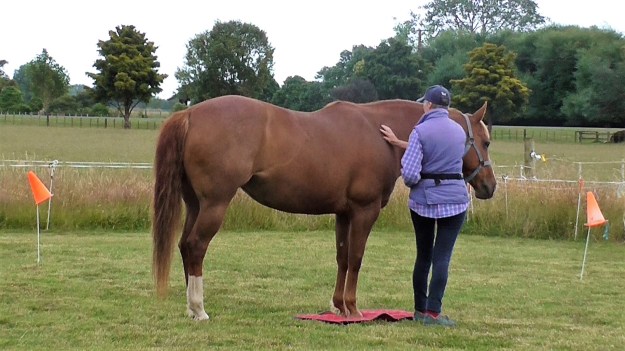
Photo: Using targets as ‘destinations’ makes it much easier to give meaning to our request in a way that the horse easily understands. Reaching the target, whether it is putting the front feet on a mat or touching the nose on a stationary object, earns the horse a click&treat. We can then move between targets to encourage the horse to come with us willingly because there is always something for him to look forward to – the next click&treat when we reach the next destination.
Training with a Marker Signal and Positive Reinforcement
Training with the click&treat dynamic is a skill worth learning well, but it is not the only thing we have to learn well.
Some people handle/condition a horse’s behavior in a way that encourages the horse to always look to the handler – a form of ‘learned helplessness’. The horse is asked to subjugate his own observations, feelings and natural responses in favor of what the handler requires him to do.
Other people set themselves the interesting challenge of doing everything with their horses using only positive reinforcement training (often called ‘clicker training’). They pair each desired response with a marker signal (click) followed immediately by a food treat. They feel that this is the only way to keep a horse’s ‘sparkle’ alive.
Somewhere between these two extremes, fall the people who teach many things with the click&treat dynamic, but they also understand, respect, learn and use universal horse language. In their view, any horse education system that fails to acknowledge group social order, different horse character types and how horses succinctly communicate with body language, will have limited success.
From our human standpoint, we could define ‘success‘ as having a horse that is safe and fun to be with and that we can take places for exercise to maintain blood circulation health, overall fitness and mental stimulation.
Success could mean that the horse:
- greets us willingly
- enters our space politely
- offers feet confidently for foot care
- accepts gear on and off comfortably
- leads safely and willingly in a variety of positions
- responds equally well to upward and downward transition requests
- confidently accepts touch and grooming all over its body
- confidently accepts ropes draped all over its body and legs
- willingly, at request, moves away from a food dish, pile of hay or grazing spot
- not unduly spooked by dragging ropes, wheelbarrows, flapping things, balls, bicycles, vehicles
- able to stay ‘parked’ quietly or stand and ‘wait’ for a further signal
- confident moving through gates/narrow spaces/lanes and over water/unusual surfaces at our request
- approaches new/spooky things as long as we give him the approach & retreat time to convince himself it is harmless
- at ease with any body extensions the handler might use to clarify or accentuate signals
Once we have all that, we can endlessly refine the basics and teach new patterns and tricks.
Teaching with the click&treat dynamic is hugely helpful to horse handlers for two main reasons:
- Encourages accurate observation of what the horse is doing in order to pick the ‘clickable moments‘, which are also the moments that signal/cue pressure is released. Therefore becoming a good clicker trainer also hones the skill of becoming an excellent trainer with simple ‘release reinforcement’.
- It teaches ‘thin-slicing’ — the cutting of a large task into its smallest ‘clickable’ components so that we can get the horse confident with each tiny ‘slice’. Then we can chain the slices together until the whole task is achieved. This way of teaching/learning, often called ‘mastery learning‘ keeps the horse successful all the way through the process. A clicker-savvy horse knows that if the click&treat is withheld, they need to try something else.
Developing the two skills above will greatly increase the ‘feel‘ of the handler. That ‘feel‘ will translate to the times when a good choice is use of ‘release reinforcement’ by itself. Feeling what the horse is doing — understanding what his body language is saying and knowing how to respond to that with our feel and body language, is the key to training with signal pressure and release of signal pressure (‘release reinforcement’).
What horses gain from positive reinforcement Horses trained with the click&treat dynamic discover that they can have a voice. Once they learn that a certain behavior will earn them a click&treat, they can become pro-active in offering that behavior. For many horses this is huge because in the past things have only been done to them or demanded of them — they could only be re-active.
When a task is thin-sliced so they understand each part of the training process, the horse’s learning can progress in leaps and bounds. We’d all rather work for a boss who praises what he likes rather than one who only criticizes what he doesn’t like.
Horses are not blank pages on which we write what we want. They already have a perfectly good language. It seems logical to learn it and use it as best as we can with our non horse-shaped bodies. Horses are very generous with their interpretation of what we mean. No doubt we have a very funny accent, but unless they have been traumatized by humans, they are happy to learn new things and accept us as part of their personal herd.
Social Group Once the horse accepts us as part of her personal ‘ in-group’, we have a position in the group social order. The two things go together. We can’t form a bond of understanding with a horse unless he or she lets us into their social group. Once we are part of the social group, we have a ranking within it. If the horse can move our feet at will, she or he stands above us in the social order. If we can ask move the horse’s feet, we rank above him her in the social grouping recognized by the horse. When people don’t understand this dynamic, or chose to deny/ignore it, things might not go well.
Horse Character Types Like us, horses can be innately anxious or innately confident and imaginative. They come as extroverts who like to/need to move their feet a lot and they come as introverts who prefer the quiet life. A careful look at how our horse perceives and reacts to things can give us insight into how we can best proceed with an individualized training program. What works perfectly with one horse can be quite problematic with another.
Universal Horse Language Horses have a complex communication system using their body language and a few vocalizations. They ‘message’ other horses with body tension, body orientation, neck position/movement, ear position, tail activity, posturing, striking out, kicking, biting, nibbling. How they use each of these depends on their intent at the time. An ‘alarm snort’ will instantly have the whole herd on alert. Quietly turning the head away as another horse (or a person) approaches is an appeasement signal.
With the aid of body extensions which make us as tall and long as a horse, and simulate a horse’s expressive tail, we can more clearly emulating universal horse language. If we are good at it and use our movements consistently, any horse will understand our intent without us ever needing to touch the horse or use a rope. We can establish our position in the social order by ensuring we can move the horse’s feet in a variety of situations while the horse is at liberty to move away, as it would be in a natural herd situation.
Once we have established our social position, we maintain it by the way we behave. Anxious type horses may rarely challenge our position. Confident, imaginative type horses may well challenge our position regularly. In a natural herd situation, they have the drive and sparkle to work their way up the group’s social order.
With an understanding of, horse character types, equine body language, and how the social order works, we can flow with the information the horse gives us via his behavior and body language. Skills of observation, timing and ‘feel’ allow us to decide how we will use clicker training to make his life in his strange human-dominated world a little bit more interesting and understandable.
With equine clicker training, we experiment to find out what the horse can already do, then build his skills in a way that has him being continually successful.
The link below contains a bit more information about horse character types.


 herthamuddyhorse