Category Archives: Movement Routine

Leading Position 1

Leading Position 1 (LP1) has the handler in front of the horse, facing the same way as the horse.
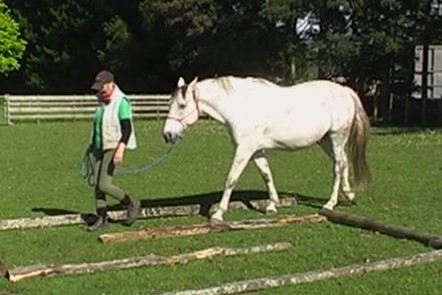
Bridget is walking right in front of Smokey with a nice loop or ‘smile’ in the lead rope.

This concept of ‘Walking Away’ can also be useful whenever we want to get our horse used to something new. Horses have a tendency to follow anything moving away, and move away from anything coming toward them.

Leading a horse on a narrow track or road, spooky things can happen behind, so having the horse walk a meter or so behind you on a loose lead means the horse can spook right or left without running into you. For casual walking out, this can be a useful position.

However, Leading Position 1 is especially interesting because horses have two ways of looking at it.

Concept One: the horse is happy to mosey along behind.

We can cruise along together like horses following each other on their way to water or new grazing. The horse in front watches for snakes or other dangers, allowing the horse or horses filing behind to relax their guard a little bit.

Boots is happy to mosey along behind me knowing I will keep a lookout for dangers ahead.

Concept Two: The horse is ‘driving’ us from behind.

The second concept the is that horse sees it as an opportunity to haze (drive) the person along. Horses often haze each other from behind. Stallions use hazing to gather up and move their mares if they feel the need to shift them, and mares do the same with their foals.

Horses higher in the social order do it to move a horse lower in the social order if it is in their way or being annoying – something that is very noticeable in domestic horse situations.
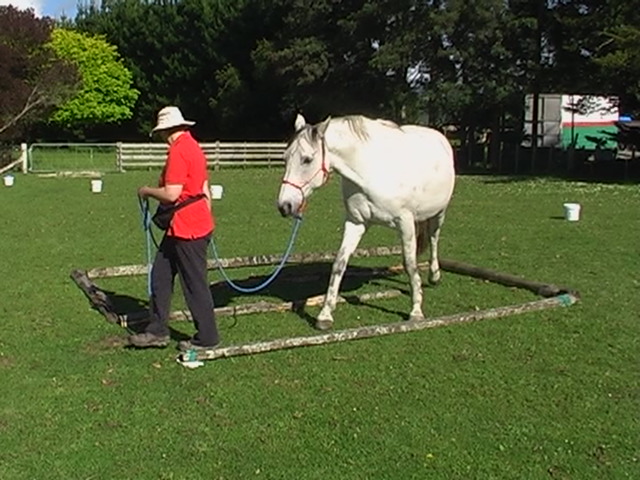
When we taught Smoky to walk behind us through the S-bend for Horse Agility, we had to be watchful because he loved to catch up with us and give us a solid nudge with his nose to ‘move us along’.

It’s definitely best if the horse is happy to work with the first concept – follow behind in a relaxed mode. We’d also like the horse to know signals for slowing down or stopping when we are walking in front of him. It’s quite different from when we ride or long-rein, and are guiding from behind.

So: We can teach the horse clear signals to indicate when we intend to walk out in front of him, and that we’d like him to maintain a polite distance behind us, slow when we slow, and stop when we stop.

The following Training Plan looks at a possible way of teaching clear boundaries with Leading Position 1.

TRAINING PLAN

Aims:

  1. To develop a signal that lets the horse know when we are going to move from LP3 (beside neck) into LP1 (in front facing away from him).
  2. To have the horse comfortable with us in front and moving in single file.
  3. To develop clear signals while in Leading Position 1, to let the horse know when we are slowing into a halt and when he needs to halt or back up.

Environment:

  • Horse in an area where he is usually relaxed and confident.
  • Herd buddies not able to interfere but in view if possible.
  • Horse in a learning frame of mind.
  • Body extension during the teaching/learning phase if we need to emphasize a signal.
  • Halter and lead.
  • Lane 10-12 feet long with one high side (e.g., a safe fence) and one side a rail on the ground which the handler can easily step over.
  • If using destinations, set a mat or nose target destination several meters beyond each end of the lane.
  • Prerequisite: horse is confident with various ways of backing up in a lane. https://youtu.be/XcKSrz8feN8,
  • https://youtu.be/rMN5jWSn-HU
  • Consciously look for signs which indicate that the horse is reaching the limit of his ability to keep trying. Aim to stop while he is still engaged and willing. You can stop at any time on any slice of the process.

Slices of the Plan: 

For each slice, begin walking with the horse in LP3 – beside neck. Move on when each slice is smooth and ho-hum for the horse.

  1. Refresh the three basic lane tasks using LP3 – beside neck: a) walk through; b) walk in, halt and walk on out; c) walk in, halt and back out. Make sure these are all smooth when you are leading the horse on his left side and on his right side.
  2. Walk the horse into the beginning of the lane, halt, and step over the rail into the lane, pivoting into LP7 which is facing the horse. Give him an arm’s length of space. Turn off your body energy; relax (click&treat). Check for any signs of anxiety (looking away, shifting feet, backing away, stepping toward you, nudging you or stepping over the rail out of the lane). Stay with this slice until the horse can remain totally relaxed as you move into position and stand facing him (which is Leading Position 7), with your energy turned off, for a few seconds before the click&treat. Gradually work up to about ten seconds.
  3. When 2 is good, repeat but now step in front of the horse facing away from him after the halt. Give him a couple of feet of space behind you as you step into the lane to stand in front of him; relax (click&treat – turn to deliver the treat, then turn away again), pause.
  4. Ask the horse to walk forward out of the lane while you stay in the single file facing away position in front of him. You may need to create a new ‘walk on’ signal for this context. Hopefully you have already established a strong vocal ‘walk on’ cue. Walk to your destination; relax (click&treat). Walk a loop in LP3 (beside neck) to return to the lane.
  5. Repeat 3-4 until it is ho-hum for the horse.
  6. Repeat 3-4 but gradually stand in front of him (facing away) a bit longer before walking on. Increase the time in one second intervals. Ten seconds is a good time to aim for.  When he can do ten seconds before a click&treat, vary how long you wait facing forward before walking out of the lane.
  7. Once the horse is cool about having you step in front of him into the lane, decide on a clear signal you can use in motion to let the horse know you are about to step in front of him. I used a raised outside arm because that seemed easiest for the horse to see. The signal Boots and I eventually developed is more like a half halt in my body, change in breathing and a small hand gesture. Each horse and handler will work out and refine something that makes sense to them.
  8. First use your new signal to let him know you are going to step in front of him when he is halted in the lane.
  9. Then walk alongside his neck/ears and step in front of him while he is still in motion, using the signal you worked out in 8. above. After stepping in front of the horse, keep walking along in LP1 (facing forward) all the way to your destination mat or nose target; relax (click&treat).
  10. When 9. is smooth, we can start to build in the back-up. Check that the back-up is in good shape by asking for it first while you remain outside the lane.

Building in the Back Up

Step into the lane into LP1, then gently turn and ask the horse to back-up. Ideally the horse will quietly step back as you make the request; relax (click&treat).

11. When 10. is smooth, you can begin to teach the horse to back up while you remain facing away in LP1. First, refresh 8 above: as you approach the lane, move from LP3 into LP1 and walk right through the lane in LP1 to the destination mat for a release plus (click&treat).

12. When 11. is smooth (over however many sessions, this is not something to rush) gently slow down your walking pace in the middle of the lane for a few steps, then pick up your original pace. This should give you feedback about whether your horse easily keeps a safe distance behind you, or might barge into you. You might need your body extension to wave behind you to remind him to keep a nice space between you when you slow down. Safety is always first.

If you are unsure, it is smart to carry a body extension in neutral. You may or may not need to activate it. Having it there allows you to be clear for the horse the first instance he needs clarification. You don’t want him to nudge you, push through you, step out of the lane or push past you.

13. The most straightforward body language signal I’ve found, to let the horse know I am slowing down, halting and backing up from LP1, is flapping my elbows sideways. It’s possible to flap elbows and wave a body extension toward the horse’s legs or chest at the same time. If we can be crystal clear right from the beginning, that he needs to keep space between us, the horse usually picks this up easily.

14. Introduce your flapping elbow signal as you slow down, then pick up pace and walk to your destination; relax (click&treat). Repeat until smooth and ho-hum.

15. When the horse easily keeps his distance during 14 above, slow down gradually into a halt in the middle of the lane. If the slices have been taught carefully, the horse will also slow down and halt; relax (click&treat – turn around to deliver the treat). Repeat until smooth and ho-hum. Also use your ‘whoa’ verbal cue.

16. Now that the horse knows that flapping elbows means ‘slow down’ and possibly halt, we want to add a back-up while remaining in LP1. As you approach the lane, step into LP1 (using your signal). Walk into the lane, slow down, halt, and then energetically flap your elbows to ask the horse to move back a step or two before you halt. Drop your elbows; relax (click&treat – turn to deliver the treat). In the beginning, reward any indication that the horse is thinking ‘back’. Then use your voice and body languate ‘walk on’ signals to walk on out to your treat destination.

17. When 16. is smooth, ask for a few more steps of back-up before you relax (click&treat).

18. When you are smoothly getting several steps of back-up, work up to a series of ‘walk forward, slow to halt, back-up’ sequences before you walk to your relaxation and click&treat destination.

By now you may not need the rail on the ground but it is a good idea to work along a fence for a bit longer, to put the ideas into deep memory.

Ideally you can now signal the horse that you would like him to ‘follow you’ and he will slot in behind you. He will stay in LP1, slow as you slow and step back when you step back.

Generalization

Generalization often requires us to go back to early slices in order to build the horse’s confidence in new situations.

A horse’s confidence is highly dependent on context. He may do something perfectly ‘at home’ or in his initial training environment but be totally thrown by the same request in a different environment.

For generalization of LP1 we can play with:

  1. Different safe fence lines
  2. Away from fences
  3. New places
  4. Following us through narrow spaces
  5. Following us over water and unusual surfaces
  6. Following us through a pattern such as a weave, a U-bend, Z-bend or S-bend
  7. Following us in a circle
  8. Following us at liberty
  9. Following us at trot
  10.  Halt – walk – trot – walk – halt – back up transitions
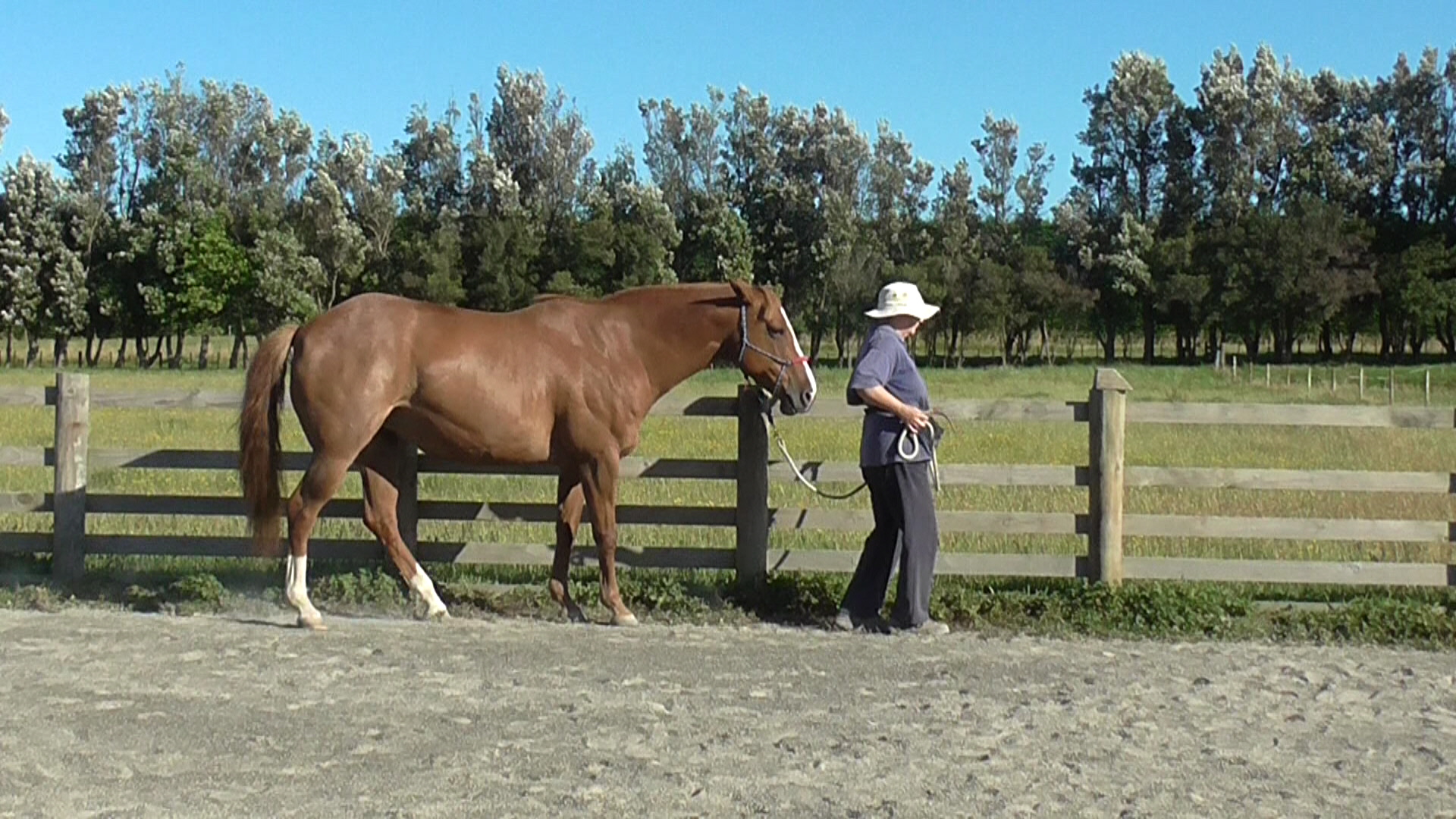
I’m flapping my elbows to indicate to Boots that I would like her to back up.
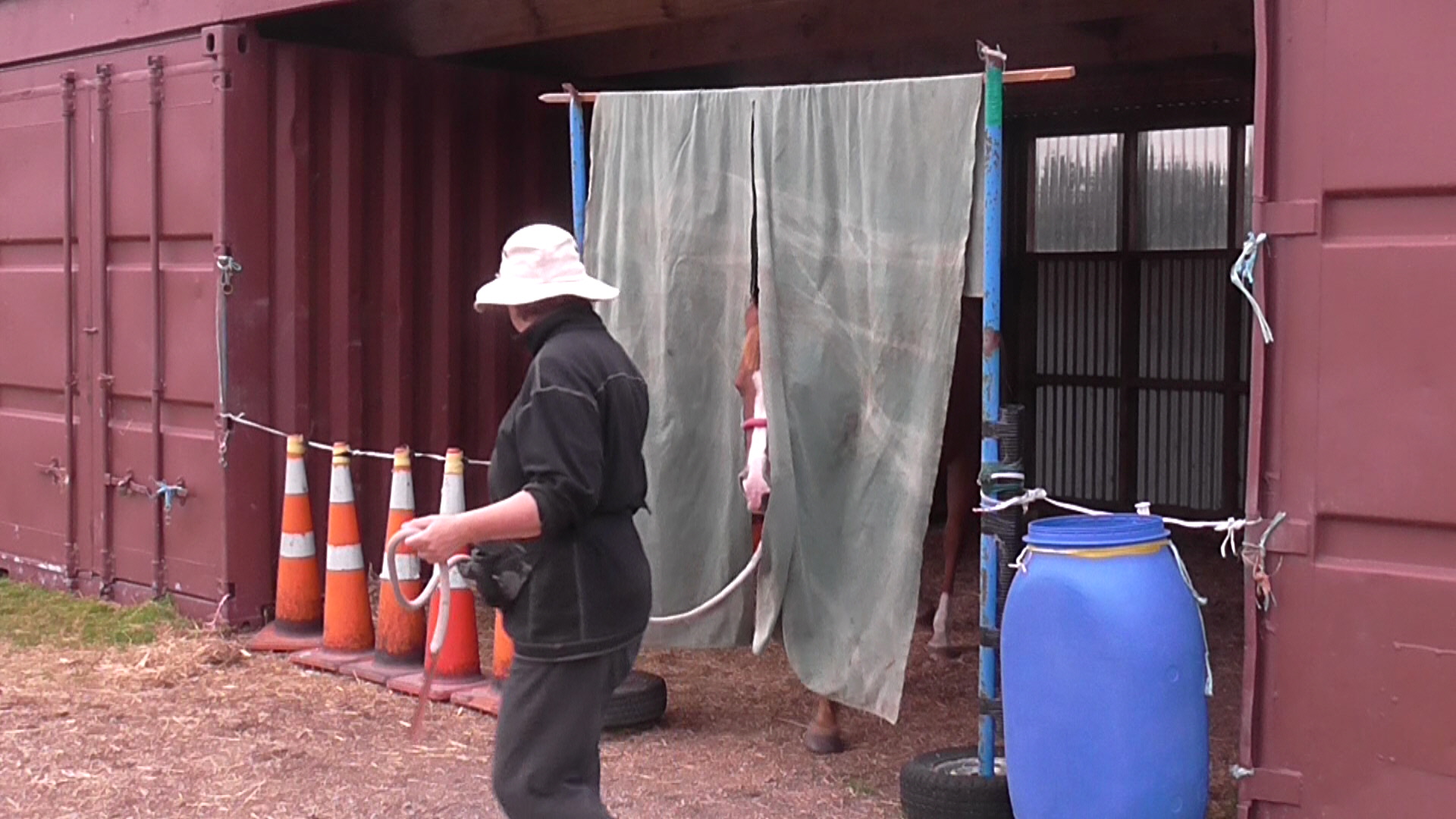
Using LP1 to teach a new skill. She learned this quickly when coming through the curtain earned a click&treat.

Do let me know if you decided to take up this big piece of training or have already trained something similar.

Leading Position Three

There are 8 diffent basic positions we can be in when we want to communicate with our horse. In order to simplify the notes about each one, I’ve given the leading positions numbers 1-8.

1 is in front of the horse walking with ones back to him, the horse walking behind the owner.

2 is walking alongside the ear/eye area, as we migh be if we are asking the horse to turn away from us.

3 is beside the horse’s neck/shoulder area, which is often the most comfortable spot when leading the horse. It’s the one we will start with.

4 is alongside the horse’s ribs if we are teaching him to walk with us confidently having his nose well out in front. It puts us in the position we will be in if/when we ride.

5 is beside his hindquarters as we mighte be when grooming,asking him to lift a hind foot or enter a trailer.

6 is behind the horse, as for long reining.

7 is in front of the horse, facing him if we are asking him to back up away from us or come toward us.

8 is facing the side or back of the horse, as for grooming, saddling, mounting, foot care.

This clip demonstrates the 8 leading positions.

FIRST: Leading Position 3 Beside the neck/shoulder

When I started working through the 8 Leading Positions, it made sense to start with Leading Position 3 (beside neck or shoulder) because it is the ‘handiest’ position if we are moving along in close communication.

Leading Position 3 (LP3) has the handler beside the horse’s neck or shoulder, facing forward in the same direction as the horse.

I think of LP3 as our ‘baseline’ position when moving between two points.

Walking shoulder-to-shoulder in step with each other.

Much of ground work starts with Leading Position 3. From this position we can easily read the horse and the horse can most easily read our intent.

When we walk with our horse we are always between two points: the point we just left and the point to which we are heading. The two points can be relatively close together or, if we are walking on the road or on a trail, they can be miles apart.

Staying in LP3 we can:

  • Walk forward together in a straight line.
  • Walk forward together in a weave pattern.
  • Walk forward together doing inward turns and counter-turns.
  • Walk forward together over rails, tarps, and other unusual surfaces.
  • Walk together through water or curtains or under arches and overhangs.
  • Walk forward together with the horse in a lane while we walk outside the lane.
  • Walk forward together, then do 180 degree turns together.
  • Walk forward together in circles or triangle shapes – handler on the inside
  • Walk forward together up slopes and down slopes.
  • Go over a jump together.
  • Back up shoulder-to-shoulder.
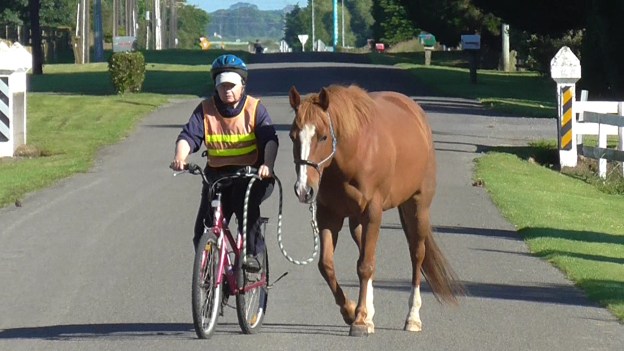
  • Trot along with a bicycle or mobility scooter.

Figure 63: LP3: An outing with the bike. It gives her an opportunity to do sustained trotting on the grass verge.

Teaching Leading Position 3

It makes sense to teach everything on both sides of the horse right from the beginning so both the horse and the handler become more ambidextrous. Then we won’t have the problem of ‘left neglect’ or ‘right neglect’ in either the horse or the handler.

The term ‘neglect’ simply means that lack of use has resulted in lack of strong nerve pathways developed on that side of the body.

Since both horses and people have a ‘preferred side’, (i.e., we tend to prefer using either our left hand or our right hand) things will feel more awkward on one side for both the horse and the handler. Frequent short practice on the ‘hard’ is ideal.

If both the horse’s weaker side and the handler’s weaker side come together, it will take extra time and effort to get things on that side moving smoothly, since both parties have to form new nerve pathways/habits.

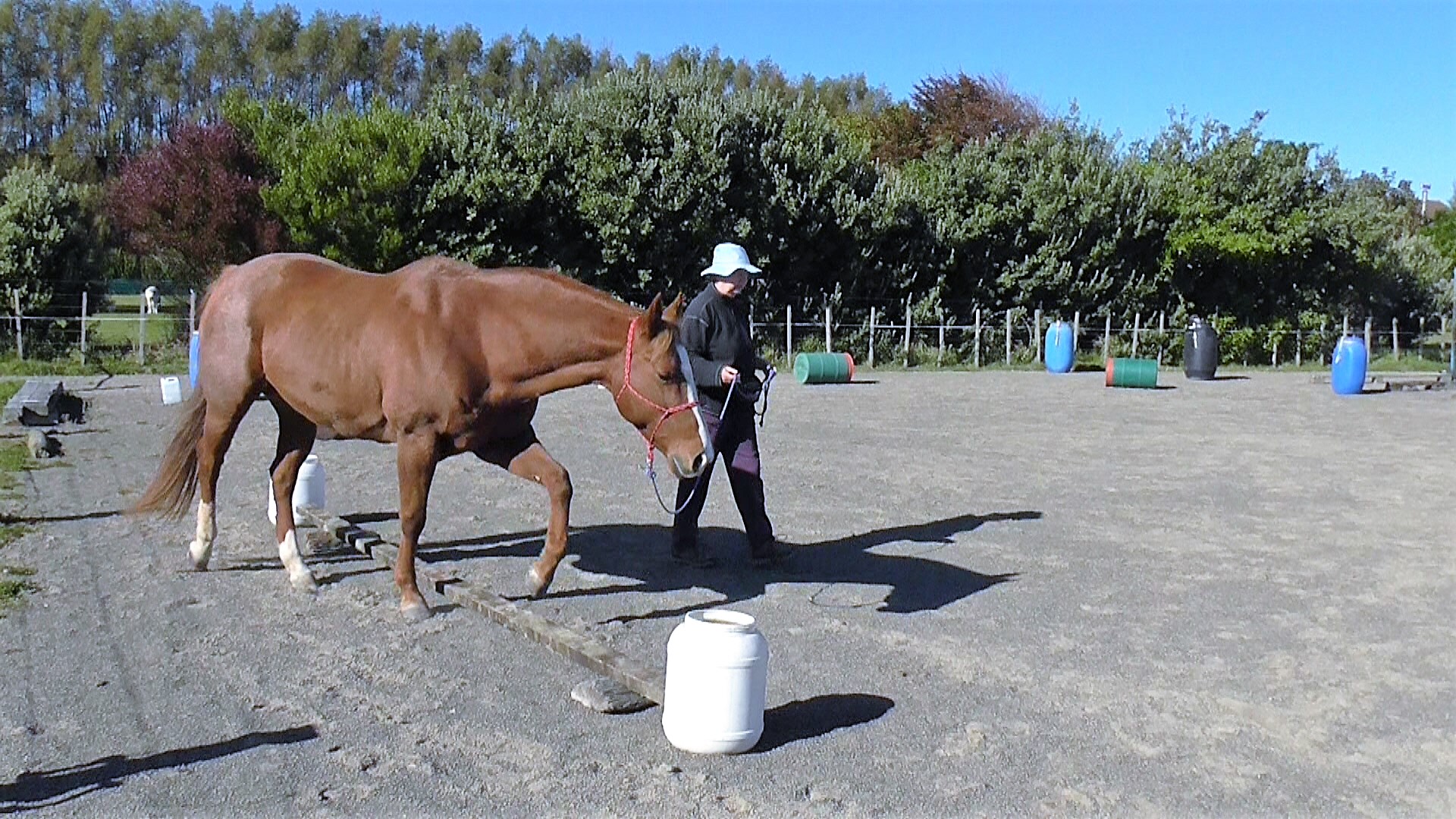
Working with mats as destinations makes it easy to develop the horse’s interest and willingness to walk along with us. See the training plans at Number 9 in my Blog Contents List (at the top of the page).

#29 and #30 HorseGym with Boots illustrate of a variety of approaches to teaching LP3.

The end-of-video comment about ‘notes’ have now been superceded by my book, Walking wiht Horses.

It is a great exercise to play with this task at libery if you have a safe enclosed area. Have fun with it.

Let me know which leading positions you use the most and which might be a new challenge for you.

Foot Awareness for Improving Proprioception

Introduction

Proprioception is the awareness of where our body parts are in space, what each is doing, and how much energy the movement is using.

Here is a definition from the Internet:

Proprioception enables us to judge limb movements and positions, force, heaviness, stiffness, and viscosity. It combines with other senses to locate external objects relative to the body and contributes to body image. Proprioception is closely tied to the control of movement.

I’ve collected together an assortment of video clips I’ve made over the years that include ideas we can use to encourage the horse to be aware of where his feet are and what they are doing.

Quite a few of the clips are part of a training series and I’ve chosen just one of the series to illustrate the overall task. By going to my YouTube channel – herthamuddyhorse – you can find my assortment of playlists containing series of numbered clips to show the thin-slicing I used to achieve the final task. Message me if you need help to find a particular series.

Good proprioception relates to all sorts of things, but mainly to overall balance and suppleness.

Horses that grow up in rough hill country develop good proprioception as a necessity for survival. Horses raised in confined areas without needing to move much to find enough food don’t have the opportunity to develop excellent proprioception.

In the same way, athletes become good at their sport by developing the aspects of proprioception that especially relate to that sport. If our lifestyle lacks regular movement, our body suffers the same way as that of a stabled horse.

Video Clips

#88 HorseGym with Boots: Foot Awareness. https://youtu.be/7bEkFk0w_gk

A few tasks that play with improving foot awareness.

#89 HorseGym with Boots: Balance on 3 Legs. https://youtu.be/x1WKppV3N_0

Playlist: Challenges for Clicker Trainers: August 2017 Challenge: Precision with a Single Rail. https://youtu.be/bJzwDq-NvtE

Playlist: Foot Awareness: Thin-slicing the 1m Board. https://youtu.be/pLLqtbQJqMs

#220 HorseGym with Boots: Counting with the Front Feet Clip 1. https://youtu.be/hHpQgsUOINA

#246 HorseGym with Boots: Counting with the Hind Feet. https://youtu.be/rMsRVL_M33w

Playlist: Foot Awareness: Single Obstacle Challenges Hoops 3. https://youtu.be/xc-4yGiWDxk

Playlist: Challenges for Clicker Trainers: September 2017 Challenge: Figure 8. https://youtu.be/QrberCzAO6c

Playlist: Challenges for Clicker Trainers: November 18, Sidestepping Clip 1. https://youtu.be/Joxp9bYzMRc

Playlist: Foot Awareness: S-Bend Final Clip. Click here.

#199 HorseGym with Boots: Unusual Surface with Bottles. https://youtu.be/3LTmUSa0Y1M

#184 HorseGym with Boots: Back Between Rails. https://youtu.be/FGh7_MeFHcQ

#95 HorseGym with Boots: Backing down Slopes. https://youtu.be/M9pEFnDSbwc

Ponying from a Bike or Scooter

Introduction

When my hips gave up riding horses but not riding my bike, it made sense to teach Boots to ‘pony’ from my bike. Usually people ‘pony’ a second horse while riding another horse.

It’s a skill developed for pack horses or to exercise two horses at the same time. When my son was very small we rode together with his pony on a lead. Leading a horse from a bike or scooter rather than another horse comes with its own hazards and challenges.

Aim

The horse walks/trots confidently and safely led by a person on a bike or a scooter.

Prerequisites

  1. Horse and handler are clicker savvy.
  2. Horse and handler agree on voice and breathing signals for ‘walk on’, ‘halt’ with the handler beside the horse. Number 16 in the Blog Contents List.
  3. Horse and handler agree on voice and gesture signals for ‘back up’ while the handler is beside the horse. Number 32 in the Blog Contents list.
  4. Horse and handler have a good command of prompt transitions upward and downward using voice signals.
  5. Horse is relaxed about a dragging rope. It’s inevitable that we will drop the rope at some point to stop being pulled off our bike. #60 HorseGym with Boots – specifically the second half of this clip. Click Here.
  6. Horse and handler agree on voice signals for ‘right turn’ and ‘left turn’. #137 HorseGym with Boots: Click here.
  7. Horse and handler agree on signals for ‘go around and turn’. This is important to have smooth because as much as possible, we want ourselves between the horse and anything ahead that he might find worrisome. If he needs more space, we want him to move away from us, not into us. # 250 HorseGym with Boots: https://youtu.be/3oqPs4LM5AM and video clip #251 below.
  8. If riding on public roads or tracks, we must ensure that the horse has been given the time and opportunity to be comfortable around cars, motorbikes, trucks, dogs, pushchairs, other people on bikes, tractors, hikers, and children while the handler is walking with the horse. We need to feel secure with other road users approaching from in front or from behind. Trailers with flapping plastic are an ultimate test. Essential to get used to flapping plastic at home.

Videos

#247 HorseGym with Boots: Boots and Bicycle. Older video – short.

#228 HorseGym with Boots: Intro to Bike. Recent video.

#230 HorseGym with Boots: Bike on the Road. Recent video.

#251 HorseGym with Boots: Changing Sides. Recent video.

#249 HorseGym with Boots: Scooter Outings. Recent video.

#248 HorseGym with Boots: Bob meets Bicycle. Click here. Older video featuring a young horse seeing a bike for the first time.

Materials and Environment

  • We need a safe enclosed place where it’s possible to use free-shaping to introduce the horse to the bicycle and establish the basic protocols using a lead rope.
  • A helper is great to have at the beginning.
  • Horse is not hungry.
  • Quiet tracks, trails or roads to expand confidence. For public roads, the key is usually choosing the quietest part of the day.
  • Walk with the horse on the routes you will take, for many days, weeks, months, so the route is as familiar as possible. I’d walked or ridden our routes for a long time before ponying on my bike.
  • Bicycle or mobility scooter or similar.
  • Be especially sure the horse is not hungry before you set off. For some horses, a light mesh grazing muzzle can be a safety feature if the horse tends to dive for grass. Use it first walking out so it is not directly related to the bike. Munch-N-Go make a muzzle that is light and its easy to slip a treat into the side.

Notes

  1. It’s important to take the time to get all the prerequisites established. Although I put up monthly challenges, each challenge is just an idea that you may like to work toward. The real magic is in getting the prerequisites into good shape, which can take months or years, depending on many factors.
  2. Keep each session short. Three repeats is often plenty. Many short sessions keep the horse keen to ‘do it again’ next time.
  3. Click&treat often enough to keep the horse continually successful with what you are asking him to learn. Build duration gradually, but always be conscious of increasing duration as you can.
  4. Create a strong habit of using your voice signals all the time when they are appropriate, not just with the bike. Our “Whoa” response has saved my bacon numerous times. The “Back-up” with voice and gesture signals is essential. We don’t want the horse crossing in front of us unless we are inviting him to change sides.
  5. You may be fortunate enough to have tracks and trails where the horse can accompany you on your bike without the need for a lead rope. Some horses, like mine, will gravitate to the closest grass and stay there. If you are limited to public roads or tracks, safety with the lead rope is a must.
  6. When I take my horse out and about in the neighborhood, we have grazing destinations. If there is no grass, I take an ample supply of carrots and horse pellets which we stop to enjoy at the furthest point of our outing. In other words, I don’t expect the horse to randomly go with me. I give her a destination that makes sense to her. Horses who can move freely always know where they are going and why. We remove much of this self-determination from them when we want to do something with the horse. Working with destinations is a way to return it in a small way. See also Number 17 in my Blog Contents List: Destination Training.

Slices

  1. Have someone walk with your bike and you follow behind with your horse wearing halter and lead. Allow the horse to decide how close (or not) he will get to the bike. As soon as you see/feel interest or less tension (sighing, blowing out, lower head, softer body) – click&treat.
  2. Repeat 1 above until the horse is confident enough to walk right up close to the back of the bike, with click&treat for each sign of greater confidence.
  3. Ask the person wheeling the bike to slow gradually to a stop so the horse can touch his nose to the bike if he’s ready for that step; click&treat. Repeat a few times to consolidate.
  4. Have your helper ride the bike and repeat 1-3 above.
  5. At this point, if it feels safe, take off the lead rope so the horse makes his own decisions about approaching and/or following the bike.
  6. Without a helper: Walk with the bike yourself. Click&treat any movement of the horse toward you and the bike. The aim here is for him to want to come and target your hand or the bike to earn a click&treat.
  7. When 6 is smooth, ride the bike. Click&treat coming over plus any offer to move with you and the bike. At this point, it’s helpful to expect little but click&treat each tiny sign of increasing interest and confidence.
  8. Gradually work on duration of staying with you and the bike. Setting up a roomy reverse round pen is helpful at this stage – protected contact for you as the horse gains confidence. You bike inside the barrier while the horse follows outside the barrier. You can use foot targets in set places on the path of travel where you will always stop to click&treat, so the horse knows that there is a destination – a stop point if he stays with you. Eventually have just one foot target on the perimeter of the reverse pen.
  9. When the horse stays with you on the bike willingly and with confidence, see if you can speed it up so he trots. Sometimes transitioning to a higher gait brings out a spurt of excited energy. It’s good to test this out while you are in protected contact inside the reverse pen. It’s also a good place to work with upward and downward transitions using voice signals. Use your downward transition (trot-walk or walk-halt) voice signals as you approach the foot target when slowing down makes sense to the horse. Use your upward transition signal (halt-walk) as you leave the mat and your walk-trot signal a little while after you leave the foot target when the horse is anticipating reaching it again.
  10. Build duration without the reverse round pen by using foot or nose targets as destinations. Start with them close together and gradually put them further apart. If you used this method for teaching good leading behavior while walking with the horse, the horse will already be familiar with the concept.
  11. Introduce the lead rope into the situation. At first, walk the bike while leading the horse. When you introduce a new element to a situation, always go back to click&treat more often (in this case, anytime the horse is coming along smoothly for a few steps), then gradually less often as the horse gains confidence.
  12. When ponying from the bike at home in familiar places is smooth, venture out on the road first walking the bike. As mentioned in the prerequisites, ensure that you have walked with the horse many times on the public roads you plan to bike with your horse, so that dogs running out, horses or cattle galloping in adjoining paddocks, vehicles, children, and so on, have all been met before and worked through.
  13. When walking with the horse and bike is smooth, one day it will feel right to get on your bike. Keep the early sessions going away from home and returning home short – celebrate your safe return. It takes a long time to build confidence (yours and the horse’s) but it can be lost in a nanosecond.
  14. When you reach the farthest point of your day’s outing, allow the horse grazing time or stop for a generous jackpot of treats, before heading home again. This gives the horse a sense of ‘destination’ as outlined in NOTE 6.
  15. Slowly build up confidence with the types of landscapes you have for biking or scootering with your horse. Shorter distances done often are preferable to long distances less often.
  16. If you have graduated to a mobility scooter or similar, play with it at home first. Play with having the horse follow it with you while another person drives it. Walk the horse on the left side and the right side of the scooter, first with you nearest the scooter, then with the horse nearest the scooter. Practice the ‘walk on’, ‘halt’, ‘back-up’ transitions. Practice the ‘go around in front and turn to change sides’ maneuver (Prerequisite 7) from both sides until both sides feel smooth.

Generalizations

  1. Different venues.
  2. Electric bike.
  3. Four-wheeler – avoid horse having to breathe in exhaust.
  4. Golf cart.
  5. Introduce a rider to horse’s movement without having to ‘be in charge’.
  6. Ride one horse and lead a second horse.

4 Corners Pattern for Exercise

Introduction

If we have a non-ridden horse because we prefer not to ride, our horse is retired or recovering from injury, or we love small ponies, donkeys, or mules, it can be tricky to ensure regular adequate continuous movement in a way that is not boring.

Walking out in-hand is ideal if we have safe places to go. But lack of time or weather might not make this a regular option. Or the handler may not be able to walk long distances due to injury, infirmity, or age.

Horses in the wild move a lot, especially during the seasons when fodder is scarce and water sources are limited. Grazing horses continually move along one step at a time as they search out the nicest grass.

When we have to restrict grass, feed hay, and keep our horse in a relatively small space, we obviously also severely restrict the natural continuous gentle movement that accompanies grazing and life unrestricted by fences.

In a natural situation, most horse movement is walking. Occasionally they trot. Gallop is generally in response to a perceived threat. The play drive of younger horses may initiate occasional energetic movement. Some horses are by nature more energetic than others. As with people, daily sustained movement is a cornerstone of good health.


If we can’t do sustained walking out and about, we can organize novel walking patterns at home in a limited space.

Wanting horses to move consistently at faster gaits is a human construct. While brisk trotting and a good canter or gallop are great to occasionally increase the heart rate and clear out the lungs, we can easily maintain or improve our horse’s welfare with regular sustained walking and a bit of trotting.

Sustained walking means twenty or thirty minutes of continuous movement. Steady walking increases circulation and helps the horse ‘blow out’ to clear his breathing system. Horses living in a peaceful group in a paddock will do some walking, but it is not usually sustained.

Aim

To create interesting walking and movement routines for our horse in a relatively small area.

Prerequisites

  1. Confident with walking shoulder-to-shoulder. Number 16 in my Blog Contents List: Smooth ‘walk on’ and ‘halt’ transitions. Click here.
  2. Handler has developed a clear ‘Zero Intent’ signal so the horse knows when standing quietly is what is wanted. Number 10 in my Blog Contents List: ‘Zero Intent’ and ‘Intent’. Click here.
  3. Horse is comfortable standing across and walking across solid rails. Number 18 in my Blog Contents List: Placing the Feet Accurately Using a Rail. Click here.
  4. While walking shoulder-to-shoulder, the horse follows the movement of the handler’s body axis away from the horse to navigate turns. Number 31 in my Blog Contents List: Smooth 90-Degree Turns. Click here.
  5. Established clear signals for weaving obstacles. #170 HorseGym with Boots: Body Axis Orientation Signals. Click here. There are more clips about weaving in my YouTube playlist called: Weave and Tight Turns.
  6. If you want to add in the ‘wait’ game for variety, ensure the horse understands a ‘wait’ signal to stay parked while we move away. This clip is in my playlist called Obstacle Challenges for Clicker Trainers: October 2017 Challenge Park & Wait. Click here.
  7. If you want to walk or trot together at liberty: see Number 68 in my Blog Contents List: 20 Steps Exercise: Click here.

Videos

#169 HorseGym with Boots: Walk and Hock Gym with Obstacles is found as Number 21 in my Blog Contents List. It is a simple circuit around the perimeter of a defined area.

The next two video clips divide a defined area into four quarters and describe a pattern of movement that makes exercising our horse more interesting. We can add moves our horse knows into the pattern and change our obstacles and objects around to create a variety of novel situations.

This clip demonstrates the pattern of movement through the ‘four corners’ arrangement. #232 HorseGym with Boots.

This clip shows the pattern walking with a horse. #233 HorseGym with Boots.

Materials and Environment

  • A venue with good or reasonable footing. If it’s dry, the corner of a grazed paddock can work well. An arena is excellent. A round pen can also be cut into quarters. Once the handler has the pattern in memory, it can be carried out anywhere and include natural features of the landscape.
  • Ideally the horse can see his buddies but they can’t or don’t interfere.
  • Horse is not hungry.
  • An assortment of safe objects and obstacles. The only limit is our imagination.
  • Halter and lead, with the lead kept draped unless used momentarily to give the horse directional information.

Notes

  1. The prerequisites above cover the basics. We can, of course, add other tasks our horse knows. Or we can use one part of the pattern to work on something new.
  2. The idea is to use voice, gesture, body language, breathing and energy changes to signal the horse, not halter pressure via the rope. However, we can use rope pressure to give the horse momentary guidance so that he can more quickly figure out what will result in the click&treat.
  3. Each pattern contains 12 right angle turns. When we’ve mastered the basic pattern we can factor in halts, back-ups, sidestepping and a variety of other movements.
  4. To begin with, have the horse on the outside of the turns. Eventually you may want to do the pattern with counter-turns at each corner.
  5. The pattern is done once on the left side of the horse and again on the right side of the horse. It’s easiest to start in the center each time.
  6. When you begin to do the pattern with counter-turns, start again at the beginning with click&treat for each elegant turn.
  7. The arena in the video clips is 30 meters long and 20 meters wide. Therefore walking this pattern once is about 200 meters. Walking it on either side of the horse gives us 400 meters. If we walk the pattern first with no stops for special tasks (400 meters) and again on right and left sides adding special tasks, we’ve walked 800 meters. If you have a larger area, it will be easy to walk over a kilometer within your restricted space.
  8. To first learn the pattern, it’s helpful if the handler walks the basic pattern on their own or with another person (or dog) standing in for the horse. There are 12 corners in the pattern. We don’t stop in the center again until we’ve walked the whole pattern. We can add variation by facing any one of the four directions to begin the pattern.

The pattern starts and finishes in the middle of the area. The 12 turns are numbered. We don’t stop in the middle until we’ve completed the whole pattern. We can add variety by facing a different direction to begin the pattern.

Slices

  1. You may want to begin by asking the horse to walk the basic pattern with you for several days, before introducing objects and obstacles. It can be helpful to have markers at the four turning points which are not in the four corners, as well as a center marker.
  2. Stand in the center with zero intent. Click&treat for standing quietly. If you are on the horse’s left side, you will be turning left 12 times. If you want to teach a ‘turn left’ voice signal, use it just before your body language shifts into the turn. At first, exaggerate the shift of your body axis into the turn. We want the horse to shadow our movement so that touch on the halter via the lead rope is seldom needed. Click&treat each smooth turn. The stop for delivering the treat and walking on again add another dimension of flexibility. Eventually click&treat only for especially crisp turns.
  3. As the horse becomes familiar with the pattern and all the turns are nice and clean, I tend to click&treat only for the specific tasks I’ve added into the pattern.

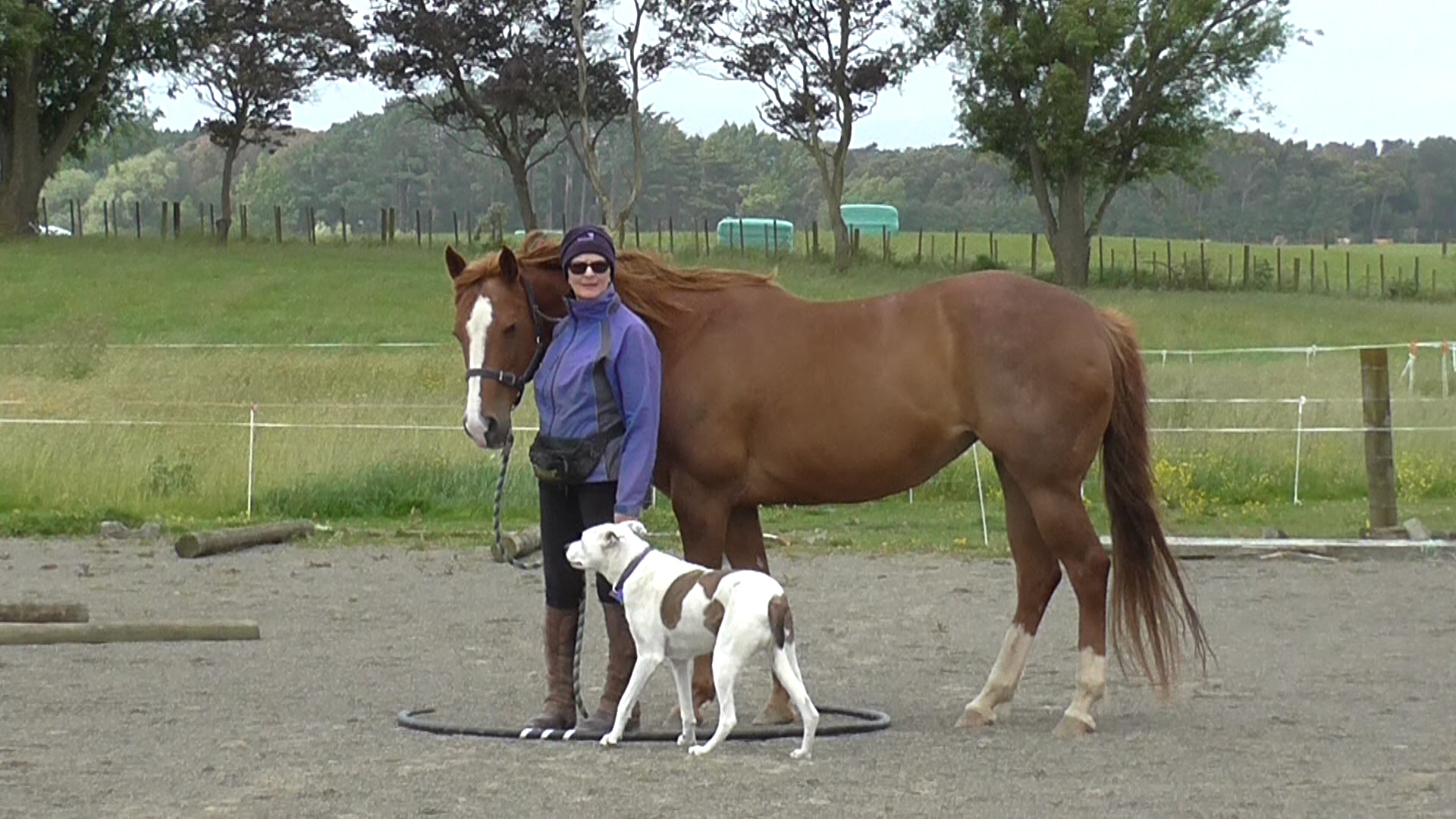
Standing in the middle of our work area, ready to start. Bridget is on the horse’s left side and they will turn left 12 times. The open hoop is our center marker.
  • Match your walk to the horse’s natural walk. Boots’ natural walk is 5km/h. Smoky’s natural walk is about 7km/h. It was always interesting when leading both of them at the same time.
  • Once you know the pattern, set up the obstacles you want to begin with. Start with items your horse knows well. To maintain interest over time, add new things and/or change where they are in the circuit.
  • Click&treat often enough to keep the horse walking with you in a willing manner. To begin with, I click&treat each brisk right-angle turn as well as successful negotiation of every obstacle. Once the pattern is well-known, I tend to click&treat for the more challenging obstacles or any new ones I’ve added since last time.
  • Once it is smooth walking on the horse’s left side, repeat on his right side. That will include 12 turns to the right. We can add a ‘turn right’ voice signal.

Generalizations

  1. Once the horse understands the pattern we can use it at liberty (Prerequisite 7). Some people may like to teach the whole thing at liberty.
  2. Add objects to weave along the center lines.
  3. Teach again asking for counter-turns at each corner.
  4. Add trotting if you are fit to run with your horse or are riding the exercise. Begin with trotting the straight lines through the center. That will give you four upward and four downward transitions within each circuit.
  5. Add challenge with sloping ground.
  6. If you’ve taught your horse to lead smoothly when you ride a bike, the pattern can be adapted.
  7. We can use one or two of the corners in the pattern to ask the horse for any behaviors we have in our repertoire. They could be stationary behaviors or movement we can do in a smallish space. This video clip illustrates some of the things Boots and I sometimes practice in the corners (#235 HorseGym with Boots: 4 Square Generalizations.)

Movement Routine 12 – Rags as Focus

INTRODUCTION

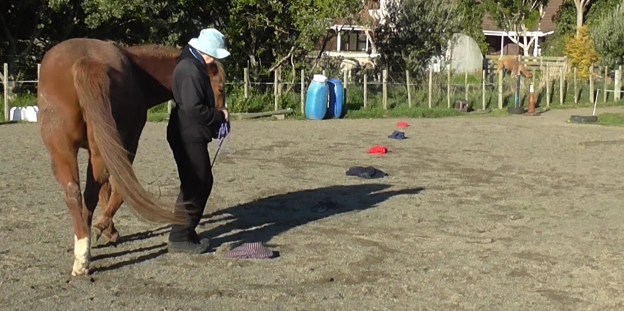
For this routine we lay the rags out in a line. Only the horse weaves the rags while the handler walks parallel to the rags. Each request for sidestepping is followed by walking a circle, to give variety and vary the flexion throughout the routine.

AIM

To link weaving, standing together quietly, walking circles together and sidestepping.

PREREQUISITES

  1. We have stepping on a mat strongly ‘on cue’ or ‘on signal’ or ‘under stimulus control’. #9 HorseGym with Boots: Putting Targets ‘On Cue’: Click here. More info about putting targets ‘on cue’: #5 HorseGym with Boots: Putting Nose Targeting ‘On Cue’. Click here.
  2. Smooth transitions staying shoulder-to-shoulder. Smooth ‘Walk On’ and ‘Halt’ Transitions. Click here.
  3. While walking shoulder-to-shoulder, the horse changes direction in response to handler moving his/her body axis toward the horse or away from the horse. #170 HorseGym with Boots: Body Axis Orientation Signals. Click here.
  4. Weaving. #70 HorseGym with Boots: Only Horse Weaves. Click here.
  5. Horse understands a signal for sidestepping. Sidestepping. Click here.
  6. Handler has developed a clear ‘Zero Intent’ signal so the horse knows when standing quietly is what is wanted. ‘Zero Intent’ and ‘Intent’. Click here.

ENVIRONMENT AND MATERIALS

  • A work area where the horse is relaxed and confident.
  • Ideally, the horse can see his buddies, but they can’t interfere.
  • The horse is not hungry.
  • Halter and relatively short lead (~8′) when not working at liberty.
  • Six rags (or any even number) laid out in a straight line with enough space between them so the horse can easily weave the rags.

VIDEO CLIP

NOTES

  1. Only the horse weaves the rags. The handler walks a line parallel to the rags.
  2. Click&treat as often as appropriate to keep the horse continually successful.
  3. This is concentrated work, so after doing the routine on one side of the horse, it’s best to do something relaxing before working on the other side.
  4. For the sidestepping tasks, you could be in front of the horse as I am in the video clip, or on the side asking the horse to either move away from you or toward you.

TASKS

  1. On the left side of the horse, weave the rags in both directions. Put in a halt and a few seconds of ‘wait together’ at each end of the weave.
  2. Walk a circle to line the horse up with his belly beside the first rag.
  3. Ask the horse to sidestep so the first two rags pass under his belly.
  4. Walk a circle to line up the horse’s belly with the third rag.
  5. Repeat the sidestepping across two rags followed by a circle to line up for the next two rags until you reach the end of the rags.
  6. Use a jackpot or Triple Treat to indicate the end of the routine on the left side of the horse.
  7. Repeat on the horse’s right side.

GENERALIZATIONS

  • If you can run with your horse, trot the weaves.
  • If the horse understands sidestepping with various signals, mix up the way you ask for it.
  • Work on a slope if you have one handy.
  • Do the routine with imaginary rags. I do this often and if I’m careful to keep my signals consistent, it’s amazing how well it works once the horse knows the routine.

Movement Routine 11: Fence for Focus

INTRODUCTION

As we build up a collection of routines, we can:

  • Improve on tasks we’ve done before.
  • Add a new aspect to a task, e.g. different handler position.
  • Do tasks in a different order.
  • Introduce new tasks.
  • Add trot to some of the tasks.

AIM

This routine links together a finesse back-up, targeting shoulder to hand, sidestepping, counterturn circle, ‘wait’ while the handler walks around the horse plus signaling a back-up from behind the horse.

PREREQUISITES

  1. Smooth ‘Walk on’ and ‘Halt’ Transitions (staying shoulder-to-shoulder). https://wp.me/p4VYHH-5TT
  2. Finesse Back-Up. https://wp.me/p4VYHH-5XL
  3. Target Shoulder to Hand. https://wp.me/p4VYHH-5SH
  4. Smooth Counterturns. https://wp.me/p4VYHH-5WK
  5. Horse has learned to ‘wait’ until handler gives a new signal or clicks&treats. Mats: Parking or Stationing and Much More. https://wp.me/p4VYHH-5S9
  6. Horse and handler agree on clear ‘stay’ signals. https://youtu.be/UvjKr9_U0ys
  7. Horse understands a back-up signal when the handler is behind the horse. https://youtu.be/501PSnAA-po
  8. Triple Treat. https://youtu.be/FaIajCMKDDU

ENVIRONMENT AND MATERIALS

  • A work area where the horse is relaxed and confident.
  • Ideally, the horse can see his buddies, but they can’t interfere.
  • The horse is not hungry.
  • Halter and 12′ (4m) or longer lead if not working at liberty.
  • A safe fence line to work alongside.

VIDEO CLIP

Movement Routine 11: Fence as Focus (filmed at liberty)

NOTES

  • Be sure that you have mastered each task before chaining them together.
  • Chain pairs of tasks to begin with, then gradually join the pairs together.
  • Click&treat at a rate that keeps your horse being continually successful. As he learns the routine, ask for a bit more before each click&treat.

TASKS

  1. Walk shoulder-to-shoulder with the horse nearest the fence.
  2. Smoothly turn to face the horse and ask for a Finesse Back-up. Eventually work up to ten steps back.
  3. Ask the horse to target your hand with his shoulder to turn him 90 degrees so his butt is against the fence.
  4. Ask the horse to sidestep one direction, then in the other direction. You could be facing the horse, at his side asking him to yield away or at his side asking him to step toward you.
  5. Take position alongside the horse’s head/neck so you can ask him to walk a counterturn half-circle with you, then halt. A counterturn has the handler on the outside of the turn.
  6. Put the rope over the horse’s back, take if off, or ground-tie if your horse knows that. Ask the horse to ‘wait’. Walk forward and right around the horse. Click&treat when you return.
  7. Complete the counterturn circle so you are both once again parallel to the fence; the handler will be nearest the fence.
  8. Ask the horse to ‘wait’ with clear voice and gesture signals. Walk backwards and around behind the horse to end up standing beside his hip furthest from the fence.
  9. Ask the horse to back up while you move to remain beside his hip. Alternately, you could keep your feet still and ask the horse to back up until his head is at your shoulder.
  10. Use your ‘end of routine’ routine to let the horse know the routine is finished for now.
  11. If you started walking on the horse’s left side, teach it again walking on his right side. One side may feel harder.

GENERALIZATIONS

  • Work alongside as many different safe fences as you can find.
  • When it is super smooth with halter and lead, play at liberty.
  • Use a line of ground rails instead of a fence.
  • Do the routine in an open area with no fence or ground rails.

Movement Routine 10 – Rags as Focus

Photo: Task 6; U-turn around one rag.

INTRODUCTION

This routine presents a novel way to walk ever-decreasing circles. It also includes weaving and 180-degree turns.

AIM

Smoothly carry out a routine walking together in a variety of configurations.

PREREQUISITES

  1. Walking together shoulder-to-shoulder. Smooth ‘Walk On’ and ‘Halt’ Transitions. Click here.
  2. While walking shoulder-to-shoulder, the horse changes direction in response to the handler moving his/her body axis toward the horse or away from the horse. #170 HorseGym with Boots: Body Axis Orientation Signals; Click here.
  3. Weaving. #70 HorseGym with Boots: Only Horse Weaves; Click here.
  4. Smooth 180 Degree Turns: Click here.

ENVIRONMENT AND MATERIALS

  • A work area where the horse is relaxed and confident.
  • Ideally, the horse can see his buddies, but they can’t interfere.
  • The horse is not hungry.
  • Halter and relatively short lead rope (8′).
  • Rags: I used six rags in this video clip for easier filming and to avoid boring viewers, but you can use as many as you like and make the circle as large as you like.

VIDEO CLIP

#215 HorseGym with Boots: Movement Routine 10 Rags as Focus; https://youtu.be/HpMSjqYdagk

NOTES

  1. I like to memorize the sequence of tasks by walking the pattern without the horse and/or with a person standing in for the horse. It also works to visualize the sequence often.
  2. Make the circle a size that suits your horse. We want him to be able to do the weave part easily. As he gets more adepts, you can gradually make the circle smaller to encourage more bend.
  3. I found it a challenge to remember which rag we were going to leave out next as we made the circle smaller. Having different colored rags made it easier.
  4. Boots is now so good about recognizing that the rags are not mats, that I could walk on the rags or inside the rag circle without her stepping on them. If your horse tends to step on the rags, walk on the outside of the rags so he is further away from them.
  5. Use a rate of reinforcement that keeps your horse continually successful. This can be very often when you first introduce the routine. As the horse gets to know the routine, gradually decrease your rate of reinforcement (how often you click&treat).
  6. Be careful not to drill. Multiple short sessions will keep the horse keen to do it again next time.

TASKS

  1. On the horse’s left side, starting from the center of the circle, ask the horse to weave the rags while you remain walking inside the rags.
  2. When you’ve weaved through all the rags, walk a full circle around all the rags.
  3. Walk a second circle leaving out one rag.
  4. Walk a third circle leaving out two rags, and so on, systematically, until you reach your last circle around just one rag.
  5. Walk to the center of the circle for a rest; click&treat.
  6. From the center, walk straight ahead and do a U-turn around the nearest rag and return to the center.
  7. You’re now facing the opposite direction, so choose another rag in front of you, walk toward it and do a U-turn and return to the center.
  8. Use your ‘end of routine’ routine so the horse knows it is the end of the routine. I use a Triple Treat.
  9. Repeat on the horse’s right side. You may want to do something else before you repeat this on the other side because it is such concentrated work.

GENERALIZATIONS

  1. When it feels smooth, work at liberty.
  2. If you are able, set up a big circle and do some of the routine at trot.
  3. Add the task of ever-increasing circles.
  4. Work on a slope if you have one handy.
  5. Use more rags.
  6. Set the rags into a rectangle or a triangle to encourage more variety of movement. Or have one end round and the other end with two right angles.

Movement Routine 8 – Rags as Focus

Photo: The first task is to weave the rags together.

INTRODUCTION

Maintaining mobility is an important aspect of keeping horses in captivity. Usually they live without the freedom of movement over large areas with varied terrain. We can take a small step to encourage whole-body movement with short routines done often but never turned into a drill.

AIM

To combine weaving (serpentines) with sidestepping, backing up and recall using rags as markers.

PREREQUISITES

  1. ‘Walk on’ and ‘halt’ transitions staying shoulder-to-shoulder. Smooth Walk and Halt transitions: https://wp.me/p4VYHH-5TT
  2. We have established clear mutual signals for weaving obstacles. https://youtu.be/mjBwyDsVX6Y. As well as this clip,there are several more in my playlist called Weave and Tight Turns.
  3. Horse understands a signal for sidestepping. Sidestepping: https://wp.me/p4VYHH-5RL
  4. Horse understands a ‘wait’ signal to stay parked while we move away so we can do a recall. Park & Wait: https://youtu.be/UvjKr9_U0ys
  5. Horse understands signal for backing up face-to-face with handler. March 2018 Challenge: Backing Up Part 1: https://youtu.be/6YYwoGgd_0Y
  6. Horse recalls after staying parked. https://youtu.be/XuBo07q8g24

ENVIRONMENT AND MATERIALS

  • A work area where the horse is relaxed and confident.
  • Ideally, the horse can see his buddies, but they can’t interfere.
  • The horse is not hungry.
  • Halter and a lead long enough so we can keep a nice drape in the rope but not so long it gets in the way. 12′ (4m) is a useful length.
  • Six rags laid out in a straight line far enough apart to allow comfortable weaving of the rags walking the pattern together. As the horse becomes more supple, the rags can be put closer together.

VIDEO CLIPS

#203 HorseGym with Boots: Routine 8, Rags as Focus:  Click here.


#204 HorseGym with Boots: Routine 8 at Liberty: Click here.

NOTES

  1. It helps to memorize the sequence of tasks by walking the pattern without the horse. If you have a willing human friend, take turns being the horse or the handler. Usually, as handler precision improves, horse precision improves.
  2. The aim is to keep the rope with a nice drape or loop as much as possible, so the horse is getting his signals from our body language and signals rather than rope pressure. We want the horse to find his own balance rather than be pushed or held into a certain outline.
  3. Click&treat at a rate that keeps your horse being successful. As a horse learns a pattern through frequent short repetitions, we can gradually ask for a bit more before each click&treat.

TASKS

  1. Handler on the horse’s left side, weave the rags together.
  2. Turn at the end of the rags and weave in the opposite direction.
  3. Walk a circle around the last rag to end up between the last two rags plus several steps beyond them.
  4. Halt, then ask the horse to back up between the rags. If he backs up on his own, go to the horse to deliver a click&treat.
  5. Ask the horse to sidestep to put him in line with the middle of the next two rags.
  6. Ask the horse to ‘wait’ while you walk between the rags to the end of the rope.
  7. Ask the horse to ‘recall’.
  8. Ask the horse to sidestep so he is in line with the middle of the next two rags.
  9. Halt, then ask the horse to back up between the rags. If he backs up on his own go to the horse to deliver a click&treat.
  10. Ask the horse to sidestep so he is in line with the middle of the next two rags.
  11. Ask the horse to ‘wait’ while you back away to the end of the rope.
  12. Ask the horse to ‘recall’.
  13. Ask the horse to do the final sideways so he is in line with the middle of the last two rags if you are using six rags.
  14. Ask the horse to back up.
  15. Do an established ‘end of routine’ celebration. I use a ‘Triple Treat’.

GENERALIZATIONS

  • Repeat with the handler on the horse’s right side for the weaving.
  • Practice in different venues.
  • Use more rags.
  • Play at liberty.
  • Have only the horse weave – handler walks a straight line.
  • Practice on a slope.
  • Carry out the same sequence of tasks without marker rags.

Movement Routine 7 – Fence as Focus

Photo: Parking for up to 10 seconds with the handler standing behind. This is the seventh task of the routine.

INTRODUCTION

This routine refines 90-degree turns, stepping sideways, parking, and backing up with the handler in two different positions.

AIMS

  1. To improve the precision of handler/horse communication by linking a series of tasks into a sequence.
  2. To do a series of gentle gymnastic moves to engage the horse’s mind and muscles.

PREREQUISITES

  1. Smooth ‘walk on’ and ‘halt’ transitions staying shoulder-to-shoulder. Smooth Walk and Halt transitions: https://wp.me/p4VYHH-5TT
  2. Smooth 90-degree Turns: https://wp.me/p4VYHH-5VM
  3. Horse understands a signal for sidestepping. Sidestepping: https://wp.me/p4VYHH-5RL
  4. Backing up with handler shoulder beside withers and beside hindquarters. https://youtu.be/501PSnAA-po and https://youtu.be/MWAH_Csr960
  5. Horse understands a ‘wait’ signal to stay parked until further notice. Mats: Parking or Stationing and Much More: https://wp.me/p4VYHH-5S9
  6. Handler has developed a clear ‘Zero Intent’ signal so the horse knows when standing quietly is what is wanted. ‘Zero Intent’ and ‘Intent’: https://wp.me/p4VYHH-5RO

ENVIRONMENT AND MATERIALS

  • A work area where the horse is relaxed and confident.
  • Ideally, the horse can see his buddies, but they can’t interfere.
  • The horse is not hungry.
  • Halter and a lead long enough so you can keep a nice drape in it but not so long it gets in the way. Or work at liberty.
  • Safe fence line or similar.

VIDEO CLIP

#201 HorseGym with Boots: Routine 7 – Fence as Focus. https://youtu.be/548G5Ektt4c


NOTES

  1. I find it easier to memorize the sequence of tasks like this by walking the pattern without the horse and then visualizing the sequence often. If you have a human friend, take turns being the horse or the handler. Usually, as handler precision improves, horse precision improves.
  2. The aim is to keep the rope with a nice drape or loop as much as possible, so the horse is getting his signals from our body language and signals rather than pressure on the halter. Then it will be easy to morph into working at liberty.
  3. Click&treat at a rate that keeps your horse being successful. As the horse learns a pattern through frequent short repetitions, we can gradually ask for a bit more before each click&treat. For this routine I began with click&treat at each halt, then gradually did a bit more before a click&treat.

TASKS

  1. Handler closest to fence, walk along shoulder-to-shoulder and make a U-turn, staying on the same side of the horse, which will put the horse closest to the fence. Walk to your starting point; halt.
  2. Standing shoulder-to-shoulder with the horse, beside or just behind his withers, ask the horse to back up several steps; halt.
  3. From halt, with the handler on the inside of the turn, make a 90-degree turn and walk 4 or 5 steps, halt. Repeat three more times so that you have walked an entire square with a halt at each corner, ending up where you started.
  4. From halt, walk the first two sides of the square as you did in 3 above, but with no halt at the corner. Halt at the end of the second side. The horse is now parallel to the fence.
  5. Move to face the horse and ask for sidesteps to the fence; halt.
  6. Ask the horse to stay parked with your ‘wait’ signal. Walk up to a couple of meters behind the horse and take up your ‘no intent’ position. Start with only a couple of seconds of ‘wait’ but try to gradually build up to ten seconds. Over multiple sessions gradually increase the distance you move away.
  7. Walk to stand beside the horse’s butt (facing the same way as the horse) and ask for several steps of back-up.
  8. Jackpot on completion of the sequence.

GENERALIZATIONS

  • Ask for a few more steps during the back-ups (tasks 2 and 7).
  • Walk a larger square (task 3).
  • Ask the horse to wait longer when he is parked (task 6).
  • Walk further away after asking the horse to ‘wait’ (task 6).
  • Start the exercise with a trot along the fence (task 1).
  • Ask for the second back-up (task 7) from further and further behind the horse.
  • Work at liberty or add halter and lead if you started at liberty.
  • Work on a slope if you have one handy.
  • Change the order of the tasks.


Movement Routine 6 – Rags as Focus

INTRODUCTION

This routine has us alternating frequently between the left and right sides of the horse. The objective is to develop our ‘walk on’, ‘halt’ and ‘turn’ signals to make them as clear and precise as possible.

AIM

To improve handler precision by linking a series of tasks into a sequence.

PREREQUISITES

  1. Smooth ‘walk on’ and ‘halt’ transitions staying shoulder-to-shoulder. (Smooth Walk and Halt transitions: https://wp.me/p4VYHH-5TT)
  2. Smooth 90-degree Turns: https://wp.me/p4VYHH-5VM
  3. Horse understands a signal for sidestepping. (Sidestepping: https://wp.me/p4VYHH-5RL)
  4. Handler has developed a clear ‘Zero Intent’ signal so the horse knows when standing quietly is what is wanted. (‘Zero Intent’ and ‘Intent’: https://wp.me/p4VYHH-5RO)

ENVIRONMENT AND MATERIALS

  • A work area where the horse is relaxed and confident.
  • Ideally, the horse can see his buddies, but they can’t interfere.
  • The horse is not hungry.
  • Halter and a lead long enough so we can keep a nice drape in it but not so long it gets in the way.
  • Six or more rags marking out a roomy circle. Have an even number of rags.

NOTES

  1. For this routine, it helps if the rags are a different color.
  2. Make the circle as large as you like. It is small in the clips for ease of filming.
  3. I like to memorize the sequence of events by walking the pattern without the horse and then visualizing the sequence often (a good substitute for counting sheep to go to sleep!) If you have a human friend, take turns being the horse or the handler. Usually, as handler precision improves, horse precision improves.
  4. Walk should-to-shoulder with the horse for all the tasks except the last two.
  5. The aim is to keep the rope with a nice drape or loop as much as possible, so the horse is getting his signals from our body language and signals rather than rope pressure.
  6. Click&treat at a rate that keeps your horse being successful. As a horse learns a pattern through frequent short repetitions, we can gradually ask for a bit more before each click&treat.

VIDEO CLIPS

#196 HorseGym with Boots: Routine 6, Rags as Focus: https://youtu.be/tqmY4RPKLrc


#197 HorseGym with Boots: Routine 6 at Liberty: https://youtu.be/KnXk8WEhXiA


#198 HorseGym with Boots: Routine 6 without Rags: https://youtu.be/ZSfK3i2Zq04


TASKS

  1. With the handler nearest the rag and on the horse’s left, stand together beside one of the rags.
  2. Walk a full circle around the rags (anticlockwise).
  3. On completing a full circle, turn into the middle of the circle and halt. Move to the horse’s right side.
  4. Vary how long you stay at the halt each time you halt in the circle’s center. Be clear with your ‘no intent’ body language during the standing together, and your ‘intent’ body language when you want to walk on again.
  5. Walk forward and curve around to circle the rags in the opposite direction (clockwise). Handler walks closest to the rags.
  6. On completing one full circle, turn into the middle again, halt and change to the horse’s left side.
  7. Walk forward and curve into an anticlockwise circle, but this time halt at every second rag. Vary how long you stay parked at the rags.
  8. After one circuit halting at every second rag, turn into the center of the circle again and change to the right side.
  9. Repeat 7 (stop at every second rag) but walking a clockwise circle.
  10. On completing the circle, turn into the middle of the circle and halt.
  11. Ask the horse to back up between two rags, halting when his belly is between the rags. In the clips, I face Boots to ask her to back up, but we could back up shoulder-to-shoulder.
  12. Ask the horse to sidestep either right or left so that one of the rags passes under his belly.
  13. Large Celebration on completion of the sequence.

GENERALIZATIONS

  • Practice in different venues.
  • Change the size of your circle.
  • Add more rags to your circle.
  • Build in walk-trot-walk transitions.
  • Repeat each task before changing to the next task.
  • Add walk-trot-walk transitions.
  • Add halt-trot transitions.
  • Add trot-halt transitions.
  • Play with it at liberty.
  • Carry out the sequence of tasks in an open area without marker rags. For the three halts along the circle (tasks 7 and 9), halt after each quarter circle.
  • Practice on a slope.


Movement Routine 5 – Fence for Focus

Photo: Task 3: Walking a half-circle away from the fence.

INTRODUCTION

The purpose of this series of movement routines is to regularly have the horse doing a series of gentle movements that aid his overall flexion and suppleness.

We need to consider both physical suppleness and mental suppleness. Mental suppleness is about the horse’s ability to understand the signals for each task and to move calmly between tasks.

Once the horse is adept with each of the tasks in the routine, this whole routine takes about two minutes. But it might take weeks or months of short daily practices to teach each element of the routine to the proficiency needed to link them all together.

I like to mark the end of a routine such as this with a celebration which in our case is a triple treat (details in Prerequisite 8).

AIM

To link this series of tasks into a sequence:

  1. Walk together.
  2. Recall toward fence.
  3. Walk a half-circle
  4. Yield shoulder to put horse’s butt at 90 degrees to fence.
  5. Back butt against fence.
  6. Two steps forward, one step back.
  7. One step forward, one step back; repeat once.
  8. Yield shoulder so horse faces fence and morph into sidestepping away.
  9. Sidestep in the opposite direction.

PREREQUISITES

  1. Smooth ‘walk on’ and ‘halt’ transitions staying shoulder-to-shoulder. (Smooth Walk and Halt transitions: https://wp.me/p4VYHH-5TT)
  2. Horse can smoothly U-turn into a recall when the handler changes from walking forward to walking backwards. (https://youtu.be/XuBo07q8g24)
  3. The horse understands yielding the shoulder. (Yielding the Shoulder: https://youtu.be/eSlin8ZYcRA)
  4. Horse backs up easily to put his butt against a solid barrier. (#186 HorseGym with Boots: Backing Against Objects: https://youtu.be/SBcdVtV-eCo)
  5. Horse is familiar with backing up one step at a time and recalling one step at a time. (One Step at a Time: https://wp.me/p4VYHH-5X6)
  6. Horse understands a signal for sidestepping away from the handler. (Sidestepping: https://wp.me/p4VYHH-5RL)
  7. Horse understand a signal for sidestepping toward the handler. (Target Shoulder to Hand: https://wp.me/p4VYHH-5SH and Targeting Hindquarters to Our Hand: https://wp.me/p4VYHH-5Tk)
  8. Triple Treat: #16 HorseGym with Boots: https://youtu.be/FaIajCMKDDU

ENVIRONMENT AND MATERIALS

  • A work area where the horse is relaxed and confident.
  • Ideally, the horse can see his buddies, but they can’t interfere.
  • The horse is not hungry.
  • Halter and 10′ (3m) or longer lead.
  • A safe fence or other barrier. For this challenge, we ask the horse to back his butt against the barrier, so something solid like a wooden fence, a wall or a hedge is best. We could also use a line of barrels or a raised rail.

VIDEO CLIP

NOTES

  1. Be sure that the horse is confident with each task before starting to link them together. We never want to make the horse feel wrong. He can’t be wrong because he doesn’t yet know what you want. Do a quiet reset and start again if things don’t go to plan.
  2. It is usually helpful to link pairs of tasks at first, then add the first pair to the second pair, and so on.
  3. I like to memorize the sequence of events by walking the pattern without the horse and then visualizing the sequence often (a good substitute for counting sheep to go to sleep!) If you have a human friend, take turns walking the sequence being both the horse and the handler.

TASKS

Use a rate of reinforcement (how often you click&treat) that keeps your horse being continually successful as much as possible. As he learns the routine, ask for a bit more before the next click&treat but always be prepared to increase the rate of reinforcement again if the horse needs you to clarify your intent.

  1. Walk along shoulder-to-shoulder with the handler nearest the fence.
  2. Gently change to walking backwards, asking the horse to make a U-turn toward the fence, so he is walking toward you.
  3. Stop walking backwards and ask him to halt in front of you.
  4. Move to the side that allows you to easily walk a half-circle together, with you on the inside of the circle.
  5. Halt when you have walked a half-circle away from the fence. Ask the horse to yield his shoulder 90 degrees so his butt is toward the fence.
  6. Ask the horse to back up until his butt (or tail) is against fence.
  7. Ask the horse to take two steps forward toward you, then ask for one step back.
  8. Now ask for one step forward, followed by one step back; repeat once.
  9. Ask the horse to yield his shoulder 180 degrees so he faces the fence and morph that movement into stepping away from you sideways.
  10. Ask the horse to sidestep toward you or move to his other side and ask him to sidestep away from you.
  11. Finish with a big celebration (e.g. a Triple Treat).
  12. Repeat from task 1 walking on the horse’s other side.

GENERALIZATIONS

  • Practice in different spots and/or different venues.
  • When it is super smooth with rope and halter, play at liberty.
  • Move away from the fence to do the routine. Change task 6 to ask for a set number of back-up steps or have a ground rail as a back-up destination.
  • Chain the tasks in a different order.


Movement Routine 4 – Rags for Focus

INTRODUCTION

This time we set the rags to form a continuous ‘rail’ to make it different from the first ‘Rags’ challenge. It is a good arrangement to see if the horse accepts that the rags are not the same as mats for standing on.

The purpose of this series of challenges is to play with communication basics in slightly different contexts. This mixture of familiarity and novelty encourages the handler to work on precision of timing and consistency of signals.

It allows the horse to consolidate behaviors he already knows in slightly different situations and in different sequences.

This routine has five basic tasks. Since we do them on both sides of the horse, the routine has ten parts in total (or more if we do more than one stationary task).

AIM

Smoothly carry out a sequence of tasks using a ‘rag rail’:

  • Walk a circuit around all the rags.
  • Halt alongside, parallel to the rags.
  • Carry out one or more stationary tasks.
  • Approach the rag rail at 90 degrees, halt, back up several steps.
  • Approach the rag rail at 90 degrees and step over it with the front feet; halt, pause, then walk forward stepping across cleanly.

PREREQUISITES

  1. We have ‘step on the mat’ strongly ‘on cue’ or ‘on signal’ or ‘under stimulus control’. (Using Mats: Parking or ‘Stationing’ and Much More: https://wp.me/p4VYHH-5S9)
  2. Smooth ‘walk on’ and ‘halt’ transitions staying shoulder-to-shoulder. (Smooth Walk and Halt transitions: https://wp.me/p4VYHH-5TT)
  3. Signals for counterturns are smooth. (Smooth Counterturns: https://wp.me/p4VYHH-5WK)
  4. Handler has developed a clear ‘Zero Intent’ signal so the horse knows when standing quietly is what is wanted. (‘Zero Intent’ and ‘Intent’: https://wp.me/p4VYHH-5RO)
  5. Smooth change of direction plus changing the side of the horse the handler is on. (Changing Direction in Motion: https://youtu.be/3oqPs4LM5AM)
  6. Horse is comfortable standing across and walking across solid rails. (Placing the Feet Accurately Using a Rail: https://wp.me/p4VYHH-5Wc)
  7. Horse backs up confidently. (Finesse Back-Up: https://wp.me/p4VYHH-5XL and The Balancera Exercise: https://wp.me/p4VYHH-5Wm)
  8. Horse knows one or more stationary exercises, e.g., head forward, head down, target knee, eye, ear or chin to hand, belly crunch. (There are several ‘stationary’ exercises illustrated here: https://wp.me/p4VYHH-5Un.)

ENVIRONMENT AND MATERIALS

  • A work area where the horse is relaxed and confident.
  • Ideally, the horse can see his buddies, but they can’t interfere.
  • The horse is not hungry.
  • Halter and 10′ (3m) or longer lead.
  • A set of chunky rags. In the videos I uses five rags, but we can easily use more.

VIDEO CLIPS

#190 HorseGym with Boots: MOVEMENT ROUTINE 4: RAGS AS FOCUS: https://youtu.be/v3B8rZJf5jg

#191 HorseGym with Boots: MOVEMENT ROUTINE 4: AT LIBERTY: https://youtu.be/yr_0wAt5kWw

NOTES

  1. Lay your rags in a long straight line touching each other, to resemble a rail on the ground.
  2. Ensure that the horse is confident with each prerequisite before you begin to link them together.
  3. I like to memorise the sequence of events by walking the patten without the horse and often visualizing the sequence (a good substitute for counting sheep!).
  4. How often you click&treat depends entirely on where you are with developing each of these skills. To begin with, I opt for too often rather than not often enough. I want the horse to be continually successful as much as possible.

TASKS

  1. On the left side of horse, with the horse closest to the rags (but far enough away from them so he doesn’t step on them), walk a circuit (counter clockwise) around the rags. In this case, we need to do a counter-turn when we reach the end of the rags. Adjust how far the horse is from the rags to ensure that he does not step on them. We want him to be sure that these rags are not the same as mats. Once he understands that they are not mats, have him walk as close to them as he can.
  2. Change to the right side of the horse and repeat 1. This will be a clockwise circuit with a counter-turn.
  3. Still on his right side (and the horse closest to the rags), walk him alongside and parallel to the rags and ask him to halt; click&treat for the halt. Then ask him to carry out one or more stationary exercises that he already knows. Click&treat each exercise. For example: a) Head kept straight forward for ‘x’ number of seconds. b) Head down. c) Target knee, eye, ear, or chin to hand. d) Belly crunch.
  1. Move to the horse’s left side and repeat 3 above (horse closest to rags).
  2. Remaining on his left side, walk away from the rags in an arc to you can directly approach the center of the rag rail at 90 degrees. Halt facing the rags back far enough so the horse doesn’t step on them. Pause up to three seconds, then ask for three – five steps of back-up; either shoulder-to-shoulder or a finesse back-up (turning to face the horse).
  3. Change to his right side, walk a loop and repeat 5 above.
  4. Staying on his right side, approach the rags at 90 degrees again, but his time ask the horse to step his front feet over them and halt with the rags under his belly; pause.
  5. Ask him to walk forward across the rags.
  6. Finish with a jackpot or triple treat.
  7. Repeat 7 and 8 on the horse’s left side.

GENERALIZATIONS

  1. Vary how long you remain at ‘halt’ while standing in front of or across the rags.
  2. Vary which stationary exercise(s) you ask for as party of task 3 above.
  3. Set up your ‘rag rail’ in different places.
  4. When if all feels smooth, play with it at liberty.
  5. Do all the tasks on one side of the horse, then switch to the other side.
  6. Change the sequence of the tasks.
  7. Repeat using a solid rail instead of rags.
  8. If you have a large tarp, use that laid out instead of a rag rail.